
 100% FREE ACCESS
11th Standard CBSE Syllabus & Materials
11th Standard CBSE
CBSE 11th Economics PART-A - Presentation of Data - New Sample Question Papers Study Material - QB365 Set A
NEW11th Standard CBSE
CBSE 11th Economics PART-A - Organisation of Data - New Sample Question Papers Study Material - QB365 Set A
NEW11th Standard CBSE
CBSE 11th Economics PART-A - Collection of Data - New Sample Question Papers Study Material - QB365 Set A
NEW11th Standard CBSE
CBSE 11th Economics PART-A - Introduction to Economics and Statistics - New Sample Question Papers Study Material - QB365 Set A
NEW11th Standard CBSE
CBSE 11th Business Studies International Trade Sample Question Papers Study Material - QB365 Set A
NEW11th Standard CBSE
CBSE 11th Business Studies Evolution and Fundamentals of Business Sample Question Papers Study Material - QB365 Set A

Published on: 07/09/2019
The p-block Elements
Download CBSE Class 11th Standard CBSE Chemistry question papers, sample papers, important questions, and previous year solved papers in PDF format. Get free study materials, NCERT solutions, and exam preparation resources for Class 11th Standard CBSE Chemistry
Questions + Answers key
Take MCQ Chemistry Test
1.
How will you prepare an aluminosilicate?
2.
Are all the B-H bonds in diborane equivalent?
3.
What is the formula of kernite, an ore of boron?
4.
How is ultra pure elemental silicon obtained? write its importance.
5.
Write suitable chemical equations to show their nature.
6.
Elemental silicon does not form a graphite-like structure as carbon does.Given reason.
7.
what happens when does NaBH4 react with iodine?
8.
What happens when boric acid is added to water?
9.
Among group 14 elements name the most electronegative element.
10.
Give reason for The decreasing stability of +3 oxidations state with increasing atomic number in group 13
11.
What do you understand by inert pair effect.
12.
How is excessive content of CO2 responsible for global warming?
13.
Give reason for Carbon has a strong tendency for catenation as compared to silicon.
14.
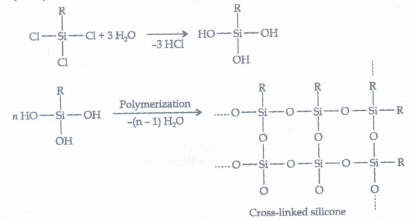
If the starting material for the manufacture of silicons is RSiCl3 write the structure of the product formed.
15.
Explain the difference in properties of diamond and graphite on the basis of their structures.
16.
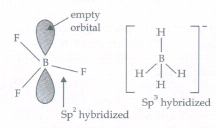
Describe the shapes of BF3 and BH4-. Assign the hybridisation of boron in these species.
1.
()
Aluminosilicate is prepared by substituting some of the Si atoms in the three dimensional network of SiO2 by Al atoms.
2.
()
No,there are two types of bonds in diborane two electron normal bonds and three centred two electron bonds.
3.
()
Formula of kernite, Na2[B4O5(OH)4] or Na2B4O7 .2H2O
4.
Ultra pure elemental silicon is prepared by the reduction of highly pure silicon tetrachloride(SiCl4) or silicon chloroform(SiHCl3) with dihydrogen
\({ SiCl }_{ 4 }+2{ H }_{ 2 }(g)\longrightarrow Si+4HCl\)
\({ SiHCl }_{ 3 }+{ H }_{ 2 }\longrightarrow Si+3HCl\)
It can also be prepared by the pyrolysis of SiH4
\({ SiH }_{ 4 }\longrightarrow Si+{ 2H }_{ 2 }\)
Ultra pure elemental silicon is used as a semiconductor.
5.
(a) Being acidic B2O3,Sio2 and CO2 react with alkalis to form salts
\(B_{ 2 }O_{ 3 }+2NaOH\rightarrow 2NaBO_{ 2 }+H_{ 2 }O\\ Boric\quad \quad \quad \quad \quad \quad sodium\quad metaborate\\ anhydride\)
\(SiO_{ 2 }+2NaOH\underrightarrow { D } Na_{ 2 }CO_{ 3 }+H_{ 2 }O\)
\(\\ Silica\quad \quad \quad \quad \quad \quad \quad \quad \quad Sodium\quad carbonate\\ CO_{ 2 }+2NaOH\rightarrow Na_{ 2 }CO_{ 3 }+H_{ 2 }O\\ Carbon\quad dioxide\quad \quad \quad sodium\quad carbonate\quad \quad \quad \quad \)
(b) Being amphotric, Al2O3 and PbO2 react with both acids and bases.
\(Al_{ 2 }O_{ 3 }+3H_{ 2 }SO_{ 4 }\rightarrow Al_{ 2 }(SO)_{ 4 }+3H_{ 2 }O\)
\( Al_{ 2 }O_{ 3 }+2NaOH\overset { fuse }{ \rightarrow } \ 2NaAlO_{ 2 }+H_{ 2 }O\)
\(\\ Alumina\quad \quad \quad \quad \quad \quad \quad sodium\quad metaaluminate\\ 2PbO_{ 2 }+2H_{ 2 }SO_{ 4 }\rightarrow 2PbSO_{ 4 }+2H_{ 2 }O+O_{ 2 }\)
\(\\ PbO_{ 2 }+2NaOH\rightarrow Na_{ 2 }PbO_{ 3 }+H_{ 2 }O\\ Lead \ dioxide\quad \quad Sodium \ plumbate\)
(c) Being basic,Tl2O3 reacts with acid
\(Tl_{ 2 }O_{ 3 }+6HCl\rightarrow 2TICl_{ 3 }+3H_{ 2 }O\)
6.
Silicon does not form \({ p\pi -p\pi }\) multiple bonds because of large size of silicon atom Hence, silicon does not form graphite-like structure as carbon does.
7.
In this reaction, diborane is obtained
aNaBH4 +I2\(\rightarrow\)B2H6 + 2NaI + H2
8.
Boric acid is sparingly soluble in cold water but fairly soluble in hot water. It acts as a weak monobasic acid. It is not a protonic acid but it acts as aLewis acid by accepting a hydroxide ion of water and releasing a proton into the solution.
H-OH + B(OH)3\(\rightarrow\) [B(OH)4]- +H+
9.
Among group 14 elements carbon is the most electronegative element
10.
It is due to inert pair effect.
11.
Inert pair effect:
The pair of electron in the valence shell does not take part in bond formation is called inert pair effect.
12.
CO2 is a greenhouse gas. About 75% of the solar energy reaching the earth is absorbed by the earth's surface. The rest of the heat radiates back to the atmosphere. But the heat radiated by the heated surface cannot pass freely into the space because excessive CO2 in the atmosphere absorb more heat.
This results in increase in the average temperature of the atmosphere. This is known as global warming.
13.
The catenation is maximum in carbon and decreases down the group. With increase in atomic size, electronegativity decreases and due to this, tendency to show catenation decreases, C-C bond enthalpy (348kJ mol-1) is greater than Si-Si bond enthalpy (297kJmol- 1). Therefore, C-C bond is stronger than Si-Si bond. That's why carbon has much higher tendency for catenation than silicon.
14.
Hydrolysis of alkyltrichlorosilanes gives cross-linked silicons.
15.
| S.No. | Diamond | Graphite |
| 1. | Cis sp3 hybridised | C is Sp2 hybridised |
| 2. | Three dimensional, tetrahedral structure |
Two dimensional, sheet like (layer like) structure. |
| 3. | Crystalline, transparent with extra brilliance (due to high refractive index). |
Crystalline, opaque and shiny substance. |
| 4. | Hardest substance with high density and high melting point |
Soft having soapy touch with low density and high melting point. |
| 5. | Bad conductor of heat and electricity (no free electron). |
Good conductor of heat and electricity (fourth electron is free). |
| 6. | It is used in glass cutting and jewellery and as abrasive. |
It is used as a lubricating agent, in making electrodes, in pencils, crucibles (due to high melting point). |
16.
In BF3' boron is sp2 hybridized.
\(\therefore\) shape of BF3= planar.
In [BH4]-, boron is sp3 hybridized, thus the shape is tetrahedral.

11th Standard CBSE Syllabus & Materials
11th Standard CBSE
CBSE 11th Business Studies Forms of Business Organisation Sample Question Papers Study Material - QB365 Set A
NEW11th Standard CBSE
CBSE 11th Business Studies Business, Trade and Commerce Sample Question Papers Study Material - QB365 Set A
NEW11th Standard CBSE
CBSE 11th Physics Waves Sample Question Papers Study Material - QB365 Set A
NEW11th Standard CBSE
CBSE 11th Physics Kinetic Theory Sample Question Papers Study Material - QB365 Set A



CBSE 11th Standard CBSE Subjects
CBSE Standards









