
 100% FREE ACCESS
11th Standard CBSE Syllabus & Materials
11th Standard CBSE
CBSE 11th Economics PART-A - Presentation of Data - New Sample Question Papers Study Material - QB365 Set A
NEW11th Standard CBSE
CBSE 11th Economics PART-A - Organisation of Data - New Sample Question Papers Study Material - QB365 Set A
NEW11th Standard CBSE
CBSE 11th Economics PART-A - Collection of Data - New Sample Question Papers Study Material - QB365 Set A
NEW11th Standard CBSE
CBSE 11th Economics PART-A - Introduction to Economics and Statistics - New Sample Question Papers Study Material - QB365 Set A
NEW11th Standard CBSE
CBSE 11th Business Studies International Trade Sample Question Papers Study Material - QB365 Set A
NEW11th Standard CBSE
CBSE 11th Business Studies Evolution and Fundamentals of Business Sample Question Papers Study Material - QB365 Set A

Published on: 07/09/2019
Hydrocarbons
Download CBSE Class 11th Standard CBSE Chemistry question papers, sample papers, important questions, and previous year solved papers in PDF format. Get free study materials, NCERT solutions, and exam preparation resources for Class 11th Standard CBSE Chemistry
Questions + Answers key
Take MCQ Chemistry Test
1.
Suggest the name of another Lewis acid instead of anhydrous aluminium chloride which can be used during ethylation of benzene.
2.
What effect does branching of an alkane chain has on its boiling point?
3.
Sodium salt of which acid will be needed for the preparation of propane? Write chemical equation for the reaction.
4.
Why do you alkenes prefer to undergo electrophilic addition reaction while arenes prefer electrophilic substitution reactions? Explain.
5.
On converting benzene to toluene, state whether there will be a rise or fall in the melting point.
6.
Which of the following compounds will show cis-trans isomerism?
CH2= CBr2
7.
Which of the following compounds will show cis-trans isomerism?
(CH3)2C=CH-C2H5
8.
How would you convert the following compounds into benzene?
(i) Ethyne
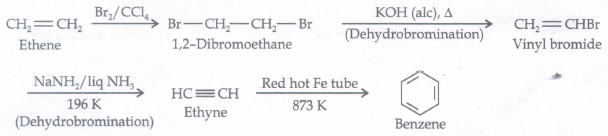
(ii) Ethene
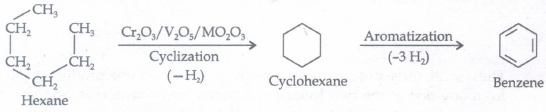
(iii) Hexane
9.
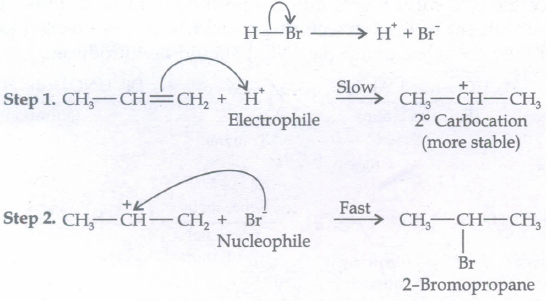
Addition of HBr to propene yields 2-bromopropane, while in the presence of benzoyl peroxide, the same reaction yields 1-bromopropane. Explain and give mechanism.
10.
Write chemical equations for combustion reaction of the following hydrocarbons:
(i) Butane
(ii) Pentene
(iii) Hexyne
(iv) Toluene
11.
Write IUPAC names of the products obtained by the ozonolysis of the following compounds :
(i) Pent-2-ene
(ii) 3,4-Dimethylhept-3-ene
(iii) 2-Ethylbut-1-ene
(iv) 1-Phenylbut-1-ene
12.
Write structures of all the alkenes which on hydrogenation give 2-methylbutane.
13.
What are the necessary conditions for any system to be aromatic?
14.
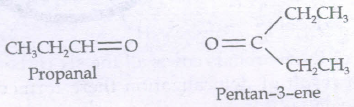
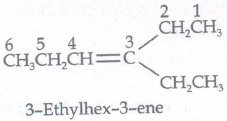
Propanal and pentan-3-one are the ozonolysis products of an alkene? What is the structural formula of the alkene?
1.
Anhydrous Ferric Chloride (FeCl3) is another Lewis acid which can be used.
2.
Boiling points of alkanes
1. The boiling points of alkanes rise as the number of carbons increases.
2. Since nonane has a longer carbon chain than octane, it will have a higher boiling point.
Effect of branching on the boiling point of alkane
1. As an alkane chain branch, the surface area of the molecule decreases.
2. The intermolecular force reduces as a result of this.
3. At a lower temperature, the forces can be readily overcome.
4. Therefore, as the branching increases, the boiling point of an alkane chain decreases.
3.
Butanoic acid,
\(\mathrm{CH}_3 \mathrm{CH}_2 \mathrm{CH}_2 \mathrm{COO}^{-} \mathrm{Na}^{+}+\mathrm{NaOH} \stackrel{\mathrm{CaO}}{\longrightarrow} \mathrm{CH}_3 \mathrm{CH}_2 \mathrm{CH}_3+\mathrm{Na}_2 \mathrm{CO}_3\)
4.
Alkenes are rich source of loosely held \(\pi \) electrons, due to which they show electrophilic addition reaction. Electrophilic addition reactions of alkenes are accompanied by large energy changes so these are energetically favourable than that of Electrophilic substitution reactions.
In special conditions alkenes also undergo free radical substitution reactions.
In arenes during electrophilic addition reactions aromatic character of benzene ring is destroyed while during electrophilic substitution reactions of areans are enegetically more favourable than that of electrophilic addition reaction.
That's why alkenes prefer to undergo electrophilic addition reaction while arenes prefer electrophilic substitution reactions.
5.
On converting benzene to toluene, there is a fall in the melting point although toluene has the higher molecular mass. This is because the planar molecules of benzene can pack more closely in the crystal lattice and the cohesive forces are strong, whereas the methyl group in toluene prevents such close packing.
6.
For exhibiting cis-trans (or geometrical isomerism, a molecule must fulfil the following condition.
The groups attached to each double bonded carbon atom must be different.
7.
For exhibiting cis-trans (or geometrical isomerism, a molecule must fulfil the following condition.
It must have atlest one double bond.
8.
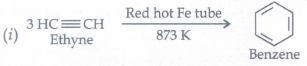
(ii) Ethene is first converted into ethyne and then to benzene as shown above.
(iii) When vapours of hexane are passed over heated catalyst consisting of Cr2 O3, MO2O3 and V2O5 at 773 K under 10-20 atm pressure, cyclization and aromatization occurs simultaneously to afford benzene
9.
Addition of HBr to propene is an ionic electrophilic addition reaction in which the electrophile, i.e., H+ first adds to give a more stable 2° carbocation. In the 2nd step, the carbocation is rapidly attacked by the nucleophile Br- ion to give 2-bromopropane.
In presence of benzoyl peroxide, the reaction is still electrophilic but the electrophile here is a Br free radical which is obtained by the action of benzoyl peroxide on HBr
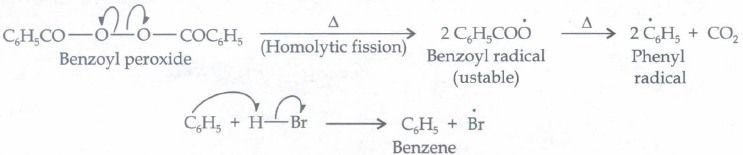
In the first step, Br radical adds to propene in such a way so as to generate the more stable 2° free radical. In the second step, the free radical thus obtained rapidly abstracts a hydrogen atom from HBr to give 1-bromopropane.
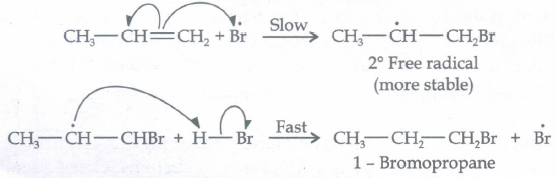
From the above discussion, it is evident that although both reactions are electrophilic addition reactions but it is due to different order of addition of H and Br atoms which gives different products.
10.
(i) \({ C }_{ 4 }{ H }_{ 10 }+13/2(g)\overset { \Delta }{ \longrightarrow } 4C{ O }_{ 2 }(g)+5{ H }_{ 2 }O(g)\)
Butane
(ii) \({ C }_{ 5 }{ H }_{ 10 }(g)+15/2{ O }_{ 2 }(g)\overset { \Delta }{ \longrightarrow } 5{ CO }_{ 2 }(g)+5{ H }_{ 2 }O(g)\)
Pentene
(iii) \({ C }_{ 6 }{ H }_{ 10 }(g)+17/{ 2O }_{ 2 }(g)\overset { \Delta }{ \longrightarrow } 6{ CO }_{ 2 }(g)+{ 5H }_{ 2 }O(g)\)
Hexyne
(iv)

11.
(i) \(\overset { 5 }{ C } { H }_{ 3 }-\overset { 4 }{ C } H_{ 2 }-\overset { 3 }{ C } H=\overset { 2 }{ C } H\overset { 1 }{ C } { H }_{ 3 }\overset { (i){ O }_{ 3 }/{ CH }_{ 2 }{ CI }_{ 2 },196\quad K }{ \underset { (ii)\quad Zn/{ H }_{ 2 }O }{ \longrightarrow } } { CH }_{ 3 }-{ CH }_{ 2 }-CH=O+O=CH-{ CH }_{ 3 }\)
Pent-2-ene Propanal Ethanal
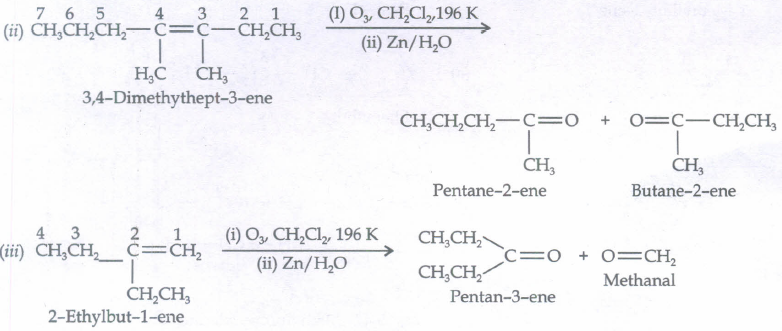
(iv) \({ \overset { 4 }{ C } }H_{ 3 }\overset { 3 }{ C } { H }_{ 2 }-\overset { 2 }{ C } H=\overset { 1 }{ C } { H }_{ 2 }-{ C }_{ 6 }{ CH }_{ 5 }\overset { (i){ O }_{ 3 },{ CH }_{ 2 }{ C1 }_{ 2 },196\quad K }{ \underset { (ii)Zn/{ H }_{ 2 }O }{ \longrightarrow } } { CH }_{ 3 }{ CH }_{ 2 }CH=0+0=CH-{ C }_{ 6 }{ H }_{ 5 }\)
1-Phenylbut-1-ene Propanal Benzaldehyde
12.
The basic skeleton 2-methylbutane is
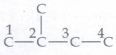
Putting double bonds at various different positions and satisfying the tetracovalency of each carbon, the structures of various alkenes which give 2-methylbutane on hydrogenation are:

13.
The necessary conditions for a molecule to be aromatic are:
(i) It should have a single cyclic cloud of delocalised \(\pi\)-electrons above and below the plane of the molecule.
(ii) It should be planar. This is because complete delocalization of \(\pi\)-electrons is possible only if the ring is planar to allow cyclic overlap of p-orbitals.
(iii) It should contain Huckel number of electrons, i.e., (4n + 2) \(\pi\)-electrons where n = 0, 1, 2, 3 ................ etc.
A molecule which does not satisfy any one or more of the above conditions is said to be non-aromatic.
14.
(i) Write the structures of prop anal and pentan-3-ene with their oxygen atoms facing each other, we have,
(ii) Removeoxygen atoms and join the two fragments by a double bond, the structure of the alkene is

11th Standard CBSE Syllabus & Materials
11th Standard CBSE
CBSE 11th Business Studies Forms of Business Organisation Sample Question Papers Study Material - QB365 Set A
NEW11th Standard CBSE
CBSE 11th Business Studies Business, Trade and Commerce Sample Question Papers Study Material - QB365 Set A
NEW11th Standard CBSE
CBSE 11th Physics Waves Sample Question Papers Study Material - QB365 Set A
NEW11th Standard CBSE
CBSE 11th Physics Kinetic Theory Sample Question Papers Study Material - QB365 Set A



CBSE 11th Standard CBSE Subjects
CBSE Standards









