
 100% FREE ACCESS
11th Standard CBSE Syllabus & Materials
11th Standard CBSE
CBSE 11th Economics PART-A - Presentation of Data - New Sample Question Papers Study Material - QB365 Set A
NEW11th Standard CBSE
CBSE 11th Economics PART-A - Organisation of Data - New Sample Question Papers Study Material - QB365 Set A
NEW11th Standard CBSE
CBSE 11th Economics PART-A - Collection of Data - New Sample Question Papers Study Material - QB365 Set A
NEW11th Standard CBSE
CBSE 11th Economics PART-A - Introduction to Economics and Statistics - New Sample Question Papers Study Material - QB365 Set A
NEW11th Standard CBSE
CBSE 11th Business Studies International Trade Sample Question Papers Study Material - QB365 Set A
NEW11th Standard CBSE
CBSE 11th Business Studies Evolution and Fundamentals of Business Sample Question Papers Study Material - QB365 Set A

Published on: 20/09/2019
Consumer Equilibrium
Download CBSE Class 11th Standard CBSE undefined question papers, sample papers, important questions, and previous year solved papers in PDF format. Get free study materials, NCERT solutions, and exam preparation resources for Class 11th Standard CBSE undefined
Questions + Answers key
Take MCQ Biology Test
1.
A consumer consumes two goods X and Y. Explain what will happen if MUx/Px is greater than MUy/Py?
2.
A consumer consumes only two goods X and Y and is in equilibrium. Price of good X falls. Show that it will lead to rise in demand for good X.Aconsumer consumes only two goods X and Y and is in equilibrium. Price of good X falls. Show that it will lead to rise in demand for good X.
3.
A consumer consumes only two goods X and Y and is in equilibrium. Price of X falls. Explain the reaction of the consumer through the Utility Analysis.
4.
A consumer consumes only two goods X and Y and is in equilibrium. Show that when the price of good X rises, the consumer buys less of good X. Use utility analysis.
5.
A consumer consumes only two goods X and Y. At a certain consumption level of these goods, he finds that the ratio of marginal utility to price in case of X is lower than that in case of Y. Explain the reaction of the consumer
6.
Giving reasons, comment on the following statements:
(i) A consumer's equilibrium is always formed at a point on the given budget line.
(ii) A consumer's equilibrium will shift to a higher indifference curve with an increase in consumer's income.
7.
A consumer has no, and both goods X and Y are priced at Rs.2 and are available in integer units. (a) give the bundles that this consumer can afford to buy (b) give the bundles that cost exactly RS.10 (c) give two bundles that this consumer cannot afford to buy.
8.
How is the law of diminishing marginal utility applied with regard to education/ knowledge?
9.
A consumer consumes only two goods X and Y. At a consumption level of these two goods, he finds that the ratio of marginal utility to price in case of X is higher than that in case of Y. Explain the reaction of the consumer.
10.
Derive the inverse relation between price of the good and its demand from single commodity equilibrium condition "marginal utility = price".
11.
"Total Utility remains the same, whether Marginal Utility is positive or negative". Defend or refute.
12.
How many chocolates will a consumer have, if they are available free of cost?
13.
Explain with diagram, the relationship between TU and MU.
14.
Suppose a consumer wants to consume two goods which are available only in integer units. The two goods are equally priced at Rs.10 and the consumer's income is Rs.40.
(i) Write down all the bundles that are available to the consumer.
(ii) Among the bundles that are available to the consumer's. Identify those which cost her exactly 40.
15.
A consumer wants to consume two goods. The prices of the two goods are Rs.4 and Rs. 5 respectively. The consumer's income is Rs.20.
(i) Write down the equation of the budget line.
(ii) How much quantity of good 1 can the consumer consume if she spends her entire income on that good?
(iii) How much of good 2 can she consume if she spends her entire income on that good?
(iv) What is the slope of the budget line?
1.
As, we know condition for consumer equilibrium is, Necessary Condition Marginal utility of last rupee spent on each commodity is same. Suppose there are two commodities, X and Y respectively. So, for commodity X, the condition is, Marginal Utility in terms of Money = Price of X
Or \(\frac { Marginal\ utility\ of\ s\ product\ in\ util[M{ U }_{ x }] }{ Marginal\ utility\ of\ one\ rupee[M{ U }_{ m }] } \)=Price of X
Or \(\frac { M{ U }_{ x } }{ { P }_{ x } } =M{ U }_{ M }\) ---------(1)
Similarly: for commodity Y, the condition is,
\(\frac { M{ U }_{ y } }{ { P }_{ y } } =M{ U }_{ M }\) -----------(2)
Putting equation (2) in (1), we get
\(\frac { M{ U }_{ x } }{ { P }_{ x } } =\frac { M{ U }_{ y } }{ { P }_{ y } } \)
But as given in the question that the ratio of marginal utility to price in case of X is higher than that in case of Y,
i.e.,\(\frac { M{ U }_{ x } }{ { P }_{ x } } >\frac { M{ U }_{ y } }{ { P }_{ y } } \)
It means marginal utility from the last rupee spent on commodity X is more than marginal utility from the last rupee spent on commodity Y. So, to attain the equilibrium consumer must increase .the quantity of X, which decreases the MUx and decreases the quantity of Y, which will increase the MU. Increase in quantity of y X and decrease in quantity of Y continue till \(\frac { M{ U }_{ x } }{ { P }_{ x } } =\frac { M{ U }_{ y } }{ { P }_{ y } } \)
2.
As, we know condition for consumer equilibrium is, Necessary Condition Marginal utility of last rupee spent on each commodity is same. Suppose there are two commodities, X and Y respectively. So, for commodity X, the condition is, Marginal Utility in terms of Money = Price of X
Or \(\frac { Marginal\ utility\ of\ s\ product\ in\ util[M{ U }_{ x }] }{ Marginal\ utility\ of\ one\ rupee[M{ U }_{ m }] } \)=Price of X
Or \(\frac { M{ U }_{ x } }{ { P }_{ x } } =M{ U }_{ M }\) ---------(1)
Similarly: for commodity Y, the condition is,
\(\frac { M{ U }_{ y } }{ { P }_{ y } } =M{ U }_{ M }\) -----------(2)
Putting equation (2) in (1), we get
\(\frac { M{ U }_{ x } }{ { P }_{ x } } =\frac { M{ U }_{ y } }{ { P }_{ y } } \)
But as given in the question that the ratio of marginal utility to price in case of X is higher than that in case of Y,
i.e.,\(\frac { M{ U }_{ x } }{ { P }_{ x } } >\frac { M{ U }_{ y } }{ { P }_{ y } } \)
It means marginal utility from the last rupee spent on commodity X is more than marginal utility from the last rupee spent on commodity Y. So, to attain the equilibrium consumer must increase .the quantity of X, which decreases the MUx and decreases the quantity of Y, which will increase the MU. Increase in quantity of y X and decrease in quantity of Y continue till \(\frac { M{ U }_{ x } }{ { P }_{ x } } =\frac { M{ U }_{ y } }{ { P }_{ y } } \)
3.
As, we know condition for consumer equilibrium is, Necessary Condition Marginal utility of last rupee spent on each commodity is same. Suppose there are two commodities, X and Y respectively. So, for commodity X, the condition is, Marginal Utility in terms of Money = Price of X
Or \(\frac { Marginal\ utility\ of\ s\ product\ in\ util[M{ U }_{ x }] }{ Marginal\ utility\ of\ one\ rupee[M{ U }_{ m }] } \)=Price of X
Or \(\frac { M{ U }_{ x } }{ { P }_{ x } } =M{ U }_{ M }\) ---------(1)
Similarly: for commodity Y, the condition is,
\(\frac { M{ U }_{ y } }{ { P }_{ y } } =M{ U }_{ M }\) -----------(2)
Putting equation (2) in (1), we get
\(\frac { M{ U }_{ x } }{ { P }_{ x } } =\frac { M{ U }_{ y } }{ { P }_{ y } } \)
But as given in the question that the ratio of marginal utility to price in case of X is higher than that in case of Y,
i.e.,\(\frac { M{ U }_{ x } }{ { P }_{ x } } >\frac { M{ U }_{ y } }{ { P }_{ y } } \)
It means marginal utility from the last rupee spent on commodity X is more than marginal utility from the last rupee spent on commodity Y. So, to attain the equilibrium consumer must increase .the quantity of X, which decreases the MUx and decreases the quantity of Y, which will increase the MU. Increase in quantity of y X and decrease in quantity of Y continue till \(\frac { M{ U }_{ x } }{ { P }_{ x } } =\frac { M{ U }_{ y } }{ { P }_{ y } } \)
4.
As, we know condition for consumer equilibrium is,
Necessary Condition
Marginal utility of last rupee spend on each commodity is same. Suppose there are two commodities, X and Y respectively.
So, for commodity X, the condition is, Marginal Utility in terms of Money = Price of X
Or \(\frac{Marginal utility of a product in utill[MUx]}{Marginal utility of one rupee[MUm]}\)=price of X
Or \(\frac { M{ U }_{ x } }{ P_{ x } } =M{ U }_{ m }\) ------(1)
Similarly, for commodity Y, the condition is
Or \(\frac { M{ U }_{ y } }{ { P }_{ y } } M{ U }_{ m }\) -------(2)
Putting equation (2) in (1), we get
\(\frac { M{ U }_{ x } }{ { P }_{ x } } =\frac { M{ U }_{ y } }{ { P }_{ y } } \)
But as given in the question that the ratio of marginal utility to price in case of X is lower than that in case of Y, i.e.,
\(\frac { M{ U }_{ x } }{ { P }_{ x } } <\frac { M{ U }_{ y } }{ { P }_{ y } } \). It means, marginal utility Px PII from the last rupee spent on commodity X is less than the marginal utility from the last rupee spent on commodity Y. So, to attain the equilibrium the consumer must decrease the quantity of X which will increase the MUx and increase the quantity of Y, which will decrease the MU. Decrease y in quantity of X and increase in quantity till \(\frac { M{ U }_{ x } }{ { P }_{ x } } =\frac { M{ U }_{ y } }{ { P }_{ y } } \) .
5.
As, we know condition for consumer equilibrium is,
Necessary Condition
Marginal utility of last rupee spend on each commodity is same. Suppose there are two commodities, X and Y respectively.
So, for commodity X, the condition is, Marginal Utility in terms of Money = Price of X
Or \(\frac{Marginal utility of a product in utill[MUx]}{Marginal utility of one rupee[MUm]}\)=price of X
Or \(\frac { M{ U }_{ x } }{ P_{ x } } =M{ U }_{ m }\) ------(1)
Similarly, for commodity Y, the condition is
Or \(\frac { M{ U }_{ y } }{ { P }_{ y } } M{ U }_{ m }\) -------(2)
Putting equation (2) in (1), we get
\(\frac { M{ U }_{ x } }{ { P }_{ x } } =\frac { M{ U }_{ y } }{ { P }_{ y } } \)
But as given in the question that the ratio of marginal utility to price in case of X is lower than that in case of Y, i.e.,
\(\frac { M{ U }_{ x } }{ { P }_{ x } } <\frac { M{ U }_{ y } }{ { P }_{ y } } \). It means, marginal utility Px PII from the last rupee spent on commodity X is less than the marginal utility from the last rupee spent on commodity Y. So, to attain the equilibrium the consumer must decrease the quantity of X which will increase the MUx and increase the quantity of Y, which will decrease the MU. Decrease y in quantity of X and increase in quantity till \(\frac { M{ U }_{ x } }{ { P }_{ x } } =\frac { M{ U }_{ y } }{ { P }_{ y } } \).
6.
(i) Budget line shows all possible combinations of the two goods that a consumer can buy, given i.e and prices of commodities another other combination lying to the right of this line will be unreachable. Any combination lying to the left of this line results in non-spending of his income.
(ii) Higher income means an increase in a consumer's ability to purchase increased quantity of both the goods, represented by a rightward shift of the budget line. The new budget line will form a tangent to a higher indifference curve.
7.
(a) The bundles that this consumer can afford. to buy, (0,0), (0,1), (0,2), (0,3), (0,4), (0,5), (1,0), (1,1), (1,2), (1,3), (1,4), (2,0), (2,1), (2,2), (2,3), (3,0), (3,1), (3,2), (4,0), (4,1) and (5,0).
(b) Bundles that cost exactly no are, (0,5), (1,4), (2,3), (3,2), (4,1), (5,0).
(c) Two bundles that the consumer cannot afford to buy are, (3,3), (4, 2).
8.
In this case the law of diminishing marginal utility will not apply because every effort to get education/ knowledge increases the utility.
Value: Analytic
9.
As, we know condition for consumer equilibrium is, Necessary Condition Marginal utility of last rupee spent on each commodity is same. Suppose there are two commodities, X and Y respectively. So, for commodity X, the condition is, Marginal Utility in terms of Money = Price of X
Or \(\frac { Marginal\ utility\ of\ s\ product\ in\ util[M{ U }_{ x }] }{ Marginal\ utility\ of\ one\ rupee[M{ U }_{ m }] } \)=Price of X
Or \(\frac { M{ U }_{ x } }{ { P }_{ x } } =M{ U }_{ M }\) ---------(1)
Similarly: for commodity Y, the condition is,
\(\frac { M{ U }_{ y } }{ { P }_{ y } } =M{ U }_{ M }\) -----------(2)
Putting equation (2) in (1), we get
\(\frac { M{ U }_{ x } }{ { P }_{ x } } =\frac { M{ U }_{ y } }{ { P }_{ y } } \)
But as given in the question that the ratio of marginal utility to price in case of X is higher than that in case of Y,
i.e.,\(\frac { M{ U }_{ x } }{ { P }_{ x } } >\frac { M{ U }_{ y } }{ { P }_{ y } } \)
It means marginal utility from the last rupee spent on commodity X is more than marginal utility from the last rupee spent on commodity Y. So, to attain the equilibrium consumer must increase .the quantity of X, which decreases the MUx and decreases the quantity of Y, which will increase the MU. Increase in quantity of y X and decrease in quantity of Y continue till \(\frac { M{ U }_{ x } }{ { P }_{ x } } =\frac { M{ U }_{ y } }{ { P }_{ y } } \)
10.
As we know a consumer purchases a good up to the point where margnial utility of the good becomes equal to the price of that good. MU = Price
(i) It can be explained with the help of the following figures. It can be seen from the given figures that Figure B is derived from Figure A.
(ii) In figure A, initially, consumer equilibrium is attained at point E, where let MU (10) = Price (10). Corresponding to point E, we derive point E, in figure B.
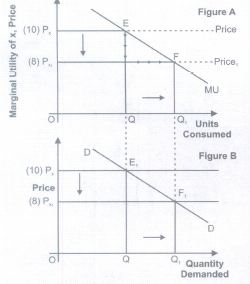
(iii) Due to fall in price (suppose from 10 to 8), MU > Price at the given quantity. So, we can say that benefit is greater than cost and the consumer increases the quantity till MU = Price condition is attained at F. Corresponding to point F, we derive the point F1, in figure B. So, by joining point E. and F1 together, we derive the demand curve.
11.
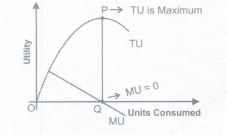
The given statement is refuted. When Marginal Utility is positive till point Q as shown in figure then total Utility increases at a diminishing rate and when Marginal Utility is negative after point Q, total Utility decreases.
12.
In case of free chocolates, consumer will carry on the consumption till his total utility is maximum. It means till the additional chocolates gives positive satisfaction, consumer will keep on having chocolates. Let us understand this with the help of the figure Consumer will stop the consumption at the point of satiety (Point 'Q'), i.e., where marginal utility is equal to zero.
13.
(i) When MU decreases, TU increases at a diminishing rate. (As shown in figure till consumption level OQ).
(ii) When MU is zero, TU is maximum at P.
(iii) When MU is negative, TU starts diminishing.
14.
Let Px = Py = Rs.10
Money Income = 40
(i) Bundles available to consumer are: (0,0), (0,1), (0,2), (0,3), (0,4), (1,0), (1,1), (1,2), (1,3), (2,0), (2,1), (2,2), (3,0), (3,1) and (4, 0).
(ii) (0,4), (1,3), (2,2), (3,1) and (4,0) cost exactly Rs.40. All the other bundles cost less than Rs.40.
15.
(i) Let the two quantities of goods be X and Y. We are given Px = Rs 4, Py = Rs.5, Consumer's income (M) = Rs.20.
Budget line equation is,
Px .X + Py .Y= M or = 4X + 5Y= 20
(ii) If quantity consumed of good Y = 0, Budget equation becomes,
Px.X + zero = M = 4.X = 20 = X = 20/4 = 5 units
(iii) If quantity consumed of good X = 0, Budget equation becomes,
Zero + Py .Y = M
or = 5Y = 20 = Y = 20/5 = 4 units.
(iv) Slope of budget line = Px/Py
=4/5 = 0.8

11th Standard CBSE Syllabus & Materials
11th Standard CBSE
CBSE 11th Business Studies Forms of Business Organisation Sample Question Papers Study Material - QB365 Set A
NEW11th Standard CBSE
CBSE 11th Business Studies Business, Trade and Commerce Sample Question Papers Study Material - QB365 Set A
NEW11th Standard CBSE
CBSE 11th Physics Waves Sample Question Papers Study Material - QB365 Set A
NEW11th Standard CBSE
CBSE 11th Physics Kinetic Theory Sample Question Papers Study Material - QB365 Set A



CBSE 11th Standard CBSE Subjects
CBSE Standards










