
 100% FREE ACCESS
11th Standard CBSE Syllabus & Materials
11th Standard CBSE
CBSE 11th Economics PART-A - Presentation of Data - New Sample Question Papers Study Material - QB365 Set A
NEW11th Standard CBSE
CBSE 11th Economics PART-A - Organisation of Data - New Sample Question Papers Study Material - QB365 Set A
NEW11th Standard CBSE
CBSE 11th Economics PART-A - Collection of Data - New Sample Question Papers Study Material - QB365 Set A
NEW11th Standard CBSE
CBSE 11th Economics PART-A - Introduction to Economics and Statistics - New Sample Question Papers Study Material - QB365 Set A
NEW11th Standard CBSE
CBSE 11th Business Studies International Trade Sample Question Papers Study Material - QB365 Set A
NEW11th Standard CBSE
CBSE 11th Business Studies Evolution and Fundamentals of Business Sample Question Papers Study Material - QB365 Set A

Published on: 16/12/2019
Demand
Download CBSE Class 11th Standard CBSE undefined question papers, sample papers, important questions, and previous year solved papers in PDF format. Get free study materials, NCERT solutions, and exam preparation resources for Class 11th Standard CBSE undefined
Questions + Answers key
Take MCQ Biology Test
1.
What determines the quantity of a good that the buyers demand for?
2.
Give one reason for a shift in demand curve.
3.
What is meant by the law of demand?
4.
Due to rise in price of the commodity x, the demand of commodity y also rises. What type of commodity they are?
5.
In case of Giffen goods, the demand curve will be:
horizontal.
downward-sloping to the right.
vertical.
upward-sloping to the right.
6.
With a fall in the price of a commodity:
consumer's real income increases
consumer's real income decreases
there is no change in the real income of the consumer
None of these.
7.
When total demand for a commodity whose price has fallen increases, it is due to:
income effect
substitution effect
complementary effect
price effect
8.
A movement along the demand curve for soft drinks is best described as:
an increase in demand.
a decrease in demand.
a change in quantity demanded.
a change in demand.
9.
All of the following items are determinants of demand except:
tastes and preferences.
quantity supplied.
income.
price of related goods
10.
Explain the causes behind law of demand.
11.
Give the meaning of inferior good and explain the same with the help of an example.
12.
What do you mean by an 'inferior good'? Give some examples.
13.
Demand for electricity has "increased". However, supply cannot be increased due to lack of resources. Explain how, in any two ways, demand for electricity can be "decreased".
14.
Differentiate between decrease in demand and contraction in demand (decrease in quantity demanded).
15.
Explain law of demand with the help of a demand schedule.
16.
Explain the effect of the following on demand for a good:
(i) Fall in Income for Normal Goods.
(ii) Fall in Income for Inferior Goods.
17.
Explain the effect of the following on demand for a good:
(i) Rise in Income for Normal Goods.
(it) Rise in Income for Inferior Goods.
18.
Explain with the help of diagrams, the effect of the following changes on the demand of a commodity:
(i) A fall in price of Substitute good.
(ii) A fall in price of Complementary good.
19.
Explain with the help of diagrams, the effect of the following changes on the demand of a commodity:
(i) A rise in price of Substitute good.
(ii) A rise in price of Complementary good.
1.
()
The quantity of a good that the buyers demand for is determined by the price of the goods, income, the prices of related goods, tastes, expectations, and the number of buyers.
2.
()
Change in price of substitute goods.
3.
()
It states that price of the commodity and quantity demanded are inversely related to each other when other factors remain constant (ceteris Paribus).
4.
()
Substitute goods.
5.
(d)
upward-sloping to the right.
6.
(a)
consumer's real income increases
7.
(d)
price effect
8.
(c)
a change in quantity demanded.
9.
(b)
quantity supplied.
10.
The inverse relationship between price of the commodity and quantity demanded for that commodity is because of the following reasons:
(i) Income effect:
(a) Quantity demanded of a commodity changes due to change in purchasing power (real income), caused by change in price of a commodity is called Income Effect.
(b) Any change in the price of a commodity affects the purchasing power or real income of the consumers although his money income remains the same.
(c) Whenpriceofa commodity rise more has to be spent on purchase of the same quantity of that commodity. Thus, rise in price of commodity leads to fall in real income, which will thereby reduce quantity demanded is known as Income effect.
(ii) Substitution effect:
(a) It refers to substitution of one commodity in place of another commodity when it becomes relatively cheaper.
(b) A rise in price of the commodity let coke, also means that price of its substitute, let Pepsi, has fallen in relation to that of coke, even though the price of Pepsi remains unchanged. So, people will buy more of Pepsi and less of coke when price of coke rises.
(c) In other words, consumers will substitute Pepsi for coke. This is called Substitution effect.
Price effect = Income effect + Substitution effect
(iii) Law of Diminishing Marginal Utility:
(a) This law states that when a consumer consumes more and more units of a commodity, every additional unit of a commodity gives lesser and lesser satisfaction and marginal utility decreases.
(b) The consumer consumes a commodity till marginal utility (benefit)he gets equals to the price (cost)they pay, i.e., where benefit = cost.
(c) For example, a thirsty man gets the maximum satisfaction (utility)from the first glass of water. Lesser utility from the 2nd glass of water, still lesser from the 3rd glass of water and so on. Clearly, if a consumer wants to buy more units of the commodity,he would like to do so at a lower price. Since, the utility derived from additional unit is lower.
(iv) Additional consumer:
(a) When price of a commodity falls, two effects are quite possible:
1. New consumers, that is, consumers that were not able to afford a commodity previously, starts demanding it at a lower price.
2. Old consumers of the commodity starts demanding more of the same commodity by spending the same amount of money.
(b) As the result of old and new buyers push up the demand for a commodity when price falls.
11.
(i) A good is called 'inferior goods' when its demand falls with a rise in the income of a consumer and vice- versa.
(ii) For example, Jowar or Bajra for a poor person.
(iii) A good is inferior in a relative terms. It means, a good is inferior or normal is determined by the income level of a consumer.
(iv) When a consumer moves to higher income, he/she may consider some goods below their income status, and treats them as inferior.
12.
(i) A good is called 'inferior goods' when its demand falls with a rise in the income of a consumer and vice- versa.
(ii) For example, Jowar or Bajra for a poor person.
(iii) A good is inferior in a relative terms. It means, a good is inferior or normal is determined by the income level of a consumer.
(iv) When a consumer moves to higher income, he/she may consider some goods below their income status, and treats them as inferior.
13.
Electricity is a public utility service therefore its increased demand should not be reduced. However, supply cannot be immediately increased due to lack of resources. Therefore, in the given situation, ways should be found to meet the increased demand of the electricity from available supply of the electricity.
Demand for electrical appliances:
1. Use of energy saving electrical appliances.
2. Use of alternative sources of energy like solar energy, wind energy etc.
Value: Environmental Conservation.
14.
| Decrease in Demand | Basis | Contraction in Demand | ||||||||||||
|---|---|---|---|---|---|---|---|---|---|---|---|---|---|---|
| A decrease in demand means that consumers now demand less at a given price level. | Meaning | It states that fall in quantity demanded due to rise in price of less commodity. | ||||||||||||
| 1. Price of substitute goods falls. 2. Price of complementary goods rises. 3. Income of a consumer falls in case of normal goods. 4. Income of a consumer rises in case of inferior goods. 5. When preferences are unfavourable. |
Cause | It is caused by rise in price of the commodity. | ||||||||||||
|
Basis should be Schedule and Price (Rs) demand (Units) |
|
||||||||||||
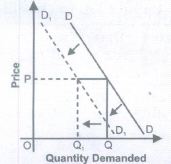 |
Diagram | 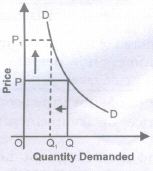 |
15.
(i) It states that price of the commodity and quantity demanded are inversely related to each other, when other factors remain constant. It means, quantity demanded of the commodity rises due to fall in price of the commodity and vice-versa.
(ii) Ceteris Paribus means:
(a) Price of Related commodity remains constant.
(b) Income of a consumer remains constant.
(c) Taste and preferences of a household remains constant.
| Price | Demand |
| 1 | 50 |
| 2 | 40 |
| 3 | 30 |
| 4 | 20 |
| 5 | 10 |
(iii)The law of demand makes a qualitative statement only and not quantitative. It indicates the direction of change in the amount demanded and it does not indicate the magnitude of change.
(iv) Law of demand is one sided. It explains only the effect of change in price on the quantity demanded. It states nothing about the effect of change in quantity demanded on the price of the commodity.
16.
(i) Fall in Income for Normal Goods:
1. In the above schedule, note that, as the income of a consumer falls from Rs.6000 to Rs.5000, the quantity demanded of normal goods decreases for any given price of normal goods. For example, the given income is Rs.6000 and at price of normal goods is Rs.150, the quantity demanded of normal goods is 25. Whereas the given income is Rs.5000, at the same price of normal goods (i.e. 150), the quantity demanded of normal goods is 20.
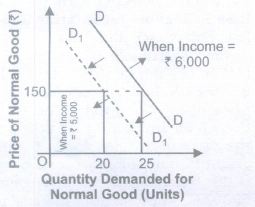
2. In the given diagram, the demand curve for normal goods, when income is Rs.5000 lies to the left of that when income is Rs.6000. Hence, an decrease in the income of a consumer shifts the demand curve for normal goods to the left.
(ii) Fall in Income for Inferior Goods:
3. In the above schedule, note that, as the income of a consumer decreases from Rs.6000 to Rs.5000, the quantity demanded of inferior goods increases for any given price of inferior goods. For example, the given income is Rs.6000 and at price of inferior goods is Rs.150, the quantity demanded of inferior goods is 18. Whereas the given income is Rs.5000, at the same price of inferior goods (i.e. 150), the quantity demanded of inferior goods is 20.
4. In the above diagram the demand curve for inferior goods when income is Rs.5000 lies to the right of that when income is Rs.6000. Hence, a decrease in the income of a consumer shifts the demand curve for inferior goods to the right.
17.
(i) Rise in Income for Normal Goods:
1. In the above schedule, note that as the income of a consumer rise from Rs.5000 to Rs.6000, the quantity demanded of normal goods increases for any given price of normal goods; namely, given income is Rs.5000 and at price of normal goods is Rs.150, the quantity demanded of normal goods is Rs.20. Whereas given income is Rs.6000, at the same price of normal goods (i.e. 150), the quantity demanded of normal goods is 25.
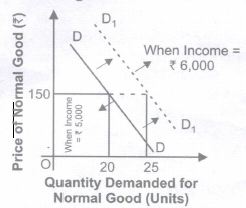
2. In the above diagram, the demand curve for normal goods, when income is Rs.6000 lies to the right of that when income is Rs.5000. Hence, an increase in the income of a consumer shifts the demand curve for normal goods to the right.
(ii) Rise in Income for Inferior Goods:
3. In the above schedule, note that, as the income of a consumer rises from Rs.5000 to Rs.6000, the quantity demanded of inferior goods decreases for any given price of inferior goods. For example, the given income is Rs.5000 and at the price of inferior goods Rs.150, the quantity demanded of inferior goods is 20. Whereas the given income is Rs.6000, at same price of inferior goods (i.e. 150), the quantity demanded for inferior goods is 18.
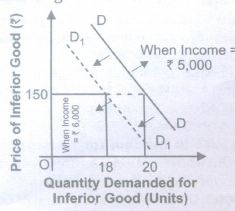
4. In the given diagram the demand curve for inferior goods when income is Rs.6000 lies to the left of that when income is Rs.5000. Hence, an increase in the income of a consumer shifts the demand curve for inferior goods to the left.
18.
(i) fall in price of Substitute good:
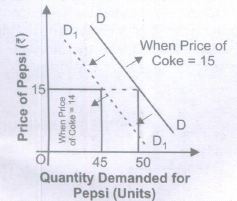
A decrease in price of substitute goods (Coke) leads to an decrease in demand of a given commodity (Pepsi). The Demand curve of Pepsi would shifts leftward It can be explained with the help of given diagram:
In the given diagram the demand curve for Pepsi when the price of Coke is Rs.14 lies to the left of that when the price of Coke is Rs.15. Hence, an decrease in the price of a substitute good shifts the demand curve for a product to the left.
(ii) A fall in price of Complimentary good
Decrease in Price of Complimentary Good [Refill] leads to a increase in demand of given commodity [Pen]. The Demand curve for Pen shifts rightwards. It can be explained with the help of diagram:
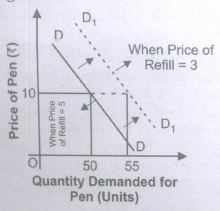
In the above diagram, the demand curve for Pen when Refill price is Rs.3 lies to the right of that when the Refill price is Rs.5.
19.
(i) A rise in price of Substitute good
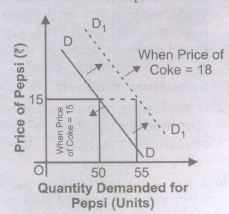
(a) Increase in Price of Substitute Goods An increase in price of substitute goods (Coke)leads to an increase in demand of a given commodity (Pepsi).The Demand curve of Pepsi would shift rightward It can be explained with the help of given diagram:
In the given diagram the demand curve for Pepsi when the price of Coke is 18 lies to the right of that when the price of Coke is Rs.15. Hence, an increase in the price of a substitute good shifts the demand curve for a product to the right.
(ii) Arise in price of Complimentary good
Increase in Price of Complimentary Good [Refill] leads to a decrease in demand of given commodity [Pen]. The Demand curve for Pen shifts leftwards. It can be explained with the help of given diagram:
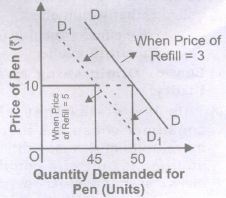
In the above diagram, the demand curve for Pen when Refill price is Rs.5 lies to the left of that when the Refill price is Rs.3

11th Standard CBSE Syllabus & Materials
11th Standard CBSE
CBSE 11th Business Studies Forms of Business Organisation Sample Question Papers Study Material - QB365 Set A
NEW11th Standard CBSE
CBSE 11th Business Studies Business, Trade and Commerce Sample Question Papers Study Material - QB365 Set A
NEW11th Standard CBSE
CBSE 11th Physics Waves Sample Question Papers Study Material - QB365 Set A
NEW11th Standard CBSE
CBSE 11th Physics Kinetic Theory Sample Question Papers Study Material - QB365 Set A



CBSE 11th Standard CBSE Subjects
CBSE Standards










