
 100% FREE ACCESS
11th Standard CBSE Syllabus & Materials
11th Standard CBSE
CBSE 11th Economics PART-A - Presentation of Data - New Sample Question Papers Study Material - QB365 Set A
NEW11th Standard CBSE
CBSE 11th Economics PART-A - Organisation of Data - New Sample Question Papers Study Material - QB365 Set A
NEW11th Standard CBSE
CBSE 11th Economics PART-A - Collection of Data - New Sample Question Papers Study Material - QB365 Set A
NEW11th Standard CBSE
CBSE 11th Economics PART-A - Introduction to Economics and Statistics - New Sample Question Papers Study Material - QB365 Set A
NEW11th Standard CBSE
CBSE 11th Business Studies International Trade Sample Question Papers Study Material - QB365 Set A
NEW11th Standard CBSE
CBSE 11th Business Studies Evolution and Fundamentals of Business Sample Question Papers Study Material - QB365 Set A

Published on: 04/11/2019
Download CBSE Class 11th Standard CBSE undefined question papers, sample papers, important questions, and previous year solved papers in PDF format. Get free study materials, NCERT solutions, and exam preparation resources for Class 11th Standard CBSE undefined
Questions + Answers key
Take MCQ Biology Test
1.
'Limitation of study' mentions:
Sample Size
Assumptions
Methodological limitations
All of the above
2.
Which of the following is a tool for presentation of data?
Bar Diagram
Pie Chart
Time Series Graph
All of the above.
3.
Historically the first index number is constructed in the year ______.
1764
1776
1881
1921
4.
A consumer price index measures changes in:
retail prices
wholesale prices
producers prices
UnAvailable Option
5.
Fisher's Ideal Index number is expressed in terms of:
(Pon)F = √ Laspeyer's Index \(\times \) (Paasche's Index)
(Pon)F = Laspeyer's Index \(\times \) 'Paasche's Index'
(Pon)F = √Marshall Edge worth Index \(\times \) Paasche's
None of these
6.
Price-relative is expressed in terms of:
\(p=\frac { { p }_{ n } }{ { p }_{ 0 } } \)
\(p=\frac { { p }_{ 0 } }{ { p }_{ } } \)
\(p=\frac { { p }_{ n } }{ { p }_{ 0 } } \times 100\)
\(p=\frac { { p }_{ n } }{ { p }_{ 0 } } \times 100\)
7.
A consumer price index measures changes in:
Wholesale Price
Consumer Price
Producer's Price
8.
Median:
Cannot be determined
Affected by extreme items
Can be determined graphically
Involves complex calculations
9.
The second quartile is known as:
Upper quartile
Lower quartile
Median
None of these
10.
What do you call the partition value which divides the series into two equal parts?
Upper quartile
Lower quartile
Mode
Median
11.
If mean of a series is 32 and median is 40, what would be the value of mode?
38
58
56
54
12.
Most frequent occurring value in a series is called:
Mode
Median
Mean
Quartiles
13.
Median can be calculated from series:
Individual
Discrete
Continuous
All of Above
14.
A grouped frequency distribution with uncertain first or last class is known as:
Open ended distribution
Discrete distribution
Exclusive class distribution
Inclusive class distribution
15.
In an ordered series, the data are:
In descending order
In ascending order
Either (a) or (b)
None of these
16.
Annual income of a person is:
A continuous variable
A discrete variable
An attribute
(c) and (a)
17.
Given below is a statistical series.
| Marks | Below 10 | 10-20 | 20-30 | 30 and above |
| Frequency | 3 | 4 | 6 | 2 |
It is an example of:
Continuous series
Open ended Series
Exclusive series
All of the above
18.
When different items have different importance we should use:
Unweighted average
Index number
Weighted Mean
Mode
19.
Which of the following is affected by extreme values?
Median
Index number
Mean
Mode
20.
Measures of central tendency are known as:
Difference
Average
Both
None of these
21.
The mean of 12 numbers is 24 .if 5 is added in every number, the new mean
29
84
25
None of these
22.
A scatter diagram:
Is a statistical test
Must be linear
Must be curvilinear
Is a graph of x and y values
23.
If all the plotted points in a scatter diagram lie on a single line, then the correlation is:
Perfect positive
Perfect negative
Either (a) or (b)
Both (a) and (b)
24.
The standard deviation of 25 numbers is 0. If each of the numbers is increased by 5, then the new standard deviation will be:
45
40
41.5
55
25.
Which measure of dispersion which ignores signs of the deviations from a central value is:
Standard deviation
Quartile deviation
Mean deviation
Range
26.
Which measures of dispersion is the quickest to compute?
Mean deviation
Quartile deviation
Range
Standard deviation
27.
The measure of variation which is mostly affected by extreme items is:
Range
Quartile deviation
Mean deviation
Standard deviation
28.
The square of standard deviation is known as:
Mean deviation
Variance
Standard deviation
Quartile deviation
29.
If you are interested in how the government expenditure have fluctuated over time, it would be best to use:
Pie graph
Histogram
Time series graphe
Frequency Curves
30.
Mode is found graphically by:
Frequency polygon
Ogive
Histogram
None of these
31.
Which of the following statements is not true for tabulation?
Facilitates comparison between rows and not columns.
Statistical analysis of data requires tabulation
Diagrammatic representation of data requires tabulation
Complicated data can be presented
32.
The most accurate mode of data presentation is:
Diagrammatic method
Tabulation
Textual presentation
None of these
33.
Suppose the technology for producing personal computers improves and, at the same time, individuals discover new uses for personal computers so that there is greater utilisation of personal computers. Which of the following statements /factors will happen to equilibrium price and equilibrium quantity?
Price will increase ; quantity cannot be determined.
Price will decrease; quantity cannot be determined.
Quantity will increase; price cannot be determined
Quantity will decrease; price cannot be determined.
34.
Suppose that the supply of cameras increases due to an increase in imports. Which of the following statements will most likely occur?
The equilibrium price of cameras will increase
The equilibrium quantity of cameras exchanged will decrease.
The equilibrium price of camera film will decrease.
The equilibrium quantity of camera film exchanged will increase.
35.
Assume that consumers' incomes and the number of sellers in the market for goods A both decrease. Based upon this information, we can conclude, with certainty, that the equilibrium
price will increase
price will decrease.
quantity will increase
quantity will decrease.
36.
With a given supply curve a decrease in demand causes
an overall decrease in price but an increase in equilibrium quantity
an overall increase in price but a decrease in equilibrium quantity.
an overall decrease in price and a decrease in equilibrium quantity
no change in overall price but a reduction in equilibrium quantity
37.
If price is above then equilibrium Price, there is:
excess demand
excess supply
price ceiling
price flooring
38.
Percentage Bar diagram is
Same as Sub divided Bar Diagram
Has all bars equal in size
is similar to multiple bar diagram
All of the above
39.
Square is a:
One-dimensional diagram
two-dimensional diagram
Diagram with no dimension
none of the above
40.
The most attractive method of data presentation is:
Tabular
diagrammatic
Textual
either (a) or (c)
41.
What is the relation between price and marginal cost at equilibrium, when price remains constant with the rise in output.
Price = Marginal Cost
Price> Marginal Cost
Price < Marginal cost
None of these
42.
What is the relation between price and marginal cost at equilibrium, when price falls with the rise in output.
Price = Marginal Cost
Price> Marginal Cost
Price < Marginal cost
None of these
43.
When MC is equal to MR, while maximizing profit, then
MC must be rising
MC must be falling
MC must be constant
None of these
44.
If MC is more than MR at a particular level of output, how will the producer react to maximize the profits________________
Decrease Production
Increase Production
Increase Revenue
None of these
45.
Average revenue and price are always equal under:
perfect competition only
Monopolistic competition only
monopoly only
all market forms
46.
A seller cannot influence the market price under :
perfect competition
Monopoly
monopolistic competition
All of the above
47.
In which form of the market structure is the degree of control over the price of its product by a firm very large?
Monopoly
Imperfect Competition
Oligopoly
Perfect competition
48.
Oligopolistic industries are characterized by_________
A few dominant firms and substantial barriers to entry
A few large firms and no entry barriers.
A large number of small firms and no entry barriers.
One dominant firm and low entry barriers.
49.
Which of the following statement is true?
Statistics deals with all kinds of data
Statistics can be used by one and all.
It is very difficult to misuse statistics
Statistics can mould data to make god or devil from it.
50.
Distrust of Statistics is due to:
Misuse of Statistics
Insufficient Statistical Methods
Lack of Scope of Statistics
Limitations of Statistics
51.
The proper use of statistics can be made by
Cheats
Everyone
Common Man
Experts
52.
The law of scarcity:
does not apply to rich, developed countries
implies that consumer's wants will never be completely satisfied
applies only to the less developed countries
implies that consumer's wants will be satisfied in a socialistic system
53.
What is the root cause of all economic problems?
Scarcity
Excess Demand
Excess Supply
Deficient Demand
54.
What implication(s) does resource scarcity has for the satisfaction of wants?
Not all wants can be satisfied
The discovery of new natural resources is necessary to increase our ability to satisfy wants.
We will never be faced with the need to make choices
We must develop ways to decrease our individual wants.
55.
Which definition was given by Adam Smith?
Welfare Definition
Scarcity Definition
Wealth Definition
Growth Oriented Definition
56.
Direct personal investigation method suffers from:
Time consuming
Excessive expenses
Personal bias
All the above
57.
A good questionnaire should have questions which are:
Not personal
Well ordered
Logical
All the above
58.
Data collected on religion from the census reports are:
Sample data
Primary data
Either (a) or (b)
Secondary data
59.
Data collected from a newspaper is an example of:
Sample data
Primary data
Secondary data
either (a) or (c)
60.
In random sampling:
Sample is always full of bias
Each element has equal chance of being selected
Cost involved is very less
Cost involved is high
61.
A purely competitive firm's supply schedule in the short run is determined by_____________.
its average revenue.
its marginal revenue.
its marginal utility for money curve
its marginal cost curve
62.
Suppose that a sole proprietorship is earning total revenues of Rs.1,00,000 and is incurring explicit costs of Rs.75,000. If the owner could work for another company for Rs.30,000 a year, we would conclude that__________________.
the firm is incurring an economic loss.
implicit costs are Rs.25,000
the total economic costs are Rs.1,00,000
the individual is earning an economic profit of Rs.25,000
63.
The firm in a perfectly competitive market is a price taker. This designation as a price taker is based on the assumption that______________.
the firm has some, but not complete, control over its product price
there are so many buyers and sellers in the market that any individual firm cannot affect the market
each firm produces a homogeneous product
there is easy entry into or exit from the market place
64.
For a price-taking firm
marginal revenue is less than price
marginal revenue is equal to price
marginal revenue is greater than price
the relationship between marginal revenue and price is indeterminate
65.
What is the shape of the demand curve faced by a firm under perfect competition?
Horizontal
Vertical
Positively sloped
Negatively sloped
66.
If the quantity supplied is exactly equal to the relative change in price then the elasticity of supply is
less than one
greater than one
one
none of them
67.
The quantity supplied of a piece of goods or service is the amount that
is actually bought during a given time period at a given price
producers wish that they could sell that at a higher price
producers plan to sell during a given time period at a given price.
people are willing to buy during a given time period at a given price
68.
A vertical supply curve parallel to Y-axis implies that the elasticity of supply is:
Zero
Infinity
Equal to one
Greater than zero but less than infinity.
69.
When price remains constant at all level of output, total revenue______.
increases at increasing rate
increases at diminishing rate
increases at constant rate
None of these.
70.
Total revenue =
Price x quantity
Price x income
Income x quantity
None of these.
71.
Marginal Revenue is equal to:
The change in price divided by the change in output.
The change in quantity divided by the change in price.
The change in P x Q due to a one unit change in output.
Price, but only if the firm is a price searcher.
72.
Assume that when price is Rs 20, the quantity demanded is 15 units and when price is ns, the quantity demanded is 16 units. Based on this information what is the marginal revenue resulting from an increase in output from 15 units to 16 units?
Rs 18
Rs 16
Rs 12
Rs 28
73.
Assume that when price is Rs 20, the quantity demanded is 9 units, and when price is Rs19 the quantity demanded is 10 units. Based on this information what is the marginal revenue resulting from an increase in output from 9 units to 10 units.
Rs 20
Rs 19
Rs 10
Rs 1
74.
A firm's average fixed cost is Rs. 20 at 6 units of output. What will it be at 4 units of output?
Rs. 60
Rs. 30
Rs. 40
Rs. 20
75.
Which one of the following statements is an example of an "implicit cost"?
Interest that could have been earned on retained earnings used by the firm to finance expansion.
The payment of rent by the firm for the building in which it is housed.
The interest payment made by the firm for funds borrowed from a bank.
The payment of wages by the firm.
76.
In the short run, when the output of a firm increases, its average fixed cost:
increases.
decreases.
remains constant.
first declines and then rises.
77.
Total cost in the short run is classified into fixed costs and variable costs. Which one of the following is a variable cost?
Cost of raw materials.
Cost of equipment.
Interest payment on past borrowings.
Payment of rent on building.
78.
Diminishing marginal returns for the first four units of a variable input is exhibited by the total product sequence:
50, 50, 50, 50
50, 110, 180, 260
50, 100, 150, 200
50, 90, 120, 140
79.
The change in the total product resulting from a change in a variable input is:
Average cost
Average product
Marginal cost
Marginal product
80.
To economists, the main difference between short run and long run is that:
In short run all inputs are fixed, while in long run all inputs are variable.
In short run the firm varies all of its inputs to find the least cost combination of inputs.
In short run, at least one of the firm's input level is fixed.
In long run, the firm is making a constrained decision about how to use existing plant and equipment efficiently.
81.
The short run, as economists use the phrase, is characterized by:
At least one fixed factor of production and firms neither leaving nor entering the industry.
A period where the law of diminishing returns does not hold.
No variable inputs-that is all the factors of production are fixed.
All inputs being variable.
82.
Diminishing marginal returns implies:
Decreasing average variable costs.
Decreasing marginal costs.
Increasing marginal costs.
Decreasing average fixed costs.
83.
With a fall in the price of a commodity:
consumer's real income increases
consumer's real income decreases
there is no change in the real income of the consumer
None of these.
84.
The price of tomatoes increases and people buy tomato puree. You infer that tomato puree and tomatoes are:
normal goods
complements
substitutes
inferior goods
85.
All of the following items are determinants of demand except:
tastes and preferences.
quantity supplied.
income.
price of related goods
86.
Suppose the price of Pepsi increases, we will expect the demand curve of Coca-Cola to:
shift towards left
shift towards right
initially shift towards left and then to right.
remains at the same level.
87.
If regardless of changes in its price, the quantity demanded of a good remains unchanged, then the demand curve for the good will be:
horizontal.
vertical.
positively sloped.
negatively sloped
88.
The price elasticity of demand is defined as the responsiveness of:
price to a change in quantity demanded.
quantity demanded to a change in price
price to a change in income.
quantity demanded to a change in income
89.
The price elasticity of demand for hamburger is
the change in the quantity demanded of hamburger when the hamburger increases by 30 paise per rupee
the percentage increase in the quantity demanded of hamburger when the price of hamburger falls by 1 percent per rupee.
the increase in the demand for hamburger when the price of hamburger falls by 10 percent per rupee.
the decrease in the quantity demanded of hamburger when the price of hamburger falls.by 1 percent per rupee
90.
Identify the factor which generally keeps the price elasticity of demand for a good low
Variety of uses for that good
Its low price
Close substitutes for that good
High proportion of the consumer's income spent on it
91.
In case of a straight line demand curve meeting the two axes, the price elasticity of demand at the midpoint of the line would be:
0
1
1.5
2
92.
Which of the following is not a subject matter of microeconomics?
Consumer's behavior
Market structure
Monetary Policy
Pricing of factor services
93.
If indifference curve is straight line downward sloping,
MRS is increasing
MRS is decreasing
MRS is constant
MRS is zero
94.
The consumer is in equilibrium when the following condition is satisfied
\(\frac { M{ U }_{ x } }{ M{ U }_{ y } } >\frac { { P }_{ x } }{ { P }_{ y } } \)
\(\frac { M{ U }_{ x } }{ M{ U }_{ y } } >\frac { { P }_{ x } }{ { P }_{ y } } \)
\(\frac { M{ U }_{ x } }{ M{ U }_{ y } } =\frac { { P }_{ x } }{ { P }_{ y } } \)
None of these
95.
The second glass of lemonade gives lesser satisfaction to a thirsty boy. This is a clear case of
Law of demand
Law of diminishing returns.
Law of diminishing
Law of supply
96.
What does the area under the marginal utility curve depict?
Average Utility
Total Utility
Indifference Curve
Consumer Equilibrium
97.
Which of the shaded area in the diagrams below represent total utility?

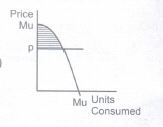

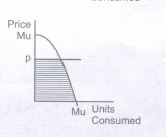

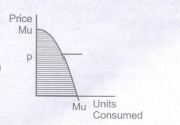

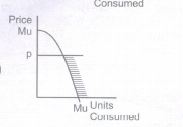
98.
Which one of the following statements is a reason for the negative slope of PPF?
The inverse relationship between the use of technology and the use of natural resources
Scarcity at any point of time due to limited amounts of productive resources.
Resource specialisation.
Increasing opportunity costs.
99.
Which one of the following bundles of goods cannot be produced with the resources the economy currently has?
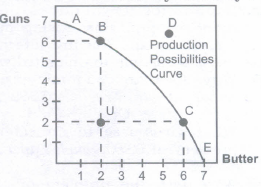
A
B
C
D
1.
(d)
All of the above
2.
(d)
All of the above.
3.
(a)
1764
4.
(a)
retail prices
5.
(a)
(Pon)F = √ Laspeyer's Index \(\times \) (Paasche's Index)
6.
(c)
\(p=\frac { { p }_{ n } }{ { p }_{ 0 } } \times 100\)
7.
(b)
Consumer Price
8.
(c)
Can be determined graphically
9.
(c)
Median
10.
(d)
Median
11.
(c)
56
12.
(a)
Mode
13.
(d)
All of Above
14.
(a)
Open ended distribution
15.
(c)
Either (a) or (b)
16.
(d)
(c) and (a)
17.
(d)
All of the above
18.
(c)
Weighted Mean
19.
(c)
Mean
20.
(b)
Average
21.
(a)
29
22.
(d)
Is a graph of x and y values
23.
(c)
Either (a) or (b)
24.
(b)
40
25.
(c)
Mean deviation
26.
(c)
Range
27.
(a)
Range
28.
(b)
Variance
29.
(c)
Time series graphe
30.
(c)
Histogram
31.
(a)
Facilitates comparison between rows and not columns.
32.
(b)
Tabulation
33.
(c)
Quantity will increase; price cannot be determined
34.
(d)
The equilibrium quantity of camera film exchanged will increase.
35.
(d)
quantity will decrease.
36.
(c)
an overall decrease in price and a decrease in equilibrium quantity
37.
(b)
excess supply
38.
(b)
Has all bars equal in size
39.
(b)
two-dimensional diagram
40.
(b)
diagrammatic
41.
(a)
Price = Marginal Cost
42.
(b)
Price> Marginal Cost
43.
(a)
MC must be rising
44.
(a)
Decrease Production
45.
(d)
all market forms
46.
(a)
perfect competition
47.
(a)
Monopoly
48.
(a)
A few dominant firms and substantial barriers to entry
49.
(d)
Statistics can mould data to make god or devil from it.
50.
(a)
Misuse of Statistics
51.
(d)
Experts
52.
(b)
implies that consumer's wants will never be completely satisfied
53.
(a)
Scarcity
54.
(a)
Not all wants can be satisfied
55.
(c)
Wealth Definition
56.
(d)
All the above
57.
(d)
All the above
58.
(d)
Secondary data
59.
(d)
either (a) or (c)
60.
(b)
Each element has equal chance of being selected
61.
(d)
its marginal cost curve
62.
(d)
the individual is earning an economic profit of Rs.25,000
63.
(b)
there are so many buyers and sellers in the market that any individual firm cannot affect the market
64.
(b)
marginal revenue is equal to price
65.
(a)
Horizontal
66.
(c)
one
67.
(c)
producers plan to sell during a given time period at a given price.
68.
(a)
Zero
69.
(c)
increases at constant rate
70.
(a)
Price x quantity
71.
(c)
The change in P x Q due to a one unit change in output.
72.
(c)
Rs 12
73.
(c)
Rs 10
74.
(b)
Rs. 30
75.
(a)
Interest that could have been earned on retained earnings used by the firm to finance expansion.
76.
(b)
decreases.
77.
(a)
Cost of raw materials.
78.
(d)
50, 90, 120, 140
79.
(d)
Marginal product
80.
(c)
In short run, at least one of the firm's input level is fixed.
81.
(a)
At least one fixed factor of production and firms neither leaving nor entering the industry.
82.
(c)
Increasing marginal costs.
83.
(a)
consumer's real income increases
84.
(c)
substitutes
85.
(b)
quantity supplied.
86.
(b)
shift towards right
87.
(b)
vertical.
88.
(b)
quantity demanded to a change in price
89.
(b)
the percentage increase in the quantity demanded of hamburger when the price of hamburger falls by 1 percent per rupee.
90.
(b)
Its low price
91.
(b)
1
92.
(c)
Monetary Policy
93.
(c)
MRS is constant
94.
(c)
\(\frac { M{ U }_{ x } }{ M{ U }_{ y } } =\frac { { P }_{ x } }{ { P }_{ y } } \)
95.
(c)
Law of diminishing
96.
(b)
Total Utility
97.
(c)
98.
(b)
Scarcity at any point of time due to limited amounts of productive resources.
99.
(d)
D

11th Standard CBSE Syllabus & Materials
11th Standard CBSE
CBSE 11th Business Studies Forms of Business Organisation Sample Question Papers Study Material - QB365 Set A
NEW11th Standard CBSE
CBSE 11th Business Studies Business, Trade and Commerce Sample Question Papers Study Material - QB365 Set A
NEW11th Standard CBSE
CBSE 11th Physics Waves Sample Question Papers Study Material - QB365 Set A
NEW11th Standard CBSE
CBSE 11th Physics Kinetic Theory Sample Question Papers Study Material - QB365 Set A



CBSE 11th Standard CBSE Subjects
CBSE Standards










