
 100% FREE ACCESS
11th Standard CBSE Syllabus & Materials
11th Standard CBSE
CBSE 11th Economics PART-A - Presentation of Data - New Sample Question Papers Study Material - QB365 Set A
NEW11th Standard CBSE
CBSE 11th Economics PART-A - Organisation of Data - New Sample Question Papers Study Material - QB365 Set A
NEW11th Standard CBSE
CBSE 11th Economics PART-A - Collection of Data - New Sample Question Papers Study Material - QB365 Set A
NEW11th Standard CBSE
CBSE 11th Economics PART-A - Introduction to Economics and Statistics - New Sample Question Papers Study Material - QB365 Set A
NEW11th Standard CBSE
CBSE 11th Business Studies International Trade Sample Question Papers Study Material - QB365 Set A
NEW11th Standard CBSE
CBSE 11th Business Studies Evolution and Fundamentals of Business Sample Question Papers Study Material - QB365 Set A

Published on: 06/09/2019
Non-Competitive Market
Download CBSE Class 11th Standard CBSE undefined question papers, sample papers, important questions, and previous year solved papers in PDF format. Get free study materials, NCERT solutions, and exam preparation resources for Class 11th Standard CBSE undefined
Questions + Answers key
Take MCQ Biology Test
1.
Willmonopolistfirmcontinueto produce in the short run if a loss is incurred at the best short run level of output?
2.
The market demand curve for a commodity and the total cost for a monopoly firm producing the commodity is given by the schedules below. Use information to calculate the following:
| Quantity | 0 | 1 | 2 | 3 | 4 | 5 | 6 | 7 | 8 |
|---|---|---|---|---|---|---|---|---|---|
| Price | 52 | 44 | 37 | 31 | 26 | 22 | 19 | 16 | 13 |
| Quantity | 0 | 1 | 2 | 3 | 4 | 5 | 6 | 7 | 8 |
|---|---|---|---|---|---|---|---|---|---|
| Total cost | 10 | 60 | 90 | 100 | 102 | 105 | 109 | 115 | 125 |
(i) The MR and MC schedules
(ii) The quantities for which the MR and MC are equal
(iii) The equilibrium quantity of output and the equilibrium price of the commodity.
(iv) The total revenue, total cost and total profit in equilibrium.
3.
What is meant by prices being rigid? How can oligopoly behaviour lead to such an outcome?
4.
List the three different ways in which oligopoly firms may behave.
5.
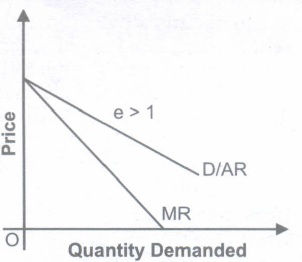
What is the value of MR when the demand curve is elastic?
6.
What is the reason for the long run equilibrium of a firm in monopolistic competition to be associated with zero profit?
7.
Explain why the demand curve facing a firm under monopolistic competition is negatively sloped?
1.
()
If the monopolist firm incurs loss in the short run, it will stop production in the long run.
2.
(i) Revenue Schedules
| Q | P | TR=PxQ | MR=\(\frac{\Delta{TR}}{\Delta{Q}}\) |
|---|---|---|---|
| 0 | 52 | 0 | - |
| 1 | 44 | 44 | 44 |
| 2 | 37 | 74 | 30 |
| 3 | 31 | 93 | 19 |
| 4 | 26 | 104 | 11 |
| 5 | 22 | 110 | 6 |
| 6 | 19 | 114 | 4 |
| 7 | 16 | 112 | -2 |
| 8 | 13 | 104 | -8 |
Cost Schedules
| Q | TC | MC |
|---|---|---|
| 0 | 10 | - |
| 1 | 60 | 50 |
| 2 | 90 | 40 |
| 3 | 100 | 10 |
| 4 | 102 | 2 |
| 5 | 105 | 3 |
| 6 | 109 | 4 |
| 7 | 115 | 6 |
| 8 | 125 | 10 |
(ii) For quantity of 6 units MRis equal to MC.
(iii) Equilibrium quantity of output occurs where MR = MC.
Equilibrium quantity = 6 units
Equilibrium price = Rs.19
(iv) TR = 114
TC = 109
Total profit = TR- TC = 114 - 109 = 5
3.
(i) Price rigidity refers to a situation in which whether there is change in demand and supply, the price tends to stay fixed.
(ii) In an oligopolistic market firms are in a position to influence the prices.
(iii) However, they stick to their prices in order to avoid a price war. If a firm tries to reduce the price the rivals will also react by reducing their prices. So, it will be of no benefit.
(iv) Likewise, if a firm tries to raise the price other firms will not do so. As a result, the firm which intended to raise the price will lose its customers. So, oligopoly behaviour leads to price rigidity in an oligopolistic market.
4.
Oligopoly firm may-
(i) cooperate with each other and formally have a contract or written document of their policies.
(ii) cooperate with each other but have tacit (informal) understanding.
(iii) not cooperate with each other.
5.
When demand curve is elastic (e > 1), MR is positive.
The relationship is given by,
MR=P\(\left( 1-\frac { 1 }{ e } \right) \)
Graphically, it is shown as is given here.
6.
(i) The reason why firm in monopolistic competition earns zero profit in the long run is free entry and exit of firm.
(ii) If firm earns super-normal profits in the short run then new entry will take place in the long run. If the firm is incurring losses in the short run, firm will leave in the long run.
(iii) The result is zero abnormal profits in the long run.
7.
(i) The demand curve of a firm under monopolistic competition is negatively sloped because of product differentiation.
(ii) The product of the sellers are differentiated but close substitutes of one another.
(iii) Each seller has some degree of monopoly power of 'Making' the price. But since there are many close substitutes available, the result is downward sloping and elastic demand curve.

11th Standard CBSE Syllabus & Materials
11th Standard CBSE
CBSE 11th Business Studies Forms of Business Organisation Sample Question Papers Study Material - QB365 Set A
NEW11th Standard CBSE
CBSE 11th Business Studies Business, Trade and Commerce Sample Question Papers Study Material - QB365 Set A
NEW11th Standard CBSE
CBSE 11th Physics Waves Sample Question Papers Study Material - QB365 Set A
NEW11th Standard CBSE
CBSE 11th Physics Kinetic Theory Sample Question Papers Study Material - QB365 Set A



CBSE 11th Standard CBSE Subjects
CBSE Standards










