
 100% FREE ACCESS
11th Standard CBSE Syllabus & Materials
11th Standard CBSE
CBSE 11th Economics PART-A - Presentation of Data - New Sample Question Papers Study Material - QB365 Set A
NEW11th Standard CBSE
CBSE 11th Economics PART-A - Organisation of Data - New Sample Question Papers Study Material - QB365 Set A
NEW11th Standard CBSE
CBSE 11th Economics PART-A - Collection of Data - New Sample Question Papers Study Material - QB365 Set A
NEW11th Standard CBSE
CBSE 11th Economics PART-A - Introduction to Economics and Statistics - New Sample Question Papers Study Material - QB365 Set A
NEW11th Standard CBSE
CBSE 11th Business Studies International Trade Sample Question Papers Study Material - QB365 Set A
NEW11th Standard CBSE
CBSE 11th Business Studies Evolution and Fundamentals of Business Sample Question Papers Study Material - QB365 Set A

Published on: 16/12/2019
Non-Competitive Market
Download CBSE Class 11th Standard CBSE undefined question papers, sample papers, important questions, and previous year solved papers in PDF format. Get free study materials, NCERT solutions, and exam preparation resources for Class 11th Standard CBSE undefined
Questions + Answers key
Take MCQ Biology Test
1.
Price discrimination should be socially desirable. How?
2.
Which features of monopolistic competition are monopolistic in nature?
3.
How many firms are there in a monopoly market?
4.
What are the shapes of AR and MR curves under monopoly?
5.
Willmonopolistfirmcontinueto produce in the short run if a loss is incurred at the best short run level of output?
6.
Compare between monopoly and monopolistic competition.
7.
Compare between perfect competition and monopolistic competition.
8.
Compare between perfect competition and monopoly.
9.
The market demand curve for a commodity and the total cost for a monopoly firm producing the commodity is given by the schedules below. Use information to calculate the following:
| Quantity | 0 | 1 | 2 | 3 | 4 | 5 | 6 | 7 | 8 |
|---|---|---|---|---|---|---|---|---|---|
| Price | 52 | 44 | 37 | 31 | 26 | 22 | 19 | 16 | 13 |
| Quantity | 0 | 1 | 2 | 3 | 4 | 5 | 6 | 7 | 8 |
|---|---|---|---|---|---|---|---|---|---|
| Total cost | 10 | 60 | 90 | 100 | 102 | 105 | 109 | 115 | 125 |
(i) The MR and MC schedules
(ii) The quantities for which the MR and MC are equal
(iii) The equilibrium quantity of output and the equilibrium price of the commodity.
(iv) The total revenue, total cost and total profit in equilibrium.
10.
What is meant by prices being rigid? How can oligopoly behaviour lead to such an outcome?
11.
List the three different ways in which oligopoly firms may behave.
12.
What is the value of MR when the demand curve is elastic?
13.
What is the reason for the long run equilibrium of a firm in monopolistic competition to be associated with zero profit?
14.
Explain why the demand curve facing a firm under monopolistic competition is negatively sloped?
15.
Pure oligopoly is based on the _________ products.
differentiated
homogeneous
unrelated
None of these
16.
Price discrimination is one of the features of________
monopolistic competition
monopoly
perfect competition
oligopoly
17.
Suppose that the demand curve for the XYZ Co. slopes downward and to the right. We can conclude that
The firm operates in a perfectly competitive market.
The firm can sell all that it wants to at the established market price.
The XYZ Co. is not a price taker in the market because it must lower the price to sell additional units of output.
The XYZ Co. will not be able to maximise profits because price and revenue are subject to change
18.
All of the following are characteristics of a monopoly except:
There is a single firm.
The firm is a price-taker.
The firm produces a unique product.
The existence of some advertising.
19.
Which one of the following statement is not a characteristic of monopolistic competition?
Ease of entry into the industry.
Product differentiation.
A relatively large number of sellers.
A homogenous product.
1.
()
There should be an approach on the part of the Monopoly Firm to fix lower prices for poor people and backward areas for its product.
2.
()
The features of monopolistic competition are:
(i) Product differentiation
(ii) Downward sloping AR and MR curves.
3.
()
One firm.
4.
()
Both AR and MR curves slope downwards.
5.
()
If the monopolist firm incurs loss in the short run, it will stop production in the long run.
6.
| Monopoly | Basis | Monopolistic Competition |
|---|---|---|
| Monopoly refers to a market situation where there is a single seller selling a product which has no close substitutes. | Meaning | Monopolistic Competition refers to a market situation in which there are large number of firms selling closely related but differentiated products. |
| There is a single seller and the monopolist has full control over the supply. | Number of sellers | There are large number of sellers. So, a firm does not have much impact on activities of other firms. |
| There are no close substitutes of the product. So, there is no competition from new and existing products. | Nature of product | Products are differentiated on the basis of brand, size, colour, shape etc. So, a firm is in a position to influence the price |
| There is restriction on entry and exit. So, a firm can earn abnormal profits in the long run. | Entry or Exit | Although there is freedom of entry and exit but it is possible only for a competitive firm to enter or leave the industry. |
| Monopolist is a price-maker as firm and industry are one and the same thing. | Price | Firm is neither a price-taker nor a price maker but has partial control over price due to product differentiation |
| Downward sloping demand curve is less elastic due to absence of close substitutes. | A demand Curve | Downward sloping demand curve is more elastic due to presence of close substitutes. |
| Low selling costs are incurred. | Selling cost | Heavy selling costs are incurred on sales promotion. |
7.
| Perfect Competition | Basis | Monopolistic Competition |
|---|---|---|
| It refers to a market situation where there are very large number of buyers and sellers dealing in a homogeneous product at a price fixed by the market. |
Meaning | It refers to a market situation in which there are large number of firms selling closely related but differentiated products. |
| The products sold are homogeneous. So, buyers are willing to pay same price for all products, which leads to uniform price in the market. | Nature of Product | Products are differentiated on the basis of brand, size, colour, shape etc. So, a firm is in a position to influence the price. |
| Demand curve is perfectly elastic as price remains the same at all levels of output. | Demand Curve | Demand curve slopes downwards as more output can be sold only at less price. |
| Firm is a price-taker as price is determined by the industry. | Price | Firm is neither a price-taker nor a price-maker but has partial control over price due to product differentiation. |
| Buyers and sellers have perfect knowledge about market conditions. | Level of Knowledge | Sellers and buyers do not have perfect knowledge due to product differentiation and selling costs incurred by the sellers. |
| No selling costs are incurred as buyers and sellers have perfect knowledge about market conditions. | Selling Cost | Heavy selling costs are incurred on sales promotion due to lack of perfect knowledge among buyers and sellers. |
8.
| Perfect Competition | Basis | Monopoly |
|---|---|---|
| It refers to a market situation where there are very large number of buyers and sellers dealing in a homogeneous product at a price fixed by the market. | Meaning | Monopoly refers to a market situation where there is a single seller selling a product which has no close substitutes. |
| There are very large number of sellers and no individual seller has control over activities of other firms | Number of Sellers | There is a single seller and the monopolist has full control over the supply. |
| The products sold are homogeneous. So, buyers are willing to pay the same price for all products, which leads to uniform price in the market. | Nature of Product | There are no close substitutes of the product. So, there is no competition from new and existing products |
| Any firm can freely enter or exit from this kind of market. It leads to absence of abnormal profits and abnormal losses in the long run. |
Entry and Exit | There is restriction on entry and exit. So, a firm can earn abnormal profits in the long run. |
| In perfect competition, industry is price maker, firm is price taker because of homogeneous goods. | Price Maker/Taker | Monopolist is a price-maker as firm and industry are one and the same thing. |
| Buyers .and sellers have perfect knowledge about market conditions. | Level of Knowledge | Sellers and buyers do not have perfect knowledge |
| Demand curve is perfectly elastic as price remains the same at all levels of output. | Demand curve | Demand curve slopes downwards as more output can be sold only at less price. |
| Nosellingcosts are incurred as buyers and sellers have perfect knowledge about market conditions. | Selling cost | Selling costs are incurred for informative purposes due to lack of perfect knowledge |
9.
(i) Revenue Schedules
| Q | P | TR=PxQ | MR=\(\frac{\Delta{TR}}{\Delta{Q}}\) |
|---|---|---|---|
| 0 | 52 | 0 | - |
| 1 | 44 | 44 | 44 |
| 2 | 37 | 74 | 30 |
| 3 | 31 | 93 | 19 |
| 4 | 26 | 104 | 11 |
| 5 | 22 | 110 | 6 |
| 6 | 19 | 114 | 4 |
| 7 | 16 | 112 | -2 |
| 8 | 13 | 104 | -8 |
Cost Schedules
| Q | TC | MC |
|---|---|---|
| 0 | 10 | - |
| 1 | 60 | 50 |
| 2 | 90 | 40 |
| 3 | 100 | 10 |
| 4 | 102 | 2 |
| 5 | 105 | 3 |
| 6 | 109 | 4 |
| 7 | 115 | 6 |
| 8 | 125 | 10 |
(ii) For quantity of 6 units MRis equal to MC.
(iii) Equilibrium quantity of output occurs where MR = MC.
Equilibrium quantity = 6 units
Equilibrium price = Rs.19
(iv) TR = 114
TC = 109
Total profit = TR- TC = 114 - 109 = 5
10.
(i) Price rigidity refers to a situation in which whether there is change in demand and supply, the price tends to stay fixed.
(ii) In an oligopolistic market firms are in a position to influence the prices.
(iii) However, they stick to their prices in order to avoid a price war. If a firm tries to reduce the price the rivals will also react by reducing their prices. So, it will be of no benefit.
(iv) Likewise, if a firm tries to raise the price other firms will not do so. As a result, the firm which intended to raise the price will lose its customers. So, oligopoly behaviour leads to price rigidity in an oligopolistic market.
11.
Oligopoly firm may-
(i) cooperate with each other and formally have a contract or written document of their policies.
(ii) cooperate with each other but have tacit (informal) understanding.
(iii) not cooperate with each other.
12.
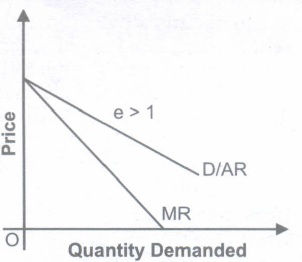
When demand curve is elastic (e > 1), MR is positive.
The relationship is given by,
MR=P\(\left( 1-\frac { 1 }{ e } \right) \)
Graphically, it is shown as is given here.
13.
(i) The reason why firm in monopolistic competition earns zero profit in the long run is free entry and exit of firm.
(ii) If firm earns super-normal profits in the short run then new entry will take place in the long run. If the firm is incurring losses in the short run, firm will leave in the long run.
(iii) The result is zero abnormal profits in the long run.
14.
(i) The demand curve of a firm under monopolistic competition is negatively sloped because of product differentiation.
(ii) The product of the sellers are differentiated but close substitutes of one another.
(iii) Each seller has some degree of monopoly power of 'Making' the price. But since there are many close substitutes available, the result is downward sloping and elastic demand curve.
15.
(b)
homogeneous
16.
(b)
monopoly
17.
(c)
The XYZ Co. is not a price taker in the market because it must lower the price to sell additional units of output.
18.
(b)
The firm is a price-taker.
19.
(d)
A homogenous product.

11th Standard CBSE Syllabus & Materials
11th Standard CBSE
CBSE 11th Business Studies Forms of Business Organisation Sample Question Papers Study Material - QB365 Set A
NEW11th Standard CBSE
CBSE 11th Business Studies Business, Trade and Commerce Sample Question Papers Study Material - QB365 Set A
NEW11th Standard CBSE
CBSE 11th Physics Waves Sample Question Papers Study Material - QB365 Set A
NEW11th Standard CBSE
CBSE 11th Physics Kinetic Theory Sample Question Papers Study Material - QB365 Set A



CBSE 11th Standard CBSE Subjects
CBSE Standards










