
 100% FREE ACCESS
11th Standard CBSE Syllabus & Materials
11th Standard CBSE
CBSE 11th Economics PART-A - Presentation of Data - New Sample Question Papers Study Material - QB365 Set A
NEW11th Standard CBSE
CBSE 11th Economics PART-A - Organisation of Data - New Sample Question Papers Study Material - QB365 Set A
NEW11th Standard CBSE
CBSE 11th Economics PART-A - Collection of Data - New Sample Question Papers Study Material - QB365 Set A
NEW11th Standard CBSE
CBSE 11th Economics PART-A - Introduction to Economics and Statistics - New Sample Question Papers Study Material - QB365 Set A
NEW11th Standard CBSE
CBSE 11th Business Studies International Trade Sample Question Papers Study Material - QB365 Set A
NEW11th Standard CBSE
CBSE 11th Business Studies Evolution and Fundamentals of Business Sample Question Papers Study Material - QB365 Set A

Published on: 16/12/2019
Perfect Competition
Download CBSE Class 11th Standard CBSE undefined question papers, sample papers, important questions, and previous year solved papers in PDF format. Get free study materials, NCERT solutions, and exam preparation resources for Class 11th Standard CBSE undefined
Questions + Answers key
Take MCQ Biology Test
1.
What is a competitive market? Briefly describe a type of market that is not perfectly competitive
2.
Explain features of perfect knowledge about the market.
3.
What is the relation between market price and average revenue of a price taking firm (i.e. perfectly competitive firm)?
4.
What is price line under perfect competition?
5.
What are the Characteristics of a perfectly competitive market?
6.
Under which market form a firm is a price-taker?
7.
What is meant by the term 'price-taker' in the context of a firm?
8.
In which market form does a firm face a perfectly elastic demand curve?
9.
In which market forms are average revenue and marginal revenue of a firm always equal?
10.
What are the main forms of market?
11.
The term 'market'refers to a______________.
place where buyer and seller bargain a product or service for a price
place where buyer does not bargain
place where seller does not bargain
None of these
12.
A purely competitive firm's supply schedule in the short run is determined by_____________.
its average revenue.
its marginal revenue.
its marginal utility for money curve
its marginal cost curve
13.
The firm in a perfectly competitive market is a price taker. This designation as a price taker is based on the assumption that______________.
the firm has some, but not complete, control over its product price
there are so many buyers and sellers in the market that any individual firm cannot affect the market
each firm produces a homogeneous product
there is easy entry into or exit from the market place
14.
For a price-taking firm
marginal revenue is less than price
marginal revenue is equal to price
marginal revenue is greater than price
the relationship between marginal revenue and price is indeterminate
15.
What is the shape of the demand curve faced by a firm under perfect competition?
Horizontal
Vertical
Positively sloped
Negatively sloped
16.
'Supply curve is the rising portion of marginal cost curve over and above the minimum of Average Variable cost curve'. Do you agree? Support your answer with valid reason.
17.
Explain the short run supply curve of the firm.
18.
Explain the features of free entry and exit of firms.
19.
Explain the implications of large number of buyers in a perfectly competitive market.
1.
(i) A competitive market is a market in which there are many buyers and many sellers of an identical product so that each has a negligible impact on the market price.
(ii) Another type of market is a monopoly in which there is only one seller.
(iii) There are also other markets that fall between perfect competition and monopoly i.e. monopolistic competition.
Value: Analytic
2.
(i) Perfect Knowledge means both buyers and sellers are fully informed about the market.
(ii) The firms have all the knowledge about the product market and the input markets. Buyers also have perfect knowledge about the product market.
(iii) Let us first take the product market. The implication of perfect knowledge about the product market is that any attempt by any firm to charge a price higher than the prevailing uniform price will fail. The buyers will not pay because they have perfect knowledge. A uniform price prevails in the market.
(iv) Regarding the knowledge about the input markets the implicit assumption is that each firm has an equal access to the technology and the inputs used in the technology.
(v) No firm has any cost advantage. Cost structure of each firm is the same.
(vi) Since there is uniform price and uniform cost in case of all firms, and since profit equals revenue less cost, all the firms earn uniform profits
3.
The average revenue (AR) of a firm is defined as total revenue per unit of output sold. Let a firm's output be Q and the market price be P, then
TR equals P x Q. Hence,
AR = \(\frac { TR }{ Q } \)=\(\frac { P\times Q }{ Q } =P\)
In other words, for a price-taking firm, average revenue equals the market price.
4.
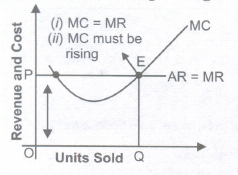
(l) The price line shows the relationship between the market price and a competitive firm's output level.
(il) The vertical height of the price line is equal to the market price as shown in the given figure.
5.
(i) Large number of buyers and sellers
(ii) Homogeneous product
(iii) Free entry and exit of firms
(iv) Perfect knowledge about the market
(v) Perfect mobility of factors of production
(vi) Absence of transportation and selling cost
6.
()
Perfect competition
7.
()
A firm is said to be a price-taker if it has to accept the price, as determined by the market forces of demand and supply.
8.
()
Perfectly competitive market.
9.
()
Perfect competition.
10.
()
(i) Perfect competition (ii) Imperfect competition.
(a) Monopoly
(b) Monopolistic competition
(e) Oliopolgy
11.
(a)
place where buyer and seller bargain a product or service for a price
12.
(d)
its marginal cost curve
13.
(b)
there are so many buyers and sellers in the market that any individual firm cannot affect the market
14.
(b)
marginal revenue is equal to price
15.
(a)
Horizontal
16.
(i) The supply curve of the firm tells us the quantity of the product that a firm is willing and able to produce and sell at each possible price.
(ii) The firm will produce and supply an output at the point at which Price is equal to Marginal cost. The derivation of the supply curve is explained with the help of the given figure.
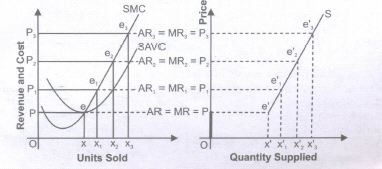
(iii) The SMC of the firm is given. Let us initially assume that the market price is OP1. The firm will produce and supply an output of OX1 because at el' price = MC. (OX1 is the equilibrium output supplied, as MC = MR and MC cuts MR from below).
(iv) Suppose the market price rises to OP2, then the firm will produce and sell OX2 level, because at e2 level price = MC = MR.
(v) Similarly, as market price increases to OP3, quantity supplied increases to OX3 However, the firm will not supply any quantity if the price falls below OP.
(vi) At OP price, the firm will produce and sell OX output. For any price below OPthe firm will not produce and sell anything. The supply will be zero units. Having the above information, the supply schedule can be determined as,
| Price of Product | Units Supplied |
|---|---|
| OP | OX |
| OP1 | OX1 |
| OP2 | OX2 |
| OP3 | OX3 |
(vii) If the market price falls below the minimum of the SAVC, the supply curve jumps to the small segment (OP) on the vertical axis at which there is zero supply. Therefore, two discontinuous [(OP) + (e'S)] pieces define the short run supply curve for the perfectly competitive firm.
17.
(i) The supply curve of the firm tells us the quantity of the product that a firm is willing and able to produce and sell at each possible price.
(ii) The firm will produce and supply an output at the point at which Price is equal to Marginal cost. The derivation of the supply curve is explained with the help of the given figure.
(iii) The SMC of the firm is given. Let us initially assume that the market price is OP1. The firm will produce and supply an output of OX1 because at el' price = MC. (OX1 is the equilibrium output supplied, as MC = MR and MC cuts MR from below).
(iv) Suppose the market price rises to OP2, then the firm will produce and sell OX2 level, because at e2 level price = MC = MR.
(v) Similarly, as market price increases to OP3, quantity supplied increases to OX3 However, the firm will not supply any quantity if the price falls below OP.
(vi) At OP price, the firm will produce and sell OX output. For any price below OPthe firm will not produce and sell anything. The supply will be zero units. Having the above information, the supply schedule can be determined as,
| Price of Product | Units Supplied |
|---|---|
| OP | OX |
| OP1 | OX1 |
| OP2 | OX2 |
| OP3 | OX3 |
(vii) If the market price falls below the minimum of the SAVC, the supply curve jumps to the small segment (OP) on the vertical axis at which there is zero supply. Therefore, two discontinuous [(OP) + (e'S)] pieces define the short run supply curve for the perfectly competitive firm.
18.
(i) Buyers and sellers are free to enter or leave the market at any time they like. New firms induced by large profits can enter the industry whereas losses make inefficient firms to leave the industry.
(ii) The freedom of entry and exit of firms has an important implication. This ensures that no firm can earn above normal profit in the long run. Each firm earns just the normal profit, i.e., minimum necessary to carry on business.
(iii) Suppose the existing firms are earning above normal profits, i.e. positive economic profits. Attracted by the positive profits, the new firms enter the industry. The industry's output, i.e. market supply, goes up. The prices come down. New firms continue to enter and the prices continue to fall till economic profits are reduced to zero.
(iv) Now suppose the existing firms are incurring losses. The firms start leaving. The industry's output starts falling, prices going up, and all this continues till losses are wiped out. The remaining firms in the industry then once again earn just the normal profits.
(v) Only zero economic profit in the long run is the basic outcome of a perfectly competitive market.
19.
Large number of sellers-
(i) The words 'large number' simply states that the number of sellers is large enough to render a single seller's share in total market supply of the product insignificant.
(ii) Insignificant share means that if only one individual firm reduces or raises its own supply, the prevailing market price remains unaffected.
(iii) The prevailing market price is the one which was set through the intersection of market demand and market supply forces, for which all the sellers and all the buyers together are responsible.
(iv) One single seller has no option but to sell what it produces at this market determined price. This position of an individual firm in the total market is referred to as price taker. This is a unique feature of a perfectly competitive market.
Large number of buyers-
(v) The words 'large number' simply states that the number of buyers is large enough, that an individual buyer's share in total market demand is insignificant, the buyers cannot influence the market price on his own by changing his demand.
(vi) This makes a single buyer also a price taker. To sum up, the feature "large number" indicates ineffectiveness of a single seller or a single buyer in influencing the prevailing market price on its own, rendering him simply a price taker.

11th Standard CBSE Syllabus & Materials
11th Standard CBSE
CBSE 11th Business Studies Forms of Business Organisation Sample Question Papers Study Material - QB365 Set A
NEW11th Standard CBSE
CBSE 11th Business Studies Business, Trade and Commerce Sample Question Papers Study Material - QB365 Set A
NEW11th Standard CBSE
CBSE 11th Physics Waves Sample Question Papers Study Material - QB365 Set A
NEW11th Standard CBSE
CBSE 11th Physics Kinetic Theory Sample Question Papers Study Material - QB365 Set A



CBSE 11th Standard CBSE Subjects
CBSE Standards










