
 100% FREE ACCESS
11th Standard CBSE Syllabus & Materials
11th Standard CBSE
CBSE 11th Economics PART-A - Presentation of Data - New Sample Question Papers Study Material - QB365 Set A
NEW11th Standard CBSE
CBSE 11th Economics PART-A - Organisation of Data - New Sample Question Papers Study Material - QB365 Set A
NEW11th Standard CBSE
CBSE 11th Economics PART-A - Collection of Data - New Sample Question Papers Study Material - QB365 Set A
NEW11th Standard CBSE
CBSE 11th Economics PART-A - Introduction to Economics and Statistics - New Sample Question Papers Study Material - QB365 Set A
NEW11th Standard CBSE
CBSE 11th Business Studies International Trade Sample Question Papers Study Material - QB365 Set A
NEW11th Standard CBSE
CBSE 11th Business Studies Evolution and Fundamentals of Business Sample Question Papers Study Material - QB365 Set A

Published on: 27/09/2019
Perfect Competition
Download CBSE Class 11th Standard CBSE undefined question papers, sample papers, important questions, and previous year solved papers in PDF format. Get free study materials, NCERT solutions, and exam preparation resources for Class 11th Standard CBSE undefined
Questions + Answers key
Take MCQ Biology Test
1.
What is a competitive market? Briefly describe a type of market that is not perfectly competitive
2.
A perfectly competitive firm faces market price equal to Rs.15.
(i) Derive its total revenue schedule for the range of output from a to 10 units.
(ii) Suppose the market price increases to 17. Will the new TR curve be flatter or steeper?
3.
There are large number of sellers in a perfectly competitive market. Explain the significance of this feature.
4.
Why is AR curve of a firm under perfect competition parallel to X-axis?
5.
What is the relationship between TR, AR and MR under perfect competition?
6.
Explain features of perfect knowledge about the market.
7.
"In perfect competition, industry is the price maker and firm is the price taker." Discuss.
8.
Explain the implication of homogeneous product.
9.
Explain feature of homogeneous product.
10.
What is the relation between market price and average revenue of a price taking firm (i.e. perfectly competitive firm)?
11.
What is price line under perfect competition?
12.
What are the Characteristics of a perfectly competitive market?
1.
(i) A competitive market is a market in which there are many buyers and many sellers of an identical product so that each has a negligible impact on the market price.
(ii) Another type of market is a monopoly in which there is only one seller.
(iii) There are also other markets that fall between perfect competition and monopoly i.e. monopolistic competition.
Value: Analytic
2.
(a)
| Output | 0 | 1 | 2 | 3 | 4 | 5 | 6 | 7 | 8 | 9 | 10 |
| Price | 15 | 15 | 15 | 15 | 15 | 15 | 15 | 15 | 15 | 15 | 15 |
| TR | 0 | 15 | 30 | 45 | 60 | 75 | 90 | 105 | 120 | 135 | 150 |
(b)
| Output | 0 | 1 | 2 | 3 | 4 | 5 | 6 | 7 | 8 | 9 | 10 |
| Price | 17 | 17 | 17 | 17 | 17 | 17 | 17 | 17 | 17 | 17 | 17 |
| TR | 0 | 17 | 34 | 51 | 68 | 85 | 102 | 119 | 136 | 153 | 170 |
New TR curve Will be a steeper straight line as the one in perfect competition
3.
Large number of sellers-
(i) The words 'large number' simply states that the number of sellers is large enough to render a single seller's share in total market supply of the product insignificant.
(ii) Insignificant share means that if only one individual firm reduces or raises its own supply, the prevailing market price remains unaffected.
(iii) The prevailing market price is the one which was set through the intersection of market demand and market supply forces, for which all the sellers and all the buyers together are responsible.
(iv) One single seller has no option but to sell what it produces at this market-determined price. This position of an individual firm in the total market is referred to as price taker. This is a unique feature of a perfectly competitive market.
4.
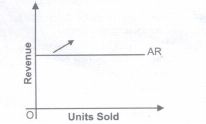
(i) AR curve of a firm under perfect competition is parallel to X-axis because in perfect competition homogeneous product are produced, that is why price remains constant and as we know AR = TR/Q = PX Q/Q = Price. So, AR remains constant.
(ii) As, AR is on Y-axis, that is why AR curve remains constant and parallel to X-axis.
5.
(i) In the perfect competition, a firm is a price taker.
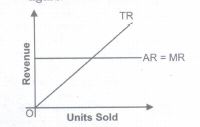
(ii) It has to sell its product at the same price as given (determined) by the industry. Consequently, price = AR = MR.
(iii) Hence, a firm's AR and MR curve will be a horizontal straight line parallel to X axis.
(iv) Since price remains the same, i.e., MR is constant, therefore, TR increases at the Constant rate as increase in the output sold.
(v) As the result of, TR curve facing a competitive firm is positively sloped straight line. Again, because at zero output Total Revenue is zero therefore, TR curve passes through the origin O as shown in the given figure.
6.
(i) Perfect Knowledge means both buyers and sellers are fully informed about the market.
(ii) The firms have all the knowledge about the product market and the input markets. Buyers also have perfect knowledge about the product market.
(iii) Let us first take the product market. The implication of perfect knowledge about the product market is that any attempt by any firm to charge a price higher than the prevailing uniform price will fail. The buyers will not pay because they have perfect knowledge. A uniform price prevails in the market.
(iv) Regarding the knowledge about the input markets the implicit assumption is that each firm has an equal access to the technology and the inputs used in the technology.
(v) No firm has any cost advantage. Cost structure of each firm is the same.
(vi) Since there is uniform price and uniform cost in case of all firms, and since profit equals revenue less cost, all the firms earn uniform profits
7.
Yes, this statement is true.
(i) As we know, in Perfect competition, homogeneous goods are produced. So, industry cannot charge different price from different firms.
(ii) So, industry will give that price to the firm where industry is in equilibrium, i.e., where Demand = Supply. Any movement from that point would be unstable.
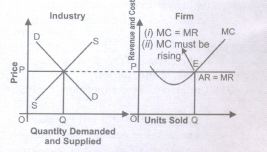
(iii) In the given diagram, price and revenue is measured on vertical axis and units of commodity on horizontal axis. Industry will give OP price or point E to the firm as at that point Demand = supply, i.e., industry is in equilibrium.
The firms will follow the same price and charges same from the consumer.
8.
(i) Products sold in the market are homogeneous, i.e., they are identical in all respects like quality, colour, size, weight, design, etc.
(ii) The products sold by different firms in the market are equal in the eyes of the buyers.
(iii) Since, a buyer cannot distinguish between the product of one firm and that of another, he becomes indifferent as to the firms from which he buys.
(iv) The implication of this feature is that since the buyers treat the products as identical they are not ready to pay a different price for the product of anyone firm. They will pay the same price for the products of all the firms in the industry. On the other hand, any attempt by a firm to sell its product at a higher price will fail.
To sum up, the "homogenous products" feature ensures a uniform price for the products of all the firms in the industry.
9.
(i) Products sold in the market are homogeneous, i.e., they are identical in all respects like quality, colour, size, weight, design, etc.
(ii) The products sold by different firms in the market are equal in the eyes of the buyers.
(iii) Since, a buyer cannot distinguish between the product of one firm and that of another, he becomes indifferent as to the firms from which he buys.
(iv) The implication of this feature is that since the buyers treat the products as identical they are not ready to pay a different price for the product of anyone firm. They will pay the same price for the products of all the firms in the industry. On the other hand, any attempt by a firm to sell its product at a higher price will fail.
To sum up, the "homogenous products" feature ensures a uniform price for the products of all the firms in the industry.
10.
The average revenue (AR) of a firm is defined as total revenue per unit of output sold. Let a firm's output be Q and the market price be P, then
TR equals P x Q. Hence,
AR = \(\frac { TR }{ Q } \)=\(\frac { P\times Q }{ Q } =P\)
In other words, for a price-taking firm, average revenue equals the market price.
11.
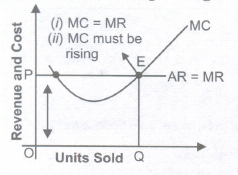
(l) The price line shows the relationship between the market price and a competitive firm's output level.
(il) The vertical height of the price line is equal to the market price as shown in the given figure.
12.
(i) Large number of buyers and sellers
(ii) Homogeneous product
(iii) Free entry and exit of firms
(iv) Perfect knowledge about the market
(v) Perfect mobility of factors of production
(vi) Absence of transportation and selling cost

11th Standard CBSE Syllabus & Materials
11th Standard CBSE
CBSE 11th Business Studies Forms of Business Organisation Sample Question Papers Study Material - QB365 Set A
NEW11th Standard CBSE
CBSE 11th Business Studies Business, Trade and Commerce Sample Question Papers Study Material - QB365 Set A
NEW11th Standard CBSE
CBSE 11th Physics Waves Sample Question Papers Study Material - QB365 Set A
NEW11th Standard CBSE
CBSE 11th Physics Kinetic Theory Sample Question Papers Study Material - QB365 Set A



CBSE 11th Standard CBSE Subjects
CBSE Standards










