
 100% FREE ACCESS
11th Standard CBSE Syllabus & Materials
11th Standard CBSE
CBSE 11th Economics PART-A - Presentation of Data - New Sample Question Papers Study Material - QB365 Set A
NEW11th Standard CBSE
CBSE 11th Economics PART-A - Organisation of Data - New Sample Question Papers Study Material - QB365 Set A
NEW11th Standard CBSE
CBSE 11th Economics PART-A - Collection of Data - New Sample Question Papers Study Material - QB365 Set A
NEW11th Standard CBSE
CBSE 11th Economics PART-A - Introduction to Economics and Statistics - New Sample Question Papers Study Material - QB365 Set A
NEW11th Standard CBSE
CBSE 11th Business Studies International Trade Sample Question Papers Study Material - QB365 Set A
NEW11th Standard CBSE
CBSE 11th Business Studies Evolution and Fundamentals of Business Sample Question Papers Study Material - QB365 Set A

Published on: 15/09/2018
Model Paper 2
Download CBSE Class 11th Standard CBSE Chemistry question papers, sample papers, important questions, and previous year solved papers in PDF format. Get free study materials, NCERT solutions, and exam preparation resources for Class 11th Standard CBSE Chemistry
Questions + Answers key
Take MCQ Chemistry Test
1.
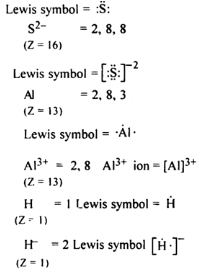
Write Lewis symbols for the following atoms and ions: S and S2- Al and AI3+; H and H-
2.
Explain the formation of a chemical bond.
3.
Discuss the hybridisation of Be in gaseous state and solid state.
4.
Explain the shape of \({ I_{ 3 }^{ - } }\) ion
5.
Aluminium forms the ion Al3+ , but not Al 4+ why?
6.
Arrange the following in order of decreasing bond angles.
(i) CH4, NH3, H2O, BF3, C2H2
(ii) \({ NH }_{ 3 },{ NH }_{ 2 }^{ - },{ NH }_{ 4 }^{ + }\)
7.
Arrange the following bonds in order of increasing ionic character giving reason. N-H, F-H, C-H and O-H
8.
Arrange the bonds in order of increasing ionic character in the molecules: LiF, K2O , N2, SO2 and ClF3 .
9.
Why axial bonds of PCI5 are longer than equatorial bonds?
10.
\({ B }_{ 4 }^{ - }\) and \({ NH }_{ 4 }^{ + }\) are is structural. Explain.
11.
What type of hybridisation is present in C-atoms of C60 allotrope called fullerene?
12.
Which one is the correct unit for entropy?
KJ mol
JK-1 mol
JK-1 mol -1
KJ mol-1
13.
The process depicted by the equation.
H2O (s) \(\rightarrow\) H2O (l)
\(\Delta\)H = +1.43 kcal represents
fusion
melting
evaporation
boiling
14.
For an endothermic reaction ______.
\(\Delta\)H is-ve
\(\Delta\)H is+ve
\(\Delta\)H is zero
none of these
15.
Which of the following properties is not a function of state?
concentration
internal energy
enthalpy
entropy
16.
As per the available data: ______.
CH4(g) + 2O2(g) \(\rightarrow \) CO2(g) + 2H2O(l); \(\triangle \)C \(H^{ \ominus }\) = -890.3 KJ mol-1
C(s) + O2(g) \(\rightarrow \) CO2(g) \(\triangle \)C \(H^{ \ominus }\)=-393.5 KJ mol-1
H2(g) + 1/2O2(g) \(\rightarrow \) H2O (l); \(\triangle \)C\(H^{ \ominus }\)= -285.8 KJ mol-1
17.
A reaction, A + B → C + D + q is found to have a positive entropy change. The reaction will be _______.
possible at high temperature
possible only at low temperature
not possible at any temperature
possible at any temperature
18.
\(\triangle U^{ \ominus }\)of combustion of methane is – X kJ mol–1. The value of \(\triangle H^{ \ominus }\) is _______.
\(=\triangle U^{ \ominus }\)
\(>\triangle U^{ \ominus }\)
\(<\triangle U^{ \ominus }\)
0
19.
The enthalpies of all elements in their standard states are: _______.
unity
zero
<0
different for each element
20.
For the process to occur under adiabatic conditions, the correct condition is:_______.
\(\triangle \)T = 0
\(\triangle \)P = 0
q = 0
w = 0
21.
Choose the correct answer. A thermodynamic state function is a quantity _______.
used to determine heat changes
whose value is independent of path
used to determine pressure volume work
whose value depends on temperature only.
1.
16S = 2,8,6 ∴ Lewis symbol =\(:\ddot { S } :\),S2- ions = [\(:\ddot { S } :\)]2-
13AI = 2, 8, 3 ∴ Lewis symbol = ·\(\overset { \cdot }{ \cdot A } l\cdot \), AI3+ion = [AI]3+
1H = 1 ∴ Lewis symbol = \(H\bullet \),\(H\bar { \bullet } \) ion =\(\dot { H } \cdot \)
2.
According to Kossel and Lewis, atoms combine together in order to complete their respective octets so as to acquire the stable inert gas configuration. This can occur in two ways; by transfer of one or more electrons from one atom to other or by sharing of electrons between two or more atoms.
3.
In gaseous state at high temperature, BeCl2 exists as linear molecule Cl-Be-Cl, thus the hybridisation of the central atoms is sp
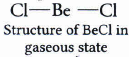
In solid state,it has a polymeric structure with chlorine bridges as follows

Two Cl-atoms are listed to be atom by two coordination bonus and two by covalent bonds. For these bonds to be formed, Be in the excited state with the configuration undergoes Sp3 hybridization. Two half-filled hybrid orbitals will form normal covalent bonds with two Cl-atoms. The other two Cl-atoms are coordinated to Be-atom. The other two Cl-atoms are coordinated be Be-atom by donating electron pairs into the empty hybrid orbitals.
4.
The central I-atoms has the outer shell electronic configuration in the ground state as. It undergoes hybridisation.Out of the five hybrid orbitals, one is half-filled, one is empty and the remaining three are fully-filled.The half-filled orbital forms covalent bond with iodine atom.
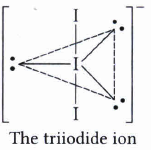
The empty orbital accepts electron pair from I- ion to form a coordinate bond. The remaining fully-filled orbitals occupy equatorial position. Thus, the geometry of three lone pairs and two bond pair is trigonal bipyramidal and the shape of \({ I_{ 3 }^{ - } }\) is linear as shown in the figure.
5.
Aluminium \(([Ne]^{ 3{ s }^{ 2 } } \ 3p'\) can achien the electronic configuration of the nearest noble gas (Ne) by losing only three electrons, Al3+ = 1s22s22p6 . Aluminium with not form the Al4+ ion because an extremely high amount of energy would be required to remove an electron from the stable noble gas configuration.
6.
(a) \({ C }_{ 2 }{ H }_{ 2 }\left( { 180 }^{ 0 } \right) >{ CH }_{ 4 }\left( { 109 }^{ 0 }{ 28 }^{ ' } \right) >{ BF }_{ 3 }\left( { 120 }^{ 0 } \right) >{ NH }_{ 3 }\left( { 107 }^{ 0 } \right) >{ H }_{ 2 }O>\left( { 104.5 }^{ 0 } \right) \)This is because all of them involve sp3 hybridisation. The number of lone pair of electrons present on N-atom are 0,1 and 2 respectively. Greater the number of lone pairs, greater is the repulsion and lesser is the bond angle.
(b) \({ NH }_{ 4 }^{ + }>{ NH }_{ 3 }>{ NH }_{ 3 }^{ - }\)
This is because all of them involve sp3 hybridisation. The number of lone pair of electrons present on N-atom are 0,1 and 2 respectively. Greater the number of lone pairs, greater is the repulsion and lesser is the bond angle.
7.
Greater is the electronegativity difference between the two bonded atoms, greater is the ionic character.
| N-H | F-H | C-H and | O-H | |
| Electronegativity difference |
(3.0-2.1) =0.9 |
(4.0-2.1) = 1.9 |
(2.5-2.1) = 0.4 |
(3.5-2.1) = 1.4 |
Therefore, increasing order of ionic character of the given bonds is as follows.
C-H.
8.
Ionic character \(\propto \) lattice energy
\(\propto \frac { 1 }{ size \ of \ ion } \propto charge \ on \ ion,\)
A non-polar molecule like N2 has almost negligible ionic character.
\(\therefore \)The order of ionic character is
\( ({ N }_{ 2 }<{ SO }_{ 2 }<{ CIF }_{ 3 }<{ K }_{ 2 }O\)
9.
This is due to greater repulsion on the axial bond pairs by the equatorial bond pairs of electrons.
10.
Both have tetrahedral shape, i.e, four lobes of sp3 hybridised orbitals so called iso structural.
11.
sp2 , each C-atom is linked to two other C-atoms.
12.
(c)
JK-1 mol -1
13.
(a)
fusion
14.
(b)
\(\Delta\)H is+ve
15.
(a)
concentration
16.
(a)
CH4(g) + 2O2(g) \(\rightarrow \) CO2(g) + 2H2O(l); \(\triangle \)C \(H^{ \ominus }\) = -890.3 KJ mol-1
17.
(d)
possible at any temperature
18.
(c)
\(<\triangle U^{ \ominus }\)
19.
(b)
zero
20.
(c)
q = 0
21.
(b)
whose value is independent of path

11th Standard CBSE Syllabus & Materials
11th Standard CBSE
CBSE 11th Business Studies Forms of Business Organisation Sample Question Papers Study Material - QB365 Set A
NEW11th Standard CBSE
CBSE 11th Business Studies Business, Trade and Commerce Sample Question Papers Study Material - QB365 Set A
NEW11th Standard CBSE
CBSE 11th Physics Waves Sample Question Papers Study Material - QB365 Set A
NEW11th Standard CBSE
CBSE 11th Physics Kinetic Theory Sample Question Papers Study Material - QB365 Set A



CBSE 11th Standard CBSE Subjects
CBSE Standards









