
 100% FREE ACCESS
11th Standard CBSE Syllabus & Materials
11th Standard CBSE
CBSE 11th Economics PART-A - Presentation of Data - New Sample Question Papers Study Material - QB365 Set A
NEW11th Standard CBSE
CBSE 11th Economics PART-A - Organisation of Data - New Sample Question Papers Study Material - QB365 Set A
NEW11th Standard CBSE
CBSE 11th Economics PART-A - Collection of Data - New Sample Question Papers Study Material - QB365 Set A
NEW11th Standard CBSE
CBSE 11th Economics PART-A - Introduction to Economics and Statistics - New Sample Question Papers Study Material - QB365 Set A
NEW11th Standard CBSE
CBSE 11th Business Studies International Trade Sample Question Papers Study Material - QB365 Set A
NEW11th Standard CBSE
CBSE 11th Business Studies Evolution and Fundamentals of Business Sample Question Papers Study Material - QB365 Set A

Published on: 18/08/2026
Download CBSE Class 11th Standard CBSE Mathematics question papers, sample papers, important questions, and previous year solved papers in PDF format. Get free study materials, NCERT solutions, and exam preparation resources for Class 11th Standard CBSE Mathematics
Questions + Answers key
Take MCQ Mathematics Test
1.
Find the distance between the directrices of the ellipse \(\frac { { x }^{ 2 } }{ 36 } +\frac { { y }^{ 2 } }{ 20 } \) =1.
2.
In each of the following questions, find the coordinates of the focus, axis of the parabola, the equation of the directrix and the length of the latusrectum . (ii) y2 = -8x
3.
Find the centre and radius of each of the following circles.
\((x-\frac { 1 }{ 2 } { ) }^{ 2 }+(y+\frac { 1 }{ 3 } { ) }^{ 2 }=\frac { 1 }{ 4 } \)
4.
Find the equation of the circle with
center=(-a,-b) and radius= \(\sqrt { { a }^{ 2 }-{ b }^{ 2 } } \)
5.
Find the equation of the ellipse, Whose foci are (\(\pm\)3,0) and passing through (4,1)
6.
Find out the equation of parabola, if the focus is at (-6,-6) and the vertex is at (-2,2)
7.
Draw the shape of ellipse \(\frac { { x }^{ 2 } }{ 49 } +\frac { { y }^{ 2 } }{ 16 } =1\) and find the eccentricity.
8.
Draw the shape of ellipse \(\frac { { x }^{ 2 } }{ 49 } +\frac { { y }^{ 2 } }{ 16 } =1\)and find the major axis.
9.
Find the foci,vertices, eccentricity and length of latusrectum of the hyperbola \(5{ y }^{ 2 }+{ 9x }^{ 2 }=36\)
10.
Find the eccentricity of the hyperbola \(\frac { { x }^{ 2 } }{ { a }^{ 2 } } -\frac { { y }^{ 2 } }{ { b }^{ 2 } } =1\) , when passes through the points (3,0) and \((3\sqrt { 2 } ,2)\)
1.
Given, \(\frac { { x }^{ 2 } }{ 36 } +\frac { { y }^{ 2 } }{ 20 } \) =1.
On comparing the above equation with
\(\frac { { x }^{ 2 } }{ 36 } +\frac { { y }^{ 2 } }{ 20 } \) =1, we get
a2 = 36 \(\Rightarrow \) a = 6 and b2 = 20 \(\Rightarrow \) b = 2\(\sqrt { 5 } \)
\(\because \ e=\frac { \sqrt { { a }^{ 2 }-{ b }^{ 2 } } }{ a } =\frac { \sqrt { 36-20 } }{ 6 } =\frac { 4 }{ 6 } =\frac { 2 }{ 3 } \)
Distance between the directrices = \(\frac { 2a }{ e } =\frac { 2X6 }{ 2/3 } \) = 18.
2.
Given, equation of parabola is .y2 = -8x, which is of the form .y2 = 4ay i.e focus lies on the positive direction of x-axis
Here, 4a = 2 \(\Rightarrow\) a = 2
\(\therefore\) Focus = (-a, 0) =\(\left(-2 ,0 \right) \)
Axis = X-axis
Directrix, x = a \(\Rightarrow\) x = 2 and length of latusrectum = 4a = 4\(\times\)2 = 8
3.
On comparing the given equation with (x - h)2 + (y - k)2 = r2 , we get
\(h=\frac { 1 }{ 2 } ,k=-\frac { 1 }{ 3 } \)
\(and\quad r=\frac { 1 }{ 2 } \)
\((\frac { 1 }{ 2 } ,-\frac { 1 }{ 3 } )\quad and\quad \frac { 1 }{ 2 } \)
4.
Given center is (-a,-b)
\(\therefore h=-a,k=-b\) and radius (r) =\(\sqrt { { a }^{ 2 }-{ b }^{ 2 } } \)
On putting these values in equation of circle
\((x-h)^{ 2 }+(y-k)^{ 2 }={ r }^{ 2 }\) we get
\([x-(-a)]^{ 2 }+[y-(-b)]^{ 2 }=(\sqrt { { a }^{ 2 }-{ b }^{ 2 } } )^{ 2 }\)
\(\Rightarrow (x+a)^{ 2 }+(y+b)^{ 2 }={ a }^{ 2 }-{ b }^{ 2 }\)
\(\Rightarrow { x }^{ 2 }+a^{ 2 }+2ax+{ y }^{ 2 }+b^{ 2 }+2by={ a }^{ 2 }-{ b }^{ 2 }\quad [\because (A+B)^{ 2 }={ A }^{ 2 }+2AB+B^{ 2 }]\)
\(\Rightarrow { x }^{ 2 }+y^{ 2 }+2ax+2by+{ a }^{ 2 }+{ b }^{ 2 }=0\)
\(\therefore { x }^{ 2 }+y^{ 2 }+2ax+2by+2b^{ 2 }=0\)
Which is the required equation of circle
5.
We have, foci of the ellipse at (\(\pm\)3,0) which are on the x-axis.
therefore, the equation of the ellipse is of the form
\(\Rightarrow a(\frac { 2a }{ 5 } )=2\Rightarrow { a }^{ 2 }=5\)
\(e=\frac { 2\sqrt { 5 } }{ 5 } =\frac { 2 }{ \sqrt { 5 } } and\quad { b }^{ 2 }={ a }^{ 2 }(1-{ e }^{ 2 })\)
\(\Rightarrow { b }^{ 2 }=5(1-\frac { 4 }{ 5 } )=5\times \frac { 1 }{ 5 } \)
\({ b }^{ 2 }=1\)
Hence,the equation of ellipse is \( \frac { { x }^{ 2 } }{ 5 } +\frac { { y }^{ 2 } }{ 1 } =1\)
\(\Rightarrow { 17b }^{ 2 }+9={ 9b }^{ 2 }+{ b }^{ 4 }\)
\(\Rightarrow { b }^{ 4 }-{ 8b }^{ 2 }-9=0\)
\(but{ \quad b }^{ 2 }\neq -1\Rightarrow { b }^{ 2 }=1\)
From eq.(ii), we get
\({ a }^{ 2 }=9+{ b }^{ 2 }\Rightarrow { a }^{ 2 }=9+9\)
\(\Rightarrow { a }^{ 2 }=18\)
On putting the values of a2 and b2 in equ(i) we get
\(\frac { { x }^{ 2 } }{ 18 } +\frac { { y }^{ 2 } }{ 9 } =1\Rightarrow { x }^{ 2 }+{ 2y }^{ 2 }=18\)
6.
Let B(x1,y1) be coordinates of the point of intersection of axis and directrix. Then A(-2,2) is the mid-point of line segment joining F(-6,-6) and B(x1,y1)
\(\therefore -2=\frac { x_{ 1 }-6 }{ 2 } \Rightarrow x_{ 1 }=2 \ and \ 2=\frac { { y }_{ 1 }-6 }{ 2 } \ \Rightarrow \ y_{ 1 }=10\)
So, the point B(2,10) is the point of intersection of axis and directrix.
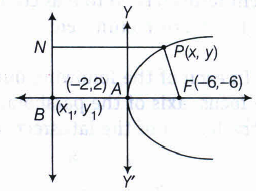
Now, slope of line segment joining vertex and focus is
\({ m }_{ 1 }=\frac { -6-2 }{ -6+2 } =\frac { -8 }{ -4 } =2\)
\( \therefore Slope\quad of\quad directrix,\quad m_{ 2 }=\frac { -1 }{ 2 } \left[ \because AF\quad \bot \quad NB,\quad so\quad m_{ 1 }{ m }_{ 2 }=-\Rightarrow m_{ 2 }=\frac { -1 }{ m_{ 1 } } \right] \)
\(Then,\quad the\quad equation\quad of\quad directrix\quad is\quad y-10=\frac { -1 }{ 2 } (x-2)\)
\(\Rightarrow 2y-20=-x+2 \Rightarrow x+2y=22 \)
Let P(x,y) be any point on parabola and PN be the length of perpendicular from P on directrix and FP be the distance between focus F and point P
\(So,\quad FP=PN\Rightarrow (FP)^{ 2 }=(PN)^{ 2 }\)
\(\Rightarrow (x+6)^{ 2 }+(y+6)^{ 2 }=\left( \frac { x+2y-22 }{ \sqrt { 1+4 } } \right) ^{ 2 }\)
\(\Rightarrow { x }^{ 2 }+36+12x+y^{ 2 }+36+12y\)
\(=\frac { { x }^{ 2 }+4y^{ 2 }+484+4xy-44x-88y }{ 5 } \)
\(\Rightarrow 5x^{ 2 }+180+60x+5y^{ 2 }+60y+180\)
\(={ x }^{ 2 }+4y^{ 2 }+484+4xy-44x-88y\)
\(\Rightarrow { 4x }^{ 2 }+{ y }^{ 2 }-4xy+104x+148y-124=0\)
\(which\quad is\quad the\quad required\quad equation\quad of\quad parabola\)
7.
Given equation of ellipse is \(\frac { { x }^{ 2 } }{ 49 } +\frac { { y }^{ 2 } }{ 16 } =1.\)
\(\text{On comparing with} \frac { { x }^{ 2 } }{ { a }^{ 2 } } +\frac { { y }^{ 2 } }{ { b }^{ 2 } } =1\text{,we get }a=7,b=4\)
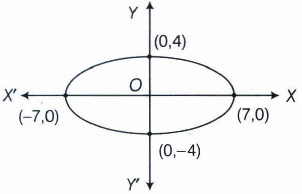
Here, a>b, so major axis is along X-axis.
\(Eccentricity,e=\frac { c }{ a } =\frac { \sqrt { 33 } }{ 7 } \)
8.
Given equation of ellipse is \(\frac { { x }^{ 2 } }{ 49 } +\frac { { y }^{ 2 } }{ 16 } =1.\)
\(\text{On comparing with} \frac { { x }^{ 2 } }{ { a }^{ 2 } } +\frac { { y }^{ 2 } }{ { b }^{ 2 } } =1\text{,we get }a=7,b=4\)
Here, a > b, so major axis is along X-axis.
Major axis, 2a = 2 x 7 = 14
9.
\(\frac { { y }^{ 2 } }{ \frac { 36 }{ 5 } } -\frac { { x }^{ 2 } }{ 4 } -=1\)
Here , \({ a }^{ 2 }=\frac { 36 }{ 5 } \) and b2 = 4 \(c=\sqrt { { a }^{ 2 }+{ b }^{ 2 } } \)
\(=\sqrt { \frac { 36 }{ 5 } +4 } =\sqrt { \frac { 56 }{ 5 } } =2\sqrt { \frac { 14 }{ 5 } } \)
\(\left( 0,\pm \frac { 2\sqrt { 14 } }{ \sqrt { 5 } } \right) ,\left( 0,\pm \frac { 6 }{ \sqrt { 5 } } \right) ,\frac { \sqrt { 14 } }{ 3 } ,\frac { 4\sqrt { 5 } }{ 3 } \)
10.
Let Since, it is passes through (3,0) and \((3\sqrt { 2 } ,2)\)
\(\frac { 9 }{ { a }^{ 2 } } -0=1\) and \(\frac { 18 }{ { a }^{ 2 } } -\frac { 4 }{ { b }^{ 2 } } =1\)
a2 = 9 and b2 = 4
b2 = a2 (e2-1)
\(e=\frac { \sqrt { 13 } }{ 2 } \)

11th Standard CBSE Syllabus & Materials
11th Standard CBSE
CBSE 11th Business Studies Forms of Business Organisation Sample Question Papers Study Material - QB365 Set A
NEW11th Standard CBSE
CBSE 11th Business Studies Business, Trade and Commerce Sample Question Papers Study Material - QB365 Set A
NEW11th Standard CBSE
CBSE 11th Physics Waves Sample Question Papers Study Material - QB365 Set A
NEW11th Standard CBSE
CBSE 11th Physics Kinetic Theory Sample Question Papers Study Material - QB365 Set A



NCERT Books

Syllabus

Exam Pattern

Sample Question Papers

Previous year Question Papers

Important Notes

MCQ Practice test

NCERT Exemplers

Case study Questions

Image Based Questions

Passage based Questions

HOT Questions

Value Based Questions

Model Questions Papers
NCERT ( Book Back ) Questions

Assertion and Reason
Important Questions And Answers

CBSE 11th Standard CBSE Subjects
CBSE Standards







