
 100% FREE ACCESS
11th Standard CBSE Syllabus & Materials
11th Standard CBSE
CBSE 11th Economics PART-A - Presentation of Data - New Sample Question Papers Study Material - QB365 Set A
NEW11th Standard CBSE
CBSE 11th Economics PART-A - Organisation of Data - New Sample Question Papers Study Material - QB365 Set A
NEW11th Standard CBSE
CBSE 11th Economics PART-A - Collection of Data - New Sample Question Papers Study Material - QB365 Set A
NEW11th Standard CBSE
CBSE 11th Economics PART-A - Introduction to Economics and Statistics - New Sample Question Papers Study Material - QB365 Set A
NEW11th Standard CBSE
CBSE 11th Business Studies International Trade Sample Question Papers Study Material - QB365 Set A
NEW11th Standard CBSE
CBSE 11th Business Studies Evolution and Fundamentals of Business Sample Question Papers Study Material - QB365 Set A

Published on: 18/08/2026
Download CBSE Class 11th Standard CBSE Mathematics question papers, sample papers, important questions, and previous year solved papers in PDF format. Get free study materials, NCERT solutions, and exam preparation resources for Class 11th Standard CBSE Mathematics
Questions + Answers key
Take MCQ Mathematics Test
1.
Find the octant in which the points (–3,1,2) and (–3,1,– 2) lie.
2.
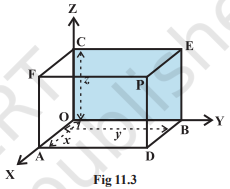
In Fig , if P is (2,4,5), find the coordinates of F.
3.
Show that the points (-2, 3, 5), (1, 2, 3) and (7, 0, -1) are collinear.
4.
Find the equation of the set of points which are equidistant from the points (1, 2, 3) and (3, 2, –1).
5.
Find the equation of the set of points P, the sum of whose distances from A (4, 0, 0) and B (– 4, 0, 0) is equal to 10.
6.
A point is in the XZ-plane. What can you say about its y-coordinate?
7.
A point is on the x-axis. What are its y-coordinate and z-coordinates?
8.
Name the octants in which the following points lie.
(1,2,3),(4,-2,3),(4,-2,-5),(4,2,-5),(-4,2,-5),(-4,2,5),(-3,1,6),(2,-4,-7)
9.
If A and B be the points (3, 4, 5) and (–1, 3, –7), respectively, find the equation of the set of points P such that PA2+PB2=K2 where k is a constant.
10.
If the origin is the centroid of the triangle PQR with vertices P (2a, 2, 6), Q (– 4, 3b, –10) and R(8, 14, 2c), then find the values of a, b and c.
11.
Find the lengths of the medians of the triangle with vertices A (0, 0, 6), B (0,4, 0) and (6, 0, 0).
12.
Three vertices of a parallelogram ABCD are A(3, – 1, 2), B (1, 2, – 4) and C (– 1, 1, 2). Find the coordinates of the fourth vertex.
13.
Verify the following:
(i) (0, 7, –10), (1, 6, – 6) and (4, 9, – 6) are the vertices of an isosceles triangle.
(ii) (0, 7, 10), (–1, 6, 6) and (– 4, 9, 6) are the vertices of a right angled triangle.
(iii) (–1, 2, 1), (1, –2, 5), (4, –7, 8) and (2, –3, 4) are the vertices of a parallelogram.
14.
Find the distance between the following pairs of points:
(i) (2, 3, 5) and (4, 3, 1)
(ii) (–3, 7, 2) and (2, 4, –1)
(iii) (–1, 3, – 4) and (1, –3, 4)
(iv) (2, –1, 3) and (–2, 1, 3)
15.
The centroid of a triangle ABC is at the point (1, 1, 1). If the coordinates of A and B are (3, –5, 7) and (–1, 7, – 6), respectively, find the coordinates of the point C.
16.
Find the equation of the set of the points P such that its distances from the points A (3, 4, –5) and B (– 2, 1, 4) are equal.
17.
Show that the points A (1, 2, 3), B (–1, –2, –1), C (2, 3, 2) and D (4, 7, 6) are the vertices of a parallelogram ABCD, but it is not a rectangle.
18.
Find the equation of set of points P such that PA2 + PB2 = 2k2, where A and B are the points (3, 4, 5) and (–1, 3, –7), respectively.
19.
Are the points A (3, 6, 9), B (10, 20, 30) and C (25, – 41, 5), the vertices of a right angled triangle?
20.
Show that the points P (–2, 3, 5), Q (1, 2, 3) and R (7, 0, –1) are collinear.
21.
Find the distance between the points P(1, –3, 4) and Q (– 4, 1, 2).
22.
Coordinate planes divide the space into ______ octants.
23.
The coordinates of points in the XY-plane are of the form _______.
24.
The x-axis and y-axis taken together determine a plane known as_______.
1.
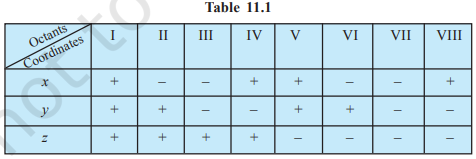
From the Table , the point (–3,1, 2) lies in second octant and the point (–3, 1, – 2) lies in octant VI.
2.
For the point F, the distance measured along OY is zero. Therefore, the coordinates of F are (2,0,5).
3.
Let A(- 2, 3, 5), B(1, 2, 3) and C(7, 0, -1) be three given points.
Then PQ = \(\sqrt { { \left( 1+2 \right) }^{ 2 }+{ \left( 2-3 \right) }^{ 2 }+{ \left( 3-5 \right) }^{ 2 } } \)
= \(\sqrt { 9+1+4 }\)
\( =\sqrt { 14 } \)
QR = \(\sqrt { { \left( 7-1 \right) }^{ 2 }+{ \left( 0-2 \right) }^{ 2 }+{ \left( -1-3 \right) }^{ 2 } } \)
\(\sqrt { 36+4+16 } \)
\(=\sqrt { 56 }\)
\( =2\sqrt { 14 } \)
PR = \(\sqrt { { \left( 7+2 \right) }^{ 2 }+{ \left( 0-3 \right) }^{ 2 }+{ \left( -1-5 \right) }^{ 2 } } \)
\(\sqrt { 81+9+36 } \)
\(=\sqrt { 126 } \)
\(=3\sqrt { 14 } \)
\(\text { Here, } \mathrm{PQ}+\mathrm{QR}=\sqrt{14}+2 \sqrt{14}=3 \sqrt{14}=\mathrm{PR}\)
\(\text { Hence, points } \mathrm{P}(-2,3,5), \mathrm{Q}(1,2,3), \text { and } \mathrm{R}(7,0,-1) \text { are collinear. }\)
4.
Let A(x, y, z) be any point which is equidistant from points A(1, 2, 3) and B (3, 2, -1).
Then AB = \(\sqrt { { \left( x-1 \right) }^{ 2 }+{ \left( y-2 \right) }^{ 2 }+{ \left( z-3 \right) }^{ 2 } } \)
AC = \(\sqrt { { \left( x-3 \right) }^{ 2 }+{ \left( y-2 \right) }^{ 2 }+{ \left( z+1 \right) }^{ 2 } } \)
It is given that AB = AC
\(\therefore\) \(\sqrt { { \left( x-1 \right) }^{ 2 }+{ \left( y-2 \right) }^{ 2 }+{ \left( z-3 \right) }^{ 2 } } \)= \(\sqrt { { \left( x-3 \right) }^{ 2 }+{ \left( y-2 \right) }^{ 2 }+{ \left( z+1 \right) }^{ 2 } } \)
\(\Rightarrow { \left( x-1 \right) }^{ 2 }+{ \left( y-2 \right) }^{ 2 }+{ \left( z-3 \right) }^{ 2 }\ =\ { \left( x-3 \right) }^{ 2 }+{ \left( y-2 \right) }^{ 2 }+{ \left( z+1 \right) }^{ 2 }\)
\(\Rightarrow\) x2+ 1 - 2x + z2 + 9 - 6z = x2 + 9 - 6x + z2 + 1 + 2z
\(\Rightarrow\) - 2x - 6z + 10 = - 6x + 2z + 10
\(\Rightarrow\) -2x - 6z + 6x - 2z = 0
\(\Rightarrow\) 4x - 8z = 0
\(\Rightarrow\) x - 2z = 0.
5.
Let P(x, y, z) be any point.
Then PA = \(\sqrt { { \left( x-4 \right) }^{ 2 }+{ \left( y-0 \right) }^{ 2 }+{ \left( z-0 \right) }^{ 2 } } =\sqrt { { x }^{ 2 }+16-8x+{ y }^{ 2 }+{ z }^{ 2 } } \)
PB = \(\sqrt { { \left( x+4 \right) }^{ 2 }+{ \left( y-0 \right) }^{ 2 }+{ \left( z-0 \right) }^{ 2 } } =\sqrt { { x }^{ 2 }+16+8x+{ y }^{ 2 }+{ z }^{ 2 } } \)
It is given that PA + PB = 10
\(\therefore\) \(\sqrt { { x }^{ 2 }+16-8x+{ y }^{ 2 }+{ z }^{ 2 } } +\sqrt { { x }^{ 2 }+16+8x+{ y }^{ 2 }+{ z }^{ 2 } } =10\)
\(\Rightarrow \sqrt { { x }^{ 2 }+16-8x+{ y }^{ 2 }+{ z }^{ 2 } } =10-\sqrt { { x }^{ 2 }+16+8x+{ y }^{ 2 }+{ z }^{ 2 } } \)
Squaring both sides, we have
x2 + 16 - 8x + y2 + Z2 = 100 + x2 + 16 + 8x + y2 + Z2 - 20\(\sqrt { { x }^{ 2 }+16+8x+{ y }^{ 2 }+{ z }^{ 2 } } \)
\(\Rightarrow 20\sqrt { { x }^{ 2 }+16+8x+{ y }^{ 2 }+{ z }^{ 2 } } \) = 16x + 100
\(\Rightarrow 5\sqrt { { x }^{ 2 }+16+8x+{ y }^{ 2 }+{ z }^{ 2 } } \) = 4x + 25
Squaring both sides again, we have
25(x2 + 16 + 8x + y2 + z2) = 16x2 + 625 + 200x
\(\Rightarrow\) 25x2 + 400 + 200x + 25y2 + 25z2 -16x2 - 625 - 200x = 0
\(\Rightarrow\) 9x2 + 25y2 + 25z2 - 225 = 0
Thus the required equation is 9x2 + 25y2 + 25z2 - 225 = 0
6.
If a point is in the XZ plane, then its y-coordinate is zero.
7.
If a point is on the x-axis, then its y-coordinates and z-coordinates are zero.
8.
The x-coordinate, y-coordinate, and z-coordinate of point (1, 2, 3) are all positive. Therefore, this point lies in octant I.
The x-coordinate, y-coordinate, and z-coordinate of point (4, –2, 3) are positive, negative, and positive respectively. Therefore, this point lies in octant IV.
The x-coordinate, y-coordinate, and z-coordinate of point (4, –2, –5) are positive, negative, and negative respectively. Therefore, this point lies in octant VIII.
The x-coordinate, y-coordinate, and z-coordinate of point (4, 2, –5) are positive, positive, and negative respectively. Therefore, this point lies in octant V.
The x-coordinate, y-coordinate, and z-coordinate of point (–4, 2, –5) are negative, positive, and negative respectively. Therefore, this point lies in octant VI.
The x-coordinate, y-coordinate, and z-coordinate of point (–4, 2, 5) are negative, positive, and positive respectively. Therefore, this point lies in octant II.
The x-coordinate, y-coordinate, and z-coordinate of point (–3, –1, 6) are negative, negative, and positive respectively. Therefore, this point lies in octant III.
The x-coordinate, y-coordinate, and z-coordinate of point (2, –4, –7) are positive, negative, and negative respectively. Therefore, this point lies in octant VIII.
9.
Let P(x, y, z) be any point Then
\(PA=\sqrt { (x-3)^{ 2 }+(y-4)^{ 2 }+(z-5)^{ 2 } } \)
\(=\sqrt { x^{ 2 }+9-6x+y^{ 2 }+16-8y+z^{ 2 }+25-10z } \)
\(PA=\sqrt { (x+1)^{ 2 }+(y-3)^{ 2 }+(z+7)^{ 2 } } \)
\(\sqrt { x^{ 2 }+1+2x+y^{ 2 }+9-6y+z^{ 2 }+49-14z }\)
Now PA2 + PB2 = K2
10.
Here P(2a, 2, 6), Q(-4, 3b, -10) and R(8, 14, 2c) are vertices of triangle PQR.
\(\therefore \)Coordinates of centroid of PQR is
\(\left( \frac { 2a-4+8 }{ 3 } ,\frac { 2+3b+14 }{ 3 } ,\frac { 6-10+2c }{ 3 } \right) \)
\(=\left( \frac { 2a+4 }{ 3 } ,\frac { 6-10+2c }{ 3 } ,\frac { 2c-4 }{ 3 } \right) \)
But is it given that coordinates of centroid is (0,0,0)
\(\therefore \frac { 2a+4 }{ 3 } =0\Rightarrow 2a+4=0\Rightarrow a+-2\)
\( \frac { 3b+16 }{ 3 } =0\Rightarrow 3b+16=0\)
\(\Rightarrow b=\frac { -16 }{ 3 } \)
\(\frac { 2c-4 }{ 3 } =0\Rightarrow 2c-4=0\Rightarrow c=2.\)
11.
Here A(0,0, 6), B(0,4, 0) and C(6, 0, 0) are vertices of \(\triangle \)ABC
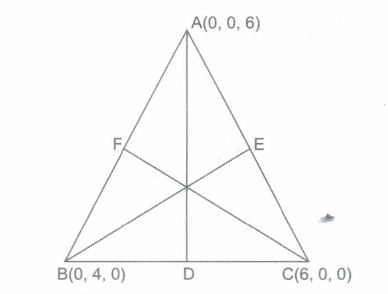
Now D is mid point of BC
\(\therefore \) Coordinates of D is \(\left( \frac { 0+6 }{ 2 } ,\frac { 4+0 }{ 2 } ,\frac { 0+0 }{ 2 } \right) \)= (3,2,0)
\(\therefore \quad AD=\sqrt { (0-3)^{ 2 }+(0-2)^{ 2 }+(6-0)^{ 2 } } \)
=\(\sqrt { 9+4+36 } =\sqrt { 7 } \) units.
Also E is mid point of AC
\(\therefore \) Coordinates of E is \(\left( \frac { 0+6 }{ 2 } ,\frac { 0+0 }{ 2 } ,\frac { 6+0 }{ 2 } \right) \)= (3,0,3)
\(\therefore \quad BE=\sqrt { (0-3)^{ 2 }+(4-0)^{ 2 }+(0-3)^{ 3 } } \)
\(=\sqrt { 9+16+9 } =\sqrt { 34 } \)units.
Also F is mid point of AB
\(\therefore \) Coordiates of F is \(\left( \frac { 0+0 }{ 2 } ,\frac { 0+4 }{ 2 } ,\frac { 6+0 }{ 2 } \right) \)=(0,2,3)
\(\therefore \) CF=\(\sqrt { (6-0)^{ 2 }+(0-2)^{ 2 }+(0-3)^{ 2 } } \)
\(=\sqrt { 36+4+9 } =7\)units.
12.
Let D(x, y, z) be the fourth vertex of parallelogram ABCD.
We know that diagonals of a parallelogram bisect each other. So the mid points ofAC and BD coincide.
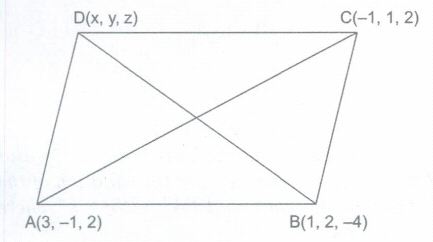
\(\therefore \) Coordinates of mid point of AC \(\left( \frac { 3-1 }{ 2 } ,\frac { -1+1 }{ 2 } ,\frac { 2+2 }{ 2 } \right) \)=(1,0,2)
Also coordiantes of mid point of BD \(\left( \frac { x+1 }{ 2 } ,\frac { y+2 }{ 2 } ,\frac { z-4 }{ 2 } \right) \)
\(\therefore \quad \frac { x+1 }{ 2 } =1\Rightarrow x+1=2\Rightarrow x=1\)
\(\frac { y+2 }{ 2 } =0\Rightarrow y+2=0\Rightarrow y=-2\)
\(\frac { z-4 }{ 2 } =2\Rightarrow z-4=4\Rightarrow z=8\)
Thus the coordinates of point Dare (1, -2,8).
13.
(i) Let A(0, 7, -10), B(1, 6, -6) and C(4, 9, -6) be three vertices of triangle ABC.Then
AB = \(\sqrt { { \left( 1-0 \right) }^{ 2 }+{ \left( 6-7 \right) }^{ 2 }+{ \left( -6+10 \right) }^{ 2 } } \)
\(\sqrt { 1+1+16 } =\sqrt { 18 } =3\sqrt { 2 } \)
BC = \(\sqrt { { \left( 4-1 \right) }^{ 2 }+{ \left( 9-6 \right) }^{ 2 }+{ \left( -6+6 \right) }^{ 2 } } \)
\(\sqrt { 9+9+0 } =\sqrt { 18 } =3\sqrt { 2 } \)
AC = \(\sqrt { { \left( 4-0 \right) }^{ 2 }+{ \left( 9-7 \right) }^{ 2 }+{ \left( -6+10 \right) }^{ 2 } } \)
\(\sqrt { 16+4+16 } =\sqrt { 36 } =6\)
Now AB = BC
Thus, ABC is an isosceles triangle.
(ii) Let A(0, 7, 10), B(-I, 6, 6) and C(- 4,9,6) be three vertices of triangle ABC. Then
AB = \(\sqrt { { \left( -1-0 \right) }^{ 2 }+{ \left( 6-7 \right) }^{ 2 }+{ \left( 6-10 \right) }^{ 2 } } \)
\(\sqrt { 1+1+16 } =\sqrt { 18 } =3\sqrt { 2 } \)
BC = \(\sqrt { { \left( -4+1 \right) }^{ 2 }+{ \left( 9-6 \right) }^{ 2 }+{ \left( 6-6 \right) }^{ 2 } } \)
\(\sqrt { 9+9+0 } =\sqrt { 18 } =3\sqrt { 2 } \)
AC = \(\sqrt { { \left( -4-0 \right) }^{ 2 }+{ \left( 9-7 \right) }^{ 2 }+{ \left( 6-10 \right) }^{ 2 } } \)
\(\sqrt { 16+4+16 } =\sqrt { 36 } =6\)
Now AC2 = AB2 + BC2
Thus, ABC is a right angled triangle.
(iii) Let A (-1, 2, 1), B (1, -2, 5) and C(4, -7, 8) and D(2, -3, 4) be four vertices of a quadrilateral ABCD. Then
AB = \(\sqrt { { \left( 1+1 \right) }^{ 2 }+{ \left( -2-2 \right) }^{ 2 }+{ \left( 5-1 \right) }^{ 2 } } \)
= \(\sqrt { 4+16+16 } =\sqrt { 36 } =6\)
BC = \(\sqrt { { \left( 4-1 \right) }^{ 2 }+{ \left( -7+2 \right) }^{ 2 }+{ \left( 8-5 \right) }^{ 2 } } \)
\(\sqrt { 9+25+9 } =\sqrt { 43 } \)
CD = \(\sqrt { { \left( 2-4 \right) }^{ 2 }+{ \left( -3+7 \right) }^{ 2 }+{ \left( 4-8 \right) }^{ 2 } } \)
\(\sqrt { 4+16+16 } =\sqrt { 36 } =6\)
AD = \(\sqrt { { \left( 2+1 \right) }^{ 2 }+{ \left( -3-2 \right) }^{ 2 }+{ \left( 4-1 \right) }^{ 2 } } \)
= \(\sqrt { 9+25+9 } =\sqrt { 43 } \)
AC = \(\sqrt { { \left( 4+1 \right) }^{ 2 }+{ \left( -7-2 \right) }^{ 2 }+{ \left( 8-1 \right) }^{ 2 } } \)
\(\sqrt { 25+81+49 } =\sqrt { 155 } \)
BD = \(\sqrt { { \left( 2-1 \right) }^{ 2 }+{ \left( -3+2 \right) }^{ 2 }+{ \left( 4-5 \right) }^{ 2 } } \)
\(\sqrt { 1+1+1 } =\sqrt { 3 } \)
Now AB = CD, BC = AD and AC\(\neq\)BD
Thus A, B, C, and D are vertices of a parallelogram ABCD.
14.
(i) Let A (2, 3, 5) and B(4, 3, 1) be two points.
\(\mathrm{PQ}=\sqrt{\left(x_{2}-x_{1}\right)^{2}+\left(y_{2}-y_{1}\right)^{2}+\left(z_{2}-z_{1}\right)^{2}}\)
Then
AB = \(\sqrt { { \left( 4-2 \right) }^{ 2 }+{ \left( 3-3 \right) }^{ 2 }+{ \left( 1-5 \right) }^{ 2 } } \)
= \(\sqrt { 4+0+16 } \)
= \(\sqrt { 20 } \)
= \(2\sqrt { 5 } \) units
(ii) Let A (- 3, 7, 2) and B(2, 4, - 1) be two points. Then
AB = \(\sqrt { { \left( 2-\left( -3 \right) \right) }^{ 2 }+{ \left( 4-7 \right) }^{ 2 }+{ \left( -1-2 \right) }^{ 2 } } \)
= \(\sqrt { { \left( 2+3 \right) }^{ 2 }+{ \left( 4-7 \right) }^{ 2 }+{ \left( -1-2 \right) }^{ 2 } } \)
= \(\sqrt { 25+9+9 } \)
= \(\sqrt { 43 } \) units
(iii) Let A (- 1, 3, - 4) and B(1, - 3, 4) be two points. Then
AB = \(\sqrt { { \left( 1-\left( -1 \right) \right) }^{ 2 }+{ \left( -3-3 \right) }^{ 2 }+{ \left( 4-\left( -4 \right) \right) }^{ 2 } } \)
\(=\sqrt { 4+36+64 } \)
\(=\sqrt { 104 } \)
\(=2\sqrt { 26 } \) units
(iv) Let A (2, - 1, 3) and B(- 2, 1, 3) be two points. Then
AB = \(\sqrt { { \left( -2-2 \right) }^{ 2 }+{ \left( 1-\left( -1 \right) \right) }^{ 2 }+{ \left( 3-3 \right) }^{ 2 } } \)
= \(\sqrt { { \left( -2-2 \right) }^{ 2 }+{ \left( 1+1 \right) }^{ 2 }+{ \left( 3-3 \right) }^{ 2 } } \)
\(\sqrt { 16+4+0 }\)
\( =\sqrt { 20 } =2\sqrt { 5 } \)units.
15.
Let the coordinates of C be (x, y, z) and the coordinates of the centroid G be (1, 1, 1). Then
\(\frac{x+3-1}{3}=1 \text { , i.e., } x=1 ; \frac{y-5+7}{3}=1 \text { , i.e., } y=1 ; \frac{z+7-6}{3}=1 \text { , i.e., } z=2 \text { . }\)
Hence, coordinates of C are (1, 1, 2).
16.
If P (x, y, z) be any point such that PA = PB.
\(\text { Now } \sqrt{(x-3)^{2}+(y-4)^{2}+(z+5)^{2}}=\sqrt{(x+2)^{2}+(y-1)^{2}+(z-4)^{2}}\)
\(\text { or }(x-3)^{2}+(y-4)^{2}+(z+5)^{2}=(x+2)^{2}+(y-1)^{2}+(z-4)^{2}\)
or 10 x + 6y – 18z – 29 = 0.
17.
To show ABCD is a parallelogram we need to show opposite side are equal
Note that
\(\mathrm{AB}=\sqrt{(-1-1)^{2}+(-2-2)^{2}+(-1-3)^{2}}=\sqrt{4+16+16}=6 \)
\(\mathrm{BC}=\sqrt{(2+1)^{2}+(3+2)^{2}+(2+1)^{2}}=\sqrt{9+25+9}=\sqrt{43} \)
\(\mathrm{CD}=\sqrt{(4-2)^{2}+(7-3)^{2}+(6-2)^{2}}=\sqrt{4+16+16}=6 \)
\(\mathrm{DA}=\sqrt{(1-4)^{2}+(2-7)^{2}+(3-6)^{2}}=\sqrt{9+25+9}=\sqrt{43}\)
Since AB = CD and BC = AD, ABCD is a parallelogram.
Now, it is required to prove that ABCD is not a rectangle. For this, we show that diagonals AC and BD are unequal. We have
\(\mathrm{AC}=\sqrt{(2-1)^{2}+(3-2)^{2}+(2-3)^{2}}=\sqrt{1+1+1}=\sqrt{3} \)
\(\mathrm{BD}=\sqrt{(4+1)^{2}+(7+2)^{2}+(6+1)^{2}}=\sqrt{25+81+49}=\sqrt{155} .\)
Since AC \(\ne\) BD, ABCD is not a rectangle
18.
Let the coordinates of point P be (x, y, z).
Here PA2 = (x – 3)2 + (y – 4)2 + ( z – 5)2
PB2 = (x + 1)2 + (y – 3)2 + (z + 7)2
By the given condition PA2 + PB2 = 2k2, we have
(x – 3)2 + (y – 4)2 + (z – 5)2 + (x + 1)2 + (y – 3)2 + (z + 7)2 = 2k2
i.e., 2x2 + 2y2 + 2z2 – 4x – 14y + 4z = 2k2 – 109.
19.
By the distance formula, we have
AB2 = (10 – 3)2 + (20 – 6)2 + (30 – 9)2
= 49 + 196 + 441 = 686
BC2 = (25 – 10)2 + (– 41 – 20)2 + (5 – 30)2
= 225 + 3721 + 625 = 4571
CA2 = (3 – 25)2 + (6 + 41)2 + (9 – 5)2
= 484 + 2209 + 16 = 2709
We find that CA2 + AB2 \(\ne\) BC2.
Hence, the triangle ABC is not a right angled triangle.
20.
We know that points are said to be collinear if they lie on a line.
\(\text { Now, }\mathrm{PQ}=\sqrt{(1+2)^{2}+(2-3)^{2}+(3-5)^{2}}=\sqrt{9+1+4}=\sqrt{14}\)
\(\mathrm{QR}=\sqrt{(7-1)^{2}+(0-2)^{2}+(-1-3)^{2}}=\sqrt{36+4+16}=\sqrt{56}=2 \sqrt{14} \)
\(\text { and } \quad P R=\sqrt{(7+2)^{2}+(0-3)^{2}+(-1-5)^{2}}=\sqrt{81+9+36}=\sqrt{126}=3 \sqrt{14}\)
Thus, PQ + QR = PR. Hence, P, Q and R are collinear
21.
The distance PQ between the points P (1,–3, 4) and Q (– 4, 1, 2) is
\(P Q =\sqrt{(-4-1)^{2}+(1+3)^{2}+(2-4)^{2}} \)
\(=\sqrt{25+16+4} \)
\(=\sqrt{45}=3 \sqrt{5} \text { units }\)
22.
()
Coordinate planes divide the space into eight octants.
23.
()
The coordinates of points in the XY-plane are of the form (x, y, 0)
24.
()
The x-axis and y-axis taken together determine a plane known as XY - plane

11th Standard CBSE Syllabus & Materials
11th Standard CBSE
CBSE 11th Business Studies Forms of Business Organisation Sample Question Papers Study Material - QB365 Set A
NEW11th Standard CBSE
CBSE 11th Business Studies Business, Trade and Commerce Sample Question Papers Study Material - QB365 Set A
NEW11th Standard CBSE
CBSE 11th Physics Waves Sample Question Papers Study Material - QB365 Set A
NEW11th Standard CBSE
CBSE 11th Physics Kinetic Theory Sample Question Papers Study Material - QB365 Set A



NCERT Books

Syllabus

Exam Pattern

Sample Question Papers

Previous year Question Papers

Important Notes

MCQ Practice test

NCERT Exemplers

Case study Questions

Image Based Questions

Passage based Questions

HOT Questions

Value Based Questions

Model Questions Papers
NCERT ( Book Back ) Questions

Assertion and Reason
Important Questions And Answers

CBSE 11th Standard CBSE Subjects
CBSE Standards







