
 100% FREE ACCESS
11th Standard CBSE Syllabus & Materials
11th Standard CBSE
CBSE 11th Economics PART-A - Presentation of Data - New Sample Question Papers Study Material - QB365 Set A
NEW11th Standard CBSE
CBSE 11th Economics PART-A - Organisation of Data - New Sample Question Papers Study Material - QB365 Set A
NEW11th Standard CBSE
CBSE 11th Economics PART-A - Collection of Data - New Sample Question Papers Study Material - QB365 Set A
NEW11th Standard CBSE
CBSE 11th Economics PART-A - Introduction to Economics and Statistics - New Sample Question Papers Study Material - QB365 Set A
NEW11th Standard CBSE
CBSE 11th Business Studies International Trade Sample Question Papers Study Material - QB365 Set A
NEW11th Standard CBSE
CBSE 11th Business Studies Evolution and Fundamentals of Business Sample Question Papers Study Material - QB365 Set A

Published on: 18/08/2026
Download CBSE Class 11th Standard CBSE Mathematics question papers, sample papers, important questions, and previous year solved papers in PDF format. Get free study materials, NCERT solutions, and exam preparation resources for Class 11th Standard CBSE Mathematics
Questions + Answers key
Take MCQ Mathematics Test
1.
Consider the sets
\(\phi\), A = { 1, 3 }, B = {1, 5, 9}, C = {1, 3, 5, 7, 9}.
Insert the symbol \(\subset\) or \(\not \subset\) between each of the following pair of sets:
(i) \(\phi\) . . . B (ii) A . . . B (iii) A . . . C (iv) B . . . C
2.
Solve \(3{ x }^{ 2 }-4x+\frac { 20 }{ 3 } =0\)
3.
Find the radian measures corresponding to the following degree measures:
(i) 25° (ii) – 47°30′ (iii) 240° (iv) 520°
4.
Show that the points (-2, 3, 5), (1, 2, 3) and (7, 0, -1) are collinear.
5.
In a lottery, there are 10 prizes and 25 blanks.Find the probability of getting a prize
6.
Given that \(\bar { x } \) is the mean and \({ \sigma }^{ 2 }\) is the variance of n observations,\({ x }_{ 1 }+{ x }_{ 2 }+{ x }_{ 3 }+...+{ x }_{ n }\) then prove that the mean and variance of the observations \(a{ x }_{ 1 },a{ x }_{ 2 },...,a{ x }_{ n }\)are a \(\bar { x } \) and \({ a }^{ 2 }\)\({ \sigma }^{ 2 }\), respectively (where,\(a\neq 0\))
7.
If R = {(x,y) : x, y \(\in \) N, x < 5 and y = 3} is a relation, then find domain and range of R.
8.
Show that the path of a moving point such that its distances from two lines 3x – 2y = 5 and 3x + 2y = 5 are equal is a straight line.
9.
If A.M. and G.M. of two positive numbers a and b are 10 and 8, respectively, find the numbers
10.
Solve the inequalities in graphically 5(2x-7) -3 (2x + 3) \(\le\)0, 2x +19 \(\le\) 6x +47
11.
A = {1, 2, 3, 5} and B = {4, 6, 9}. Define a relation R from A to B by R = {(x, y) : the difference between x and y is odd: x ∈ A, y ∈ B}. Write R in roster form.
12.
If a parabolic reflector is 20 cm in diameter and 5 cm deep. Find the focus.
13.
How many 3 digit numbers can be formed usingthe digits 0, 2, 3, 6, 8, when the digits may be repeated any number of times ?
14.
Write the complex number \(\sqrt { 3 } \)+i into polar form and determine the modulus and the principal value of the argument.
15.
Find the derivative of
(i) 2x-\(\frac{3}{4}\)
(ii) (5x3 + 3x - 1) (x - 1)
(iii) \(x^{-3}(5+3x)\)
(iv) x5(3-6x-9)
(v) x-4(3-4x-5)
(vi) \(\frac{2}{x+1}-\frac{x^{2}}{3x-1}\)
16.
Which term of the following sequences:
(a) 2,2\(\sqrt { 2 } \) ,4 .... is128?
(b) \(\sqrt { 3 } \),3,3\(\sqrt { 3 } \) ,..... is 729?
(c) \(\frac { 1 }{ 3 } ,\frac { 1 }{ 9 } ,\frac { 1 }{ 27 } .....is\quad \frac { 1 }{ 19683 } \)?
17.
Find the values of other five trigonometric functions tan x =\(-\frac{5}{12}\) ,x lies in second quadrant.
18.
Calculate the mean deviation about median age for the age distribution of 100 persons gives below:
| Age | 16-20 | 21-25 | 26-30 | 31-35 | 36-40 | 41-45 | 46-50 | 51-55 |
| Number | 5 | 6 | 12 | 14 | 26 | 12 | 16 | 9 |
[Hint Convert the given data into continuous frequency distribution by subtracting 0.5 from the lower limit and adding 0.5 to the upper limit of each class interval]
19.
Find the term independent of x in the expansion of (1+x+2x3)\(\left( \frac { 3 }{ 2 } x^{ 2 }-\frac { 1 }{ 3x } \right) ^{ 9 }\)
20.
\(\text { If } x=r \cos \theta, y=r \sin \theta \text { such that } x, y>0 \text { and }\)\(z=r(\cos \theta+i \sin \theta), \text { then }\)
\(\text { I. }|z|=r=\sqrt{x^{2}-y^{2}}\)
\(\text { II. }|z|=r=\sqrt{x^{2}+y^{2}}\)
\(\text { III. } \arg (z)=\theta\)
I and III are correct
II and III are correct
All are correct
None of these
21.
The coefficient of variation (CV) is defined as where. \(\sigma\) and \(\bar{x}\) are the standard deviation and mean of the data.
\(\mathrm{CV}=\frac{\bar{x}}{\sigma} \times 100\)
\(\mathrm{CV}=\frac{\sigma^{2}}{\bar{x}} \times 100\)
\(\mathrm{CV}=\frac{(\sigma)^{1 / 2}}{\bar{x}} \times 100\)
\( \mathrm{CV}=\frac{\sigma}{\bar{x}} \times 100\)
22.
\(\text { If } y=1+\frac{x}{1 !}+\frac{x^{2}}{2 !}+\frac{x^{3}}{3 !}+\ldots+\frac{x^{n}}{n !}\) then the value of \(\frac{d y}{d x}-y+\frac{x^{n}}{n !} \text { is }\)_______.
0
n
2n
None of these
23.
The coordinates of the point R, which divides the segment joining P(x1,y1,z1) and Q(x2,y2,z2) internally in the ratio k : 1,are ______.
\(\left(\frac{k x_{2}-x_{1}}{1-k}, \frac{k y_{2}-y_{1}}{1-k}, \frac{k z_{2}-z_{1}}{1-k}\right) \)
\(\left(\frac{k x_{2}+x_{1}}{1+k}, \frac{k y_{2}+y_{1}}{1+k}, \frac{k z_{2}+z_{1}}{1+k}\right) \)
\(\left(\frac{k x_{2}+x_{1}}{1-k}, \frac{k y_{2}+y_{1}}{1-k}, \frac{k z_{2}+z_{1}}{1-k}\right)\)
None of the above
24.
Distance between the points P(x1, y1) and Q (x2, y2) is ______.
\(\left(x_{2}-x_{1}\right)+\left(y_{2}-y_{1}\right)\)
\(\left(x_{2}-x_{1}\right)^{2}+\left(y_{2}-y_{1}\right)^{2}\)
\(\sqrt{\left(x_{2}-x_{1}\right)^{2}+\left(y_{2}-y_{1}\right)^{2}}\)
\(\sqrt[3]{\left(x_{2}-x_{1}\right)^{2}+\left(y_{2}-y_{1}\right)^{2}}\)
25.
The study of coordinate geometry include ______.
coordinate axes and coordinate planes
plotting of points in a plane
distance between two points and section formulae
All of the above
26.
The collection of objects listed in a sequence is ______.
random
ordered
random or ordered
None of these
27.
The greatest integer which divides the number (101)100-1, is _____.
100
1000
10000
100000
28.
Ifin the binomial expansion of (a + b)n, the coefficients of 4th and 13th terms are equal to each other, then n equals _____.
14
15
16
17
29.
The number of 5-digit telephone numbers having atleast one of their digits repeated is _______.
90000
10000
30240
69760
30.
Match the following columns and choose the correct option from the codes given below.
| Column I | Column II |
| A.5! equals | 5040 |
| B.7! equals | 120 |
| C.8! equals | 4920 |
| D.7! - 5! equals | 40320 |
| E.4! - 3! equals | 18 |
| A | B | C | D | E |
| 1 | 2 | 3 | 4 | 5 |
| A | B | C | D | E |
| 2 | 1 | 3 | 4 | 5 |
| A | B | C | D | E |
| 2 | 1 | 4 | 3 | 5 |
| A | B | C | D | E |
| 5 | 4 | 3 | 2 | 1 |
31.
A company manufactures cassettes. Its cost and revenue functions are C(x) = 26000 + 30x and R(x) = 43x, respectively, where x is the number of cassettes produced and sold in a week. How many cassettes must be sold by the company to realise some profit?
more than 2000
less than 2000
more than 5000
less than 5000
32.
The value of sin(45° + \(\theta\)) - cos(45° - \(\theta\)) is ______.
2cos\(\theta\)
2sin\(\theta\)
1
0
33.
If x \(\neq\) 1 and \(f(x)=\frac{x+1}{x-1}\) is a real function, then f(f(f(2))) equals ______.
1
2
3
4
34.
Most of the relationships between sets can be represented by means of diagrams which are known as _____.
rectangles
circles
Venn diagrams
triangles
35.
If A, B, C are in A.P. then \({sinA-sinC\over cosC-cosA}\) is equal to ______.
sin B
cot B
sin 2B
cot 2B
36.
\(\overset{lim}{x\rightarrow \frac{\pi}{2}} \) (sec x-tan x) is equal to ______.
0
1
2
3
37.
The eccentricity of the ellipse \(\frac { { x }^{ 2 } }{ { a }^{ 2 } } +\frac { { y }^{ 2 } }{ { b }^{ 2 } } =1\) if its latus rectum is equal to one half of its minor axis is _______.
\(\frac { 1 }{ 2 } \)
\(\frac { \sqrt { 3 } }{ 2 } \)
\(\frac { 1 }{ \sqrt { 3 } } \)
None of these
38.
The four distinct points (0,0), (2,0), (0,−2) and (k,−2) are concyclic if k is equal to ______.
-1
-2
2
0
39.
Two die are thrown simulatneously. The probability of getting a total of 5 is _______.
\(\frac { 1 }{ 16 } \)
\(\frac { 1 }{ 10 } \)
\(\frac { 1 }{ 9 } \)
\(\frac { 1 }{ 6 } \)
1.
(i) \(\phi\) \(\subset\) B as \(\phi\) is a subset of every set.
(ii) A \(\not \subset\) B as 3 \(\in\) A and 3 \(\notin\) B
(iii) A \(\subset\) C as 1, 3 \(\in\) A also belongs to C
(iv) B \(\subset\) C as each element of B is also an element of C.
2.
Here \(3{ x }^{ 2 }-4x+\frac { 20 }{ 3 } =0\)
Comparing the given quadratic equation with ax2 + bx + C = 0, we have
a=3,b=-4 and c=\(\frac { 20 }{ 3 } \)
∴ \(x=\frac { -(-4)\pm \sqrt { (-4)^{ 2 }-4\times 3\times \frac { 20 }{ 3 } } }{ 2\times 3 } \)
= \(\frac { 4\pm \sqrt { 16-80 } }{ 6 } =\frac { 4\pm \sqrt { -64 } }{ 6 } \)
= \(\frac { 4\pm 8\sqrt { -1 } }{ 6 } =\frac { 4\pm 8i }{ 6 } =\frac { 2\pm 4i }{ 3 } \)
Thus x = \(\frac { 2+4i }{ 3 } \)and x=\(\frac { 2-4i }{ 3 } \)
3.
(i) To convert degree measures into radians, we multiply by \({\pi\over 180}\)
\(\therefore 25^o=(25\times {\pi\over 180})^c=({5\pi\over 36})^c\)
(ii) - 47° 30' = -\((47{30\over 60})^c=-({95\over 2})^o\)
\(=-({95\over 2}\times{\pi\over 180})^c=-({19\pi\over 72})^c\)
(iii) 240o
We know that 180° = π radian
=\(({240\times {\pi\over 180}})^C=({4\pi\over 3})^C\)
(iv) 520o
We know that 180° = π radian
\(=({520\times {\pi\over180}})^c=({26\pi\over 9})^C\)
4.
Let A(- 2, 3, 5), B(1, 2, 3) and C(7, 0, -1) be three given points.
Then PQ = \(\sqrt { { \left( 1+2 \right) }^{ 2 }+{ \left( 2-3 \right) }^{ 2 }+{ \left( 3-5 \right) }^{ 2 } } \)
= \(\sqrt { 9+1+4 }\)
\( =\sqrt { 14 } \)
QR = \(\sqrt { { \left( 7-1 \right) }^{ 2 }+{ \left( 0-2 \right) }^{ 2 }+{ \left( -1-3 \right) }^{ 2 } } \)
\(\sqrt { 36+4+16 } \)
\(=\sqrt { 56 }\)
\( =2\sqrt { 14 } \)
PR = \(\sqrt { { \left( 7+2 \right) }^{ 2 }+{ \left( 0-3 \right) }^{ 2 }+{ \left( -1-5 \right) }^{ 2 } } \)
\(\sqrt { 81+9+36 } \)
\(=\sqrt { 126 } \)
\(=3\sqrt { 14 } \)
\(\text { Here, } \mathrm{PQ}+\mathrm{QR}=\sqrt{14}+2 \sqrt{14}=3 \sqrt{14}=\mathrm{PR}\)
\(\text { Hence, points } \mathrm{P}(-2,3,5), \mathrm{Q}(1,2,3), \text { and } \mathrm{R}(7,0,-1) \text { are collinear. }\)
5.
2/7
6.
We have ,mean
\(\bar { (x) } =\frac { { x }_{ 1 }+{ x }_{ 2 }+{ x }_{ 3 }+...+{ x }_{ n } }{ n } \)
Now, mean of \( a{ x }_{ 1 },a{ x }_{ 2 },...,a{ x }_{ n }\)
\(=\frac { { ax }_{ 1 }+{ ax }_{ 2 }+...+a{ x }_{ n } }{ n } \)
\(=\frac { a({ x }_{ 1 }+{ x }_{ 2 }+{ x }_{ 3 }+...+{ x }_{ n } }{ n }\)
\(=a\bar { x } \quad [using\quad eq.(i)]\)
Also, we have variance.
\({ \sigma }^{ 2 }=\frac { \sum { ({ x }_{ i }-\bar { x } { ) }^{ 2 } } }{ n } ....(ii)\)
\(\therefore Variance\ of\ a{ x }_{ 1 },a{ x }_{ 2 },a{ x }_{ 3 },...,a{ x }_{ n }=\frac { \sum { (a{ x }_{ 1 }-a\bar { x } { ) }^{ 2 } } }{ n } \)
\(=\frac { { a }^{ 2 }({ x }_{ 1 }-\bar { x } { ) }^{ 2 }+{ a }^{ 2 }({ x }_{ 2 }-\bar { x } { ) }^{ 2 }+...+{ a }^{ 2 }({ x }_{ n }-\bar { x } { ) }^{ 2 } }{ n } \)
\(=\frac { { a }^{ 2 }\sum { ({ x }_{ 1 }-\bar { x } { ) }^{ 2 } } }{ n } ={ a }^{ 2 }{ \sigma }^{ 2 }\)
7.
R = {(1,3),(2,3),(3,3),(4,3)}
∴ Domain(R) = {1,2,3,4} and range(R) = {3}
8.
Given lines are
3x – 2y = 5 … (1)
and 3x + 2y = 5 … (2)
Let (h, k) is any point, whose distances from the lines (1) and (2) are equal. Therefore
\(\frac{|3 h-2 k-5|}{\sqrt{9+4}}=\frac{|3 h+2 k-5|}{\sqrt{9+4}} \text { or }|3 h-2 k-5|=|3 h+2 k-5|\)
which gives 3h – 2k – 5 = 3h + 2k – 5 or – (3h – 2k – 5) = 3h + 2k – 5.
Solving these two relations we get k = 0 or h \(\frac{5}{3}\)Thus, the point (h, k) satisfies the equations y = 0 or x =\(\frac{5}{3}\) which represent straight lines. Hence, path of the point equidistant from the lines (1) and (2) is a straight line.
9.
Given that \(\text { A.M. }=\frac{a+b}{2}=10 \) ..(1)
and \(\text { G.M. }=\sqrt{a b}=8\) ..(2)
From (1) and (2), we get
a + b = 20 ... (3)
ab = 64 ... (4)
Putting the value of a and b from (3), (4) in the identity (a – b)2 = (a + b)2 – 4ab,
we get
(a – b)2 = 400 – 256 = 144
or a – b = ± 12... (5)
Solving (3) and (5), we obtain
a = 4, b = 16 or a = 16, b = 4
Thus, the numbers a and b are 4, 16 or 16, 4 respectively.
10.
We have 5(2x-7) -3 (2x + 3) \(\le\)0 and 2x +19 \(\le\) 6x +47
From inequality (i),we get
5(2x-7) -3 (2x + 3) \(\le\)0
\(\Rightarrow\) 10x - 35 - 6x - 9 \(\le\) 0 and -4x \(\le\) 28
\(\Rightarrow\) -4x -44 \(\le\) 0 and x \(\ge\) -7 [adding 44 on both sides]
\(\Rightarrow\) 4x\(\le\)44 and x \(\ge\) -7
\(\Rightarrow\) x\(\le\)11 and x\(\ge\) -7 [dividing both sides by 4]
\(\therefore\) The solution set is (- \(\infty\), 11].
From inequality (ii), we get
\(2 x+19 \leq 6 x+47\)
\(\Rightarrow \quad 2 x+19-2 x \leq 6 x+47-2 x\) [subtracting 2x from both sides
\(\Rightarrow 19 \leq 4 x+47 \)
\(\Rightarrow 19-47 \leq 4 x+47-47\) [subtracting 47 from both sides]
\(\Rightarrow \quad-28 \leq 4 x \text { or } 4 x \geq-28\)
\(\Rightarrow \frac{4 x}{4} \geq \frac{-28}{4}\) [dividing both sides by 4]
\(\Rightarrow x \geq-7\)
\(\therefore \text { The solution set is }[-7, \infty) \text { . }\)
Now, let us draw the graphs of the solutions of both inequalities on number line.

It can be seen that the values of x, which are common to both are lying in the interval [-7,11].
Hence, the solution set of given system of inequations is [- 7, 11] and this can be represented graphically on the number line as

11.
Here A = {1, 2, 3, 5} and B = {4, 6, 9}, x ∈ A,y ∈ B
\(\therefore\)x - y = (1 - 4), (1 - 6), (1 - 9), (2 - 4),
(2- 6), (2 - 9), (3-4), (3-6),
(3- 9), (5- 4), (5- 6), (5- 9)
x - Y = -3, -5, -8, -2, -4, -7, -1, -3,-6,1, -1,-4
\(\therefore\)R = {(1, 4), (1, 6), (2, 9), (3, 4), (3, 6), (5, 4), (5, 6)}
12.
Let POQ be the parabolic reflector which is 20 cm in diameter and 5 cm deep.
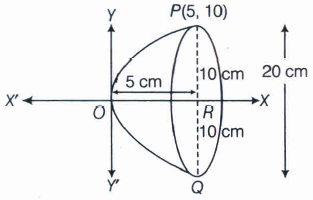
Then, PQ = 20 cm and OR = 5 cm, where R is the midpoint of PQ. We take OX as X-axis and OY as Y-axis. The equation of parabola may be taken as 4ax. Since, the point P(5, 10) lies on the parabola.
\({ 10 }^{ 2 }=4a(5)\Rightarrow a=5\)
Therefore, the coordinate of the focus are (a, o) i.e. (5, 0). Hence, the focus is the midpoint of the given diameter.
13.
0 do not comes in hundred's place, so only 4 numbers are posiible in hundred's place. Since, the digits are repeated, so remaining two digits, 5 numbers are possible in each place.
\(\therefore \) Total number of ways = 4 x 5 x 5 = 100
14.
Let z = \(\sqrt { 3 } \)+i= r (cos\(\theta\) + isin\(\theta\))
Now, equate real and imaginary parts of this equation and solve it for r and \(\theta\)
\(2\left( cos\frac { \pi }{ 6 } +isin\frac { \pi }{ 6 } \right) ;2,\frac { \pi }{ 6 } \)
15.
(i) Here f(x)=2x-\(\frac{3}{4}\)
∴ \(f^{'}(x)=\frac{d}{dx}(2x-\frac{3}{4})\)
=\(2\frac{d}{dx}(x)-\frac{d}{dx}(\frac{3}{4})\)
=\(2\times 1 -0=2\).
(ii) Here f(x)=(5x3 + 3x - 1) (x - 1)
∴ \(f^{'}(x)=\frac{d}{dx}[(5x^{3}+3x-1)(x-1)]\)
=\((5x^{3}+3x-1)\frac{d}{dx}(x-1)+(x-1)\frac{d}{dx}(5x^{3}+3x-1)\)
=\(5x^{3}+3x-1)\times 1 + (x-1)(15x^{2}+3)\)
=\(5x^{3}+3x-1+15x^{3}+3x-15x^{2}-3\)
=\(20x^{3}-15x^{2}+6x-4\).
(iii) Here f(x)=\(x^{-3} (5+3x)\)
ஃ \(f^{'}(x)=\frac{d}{dx}[x^{-3}(5+3x)]\)
=\(x^{-3}\frac{d}{dx}(5+3x)+(5+3x)\frac{d}{dx}(x^{-3}) \)
=\(x^{-3}\times 3+(5+3x)\times -3x^{-4}\)
=\(\frac{3}{x^{3}}-\frac{3}{x^{4}}(5+3x)\)
=\(\frac{3}{x^{3}}[1-\frac{5+3x}{x}]=\frac{3}{x^{3}}[\frac{x-5-3x}{x}]\)
=\(\frac{-3}{x^4}(5+2x)\).
(iv) Here \(f(x)=x^{5}(3-6x^{-9})\)
∴ \(f^{'}(x)=\frac{d}{dx}[x^{5}(3-6x^{-9})] \)
=\(x^{5}\frac{d}{dx}(3-6x^{-9})+(3-6x^{-9})\frac{d}{dx}(x^{5})\)
=\(x^{5}(54x^{-10})+(3-6x^{-9})\times 5x^{4}\)
=\(54x^{-5}+15x^{4}-30x^{-5}\)
=\(24x^{-5}+15x^{4}\)
=\(\frac{24}{x^{5}}+15x^{4}\).
(v) Here f(x)=x-4(3-4x-5)
∴ \(f^{'}(x)=\frac{d}{dx}[x^{-4}(3-4x^{-5})]\)
=\(x^{-4}\frac{d}{dx}(3-4x^{-5})+(3-4x^{-5})\frac{d}{dx}(x^{-4})\)
=\(x^{-4}(20x^{-6})+(3-4x^{-5})(-4x^{-5})\)
=\(20x^{-10}-12x^{-5}+16x^{-10}\)
=\(36x^{-10}-12x^{-5}=\frac{36}{x^{10}}-\frac{12}{x^{5}}\)
(vi) Here, f(x)=\(\frac{2}{x+1}-\frac{x^{2}}{3x-1}\)
ஃ \(f^{'}(x)=\frac{d}{dx}[\frac{2}{x+1}-\frac{x^{2}}{3x-1}]\)
=\(\frac{d}{dx}(\frac{2}{x+1})-\frac{d}{dx}(\frac{x^{2}}{3x-1})\)
=\(\frac{(x+1)\frac{d}{dx}(2)-2\frac{d}{dx}(x+1)}{(x+1)^{2}}\)-\(\frac{(3x-1)\frac{d}{dx}(x^{2}-x^{2}\frac{d}{dx}(3x-1)}{(3x-1)^{2}}\)
=\(\frac{(x+1)\times 0 -2 \times 1}{(x+1)^{2}}-\frac{(3x-1)(2x)-x^{2}\times 3}{(3x-1)^{2}}\)
=\(\frac{-2}{(x+1)^{2}}-\frac{6x^{2}-2x-3x^{2}}{(3x-1)^{2}}\)
=\(\frac{-2}{(x+1)^{2}}-\frac{3x^{2}-2x}{(3x-1)^{2}}\)
16.
(a) Here a = 2, and r = \(\frac { 2\sqrt { 2 } }{ 2 } =\sqrt { 2 } \).
Let nth term of given sequence be 128 is,
an = 128.
We know that an = arn-1
\(\therefore \) 128 =2\(\times \)\(\left( \sqrt { 2 } \right) ^{ n-1 }\)\(\Rightarrow \)64 = \(\left( \sqrt { 2 } \right) ^{ n-1 }\)
\(\Rightarrow \)\(\left( \sqrt { 2 } \right) ^{ 12 }\)=\(\left( \sqrt { 2 } \right) ^{ n-1 }\) \(\Rightarrow \) n-1=12
\(\Rightarrow \) n=13
Thus, 13thterm of the given sequence is 128.
(b) Here a =\(\sqrt { 3 } \)and r =\(\frac { 3 }{ \sqrt { 3 } } \)=\(\sqrt { 3 } \)
Let nth term of given sequence be 729 i.e
an =729
We know that an = arn-1
\(\therefore \)729=\(\sqrt { 3 } \)x\(\left( \sqrt { 3 } \right) ^{ n-1 }\)\(\Rightarrow \)\(\left( \sqrt { 3 } \right) ^{ 12 }\)=\(\left( \sqrt { 3 } \right) ^{ n}\)
\(\Rightarrow \) n=12
Thus, the 12th term of the given sequence is 729.
(c) Here a=\(\frac { 1 }{ 3 } \)and r= \(\frac { \frac { 1 }{ 9 } }{ \frac { 1 }{ 3 } } \)
Let nth term of given sequence be\( \frac { 1 }{ 19683 } \)
i.e an\( \frac { 1 }{ 19683 } \)
We know that an = arn-l.
\(\therefore \)\( \frac { 1 }{ 19683 } \)\( \frac { 1 }{ 19683 } \)=\(\frac { 1 }{ 3 } \)x \(\left( \frac { 1 }{ 3 } \right) ^{ n-1 }\)\(\Rightarrow \)\(\left( \frac { 1 }{ 3 } \right) ^{ 9 }\)=\(\left( \frac { 1 }{ 3 } \right) ^{ n }\)
\(\Rightarrow \)n =9
Thus, the 9th term of the given sequence is
\( \frac { 1 }{ 19683 } \).
17.
Here tan x =\(-{5\over12}\)
cot x=\({1\over tan \ x}={-12\over 5}\)
Now sec2x = 1 + tan 2x
\(\Rightarrow sec^2 x=1+({-5\over 12})^2\)
\(\Rightarrow sec \ x={169\over 144}\)
\(\Rightarrow sec x=\pm{13\over 12}\)
But x lies in second quadrant.
\(\therefore \ sec \ x={-13\over 12}\)
\(cos \ x={1\over sec \ x}={-12\over 13}\)
Also sin2 x + cos2 x = 1
\(\Rightarrow sin^2 x+({-12\over 13})^2=1\)
\(\Rightarrow sin ^2=1-{144\over 169}\)
\(\Rightarrow sin ^2 \ x ={25\over 169}\)
\(\Rightarrow sin \ x=\pm{5\over13}\)
But x lies in second quadrant.
\(\therefore sin x={5\over13}\)
\(cosec \ x={1\over sin \ x}={13\over 5}\)
18.
| Age | Mid values xi | fi | c.f | |xi-38| | fi|xi-38| |
| 16-20 | 18 | 5 | 5 | 20 | 100 |
| 21-25 | 23 | 6 | 11 | 15 | 90 |
| 26-30 | 28 | 12 | 23 | 10 | 120 |
| 31-35 | 33 | 14 | 37 | 5 | 70 |
| 36-40 | 38 | 26 | 63 | 0 | 0 |
| 41-45 | 43 | 12 | 75 | 5 | 60 |
| 46-50 | 48 | 16 | 91 | 10 | 160 |
| 51-55 | 53 | 9 | 100 | 15 | 135 |
| 100 | 735 |
\(\frac{N}{2}=\frac{100}{2}=50\)
∴ Median class is 35.5-40.5
∴ Median =\(35.5+\frac { 50-37 }{ 26 } \times 5=35.5+2.5=38\)
M.D. about median
\(=\frac { 1 }{ N } \sum _{ i=1 }^{ n }{ { f }_{ i }\left| { x }_{ i }-M \right| } =\frac { 1 }{ 100 } \times 735=7.35\)
19.
General term in \(\left( \frac { 3 }{ 2 } x^{ 2 }-\frac { 1 }{ 3x } \right) ^{ 9 }\)
\(T_{ r+1 }={ ^{ 9 }C }_{ r }\left( \frac { 3 }{ 2 } \right) ^{ 9-r }\left( -\frac { 1 }{ 3 } \right) ^{ r }x^{ 18-3r }\)
So, general form in the expansion of
\((1+x+{ 2x }^{ 3 })\left( \frac { 3 }{ 2 } x^{ 2 }-\frac { 1 }{ 3x } \right) ^{ 9 }\)
\(={ ^{ 9 }C }_{ r }\left( \frac { 3 }{ 2 } \right) ^{ 9-r }\left( -\frac { 1 }{ 3 } \right) ^{ r }x^{ 18-3r }+{ ^{ 9 }C }_{ r }\left( \frac { 3 }{ 2 } \right) ^{ 9-r }\left( -\frac { 1 }{ 3 } \right) ^{ r }x^{ 19-3r }+2{ ^{ 9 }C }_{ r }\left( \frac { 3 }{ 2 } \right) ^{ 9-r }\left( -\frac { 1 }{ 3 } \right) ^{ r }x^{ 21-3r }\)
For the term independent of x
18-3r=0, 19-3r=0 and 21-3r=0
\(\Rightarrow \ r=6,\quad \frac { 19 }{ 3 } and\quad 7\)
Thus, posible value of r are 6 and 7
Term independent of x
\(={ ^{ 9 }C }_{ r }\left( \frac { 3 }{ 2 } \right) ^{ 9-6 }\left( -\frac { 1 }{ 3 } \right) ^{ 6 }+2.^{ 9 }C_{ 7 }\left( \frac { 3 }{ 2 } \right) ^{ 9-7 }\left( -\frac { 1 }{ 3 } \right) ^{ 7 }\)
\(=\frac { 84 }{ 8 } .\frac { 1 }{ 3^{ 3 } } -\frac { 36 }{ 4 } .\frac { 2 }{ 3^{ 5 } } =\frac { 17 }{ 54 } \)
20.
(b)
II and III are correct
21.
(d)
\( \mathrm{CV}=\frac{\sigma}{\bar{x}} \times 100\)
22.
(a)
0
23.
(b)
\(\left(\frac{k x_{2}+x_{1}}{1+k}, \frac{k y_{2}+y_{1}}{1+k}, \frac{k z_{2}+z_{1}}{1+k}\right) \)
24.
(c)
\(\sqrt{\left(x_{2}-x_{1}\right)^{2}+\left(y_{2}-y_{1}\right)^{2}}\)
25.
(d)
All of the above
26.
(b)
ordered
27.
(c)
10000
28.
(b)
15
29.
(d)
69760
30.
(c)
| A | B | C | D | E |
| 2 | 1 | 4 | 3 | 5 |
31.
(a)
more than 2000
32.
(d)
0
33.
(c)
3
34.
(c)
Venn diagrams
35.
(b)
cot B
36.
(a)
0
37.
(b)
\(\frac { \sqrt { 3 } }{ 2 } \)
38.
(c)
2
39.
(c)
\(\frac { 1 }{ 9 } \)

11th Standard CBSE Syllabus & Materials
11th Standard CBSE
CBSE 11th Business Studies Forms of Business Organisation Sample Question Papers Study Material - QB365 Set A
NEW11th Standard CBSE
CBSE 11th Business Studies Business, Trade and Commerce Sample Question Papers Study Material - QB365 Set A
NEW11th Standard CBSE
CBSE 11th Physics Waves Sample Question Papers Study Material - QB365 Set A
NEW11th Standard CBSE
CBSE 11th Physics Kinetic Theory Sample Question Papers Study Material - QB365 Set A



NCERT Books

Syllabus

Exam Pattern

Sample Question Papers

Previous year Question Papers

Important Notes

MCQ Practice test

NCERT Exemplers

Case study Questions

Image Based Questions

Passage based Questions

HOT Questions

Value Based Questions

Model Questions Papers
NCERT ( Book Back ) Questions

Assertion and Reason
Important Questions And Answers

CBSE 11th Standard CBSE Subjects
CBSE Standards







