
 100% FREE ACCESS
11th Standard CBSE Syllabus & Materials
11th Standard CBSE
CBSE 11th Economics PART-A - Presentation of Data - New Sample Question Papers Study Material - QB365 Set A
NEW11th Standard CBSE
CBSE 11th Economics PART-A - Organisation of Data - New Sample Question Papers Study Material - QB365 Set A
NEW11th Standard CBSE
CBSE 11th Economics PART-A - Collection of Data - New Sample Question Papers Study Material - QB365 Set A
NEW11th Standard CBSE
CBSE 11th Economics PART-A - Introduction to Economics and Statistics - New Sample Question Papers Study Material - QB365 Set A
NEW11th Standard CBSE
CBSE 11th Business Studies International Trade Sample Question Papers Study Material - QB365 Set A
NEW11th Standard CBSE
CBSE 11th Business Studies Evolution and Fundamentals of Business Sample Question Papers Study Material - QB365 Set A

Published on: 18/08/2026
Download CBSE Class 11th Standard CBSE Mathematics question papers, sample papers, important questions, and previous year solved papers in PDF format. Get free study materials, NCERT solutions, and exam preparation resources for Class 11th Standard CBSE Mathematics
Questions + Answers key
Take MCQ Mathematics Test
1.
Let \(x_i\) and \(y_i\) are two data such that \(y_i=a x_i+b\). If \(\bar{x}, \bar{y}\) are mean and \(\sigma_x, \sigma_y\) are standard deviation of the given data x, and y, respectively. Then, we have \(\vec{y}=a \vec{x}+b\) and \(a_y=|a| \sigma_y\)
On the basis of above information, answer th. following question.
(i) If \(y_t=4 x_i-3\) and x2 is 10 , then y=
| (a) 40 | (b) 7 | (c) 37 | (d) 43 |
(ii) If \(y_i=\frac{a x_i+b}{c}\), then \(\sigma_y=\)
| (a) \(\frac{a \sigma_x+b}{c}\) | (b) \(\frac{a}{c} \sigma\) | (c) \(\left|\frac{a}{c}\right| \sigma_x\) | (d) None of these |
(iii) If \(y_i=x_i+10\), then
| (a) \(\sigma_y=\sigma_x+10\) | (b) \(\sigma_y=\sigma_x\) | (c) \(\sigma_y=\sigma_x-10\) | (d) None of thes |
(iv) If \(x_i=3 y_i+2\), then
| (a) \(\bar{y}=\bar{x}\) | (b) \( \bar{y}=3 \vec{r}+2\) | (c) \(\bar{y}=\bar{x}-2 \) | (d) None of these |
(v) If \(y_i=a x_i+b\), then
| (a) \( \operatorname{var}(Y)=a^2 \operatorname{var}(X)\) | (b) \(\operatorname{var}(X)=a^2 \operatorname{var} (Y)\) | (c) \(\operatorname{var}(Y)=\operatorname{var}(X)+b\) | (d) None of these |
2.
The marks of students of class XI in Maths test (out of 20) are given below:
\(\begin{array}{c|c|c|c|c|c|c|c}
\hline \text { Marks }\left(x_i\right) & 5 & 7 & 9 & 11 & 13 & 15 & 17 \\
\hline \begin{array}{c}
\text { Number of } \\
\text { students }\left(f_i\right)
\end{array} & 2 & 4 & 6 & 8 & 10 & 12 & 8 \\
\hline
\end{array}\)
On the basis of above information, answer the following questions.
(i) Total number of students in the class is
| (a) 20 | (b) 30 | (c) 40 | (d) 50 |
(ii) Cumulative frequency corresponding to mark 11 is
| (a) 10 | (b) 20 | (c) 22 | (d) 28 |
(iii) Median (M) of given data is
| (a) 11 | (b) 13 | (c) 15 | (d) None of these |
(iv) The value of \(\sum_{i=1}^n f_i\left|x_i-M\right|\) is
| (a) 116 | (b) 126 | (c) 136 | (d) 146 |
(v) The value of mean deviation from median of given data is
| (a) 2.72 | (b) 2.70 | (c) 2.68 | (d) 2.66 |
3.
Salim made a flower-bed in his garden. Surprisingly which is in the shape of a parabola whose equation is y2 =8x, the flower-bed is shown as in below figure.
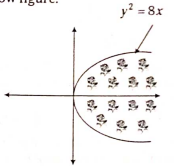
Then, answer the following questions which are based on above figure.
(i) Focus of given parabola is
| (a) (1, 0) | (b) (2, 0) | (c) (3, 0) | (d) (4, 0) |
(ii) Axis of the parabola is
| (a) x = 0 | (b) x = 1 | (c) y = 0 | (d) y = 1 |
(iii) Equation of the directrix of the parabola is
| (a) x + 2 = 0 | (b) y + 2 = 0 | (c) x - 2 = 0 | (d) y - 2 = 0 |
(iv) Length of the latusrectum of the parabola is
| (a) 4 | (b) 6 | (c) 8 | (d) 10 |
(v) If the focal distance of a point on the parabola is 3, then abscissa of the point is
| (a) 1 | (b) 2 | (c) 3 | (d) 4 |
4.
Mr. Sharma a sincere citizen of "Laxmi Nikunj Society" in Jaipur. He makes a green gardenin his plot which is in the shape of ellipse, i.e.shown in the below figure.
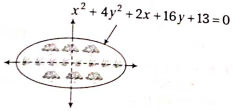
Now, answer the following questions which are based on above garden.
(i) Value of (a + b) is
| (a) 2 | (b) 1 | (c) 3 | (d) 4 |
(ii) Value of eccentricity(e) is
| (a) \(\frac{2}{\sqrt3}\) | (b) \(\frac{\sqrt3}{2}\) | (c) \(\frac{\sqrt3}{4}\) | (d) \(\frac{4}{\sqrt3}\) |
(iii) Which of the following is equation of directrices?
| (a) \(x= \pm \frac{4}{\sqrt{3}}-1 \) | (b) \(x= \pm \frac{4}{\sqrt{3}}+1 \) | (c) \(y= \pm \frac{4}{\sqrt{3}}+1 \) | (d) \(y= \pm \frac{4}{\sqrt{3}}-1 \) |
(iv) Length of the latusrectum is
| (a) 2 | (b) 1 | (c) 3 | (d) 4 |
(v) Which of the following is equation of latusrectum?
| (a) \(x= \pm {\sqrt{3}}+1 \) | (b) \(y= \pm {\sqrt{3}}-1 \) | (c) \(x= \pm {\sqrt{3}}-1 \) | (d) \(y= \pm {\sqrt{3}}+1 \) |
5.
Mr. Ankt Triwedi a mathematics teacher of class XI write two things about Mohan and Sohan, which are below in figure.
\(\begin{array}{|c|c|c|} \hline & \text { Mohan } & \text { Sohan } \\ \hline \text { Age } & { }^n P & { }^n P_{r+1} \\ \hline \text { Height (in feet) } & { }^n C_r & { }^n C_{r-1} \\ \hline \end{array}\)
Now,answer the following question which are based on above data.
(i)) If the age of mohan and Sohan are equal, then find the value of (n -r).
| (a) 1 | (b) -1 | (c) -2 | (d) 2 |
(ii) Which of the following formula is used to find nPr ?
| (a) \(\frac{n !}{(n-r) !}\) | (b) \(\frac{(n-r) !}{n !}\) | (c) \(\frac{n !}{(n+r) !}\) | (d) \(\frac{n !}{r !(n-r) !}\) |
(iii) If the height of Mohan and Sohan are equal, then find the value of (n - 2r).
| (a) 1 | (b) -1 | (c) 2 | (d) -2 |
(iv) Find the age of Mohan.
| (a) 6 yr | (b) 4 yr | (c) 8 yr | (d) 9 yr |
(v) Find the height of Sohan
| (a) 3 feet | (b) 4 feet | (c) 5 feet | (d) 6 feet |
6.
Mr. Arvind Shukla a mathematics teacher of class XI. He writes a word INDEPENDENCE on the white board. He asks some questions which are based on the arrangements of the letters of the above word.
Then, answer the following questions.
(i) The number of permutations of n objects, where p objects are of the one kind, p2 are of second kind, ...pk are of kth kind and the rest, if any are of dfferent kind is
| (a) \(\frac{n !}{p_{1} ! p_{2} ! \ldots p_{k} !}\) | (b) \(\frac{n !}{p_{1} !+p_{2} !+\ldots+p_{k} !}\) | (c) \(\frac{n !}{p !}\) | (d) None of these |
(ii) Find the number of arrangements of the letters of the word starting with P.
| (a) 183600 | (b) 128600 | (c) 138600 | (d) 118600 |
(iii) Find the number of arrangements of the letter of word, when all the vowels always occur together.
| (a) 18600 | (b) 16800 | (c) 17600 | (d) 19600 |
(iv) Find the number of arrarngements of the letter of word, when all the vowels never occur together.
| (a) 1646400 | (b) 1545400 | (c) 144400 | (d) 156600 |
(v) Find the number of arrangements of the letter of word when wor begins with Iand ends in P
| (a) 16200 | (b) 12600 | (c) 14200 | (d) 15200 |
1.
(i) (c)
(ii) (c)
(iii) (b)
(iv) (d)
(v) (a)
2.
(i) (d)
(ii) (b)
(iii) (b)
(iv) (c)
(v) (a)
3.
(i) (b)
(ii) (c)
(iii) (a)
(iv) (c)
(v) (d)
4.
(i) (c)
(ii) (b)
(iii) (a)
(iv) (b)
(v) (c)
5.
(i) (a)
(ii) (a)
(iii) (b)
(iv) (a)
(v) (a)
6.
(i) (a)
(ii) (c)
(iii) (b)
(iv) (a)
(v) (b)

11th Standard CBSE Syllabus & Materials
11th Standard CBSE
CBSE 11th Business Studies Forms of Business Organisation Sample Question Papers Study Material - QB365 Set A
NEW11th Standard CBSE
CBSE 11th Business Studies Business, Trade and Commerce Sample Question Papers Study Material - QB365 Set A
NEW11th Standard CBSE
CBSE 11th Physics Waves Sample Question Papers Study Material - QB365 Set A
NEW11th Standard CBSE
CBSE 11th Physics Kinetic Theory Sample Question Papers Study Material - QB365 Set A



NCERT Books

Syllabus

Exam Pattern

Sample Question Papers

Previous year Question Papers

Important Notes

MCQ Practice test

NCERT Exemplers

Case study Questions

Image Based Questions

Passage based Questions

HOT Questions

Value Based Questions

Model Questions Papers
NCERT ( Book Back ) Questions

Assertion and Reason
Important Questions And Answers

CBSE 11th Standard CBSE Subjects
CBSE Standards







