
 100% FREE ACCESS
11th Standard CBSE Syllabus & Materials
11th Standard CBSE
CBSE 11th Economics PART-A - Presentation of Data - New Sample Question Papers Study Material - QB365 Set A
NEW11th Standard CBSE
CBSE 11th Economics PART-A - Organisation of Data - New Sample Question Papers Study Material - QB365 Set A
NEW11th Standard CBSE
CBSE 11th Economics PART-A - Collection of Data - New Sample Question Papers Study Material - QB365 Set A
NEW11th Standard CBSE
CBSE 11th Economics PART-A - Introduction to Economics and Statistics - New Sample Question Papers Study Material - QB365 Set A
NEW11th Standard CBSE
CBSE 11th Business Studies International Trade Sample Question Papers Study Material - QB365 Set A
NEW11th Standard CBSE
CBSE 11th Business Studies Evolution and Fundamentals of Business Sample Question Papers Study Material - QB365 Set A

Published on: 18/08/2026
Download CBSE Class 11th Standard CBSE Mathematics question papers, sample papers, important questions, and previous year solved papers in PDF format. Get free study materials, NCERT solutions, and exam preparation resources for Class 11th Standard CBSE Mathematics
Questions + Answers key
Take MCQ Mathematics Test
1.
Find the locus of a point such that the sum of its distances from the point (0,2) and (0,-2) is 6.
2.
Find the sum of the following series
0.6+0.66+0.666+...
3.
Using binomial theorem, evaluate each of the following
\(\left( 53 \right) ^{ 7 }-\left( 47 \right) ^{ 7 }\)
4.
How many numbers greater than 1000, but not greater than 4000 can be formed with the digits 0, 1, 2, 3, 4, if
(i) repetition of digits is alllowed?
(ii) repetition of digits is not allowed?
5.
The sum of four consecutive integers must not be more than 22. What are the integers?
6.
Find the distances between the points A(2,-3) and B(6,3)
7.
Write the first five terms of each of the following sequence whose nth terms are
an = \(\frac { { n }^{ 3 }+1 }{ 2 } \)
8.
Find the number of terms in the expansions of following expressions.
(1-z)4
9.
Given 5 flags of different colours. How many different signals can be generated, if each signal requires the use of 2 flags, one below the other?
10.
Find the expansion of (3x2 - 2ax + 3a2)3 using binomial theorem.
11.
Find the equation of the lines through the point (3, 2) which make an angle of 45° with the line x - 2y = 3.
12.
Find the sum to n terms of the sequence, 8, 88, 888, 8888… .
13.
Which of the following represent the solution set in the following figure?
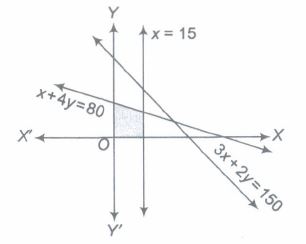
\(3 x+2 y \geq 150, x+4 y \leq 80, x \leq 15, x, y \geq 0 \)
\(3 x+2 y \leq 150, x+4 y \geq 80, x \geq 15, x, y \geq 0 \)
\(3 x+2 y \leq 150, x+4 y \leq 80, x \leq 15, x, y \geq 0\)
None of the above
14.
The middle term in the expansion of \(\left( \frac { { 2x }^{ 2 } }{ 3 } +\frac { 3 }{ { 2x }^{ 2 } } \right) ^{ 10 }\)is _____.
240
280
262
252
15.
The number of ways to arrange the letters of the word HAPPY are ______.
120
90
40
60
16.
If the first term of an AP. is 5 and common difference is - 3 then sum of its 60 terms is equal to ______.
-1050
-5010
3010
None of these
17.
Mr. Arvind Shukla a mathematics teacher of class XI. He writes a word INDEPENDENCE on the white board. He asks some questions which are based on the arrangements of the letters of the above word.
Then, answer the following questions.
(i) The number of permutations of n objects, where p objects are of the one kind, p2 are of second kind, ...pk are of kth kind and the rest, if any are of dfferent kind is
| (a) \(\frac{n !}{p_{1} ! p_{2} ! \ldots p_{k} !}\) | (b) \(\frac{n !}{p_{1} !+p_{2} !+\ldots+p_{k} !}\) | (c) \(\frac{n !}{p !}\) | (d) None of these |
(ii) Find the number of arrangements of the letters of the word starting with P.
| (a) 183600 | (b) 128600 | (c) 138600 | (d) 118600 |
(iii) Find the number of arrangements of the letter of word, when all the vowels always occur together.
| (a) 18600 | (b) 16800 | (c) 17600 | (d) 19600 |
(iv) Find the number of arrarngements of the letter of word, when all the vowels never occur together.
| (a) 1646400 | (b) 1545400 | (c) 144400 | (d) 156600 |
(v) Find the number of arrangements of the letter of word when wor begins with Iand ends in P
| (a) 16200 | (b) 12600 | (c) 14200 | (d) 15200 |
18.
The water acidity in a pool is considered normal, when the average pH reading of three daily measurements is between 7.2 and 7.8. The first two pH reading are 7.48 and 7.85, and pH reading of 3rd day is x.
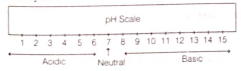
On the basis of above information, answer the following questions.
(i) The average pH of three days is
| (a) 5.11+x | (b) \(5.11+\frac{x}{3}\) | (c) 15.33+x | (d) None of these |
(ii) The system of linear inequality, which shows the given information is
| (a) \(7.2 \leq 5.11+\frac{x}{3} \leq 7.8\) | (b) \(7.2<5.11+\frac{x}{3} \leq 7.8\) | (c) \(7.2 \leq 5.11+\frac{x}{3}<7.8\) | (d) \(7.2<5.11+\frac{x}{3}<7.8\) |
(iii) The solution of linear inequality \(7.2 \leq 5.11+\frac{x}{3}\) is
| (a) x≥6.27 | (b) x>6.27 | (c) x≤6.27 | (d) x<6.27 |
(iv) The solution of linear inequality \(5.11+\frac{x}{3} \leq 78\) is
| (a) x≤8.07 | (b) x<8.07 | (c) x≥8.07 | (d) x>8.07 |
(v) The value of pH on third day is
| (a) [6.27,8.07] | (b) (627,8.07) | (c) (627,8.07] | (d) [6.27,8.07) |
1.
Let P(h,k) be the moving and A(0,2) and B(0,-2) be
the given points.By the given condition,PA + PB = 6
\(\Rightarrow \sqrt { { (h-0) }^{ 2 }+{ (k-2) }^{ 2 } } +\sqrt { { (h-0) }^{ 2 }+{ (k+2) }^{ 2 } } =6\)
\(\Rightarrow (2k+9)=3\sqrt { { h }^{ 2 }+{ (k+2) }^{ 2 } } \)
On squaring both sides, we get
(2k + 9)2 = 9[h2 + (k+2)2] \(\Rightarrow \) 9h2 + 5k2 = 45
9x2 + 5y2 = 45
2.
\(6\times 0.1+6\times 0.11+6\times 0.111+....\)n terms
\(=\frac { 6 }{ 9 } [0.9+0.99+0.999+\)...n terms]
\(=\frac { 2 }{ 3 } \left[ \frac { 9 }{ 10 } +\frac { 99 }{ 100 } +\frac { 999 }{ 1000 } +...\quad n\quad terms \right] \)
\(=\frac { 2 }{ 3 } \left[ \left( 1-\frac { 1 }{ 10 } \right) +\left( 1-\frac { 1 }{ 100 } \right) +\left( 1-\frac { 1 }{ 1000 } \right) +...n\quad terms \right] \)
\(=\frac { 2 }{ 3 } \left[ (1+1+1+...n\quad terms)-(\frac { 1 }{ 10 } +\frac { 1 }{ { 10 }^{ 2 } } +\frac { 1 }{ { 10 }^{ 3 } } +...n\quad terms) \right] \)
Ans.\(\frac { 2 }{ 3 } n-\frac { 2 }{ 27 } (1-10^{ -n })\)
3.
\(\left( 53 \right) ^{ 7 }-\left( 47 \right) ^{ 7 }=\left( 50+3 \right) ^{ 7 }+\left( 50-3 \right) ^{ 7 }\\ \left( 50+3 \right) ^{ 7 }=^{ 7 }{ C }_{ 0 }{ \left( 50 \right) }^{ 7 }+^{ 7 }{ C }_{ 1 }{ \left( 5 \right) }^{ 6 }{ \left( 3 \right) }^{ 1 }+^{ 7 }{ C }_{ 2 }{ \left( 50 \right) }^{ 5 }{ \left( 2 \right) }^{ 2 }.........(i)\\ \left( 50-3 \right) ^{ 7 }=^{ 7 }{ C }_{ 0 }{ \left( 50 \right) }^{ 7 }-^{ 7 }{ C }_{ 1 }{ \left( 50 \right) }^{ 6 }{ \left( 3 \right) }^{ 1 }+^{ 7 }{ C }_{ 2 }{ \left( 3 \right) }^{ 2 }.........(ii)\\ Sub\quad equ(i)\quad and\quad (ii)\\ \left( 50+3 \right) ^{ 7 }-\left( 50-3 \right) ^{ 7 }=2\left[ ^{ 7 }{ C }_{ 1 }{ \left( 50 \right) }^{ 6 }{ \left( 3 \right) }^{ 1 }+^{ 7 }{ C }_{ 3 }{ \left( 50 \right) }^{ 4 }{ { \left( 3 \right) }^{ 3 }+^{ 7 }{ C }_{ 5 }{ \left( 50 \right) }^{ 2 }{ { \left( 3 \right) }^{ 5 }+^{ 7 }{ C }_{ 7 }{ { \left( 3 \right) }^{ 7 } } } } \right] \\ =668088019374\)
4.
Thousand's place can be filled either by 1 or 2 or 3, i.e. thousand's place can be filled in 3 ways.
Ans. (i) 375
(ii) 72
5.
Less than or equal to 4.
6.
4
7.
1, \(\frac { 9 }{ 2 }\), 14, \(\frac { 65 }{ 2 }\), 63
8.
Given expression is (1-z)4. Here, n= 4
\(\therefore \) The number of terms in the expansion is (n+1)
i.e. 4+1 = 5
9.
First, flag can be selected in 5 ways and the second flag can be selected in 4 ways.
Ans. 20
10.
We have (3x2 - 2ax + 3a2)3
=[(3x2- 2ax) + 3a2)]3
=3C0(3x2- 2ax)3 + 3C1(3x2 - 2ax)2 (3a2)+3C2(3x2- 2ax) (3a2)2+ 3C3(3a2)3
= (3x2 - 2ax)3 + 3 x 3a2 (3x2 - 2ax)2 + 3x 9a4 (3x2 - 2ax) + 27a6
= (27x6 - 8a3x3 - 54ax5 + 36a2x4) + 9a2 (9x4+ 4a2x2 - 12ax3) + 27a4 (3x2 - 2ax) + 27a6
= 27x6 - 108a3x3- 54ax5 + 36a2x4 + 81a2x4+ 36a4x2 - 108a3x3 + 81a4x2 - 54a5x + 27a6
= 27x6 - 54ax5 + 117a2x4 - 116a3x3
+ 117a4x2 - 54a5x + 27 a6
11.
Let m be the slope of required line
which passes through point (3, 2). Then equation of required line is
y - 2 = m(x - 3)... (i)
The equation of given line is x - 2y = 3
\(\Rightarrow y=\frac{x}{2}-\frac{3}{2}\)....(ii)
\(\therefore\) Slope of given line is \(\frac{1}{2}\)
It is given that line (i) and (ii) make an angle of 45o.
\(\therefore \tan 45^o=\left| \frac { m-\frac { 1 }{ 2 } }{ 1+\frac { m }{ 2 } } \right| \)
\(\therefore 1=|\frac{2m-1}{2+m}|\)
\(\Rightarrow \frac{2m-1}{2+m}=\pm 1\)
When \(\frac{2m-1}{2+m}=1\)
\(\Rightarrow\) 2m - 1 = 2 + m \(\Rightarrow\) m = 3
Then equation of required line is
y - 2 = 3(x - 3)
\(\Rightarrow\) y - 2 = 3x - 9 \(\Rightarrow\) 3x - y - 7 = 0
When \(\frac{2m-1}{2+m}=-1\Rightarrow\) 2m - 1 = -2 -m
\(\Rightarrow\) 3m = -1 \(\Rightarrow\) m = \(\frac{-1}{3}\)
Then the equation of required line is
\(y-2=\frac{-1}{3}(x-3)\)
\(\Rightarrow\) 3y - 6 = -x + 3 \(\Rightarrow\) x + 3y - 9 = 0.
12.
Let Sn = 8 + 88 + 888 + 8888 + .... upto n terms
= 8 [1 + 11 + 111 + 1111 +.... upto n terms]
= \(\frac { 8 }{ 9 } \) [9 + 99 + 999 + 9999 + ... upto n terms]
= \(\frac { 8 }{ 9 } \) [(10 - 1)+(102 - 1) + (103 - 1)] +....upto n terms
= \(\frac { 8 }{ 9 } \) [(10 + 102 +103 + ...n terms) - (1+1+...n terms)]
= \(\frac { 8 }{ 9 } \left[ \frac { 10.\left( { 10 }^{ n }-1 \right) }{ \left( 10-1 \right) } -n \right] \)
= \(\frac { 8 }{ 9 } \left[ \frac { 10 }{ 9 } \left( { 10 }^{ n }-1 \right) -n \right] \)
= \(\frac { 80 }{ 81 } \left[ { 10 }^{ n }-1 \right] -\frac { 8 }{ 9 } n\)
13.
(c)
\(3 x+2 y \leq 150, x+4 y \leq 80, x \leq 15, x, y \geq 0\)
14.
(d)
252
15.
(d)
60
16.
(b)
-5010
17.
(i) (a)
(ii) (c)
(iii) (b)
(iv) (a)
(v) (b)
18.
(i) (b)
(ii) (d)
(iii) (a)
(iv) (a)
(v) (b)

11th Standard CBSE Syllabus & Materials
11th Standard CBSE
CBSE 11th Business Studies Forms of Business Organisation Sample Question Papers Study Material - QB365 Set A
NEW11th Standard CBSE
CBSE 11th Business Studies Business, Trade and Commerce Sample Question Papers Study Material - QB365 Set A
NEW11th Standard CBSE
CBSE 11th Physics Waves Sample Question Papers Study Material - QB365 Set A
NEW11th Standard CBSE
CBSE 11th Physics Kinetic Theory Sample Question Papers Study Material - QB365 Set A



NCERT Books

Syllabus

Exam Pattern

Sample Question Papers

Previous year Question Papers

Important Notes

MCQ Practice test

NCERT Exemplers

Case study Questions

Image Based Questions

Passage based Questions

HOT Questions

Value Based Questions

Model Questions Papers
NCERT ( Book Back ) Questions

Assertion and Reason
Important Questions And Answers

CBSE 11th Standard CBSE Subjects
CBSE Standards







