
 100% FREE ACCESS
11th Standard CBSE Syllabus & Materials
11th Standard CBSE
CBSE 11th Economics PART-A - Presentation of Data - New Sample Question Papers Study Material - QB365 Set A
NEW11th Standard CBSE
CBSE 11th Economics PART-A - Organisation of Data - New Sample Question Papers Study Material - QB365 Set A
NEW11th Standard CBSE
CBSE 11th Economics PART-A - Collection of Data - New Sample Question Papers Study Material - QB365 Set A
NEW11th Standard CBSE
CBSE 11th Economics PART-A - Introduction to Economics and Statistics - New Sample Question Papers Study Material - QB365 Set A
NEW11th Standard CBSE
CBSE 11th Business Studies International Trade Sample Question Papers Study Material - QB365 Set A
NEW11th Standard CBSE
CBSE 11th Business Studies Evolution and Fundamentals of Business Sample Question Papers Study Material - QB365 Set A

Published on: 07/09/2019
Introduction to Three Dimensional Geometry
Download CBSE Class 11th Standard CBSE Mathematics question papers, sample papers, important questions, and previous year solved papers in PDF format. Get free study materials, NCERT solutions, and exam preparation resources for Class 11th Standard CBSE Mathematics
Questions + Answers key
Take MCQ Mathematics Test
1.
Show that the points (-2,6,-2), (0,4,-1),(-2,3,1) and (-4,5,0) are the vertices of a squre.
2.
Show that the points (0,7,10), (-1,6,6) and (-4,9,6) are the vertices of a right angled isosceles triangle.
3.
Find the equation of the curve formed by the set of all points whose distances from the points (3,4,-5) and (-2,1,4) are equal.
4.
Show that D(-1,4,-3) is the circumcentre of \(\Delta ABC\) with vertices A(3,2,-5), B(-3,8,-5) and C(-3,2,1).
5.
Prove that the triangle formed by joining the three points whose coordinates are A(1,2,3), B(2,3,1) and C(3,1,2), is an equilateral triangle.
6.
Find the distance of point P(3,6,9) from the YZ-plane using distance formula.
7.
Find the ratio in which the line segment joining the points (4, 4, -10) and (-2, 2, 4) is divided by the YZ-plane.
8.
Verify that A(-1, 2, 1) B(1, -2, 5), C(4, -7, 8) and D(2, -3, 4) are the verticles of a parallelofram
9.
A point is on the x-axis. What are its y-coordinate and z-coordinates?
10.
The mid-points of the sides of a triangle are (1,5,-1), (0,4,-2) and (2,3,4). Find its vertices
11.
Two vertices of a triangle are A(3,4,2) and B(1,3,2). The medians of the triangle intersect at (2,4,3). Find the remaining vertex C of the triangle.
12.
Three points A(1,2,3), B(0,4,1) and C(-1,-1,-3) are the vertices of \(\Delta ABC\). Find the point in which the bisector of \(\angle BAC\) meets BC.
13.
If A and B be the points (3, 4, 5) and (–1, 3, –7), respectively, find the equation of the set of points P such that PA2+PB2=K2 where k is a constant.
14.
Find the lengths of the medians of the triangle with vertices A (0, 0, 6), B (0,4, 0) and (6, 0, 0).
15.
Three vertices of a parallelogram ABCD are A(3, – 1, 2), B (1, 2, – 4) and C (– 1, 1, 2). Find the coordinates of the fourth vertex.
1.
Let A(-2,6,-2), B(0,4,-1), C(-2,3,1) and D (-4,5,0) be the given points.
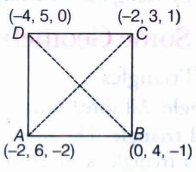
\(\therefore B=\sqrt { { (0+2) }^{ 2 }+{ (4-6 })^{ 2 }+{ (1+2) }^{ 2 } } \) [Using the distance formula]
\(=\sqrt { 4+4+1 } =\sqrt { 9 } =3\quad units\)
\(BC=\sqrt { { (-2-0) }^{ 2 }+{ (3-4) }^{ 2 }+({ 1+1) }^{ 2 } } \)
\(\sqrt { 4+1+4 } =\sqrt { 9 } =3\quad units\)
\( CD=\sqrt { { (-4+2) }^{ 2 }+{ (5-3) }^{ 2 }+{ (0-1) }^{ 2 } } \)
\(=\sqrt { 4+4+1 } =\sqrt { 9 } =3\quad units\)
\(AD=\sqrt { (-4+{ 2) }^{ 2 }+{ { (5-6) } }^{ 2 }+({ 0+2) }^{ 2 } } \)
\(=\sqrt { 4+1+4 } =\sqrt { 9 } =3\quad units\)
Here, AB=BC=CD=DA
Now, \(AC=\sqrt { { (-2+2) }^{ 2 }+{ (3-6) }^{ 2 }+({ 1+2) }^{ 2 } } \)
\([\because \quad distance=\sqrt { ({ x }_{ 2 }-{ x }_{ 1 }{ ) }^{ 2 }+{ (y }_{ 2 }-{ y }_{ 1 }{ ) }^{ 2 }+{ (z }_{ 2 }-{ z }_{ 1 }{ ) }^{ 2 } } \)
\(=\sqrt { 0+9+9=\sqrt { 18\quad units } } \)
\(and\quad BD=\sqrt { ({ -4 }-0{ ) }^{ 2 }+5-4{ ) }^{ 2 }+(0-1{ ) }^{ 2 } } \)
\(=\sqrt { 16+1+1 } =\sqrt { 18 } units\)
Sine,diagonal AC=diagonal BD
Hence, ABCD is a square.
2.
Let A(0,7,10), B(-1,6,6) and C(-4,9,6) be the given points.
Then AB= \(=\sqrt { { (-1- }0)^{ 2 }+({ 6-7) }^{ 2 }+(6-{ 10 })^{ 2 } } \) [using the distance formula]
\(=\sqrt { 1+1+16 } =\sqrt { 18 } =3\sqrt { 2 } \)units
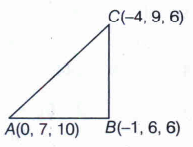
\(BC=\sqrt { { (-4+1 })^{ 2 }+{ (9- }6)^{ 2 }+{ (6-6 })^{ 2 } } \)
\(=\sqrt { 9+9+0 } =\sqrt { 18 } =3\sqrt { 2 } units\)
\(and\quad AC=\sqrt { { (-4-0) }^{ 2 }+{ (9-7) }^{ 2 }+{ (6-10) }^{ 2 } } =\sqrt { 16+4+16 }\)
\( \Rightarrow AC=\sqrt { 36 } =6\quad units\)
\(Now,\quad { AB }^{ 2 }+{ BC }^{ 2 }=(3\sqrt { 2 } { ) }^{ 2 }+(3\sqrt { 2 } { ) }^{ 2 }=18+18=36\quad units\)
\(\therefore { AB }^{ 2 }+{ BC }^{ 2 }={ AC }^{ 2 }\)
\( Also,\quad AB={ BC }^{ 2 }={ AC }^{ 2 }\)
Hence, ABC is a right angled isosceles triangle.
3.
Let P(x,y,z) be any point on the given curve and let
A(3,4,−5) and B(−2,1,4) be the given points.
Then,PA=PB⇒PA2=PB2
⇒(x−3)2+(y−4)2+(z+5)2=(x+2)2+(y−1)2+(z−4)2
⇒x2+9−6x+y2+16−8y+z2+25+10z
=x2+4+4x+y2+1−2y+z2+16−8z
⇒10x+6y−18z−29=0
Hence,the required curve is
10x+6y−18z−29=0
4.
Show that AD=BD=CD
5.
Show that AB = BC = CA
6.
When we draw a perpendicular line from the point P(3,6,9) on the YZ-plane, the x-coordinate of foot of perpendicular will be zero and the other coordinates ( y and z) will be 6 and 9, i.e coordinates of a point on YZ-plane (which is the foot of perpendicular drawn from P to YZ plane) be Q(0,6,9).
\(\therefore \) Distance between P and Q,
\(QP=\sqrt { { (3-0) }^{ 2 }+{ (6-6) }^{ 2 }+{ (9-9) }^{ 2 } } \)
\([\because distance=\sqrt { { ({ x }_{ 2 }-{ x }_{ 1 }) }^{ 2 }+{ ({ y }_{ 2 }-{ y }_{ 1 }) }^{ 2 }+{ { (z }_{ 2 }-{ z }_{ 1 }) }^{ 2 } } \)
\(=\sqrt { { 3 }^{ 2 }+{ 0 }^{ 2 }+{ 0 }^{ 2 } } \)
= 3 Units
7.
2:1 internally
8.
Show that mid-point of AC is equal to the mid-point of BD.
9.
If a point is on the x-axis, then its y-coordinates and z-coordinates are zero.
10.
(1, 2, 3), (3, 4, 5) and (-1, 6, -7)
11.
Let third vertex of \(\Delta ABC\) be C(x,y,z).
We know that intersection of medians of triangle is known as centroid of a triangle.
\(\therefore \left( \frac { 3+1+x }{ 3 } ,\frac { 4+3+y }{ 3 } \frac { 2+2+z }{ 3 } \right) =(2,4,3)\)
C(2,5,5)
12.
\(\left( \frac { -3 }{ 10 } ,\frac { 5 }{ 2 } ,\frac { -1 }{ 5 } \right) \)
13.
Let P(x, y, z) be any point Then
\(PA=\sqrt { (x-3)^{ 2 }+(y-4)^{ 2 }+(z-5)^{ 2 } } \)
\(=\sqrt { x^{ 2 }+9-6x+y^{ 2 }+16-8y+z^{ 2 }+25-10z } \)
\(PA=\sqrt { (x+1)^{ 2 }+(y-3)^{ 2 }+(z+7)^{ 2 } } \)
\(\sqrt { x^{ 2 }+1+2x+y^{ 2 }+9-6y+z^{ 2 }+49-14z }\)
Now PA2 + PB2 = K2
14.
Here A(0,0, 6), B(0,4, 0) and C(6, 0, 0) are vertices of \(\triangle \)ABC
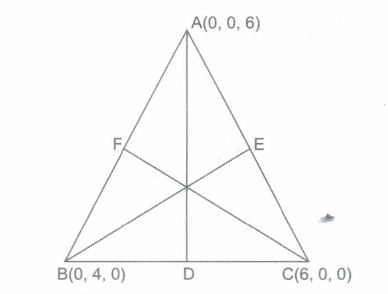
Now D is mid point of BC
\(\therefore \) Coordinates of D is \(\left( \frac { 0+6 }{ 2 } ,\frac { 4+0 }{ 2 } ,\frac { 0+0 }{ 2 } \right) \)= (3,2,0)
\(\therefore \quad AD=\sqrt { (0-3)^{ 2 }+(0-2)^{ 2 }+(6-0)^{ 2 } } \)
=\(\sqrt { 9+4+36 } =\sqrt { 7 } \) units.
Also E is mid point of AC
\(\therefore \) Coordinates of E is \(\left( \frac { 0+6 }{ 2 } ,\frac { 0+0 }{ 2 } ,\frac { 6+0 }{ 2 } \right) \)= (3,0,3)
\(\therefore \quad BE=\sqrt { (0-3)^{ 2 }+(4-0)^{ 2 }+(0-3)^{ 3 } } \)
\(=\sqrt { 9+16+9 } =\sqrt { 34 } \)units.
Also F is mid point of AB
\(\therefore \) Coordiates of F is \(\left( \frac { 0+0 }{ 2 } ,\frac { 0+4 }{ 2 } ,\frac { 6+0 }{ 2 } \right) \)=(0,2,3)
\(\therefore \) CF=\(\sqrt { (6-0)^{ 2 }+(0-2)^{ 2 }+(0-3)^{ 2 } } \)
\(=\sqrt { 36+4+9 } =7\)units.
15.
Let D(x, y, z) be the fourth vertex of parallelogram ABCD.
We know that diagonals of a parallelogram bisect each other. So the mid points ofAC and BD coincide.
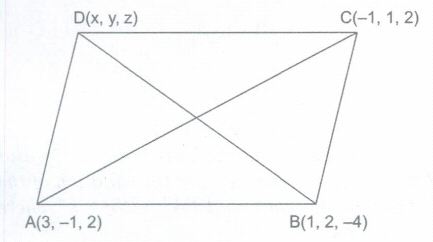
\(\therefore \) Coordinates of mid point of AC \(\left( \frac { 3-1 }{ 2 } ,\frac { -1+1 }{ 2 } ,\frac { 2+2 }{ 2 } \right) \)=(1,0,2)
Also coordiantes of mid point of BD \(\left( \frac { x+1 }{ 2 } ,\frac { y+2 }{ 2 } ,\frac { z-4 }{ 2 } \right) \)
\(\therefore \quad \frac { x+1 }{ 2 } =1\Rightarrow x+1=2\Rightarrow x=1\)
\(\frac { y+2 }{ 2 } =0\Rightarrow y+2=0\Rightarrow y=-2\)
\(\frac { z-4 }{ 2 } =2\Rightarrow z-4=4\Rightarrow z=8\)
Thus the coordinates of point Dare (1, -2,8).

11th Standard CBSE Syllabus & Materials
11th Standard CBSE
CBSE 11th Business Studies Forms of Business Organisation Sample Question Papers Study Material - QB365 Set A
NEW11th Standard CBSE
CBSE 11th Business Studies Business, Trade and Commerce Sample Question Papers Study Material - QB365 Set A
NEW11th Standard CBSE
CBSE 11th Physics Waves Sample Question Papers Study Material - QB365 Set A
NEW11th Standard CBSE
CBSE 11th Physics Kinetic Theory Sample Question Papers Study Material - QB365 Set A



CBSE 11th Standard CBSE Subjects
CBSE Standards









