
 100% FREE ACCESS
11th Standard CBSE Syllabus & Materials
11th Standard CBSE
CBSE 11th Economics PART-A - Presentation of Data - New Sample Question Papers Study Material - QB365 Set A
NEW11th Standard CBSE
CBSE 11th Economics PART-A - Organisation of Data - New Sample Question Papers Study Material - QB365 Set A
NEW11th Standard CBSE
CBSE 11th Economics PART-A - Collection of Data - New Sample Question Papers Study Material - QB365 Set A
NEW11th Standard CBSE
CBSE 11th Economics PART-A - Introduction to Economics and Statistics - New Sample Question Papers Study Material - QB365 Set A
NEW11th Standard CBSE
CBSE 11th Business Studies International Trade Sample Question Papers Study Material - QB365 Set A
NEW11th Standard CBSE
CBSE 11th Business Studies Evolution and Fundamentals of Business Sample Question Papers Study Material - QB365 Set A

Published on: 16/12/2019
Linear Inequalities
Download CBSE Class 11th Standard CBSE Mathematics question papers, sample papers, important questions, and previous year solved papers in PDF format. Get free study materials, NCERT solutions, and exam preparation resources for Class 11th Standard CBSE Mathematics
Questions + Answers key
Take MCQ Mathematics Test
1.
The water acidity in a pool is considered normal when the average pH reading of three daily measurements is between 8.2 and 8.5. If the two pH readings are 8.48 and 8.35, find the range of pH value for the third reading that will result in the acidity level being normal.
2.
Find all pairs of consecutive odd positive integers, both of which are smaller than 18, such that their sum is more than 20.
3.
Find all the pairs of consecutive positive integers, both of which are larger than 8 such that their sum is less than 28.
4.
solution of 8% boric acid is to be diluted by adding a 2% boric acid solution to it. The resulting mixture is to be more than 4% but less than 6% boric acid. If we have 640 lit res of the 8% solution, have many litres of the 2% solution will have to be added?
5.
Find the pairs of consecutive even positive integers which are larger than 5and are such that their sum is less than 20
6.
Solve the inequation \(\frac { 2x+4 }{ x-3 } \le 4\)
7.
Solve the following inequations: \(\frac { 2x-3 }{ 4 } +19\ge 13+\frac { 4x }{ 3 } \)
8.
Solve the liner inequations x + 7 \(\ge\) - 3x + 19
9.
Solve the inequalities Graphically y < - 2
10.
Solve the inequalities: \(\frac { 4+2x }{ 3 } \ge \frac { x }{ 2 } -3\)
11.
Solve the inequalities:\(\frac { x-1 }{ 3 } +4<\frac { x-5 }{ 5 } -2\)
12.
Solve the following linear in equations: 2x + 8 < 0
13.
Solve the following linear in equations: 4x - 12 \(\ge\) 0
14.
Solve the inequalities graphically 2x +y \(\ge\) 4, x + y \(\le\) 3, 2x -3y \(\le\) 6
15.
Solve the inequalities graphically 3x +4y \(\le\) 60, x +3y \(\le\) 30, x \(\ge\)0, y \(\ge\) 0
1.
\(8.2<\frac { 8.48+8.35+x }{ 3 } <8.5\)
Between 7.77 and 8.77
2.
(11, 13), (13, 15), (15, 17)
3.
(10, 12), (12, 14)
4.
Let x litre of 2% boric acid solution be added to 640litres of 8%boric acid solution. Then
Total quantity of mixture = (640 + x) litres
Total boric acid in (640 + x) litres of mixture
= \(\frac { 2x }{ 100 } +\frac { 8 }{ 100 } \times 640=\frac { x }{ 50 } +\frac { 256 }{ 5 } \)
It is given that the resulting mixture must be more than 4% but less than 6% boric acid
\(\therefore\) \(\frac { 4 }{ 100 } (640+x)<\frac { x }{ 50 } +\frac { 256 }{ 5 } <\frac { 6 }{ 100 } (640+x)\)
\(\Rightarrow\) \(\frac { 640+x }{ 25 } <\frac { x+2560 }{ 50 } <\frac { 1920+3x }{ 50 } \)
\(\Rightarrow\) 1280 + 2x
\(\Rightarrow\) x < 1280 and x > 320
\(\Rightarrow\) 320
5.
Let the consecutive even positive integers be x and x + 2
\(\therefore\) x > 5 . and x + 2 > 5
\(\Rightarrow\) x > 5 and x > 3
\(\Rightarrow\) x > 5 ....(i)
Also x + (x + 2) < 20
\(\Rightarrow\) 2x < 20 - 2 => 2x < 18
\(\Rightarrow\) x < 9 .....(ii)
From (i) and (ii), we have
5
But x is even positive integer
\(\therefore\) x = 6and8
Thus two pairs of even positive integers are 6, 8 and 8, 10
6.
Here \(\frac { 2x+4 }{ x-3 } \le 4\), \(x\neq 3\)
\(\Rightarrow\) \(\frac { 2x+4 }{ x-3 } -4\) \(\le\) 0 \(\Rightarrow\) \(\frac { 2x+4-4x+12 }{ x-3 } \le 0\)
\(\Rightarrow\) \(\frac { -2x+16 }{ x-3 } \le 0\) \(\Rightarrow\) -2x + 16\(\le\) 0
\(\Rightarrow\) -2x \(\le\) - 16
Dividing both sides by - 2
\(\therefore\) \(\frac { -2x }{ -2 } \le \frac { -16 }{ -2 } \) \(\Rightarrow\) x \(\ge\) 8
Thus the Solution et of given in equation is [8, \(\infty\))
7.
Here \(\frac { 2x-3 }{ 4 } +19\ge 13+\frac { 4x }{ 3 } \)
\(\frac { 2x-3 }{ 4 } -\frac { 4x }{ 3 } \) \(\ge\) 13 -19
\(\frac { 6x-9-16x }{ 12 } \) \(\ge\) -6 \(\Rightarrow\) \(\frac { -10x-9 }{ 12 } \) \(\ge\) -6
Multiplying both sides by 12
\(\therefore\) -10x - 9 \(\ge\) -6 x 12
\(\Rightarrow\) -10x -9 \(\ge\) -72
\(\Rightarrow\) -10x \(\ge\) -72 + 9
\(\Rightarrow\) -10x \(\ge\) -63
Dividing both sides by - 1 0
\(\therefore\) \(\frac { -10x }{ 10 } \le \frac { -63 }{ -10 } \)
\(\therefore\) \(x\le \frac { 63 }{ 10 } \)
Thus the solution set of given in equation is \(\left( -\infty ,\frac { 63 }{ 10 } \right) \)
8.
[3, \(\infty\))
9.
The given inequality is y < -2
Draw the graph of line y = -2.
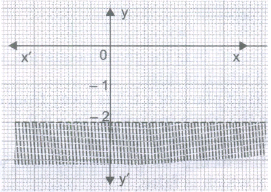
Putting (0, 0) in the given inequation, we have 0 < -2 which is false
\(\therefore\) half plane of y < -2 is away from origin
10.
[-26,\(\infty\))
11.
(-\(\infty\), -50)
12.
(4,\(\infty\))
13.
(3,\(\infty\)]
14.
The given inequality is 2x +y \(\ge\) 4
Draw the graph of the line 2x + y = 4
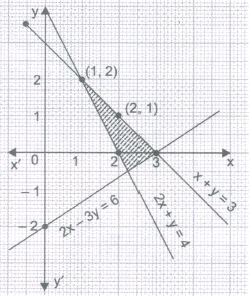
Table of values satisfying the equation 2x +y = 4
| x | 2 | 1 |
| y | 0 | 2 |
Putting (0,0) in the given inequation, we have 2 x 0 + 0 \(\ge\) 0 \(\Rightarrow\) 0 \(\ge\)4, which is false
\(\therefore\) Half plane of 2x +y \(\ge\)4 is awy from origin
Also the given inequality is x + Y \(\le\)3.
Draw the graph of the line x + y = 3.
Table of values satisfying the equation x +y = 3
| x | 2 | 1 |
| y | 1 | 2 |
The putting (0,0) in the given inequation, we have 0 + 0 \(\le\) 3 \(\Rightarrow\) 0 \(\le\) 3, Which is true
\(\therefore\) Half plane inequality is 2x - 3y \(\le\)6
Table of values satisfyinh the equation 2x -3y = 6
| x | 0 | 3 |
| y | -2 | 0 |
Putting (0, 0) in the given inequation, we have 2 x 0 -3 x 0 \(\le\) 6 \(\Rightarrow\) 0 \(\le\) 6, which is true
\(\therefore\) Half plane of 2x -3y \(\le\)6 is towards origin
15.
The given inequality is 3x +4y \(\le\)60
Draw the graph of the line 3x +4y = 60
Table of values satisfying the equation 3x +4y = 60
| x | 8 | 12 |
| y | 9 | 6 |
Putting (0, 0) in the given inequation, we have 3 x 0 + 4 x 0 \(\le\) 60 \(\Rightarrow\) 0 \(\le\)60, which is true
\(\therefore\) Half plane of 3x+4y \(\le\) 60 is towards origin
Also the given inequality is x + 3y \(\le\) 30
Draw the graph of the line x +2y = 30
Table of values satisfying the equation x +3y = 30
| x | 0 | 9 |
| y | 10 | 7 |
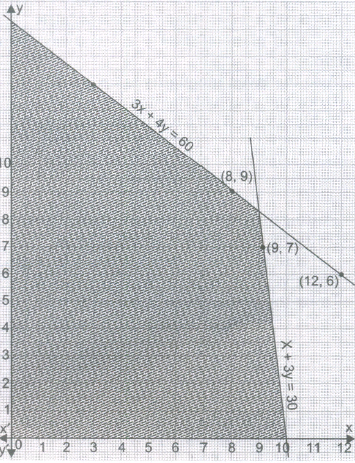
Putting (0, 0) in the given inequation, we have 0 + 3 x 0 \(\le\) 30 \(\Rightarrow\) 0 \(\le\) 30, which is true
\(\therefore\) Half plane of c +3y \(\le\) 30 is towards origin

11th Standard CBSE Syllabus & Materials
11th Standard CBSE
CBSE 11th Business Studies Forms of Business Organisation Sample Question Papers Study Material - QB365 Set A
NEW11th Standard CBSE
CBSE 11th Business Studies Business, Trade and Commerce Sample Question Papers Study Material - QB365 Set A
NEW11th Standard CBSE
CBSE 11th Physics Waves Sample Question Papers Study Material - QB365 Set A
NEW11th Standard CBSE
CBSE 11th Physics Kinetic Theory Sample Question Papers Study Material - QB365 Set A



CBSE 11th Standard CBSE Subjects
CBSE Standards









