
 100% FREE ACCESS
11th Standard CBSE Syllabus & Materials
11th Standard CBSE
CBSE 11th Economics PART-A - Presentation of Data - New Sample Question Papers Study Material - QB365 Set A
NEW11th Standard CBSE
CBSE 11th Economics PART-A - Organisation of Data - New Sample Question Papers Study Material - QB365 Set A
NEW11th Standard CBSE
CBSE 11th Economics PART-A - Collection of Data - New Sample Question Papers Study Material - QB365 Set A
NEW11th Standard CBSE
CBSE 11th Economics PART-A - Introduction to Economics and Statistics - New Sample Question Papers Study Material - QB365 Set A
NEW11th Standard CBSE
CBSE 11th Business Studies International Trade Sample Question Papers Study Material - QB365 Set A
NEW11th Standard CBSE
CBSE 11th Business Studies Evolution and Fundamentals of Business Sample Question Papers Study Material - QB365 Set A

Published on: 18/01/2020
Download CBSE Class 11th Standard CBSE Mathematics question papers, sample papers, important questions, and previous year solved papers in PDF format. Get free study materials, NCERT solutions, and exam preparation resources for Class 11th Standard CBSE Mathematics
Questions + Answers key
Take MCQ Mathematics Test
1.
Evaluate:\(\lim_ { x\rightarrow 0 } \frac { { e }^{ x }-1-x-{ x }^{ 2 } }{ { x }^{ 2 } } \)
2.
In an examination, a student has to answer 4 questions out of 5 questions, questions 1 and 2 are compulsory. Determine the number of ways in which the student can make the choice.
3.
Find the derivative of x5(3-6x-9)
4.
Find the area of an equilateral triangle inscribed in the circule x2+y2+2gx+2fy+c=0.
5.
Find the coordinates of the point which divides the line segment joining the points (1, -2, -1) and
(1,5, -8) in the ratio
(i) 3:4 internally (ii) 3:4 externally
6.
Find the values of cos 75o
7.
Find the mean deviation about the mean of the following data:
| Classes | 5-6 | 6-7 | 7-8 | 8-9 | 9-10 | 10-11 |
| Frequencies | 8 | 20 | 12 | 6 | 3 | 1 |
8.
solution of 8% boric acid is to be diluted by adding a 2% boric acid solution to it. The resulting mixture is to be more than 4% but less than 6% boric acid. If we have 640 lit res of the 8% solution, have many litres of the 2% solution will have to be added?
9.
Express the complex number in the form a+ib: (1-i)4
10.
If U = {1, 2, 3,4,5,6,7,8,9,10},A = {2, 4, 6, 8, 10},B = {1, 3, 5, 7, 9}, C = {3, 4, 7, 8, 10},find:
B' - A'
11.
For each of the following statement, determine whether an inclusive 'OR' or exclusive 'OR' is used.Give reason for your answer.
Students can take Hindi or Sanskrit as their third language.
12.
Find the inclination of the lines x - y + 3 = 0 with the positive direction of X-axis
13.
If \( \frac{a^n+b^n}{a^{n-1}+b^{n-1}}\) is AM between a and b , then find the value of n.
14.
Find n in the binomial\({ \left( \sqrt [ 3 ]{ 2 } +\frac { 1 }{ \sqrt [ 3 ]{ 3 } } \right) }^{ n }\), if the ratio of 7th term from the beginning to the 7th term from the end is\(\frac { 1 }{ 6 } \).
15.
A room has 7 doors. In how many ways can a man enter the room through one door and come out through a different door ?
16.
Evaluate \(\underset { x\longrightarrow 0 }{ lim } \cfrac { { tan\quad x }^{ 0 } }{ { x }^{ 0 } } \)
17.
Let A be the set of first 10 natural numbers and let R be a relation on A defined by \(\left( x,y \right) \in R\Leftrightarrow x+2y=10\) i.e R = \(\left\{ \left( x,y \right) :x\in A,y\in A\quad and\quad x+2y=10 \right\} \). Express R and \({ R }^{ -1 }\) as sets of ordered pair. Also, determine
(i) domain of R and \({ R }^{ -1 }\)
(ii)Range of R and \({ R }^{ -1 }\)
18.
Which of the following pairs of sets are equal? Justify your answer.
A= {x : x is a letter of the word "LOYAL"},
B= {x : x is a letter of the word "ALLOY"}
19.
Find the general solution for each of the following equations:
sin x + sin 3x + sin 5x = 0
20.
A committe of two persons is selected from two men and two women.What is the probability that the committee will have one man?
21.
Evaluate (sin x - cos x)
22.
Show that the points P(0,7,10), Q(-1,6,6)and R(-4,9,6) form a right angled isosceles triangle.
23.
Find the equation of parabola whose focus is (2,3) and directrix is x-2y-6=0
24.
If the integers r (>1), n (>2) and coefficients of (3r)th and (r + 2)nd terms in the expansion of (1 + x)2n are equal, then prove that n = 2r.
25.
How many numbers lying between 100 and 1000 can be formed with the digits 0, 1, 2, 3, 4, 5, if the repetition of the digits is not allowed?
26.
Solve \(\left| x \right| <4\) and represent the sollution set on number line.
27.
If \(\frac { z-1 }{ z+1 } \) is a purely imaginary number \((z\neq -1)\) then find the value of \(|z|\)
28.
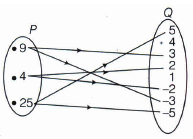
Write the relation between set P and Q given by an arrow diagram in
(i) roster form (ii) set-builder form
29.
Which of the following sentences are statements? Give reasons for your answer.
(i)There are 35 days in a month.
(ii)Mathematics is difficult.
(iii)The sum of 5 and 7 is greater than 10.
(iv) The square of a number is an even number.
(v) The sides of a quadrilateral have equal length.
(vi) Answer this question.
(vii)The product of (-1) and 8 is 8.
(viii) The sum of all interior angles of a triangle is 180°.
(ix) Today is a windy day.
(x) All real numbers are complex numbers.
30.
Prove by the principle of mathematical induction that \({ 3 }^{ n }>{ 2 }^{ n }\) , for all \(n\in N\) .
31.
Show that the following statement is true. p:For any real numbers x,y if x = y, then 2x + a = 2y + a when a \(\in\) Z.
32.
Prove that \({ 1 }^{ 2 }{ +2 }^{ 2 }+....+{ n }^{ 2 }>\frac { { n }^{ 3 } }{ 3 } ,n\in N\) .
33.
How many numbers are there between 100 and 1000 such that at least one of their digits is 7?
34.
Given that P(5, 4, -2), Q (7, 6, -4) and R (11, 10, -8) are collinear points. Find the ratio in which Q divides PR.
35.
Find the square root of \(3-4\sqrt 7i\).
36.
Find the equation of the ellipse \(\frac { { x }^{ 2 } }{ { a }^{ 2 } } +\frac { { y }^{ 2 } }{ { b }^{ 2 } } =1\) when the origin is shifted to (-3, 2).
37.
The mean and variance of eight observations are 9 and 9.25 respectively. If six of the observations are 6, 7, 10, 12, 12 and 13, find the remaining two observations.
38.
The difference between any two consecutive interior angles of a polgon is 5°. If the smallest angle is 120°, find the number of the sides of the polygon.
39.
If A = {3, 5, 7,9, 11}, B = {7, 9, 11, 13}, C = {11, 13, 15} and D = {15, 17};find:
(l) A \(\cap\) B
(ii) B \(\cap\) C
(iii) A \(\cap\) C \(\cap\) D
(iv) A \(\cap\) C
(v) B \(\cap\) D
(vi)A \(\cap\) (B\(\cup\) C)
(vii) A \(\cap\) D
(viil) A \(\cap\) (B \(\cup\) D)
(ix) (A \(\cap\)B) \(\cap\) (B \(\cup\) C)
(x) (A \(\cup\) D) \(\cap\) (B \(\cup\) C)
1.
\(\lim_ { x\rightarrow 0 }\frac { { e }^{ x }-1-x-{ x }^{ 2 } }{ { x }^{ 2 } } \)
\(\Rightarrow \lim_ { x\rightarrow 0 } \left[ \frac { \left( 1+x+\frac { { x }^{ 2 } }{ 2! } +\frac { { x }^{ 3 } }{ 3! } ... \right) -1-x }{ { x }^{ 2 } } -1 \right] \left[ \because { e }^{ x }=1+x+\frac { { x }^{ 2 } }{ 2! } +\frac { { x }^{ 3 } }{ 3! } ... \right] \)
\(\Rightarrow \lim_ { x\rightarrow 0 } \frac { \left( \frac { { x }^{ 2 } }{ 2! } +\frac { { x }^{ 3 } }{ 3! } +.. \right) }{ { x }^{ 2 } } -1\)
\(\Rightarrow \lim_ { x\rightarrow 0 } \frac { { x }^{ 2 }\left( \frac { 1 }{ 2! } +\frac { { x } }{ 3! } +.... \right) }{ { x }^{ 2 } } -1\)
\(\Rightarrow \lim_{ x\rightarrow 0 } \frac { 1 }{ 2! } +\frac { { x } }{ 3! } -1\Rightarrow \frac { 1 }{ 2 } -1\Rightarrow -\frac { 1 }{ 2 } \)
2.
3
3.
Here \(f(x)=x^{5}(3-6x^{-9})\)
∴ \(f^{'}(x)=\frac{d}{dx}[x^{5}(3-6x^{-9})] \)
=\(x^{5}\frac{d}{dx}(3-6x^{-9})+(3-6x^{-9})\frac{d}{dx}(x^{5})\)
=\(x^{5}(54x^{-10})+(3-6x^{-9})\times 5x^{4}\)
=\(54x^{-5}+15x^{4}-30x^{-5}\)
=\(24x^{-5}+15x^{4}\)
=\(\frac{24}{x^{5}}+15x^{4}\).
4.
Let ABC be an equilateral triangle inscribed in the circle
x2+y2+2gx+2fy+c=0.
Then center of circle isO(−g,−f).
\(\therefore OA=OB=OC=\sqrt { { { g }^{ 2 }{ +f }^{ 2 }-c } } \)
\(In\triangle OBD\)
\(\sin { 60^{ 0 } } =\frac { BD }{ OB } \Rightarrow \frac { \sqrt { 3 } }{ 2 } =\frac { BD }{ \sqrt { { g }^{ 2 }{ f }^{ 2 }-c } } \)
\(\therefore \quad BD=\frac { \sqrt { 3 } }{ 2 } \sqrt { { g }^{ 2 }{ f }^{ 2 }-c } \)
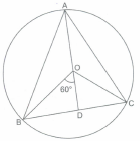
\(Also\quad BC=2BD\)
\( \Rightarrow BC=\sqrt { 3 } \sqrt { { g }^{ 2 }+{ f }^{ 2 }-c } \)
\( Area\quad \triangle ABC=\frac { \sqrt { 3 } }{ 4 } \times \left( BC \right) ^{ 2 }\)
\(=\frac { \sqrt { 3 } }{ 4 } \times 3({ g }^{ 2 }+{ f }^{ 2 }-c)\)
\(=\frac { 3\sqrt { 3 } }{ 4 } { (g }^{ 2 }{ +f }^{ 2 }-c)\) sq.units
5.
(1, 1, -4)
6.
\({\sqrt{3}-1\over 2\sqrt{2}}\)
7.
0.97
8.
Let x litre of 2% boric acid solution be added to 640litres of 8%boric acid solution. Then
Total quantity of mixture = (640 + x) litres
Total boric acid in (640 + x) litres of mixture
= \(\frac { 2x }{ 100 } +\frac { 8 }{ 100 } \times 640=\frac { x }{ 50 } +\frac { 256 }{ 5 } \)
It is given that the resulting mixture must be more than 4% but less than 6% boric acid
\(\therefore\) \(\frac { 4 }{ 100 } (640+x)<\frac { x }{ 50 } +\frac { 256 }{ 5 } <\frac { 6 }{ 100 } (640+x)\)
\(\Rightarrow\) \(\frac { 640+x }{ 25 } <\frac { x+2560 }{ 50 } <\frac { 1920+3x }{ 50 } \)
\(\Rightarrow\) 1280 + 2x
\(\Rightarrow\) x < 1280 and x > 320
\(\Rightarrow\) 320
9.
(1-i)4 =[(1-i)2]2 = (1+i2-2i)2
= (1-1-2i)2 = (-2i)2
= 4i2=4\(\times\)-1 =-4
10.
{2,4,6,8,10}
11.
Exclusive 'OR' because students cannot take both Hindi and Sanskrit as their language
12.
The equation of the lines x - y + 3 = 0 can be rewritten as y = x + 3.
Here m=tan\(\theta \)=1 \(\theta \)=450.
13.
We know that AM between a and b is \( \frac{a+b}{2}\)
\(\therefore\) \(\frac{a^n+b^n}{a^{n-1+b^{n-1}}}\) = \(\frac{a+b}{2}\)
\(\Rightarrow\) 2a\(^n\) +2b\(^n\) = a\(^n\) +ab\(^{n-1}\)+ba\(^{n-1}\)+b\(^n\)
\(\Rightarrow\) 2a\(^n\) -a\(^n\) +2b\(^n\) -b\(^n\) = ab\(^{n-1}\) +ba\(^{n-1}\)
\(\Rightarrow\) a\(^n\)+b\(^n\)= ab\(^{n-1}\)+ba\(^{n-1}\)
\(\Rightarrow\) a\(^n\) - ba\(^{n-1}\) = ab\(^{n-1}\) - bn
\(\Rightarrow\) a\(^{n-1}\)[a-b] = b\(^{n-1}\) [a-b]
\(\Rightarrow\) a\(^{n-1}\) = b\(^{n-1}\) [ \(\because\) a \(\neq\) b]
\(\Rightarrow\) \((\frac{a}{n})^{n-1}\) = 1 = \( (\frac{a}{n})^0\) [ \(\because\)x\(^0\) = 1 ]
On comparing the exponential powersd, we get
n - 1 = 0
\(\Rightarrow\) n = 1
14.
\({ T }_{ 7 }=^{ n }{ { C }_{ 6 } }{ \left( \sqrt [ 3 ]{ 2 } \right) }^{ n-6 }{ \left( \frac { 1 }{ \sqrt [ 3 ]{ 3 } } \right) }^{ 6 }=^{ n }{ { C }_{ 6 } }{ 2 }^{ \frac { n-6 }{ 3 } }{ \left( \frac { 1 }{ 3 } \right) }^{ 2 }\)
and 7th term from the end = (n + 1) - (7 - 1)th term from beginning =(n - 5)th term from beginning.
\(=^{ n }{ { C }_{ n-6 } }{ \left( \sqrt [ 3 ]{ 2 } \right) }^{ n-n+6 }{ \left( \frac { 1 }{ \sqrt [ 3 ]{ 3 } } \right) }=^{ n }{ { C }_{ n-6 } }{ 2 }^{ 2 }{ \left( \frac { 1 }{ 3 } \right) }^{ \frac { n-6 }{ 3 } }\)
Now, \(\frac { ^{ n }{ { C }_{ 6 } }{ 2 }^{ \frac { n-6 }{ 3 } }{ \left( \frac { 1 }{ 3 } \right) }^{ 2 } }{ ^{ n }{ { C }_{ n-6 } }{ 2 }^{ 2 }{ \left( \frac { 1 }{ 3 } \right) } } =\frac { 1 }{ 6 } \Rightarrow \frac { N-12 }{ 3 } =-1\Rightarrow N=9\)
15.
Here, we need to perform two operations:
(i) Selecting a door to enter.
(ii) Selecting a door to come out.
Clearly, the man can enter the room through anyone of the seven doors. So, there are seven ways of entering into the room. Note that the man can come out through anyone of the remaining six doors. So, he can come out through a different door in 6 ways. Hence, by fundamental principle of counting, required number of ways = 7 \(\times\) 6 = 42
16.
\(\underset { x\longrightarrow 0 }{ lim } \frac { { tan\quad x }^{ 0 } }{ { x }^{ 0 } } =\underset { x\longrightarrow 0 }{ lim } \cfrac { tan\frac { \pi x }{ 180 } }{ \frac { \pi x }{ 180 } } =1\)
17.
Given, R = \(\left\{ \left( x,y \right) :x\in A,y\in A\quad and\quad x+2y=10 \right\} \)
Here, x+2y=10
\(\Rightarrow \) \(y=\frac { 10-x }{ 2 } \forall x,y\in A\) .....(i)
and A={1,2,3,4,5,6,7,8,9,10}
From Eq. (i),
When x = 2,y = 4; When x = 4,y = 3
When x = 6,y = 2; When x = 8,y = 1
\(\therefore \) R = {(2,4),(4,3),(6,2),(8,1)}
\(\Rightarrow \) \({ R }^{ -1 }\)= {(4,2),(3,4),(2,6),(1,8)}
Clearly, domain (R) = {2,4,6,8} = Range(\({ R }^{ -1 }\)) and range (R) = {4,3,2,1} = Domain(\({ R }^{ -1 }\))
18.
Given, A= {x : x is a letter of the word "LOYAL"} = {L, O, Y, A}
and B= {x : x is a letter of the word "ALLOY"} = {A, L, O, Y}
Here, we see that both sets have exactly the same elements.
\(\therefore \) A = B
19.
sin x + sin 3x + sin 5x = 0
\(\Rightarrow\)(sin 5x + sin x) + sin 3x = 0
\(\Rightarrow\)2sin \(({5x+x\over 2})cos ({5x+x\over 2})+sin 3x=0\)
\(\Rightarrow\)2 sin 3x cos 2x + sin 3x = 0
\(\Rightarrow\)sin 3x (2 cos 2x + 1) = 0
\(\Rightarrow\)Either sin 3x = 0 or 2 cos 2x + 1 = 0
\(\Rightarrow\)3x = n\(\pi\) or cos 2x=\(-{1\over2}=cos {2\pi\over3},n\in Z\)
\(\Rightarrow\) \(x={n\pi\over3} or 2x=2n\pi\pm{2\pi\over3},n\in z.\)
\(\Rightarrow\) \(x={n\pi\over3} or x=n\pi\pm{\pi\over3},n\in z.\)
20.
Number of favourable outcomes = \(^{ 2 }{ C }_{ 1 }\)x \(^{ 2 }{ C }_{ 1 }\)
= \(\frac{2}{3}\)
21.
cos x + sin x.
22.
\(PQ=QR\quad and\quad { PQ }^{ 2 }+{ QR }^{ 2 }={ PR }^{ 2 }\)
23.
Let p(x,y) be any point on the parabola.
=Distance of p(x,y) from the directrix x-2y-6=0 [by definition of parabola]
PF=PM
PF2=PM2
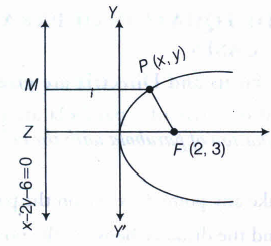
\(\Rightarrow (x-2)^{ 2 }+(y-3)^{ 2 }=\left| \frac { x-2y-6 }{ \sqrt { 1^{ 2 }+2^{ 2 } } } \right| ^{ 2 }\)
\(\Rightarrow (x-2)^{ 2 }+(y-3)^{ 2 }=\frac { (x-2y-6)^{ 2 } }{ 5 } \)
\(\Rightarrow 5[(x-2)^{ 2 }+(y-3)^{ 2 }]=(x-2y-6)^{ 2 }\)
\(\Rightarrow 5(x^{ 2 }-4x+4+y^{ 2 }-6y+9)\)
\(=x^{ 2 }+4y^{ 2 }+36-12x-4xy+24y\)
\(\Rightarrow { 4x }^{ 2 }+{ y }^{ 2 }+4xy-8x-54y+29=0\)
\(which\quad is\quad the\quad required\quad equation\quad of\quad parabola.\)
24.
Here, r>1, n>2
\(\therefore \) T3r = 2nC3r-1 x3r-1; Tr+2 = 2nCr+1 xr+1
Then, 2nC3r-1= 2nCr+1
\(\Rightarrow \) 3r - 1 + r + 1 = 2n \(\Rightarrow \) n = 2r
25.
Every number between 100 and 1000 is a 3-digit number. We, first, have to count the permutations of 6 digits taken 3 at a time. This number would be 6P3. But, these permutations will include those also where 0 is at the 100’s place. For example, 092, 042, . . ., etc are such numbers which are actually 2-digit numbers and hence the number of such numbers has to be subtracted from 6P3 to get the required number. To get the number of such numbers, we fix 0 at the 100’s place and rearrange the remaining 5 digits taking 2 at a time. This number is 5P2. So,The required number \(={ }^{6} \mathrm{P}_{3}-{ }^{5} \mathrm{P}_{2}=\frac{6 !}{3 !}-\frac{5 !}{3 !} \)
\(=4 \times 5 \times 6-4 \times 5=100\)
26.
|x| <4=-4
Ans.] -4,4 [

27.
Let z = x + iy, then
\(\frac { z-1 }{ z+1 } =\frac { ({ x }^{ 2 }-1)+{ y }^{ 2 }+i[y(x+1)-y(x-1)] }{ ({ x }^{ 2 }+1)^{ 2 }+y^{ 2 } } \\ \)
\(\because \frac { z-1 }{ z+1 } \) is purely imaginary.
\(\therefore Re(\frac { z-1 }{ z+1 } ) =0\ i.e.\ \frac { ({ x }^{ 2 }-1)+{ y }^{ 2 } }{ ({ x }^{ 2 }+1)^{ 2 }+y^{ 2 } } =0\)
\({ x }^{ 2 }-1-{ y }^{ 2 }=0\ \Rightarrow { x }^{ 2 }+{ y }^{ 2 }=1= |z|=1\)
28.
From arrow diagram,we have
\(P=\{ 9,4,25\} \) and \(Q=\{ 5,4,3,2,1,-2,-3,-5\} \)
Here, the relation R is 'x' is the square of 'y' where \(x\in P\) and \(y\in Q\)
In roster form, it can be written as
\(R={ (9,3)(9,-3),(4,2),(4,-2)(25,5)(25,-5)} \)
In set-builder from R cam be written as
\(R=\{ x,y):x\in P,y\in Q\) and x is the square of y}
29.
(i) No month has 35 days. Thus the sentence is false declarative sentence. Hence it is a statement. (ii)Here the correctness of the sentence depends upon the observer. It may be easy for someone and may be difficult for other one. Hence it is not a statement.
(iii)The sentence is true. Hence it is a statement.
(iv) Here the correctness of the sentence depends upon the number that is squared. Hence it is not a statement.
(v) This sentence is sometimes true and sometimes false. For example sides in squares and rhombuses have equal length whereas, in a rectangle and trapezium, they have unequal length. Hence it is not a statement.
(vi) This sentence is an order. Hence it is not a statement.
(vii)The sentence is true. Hence it is a statement.
(viii) The sentence is false. Hence it is a statement.
(ix) It is not clear from the context which day is referred. Hence it is not a statement.
(x) The sentence is true because all real numbers can be written in the form a + i x O.Hence it is a statement.
30.
Step I Let P(n) be the given statement.
i.e.P(n):\({ 3 }^{ n }>{ 2 }^{ n }\)
Step II For =1,we have \({ 3 }^{ 1 }>{ 2 }^{ 1 }\)
\(\Rightarrow \) 3 > 2, Which is true.
Thus P(1) is true.
Step III Let us assume that P(k) is true.
i.e P(k):\({ 3 }^{ k }>{ 2 }^{ k }\)
Step IV Now, we shall prove the statement for n=k+1.For this,we have to show \({ 3 }^{ k+1 }>{ 2 }^{ k+1 }\)
from Eq.(i) we have \({ 3 }^{ k }>{ 2 }^{ k }\)
\({ 3 }^{ k }.3>{ 2 }^{ k }.3\) [multiplying both sides by 3]
\(\Rightarrow \) \({ 3 }^{ k+1 }>{ 2 }^{ k }.3\)
\({ 2 }^{ k }.3>{ 2 }^{ k }.3\) \(\Rightarrow \) \({ 3 }^{ k }.3>{ 2 }^{ k }.2\) = \({ 2 }^{ k+1 }\)
Thus ,P(K+1) is true whenever P(k) is true. Hence, by principle of mathematical induction,P(n) is true for all \(n\in N\)
31.
Direct Method For any real number x,y, it is given
x = y \(\Rightarrow \) 2x = 2y
\(\Rightarrow \) 2x + a = 2y + a for some a \(\in\) Z.
Contrapositive Method The contrapositive statement of 'p' is 'For any real numbers x,y, if 2x+a\(\neq \)2y+a, where a\(\epsilon \)Z.then x\(\neq \)yn .
32.
\({ 1 }^{ 2 }{ +2 }^{ 2 }+....+{ k }^{ 2 }>\frac { { k }^{ 3 } }{ 3 } \)
\(\Rightarrow \) \( { 1 }^{ 2 }{ +2 }^{ 2 }+....+{ k }^{ 2 }+{ (k+1) }^{ 2 }>\frac { { k }^{ 3 } }{ 3 } +{ (k+1) }^{ 2 }\)
\(=\frac { 1 }{ 3 } [{ k }^{ 3 }+{ S(k+1) }^{ 2 }]=\frac { 1 }{ 3 } [{ k }^{ 3 }{ +3k }^{ 2 }+6k+3]\)
\(=\frac { 1 }{ 3 } [({ k }+1)^{ 3 }+3k+2]\)
\({ 1 }^{ 2 }{ +2 }^{ 2 }+....+{ k }^{ 2 }>\frac { 1 }{ 3 } (k+1){k}^{3}\)
33.
Since the numbers between 100 and 1000 are all three digit numbers. So these three digit numbers can be formed by using the digits 0, 1, 2, 3,..., 8, 9.
Here the unit place and tens place can be filled in 10 ways each and hundreds place can be filled in 9 ways.
So total number of three digit numbers between 100 and 1000 = 9 x 10 x 10 = 900
We have to find out those numbers between 100 and 1000 which do not have 7 as a digit.
Here the unit place and tens place can be filled in 9 ways each and hundreds place can be filled in 8 ways.
So total number of three digit numbers between 100 and 1000 which do not have 7 as a digit = 8 x 9 x 9 = 648
Thus total number of three digit numbers between 100 and 1000 which having at least one of their digits as 7 = 900 - 648 = 252.
34.
Let Q divides PR in the ratio k : l. Thus co-ordinates of Q are
\(\left[ \frac { 11k+5 }{ k+1 } ,\frac { 10k+4 }{ k+1 } ,\frac { -8k-2 }{ k+1 } \right] \)
It is given that coordinates of Q are (7, 6, - 4).
\(\therefore \frac { 11k+5 }{ k+1 } =7,\frac { 10k+4 }{ k+1 } =6,\frac { -8k-2 }{ k+1 } =-4\)
Now solving these, we get k=\(\frac { 1 }{ 2 } \) .
Thus Q divides PR in the ratio \(\frac { 1 }{ 2 } \) : 1 or 1 : 2.
35.
Let \(x+yi=\sqrt {3-4\sqrt 7}i\)
Squaring both sides, we get
x2- y2 + 2xyi = \(3-4\sqrt 7i\)
Equating the real and imaginary parts
x2 - y2 = 3.......(i)
\(2xy=-4\sqrt 7\Rightarrow\ xy=-2\sqrt 7\)
Now from the identity, we know
(x2+y2)2=(x2-y2)2+4x2y2
\(=(3)^2+4(-2\sqrt 7)^2\)
=9+112=121
\(\therefore\) x2 + y2 = 11........(ii) [Neglecting (-) sign as x2+y2>0]
Solving (i) and (ii) we get
x2=7 and y2=4
\(\therefore\) \(x=\pm\sqrt 7,y=\pm 2\)
Since the sign of xy is (-)
\(\therefore\) if \(x=\sqrt 7 y=-2\)
and if \(x=-\sqrt 7\ y=2\)
\(\therefore \sqrt {3-4\sqrt7}i=\pm(\sqrt 7-2i).\)
36.
Let (x', y') be the new coordinates of the point (x, y) in new system.
Origin is shifted to a new point (-3, 2) by a translation.
\(\therefore\) h = -3, k = 2
x = x' + h = x' - 3
and y = y' + k = y' + 2
Substituting these vales of x and y in the given equation \(\frac { { x }^{ 2 } }{ { a }^{ 2 } } +\frac { { y }^{ 2 } }{ { b }^{ 2 } } =1\) , we get
\(\frac { ({ x }^{ ' }-3)^{ 2 } }{ { a }^{ 2 } } +\frac { { (y'+2) }^{ 2 } }{ { b }^{ 2 } } =1\)
\(\Rightarrow \frac { { x' }^{ 2 }+9-6x' }{ { a }^{ 2 } } +\frac { { y' }^{ 2 }+4+{ 4y }^{ ' } }{ { b }^{ 2 } } =1\)
\(\Rightarrow\) b2x'2+9b2-6b2x'+a2y'2+4a2+4a2y'=a2b2
\(\Rightarrow\) b2x'2+a2y'2-6b2x'+4a2y'+4a2+9b2-a2b2=0
Hence the new equation of the ellipse is b2x2+a2y2-6b2x+4a2y+4a2+9b2-a2b2 = 0.
37.
Let two remaining observations be x and y. Then
\(\frac { 6+7+10+12+12+13+x+y }{ 8 } =9\)
\(\therefore\) 60 + x + y = 72 \(\Rightarrow\) x + y = 12 ......(i)
Also \(\frac { 1 }{ 8 } ({ 6 }^{ 2 }+{ 7 }^{ 2 }+{ 10 }^{ 2 }+{ 12 }^{ 2 }+{ 12 }^{ 2 }+{ 13 }^{ 2 }+{ x }^{ 2 }+{ y }^{ 2 })-{ (9) }^{ 2 }=9.25\)
\(\Rightarrow \frac { 1 }{ 8 } (36+49+100+144+144+169+{ x }^{ 2 }+{ y }^{ 2 })-81=9.25\)
\(\Rightarrow\) 642 + x2 + y2 = 722
\(\Rightarrow\) x2 + y2 = 80 ......(ii)
Now (x+y)2 + (x-y)2 = 2(x2+y2)
\(\Rightarrow\) (12)2 + (x - y)2 = 2 x 80
\(\Rightarrow\) (x - y)2 = 160 - 144
\(\Rightarrow\) (x - y)2 = 16 \(\Rightarrow\) x - y = \(\pm \) 4
When x - y = 4
Solving x + y = 12 and x - y = 4 we get x = 8 and y = 4
When x - y = -4
Solving x + y = 12 and x - y = -4 we get x = 4 and y = 8.
38.
Let the number of sides of polygon be n. The interior angles of the polygon form an A.P.
Here, a = 120° and d=5°
We know that sum of interior angles of a polygon with n sides is (n-2) \(\times\)180°
Sn = (n-2) \(\times\) 180°
\(\Rightarrow \frac{n}{2}[2 a+(n-1) d]=180^{\circ}(n-2) \)
\(\Rightarrow \frac{n}{2}\left[240^{\circ}+(n-1) 5^{\circ}\right]=180(n-2) \)
\(\Rightarrow n[240+(n-1) 5]=360(n-2) \)
\(\Rightarrow 240 n+5 n^{2}-5 n=360 n-720 \)
\(\Rightarrow 5 n^{2}+235 n-360 n+720=0 \)
\(\Rightarrow 5 n^{2}-125 n+720=0 \)
\(\Rightarrow n^{2}-25 n+144=0 \)
\(\Rightarrow n^{2}-16 n-9 n+144=0 \)
\(\Rightarrow n(n-16)-9(n-16)=0 \)
\(\Rightarrow(n-9)(n-16)=0 \)
\(\Rightarrow n=9 \text { or } 16\)
39.
Here A = {3, 5, 7, 9, 11}, B = {7, 9, 11, 13}, C = {11, 13, 15} and D = {15, 17}
(i) A \(\cap\) B = {3, 5, 7,9, 11} \(\cap\) {7, 9, 11, 13}
= {7, 9, 11}
(ii) B \(\cap\) C = {7, 9, 11, 13} \(\cap\) {11, 13, 15}
= {11, 13}
(iii) A\(\cap\)C\(\cap\)D = {3, 5, 7, 9, 11} \(\cap\) {11, 13, 15} \(\cap\){15,17}=ф
(iv) A\(\cap\) C = {3, 5, 7, 9, 11} \(\cap\) {11, 13, 15}
= {11}
(v) B \(\cap\) D = {7, 9, 11, 13} \(\cap\) {15, 17} = ф
(vi) A\(\cap\)(B \(\cup\)C) ={3, 5, 7, 9, 11} \(\cap\) ({7, 9,11, 13} \(\cup\) {11, 13, 15})
= {3, 5, 7, 9, 11} \(\cap\) {7, 9, 11, 13, 15}
= {7, 9, 11}
(vii) A \(\cap\) D
= {3, 5, 7, 9, 11}\(\cap\) {15, 17} = ф
(viii) A \(\cap\) (B \(\cup\)D)
= {3, 5, 7, 9, 11}\(\cap\) ({7,9,11,13}\(\cup\){15,17}
= {3, 5, 7, 9, 11} \(\cap\) {7, 9,11,13,15,17} = {7, 9, 11}
(ix) (A \(\cap\) B)\(\cap\) (B \(\cup\)C)
= ({3, 5, 7, 9, 11} \(\cap\) {7, 9,11,13}) \(\cap\) ({7, 9, 11, 13} \(\cup\) {11, 13, 15})
= {7, 9, 11} \(\cap\) {7, 9, 11, 13, 15}
= {7, 9, 11}
(x) (A \(\cup\)D) \(\cap\) (B \(\cup\)C)
= ({3, 5, 7, 9, 11}\(\cup\) {15, 17}) \(\cap\) ({7, 9, 11, 13}\(\cup\){11, 13, 15})
= {3, 5, 7, 9, 11, 15, 17}\(\cap\) {7, 9, 11, 13, 15}
= {7, 9, 11, 15}

11th Standard CBSE Syllabus & Materials
11th Standard CBSE
CBSE 11th Business Studies Forms of Business Organisation Sample Question Papers Study Material - QB365 Set A
NEW11th Standard CBSE
CBSE 11th Business Studies Business, Trade and Commerce Sample Question Papers Study Material - QB365 Set A
NEW11th Standard CBSE
CBSE 11th Physics Waves Sample Question Papers Study Material - QB365 Set A
NEW11th Standard CBSE
CBSE 11th Physics Kinetic Theory Sample Question Papers Study Material - QB365 Set A



CBSE 11th Standard CBSE Subjects
CBSE Standards









