
 100% FREE ACCESS
11th Standard CBSE Syllabus & Materials
11th Standard CBSE
CBSE 11th Economics PART-A - Presentation of Data - New Sample Question Papers Study Material - QB365 Set A
NEW11th Standard CBSE
CBSE 11th Economics PART-A - Organisation of Data - New Sample Question Papers Study Material - QB365 Set A
NEW11th Standard CBSE
CBSE 11th Economics PART-A - Collection of Data - New Sample Question Papers Study Material - QB365 Set A
NEW11th Standard CBSE
CBSE 11th Economics PART-A - Introduction to Economics and Statistics - New Sample Question Papers Study Material - QB365 Set A
NEW11th Standard CBSE
CBSE 11th Business Studies International Trade Sample Question Papers Study Material - QB365 Set A
NEW11th Standard CBSE
CBSE 11th Business Studies Evolution and Fundamentals of Business Sample Question Papers Study Material - QB365 Set A

Published on: 16/12/2019
Sequences and Series
Download CBSE Class 11th Standard CBSE Mathematics question papers, sample papers, important questions, and previous year solved papers in PDF format. Get free study materials, NCERT solutions, and exam preparation resources for Class 11th Standard CBSE Mathematics
Questions + Answers key
Take MCQ Mathematics Test
1.
Find the number of terms common to the two AP's 3, 7, 11, .... 407 and 2, 9, 16, ....709.
2.
The 2nd, 31st and last term of an AP are 7\(\frac { 2 }{ 4 } \) , \(\frac { 1 }{ 2 } \) and - 6 \(\frac { 1 }{ 2 } \), respectively. Find the first term and the number of terms.
3.
The sum of an infinite G.P. is 57 and the sum of their cubes is 9747, find the G.P.
4.
If S1, S2, S3, .... SP denote the sums of infinite geometric series whose first terms are 1, 2, 3, .... P respectively and whose common rations are \(\frac{1}{2},\frac{1}{3},\frac{1}{4},....,\frac{1}{P-1}\) respectively Prove that \(S_1+S_2+S_3+..+S_P=\frac{P(P+3)}{2}\)
5.
Find the sum to infinity of the series (x + y) + (x2 + xy + y2) + (x3 + x2y + xy2 + y3) + .......
6.
Using Geometric series, find the rational number whose decimal expansion is 0.142.
7.
The fourth term of a C.P. is 4. Find the product of its first seven terms.
8.
Determine the number of terms in the A.P. 4, 8, 12, 288. Also find its 18th term from the end.
9.
If third and fourth terms in the expansion of (a + b)n are in the ratio as the fourth and fifth terms in (a + b)n+3, find the value of n.
10.
The (m+n)th and (m -n)th terms of G.P are P and q respectively. Show that the mth and nth terms are \(\sqrt { pq } \) and \(p\left( \frac { p }{ q } \right) ^{ \frac { m }{ 2n } }\) respectively
11.
A square is drawn by joining the mid points of the sides of a square. A third square is drawn inside the second square in the same way and the process is continued indefinitely. If the side of the square is 10 cm. Find the sum of the areas of all the squares so formed
12.
Find two numbers whose A.M. is 34 and G.M. is 16
13.
The sum of infinity of the G.P. a, ar, ar2, ar3, ...... \(\infty\) is ______.
\(\frac{a-1}{1-r}\)
\(\frac{a}{1-r}\)
\(\frac{2a}{1-r}\)
\(\frac{a}{1-r^2}\)
14.
The seen to infinity of the series \(1+2.\frac{1}{2}+3.\frac{1}{2^2}+4.\frac{1}{2^3}+...+\infty\) ______.
4
5
1
None
15.
The sum of the square of (n - 1) natural numbers is ______.
\(\frac{n(n+1)(2n+1)}{6}\)
\(\frac{n(n-1)(2n-1)}{6}\)
\(\frac{(n+1)(n-1)(n-2)}{6}\)
None
16.
The sum to infinity of \(\frac{1}{3}+\frac{3}{9}+\frac{5}{27}+\frac{7}{81}+...+\infty\) is ______.
2
1
0
3
17.
If the sum of first n even natural numbers is equal to m times the sum of first n is odd natural numbers then m is equal to ______.
\(\frac { n-1 }{ n } \)
\(\frac { n+1 }{ n } \)
\(\frac { 2n+1 }{ n } \)
None of these
18.
One side of an equilateral triangle is 18 em. The midpoints of its sides are joined to form another triangle whose midpoints, in term, are joined to form further another triangle and so on up to infinity. Fine the sum of the (i) Perimeters of all the triangle (ii) area of all the triangles.
19.
Let Sn denote the sum of the first n terms of an A.P. If S2n then prove that \(\frac { { S }_{ 6n } }{ { S }_{ 6n } } =\frac { 17 }{ 4 } \)
1.
407 = 3 + (m - 1) \(\times \) 4 and 709 = 2 + (n - 1) \(\times \) 7
\(\Longrightarrow \) m = 102 and n = 102
Let pth term of first AP = qth term of second AP.
\(\Longrightarrow \) 3 + (p - 1) \(\times \) 4 = 2 + (q - 1) \(\times \) 7
\(\Longrightarrow \) \(\frac { p+1 }{ 7 } \) = \(\frac { q }{ 4 } \) = k (say) \(\Longrightarrow \) p = 7k - 1 and q = 4k
Since, each AP consists of 102 terms.
\(\therefore \) p \(\le \) 102 and q \(\le \) 102
\(\Longrightarrow \) k \(\le \) \(\frac { 103 }{ 7 } \) and k \(\le \) \(\frac { 102 }{ 4 } \) = 14 term
2.
Tz = 7\(\frac { 3 }{ 2 } \) \(\Longrightarrow \) a + d = \(\frac { 31 }{ 4 } \) and T31 = \(\frac { 1 }{ 2 } \) \(\Longrightarrow \) a + 30d = \(\frac { 1 }{ 2 } \)
On solving, we get d = \(\frac { -1 }{ 4 } \) , a= 8
Now, 8 + (n - 1) \(\left( \frac { -1 }{ 4 } \right) \) = \(\frac { -13 }{ 2 } \) = 8, 59
3.
\(19,\frac{38}{3},\frac{76}{9},....\)
4.
Using \(S_\infty =\frac{a}{1-r}\)
\(S_1=\frac{1}{(1-\frac{1}{2})}=2\)
\(S_2=\frac{2}{(1-\frac{1}{3})}=3\)
\(S_3=\frac{3}{(1-\frac{1}{4})}=4\)
........................
........................
\(SP=\frac{P}{[1-\frac{1}{P-1}]}=P+1\)
\(\therefore\) S1 + S2 + S3 + ..... Sp = 2 + 3 + 4 + .... + (P + 1)
= \(\frac{P}{2}[2\times 2+(P-1)1]\)
= \(\frac{P}{2}(P+3)\)
5.
Given series is (x + y) + (x2 + xy + y2) + (x3 + x2y + xy2 + y3) + ......
\(\Rightarrow \frac{1}{(x-y)}[(x-y)(x+y)+(x-y)(x^2+xy+y^2)+(x-y)(x^3+x^2y+xy^2+y^3)+...]\)
\(\Rightarrow \frac{1}{(x-y)}[(x^2-y^2)+(x^3+y^3)+(x^4-y^4)+....\infty]\)
\(\Rightarrow \frac{1}{(x-y)}[(x^2+x^3+x^4+...\infty)-(y^2+y^3+y^4+....\infty)]\)
\(\Rightarrow \frac{1}{(x-y)}[\frac{x^2}{1-x}-\frac{y^2}{1-y}]\)
\(\Rightarrow \frac{1}{(x-y)}[\frac{x^2-x^2y-y^2+xy^2}{(1-x)(1-y)}]\)
\(\Rightarrow \frac{1}{(x-y)}[\frac{(x^2-y^2)-xy(x-y)}{(1-x)(1-y)}]\)
\(\Rightarrow\frac{x+y-xy}{(1-x)(1-y)}\)
6.
0.142 = 0.1424242 ... \(\infty\)
= 0.1 + 0.042 + 0.00042 + 0.0000042 + ... \(\infty\)
= \(0.1+\frac{42}{10^3}+\frac{42}{10^5}+\frac{42}{10^7}+....\infty\)
= \(\frac{1}{10}+\frac{\frac{42}{10^3}}{[1-\frac{1}{10^2}]}=\frac{1}{10}+\frac{42}{990}=\frac{141}{990}\)
7.
Let a be the first term and r be the common ratio of given G.P. then
a4 = 4 \(\Rightarrow\) ar3 = 4
Now product of first seven terms
= a1· a2· a3· a4· a5· a6· a7
= (a)(ar)(ar2)(ar3)(ar4)(ar5)(ar6)
= a7r2I = (ar3)7
= (4)7 [\(\therefore\) ar3 = 4]
= 16384.
8.
Here a = 4, d = 8 - 4 = 4 and an = 288
We know that an = a + (n - 1)d
\(\therefore\) 288 = 4 + (n - 1) x 4
\(\therefore\) 288 - 4 = (n - 1) x 4
\(\frac { 284 }{ 4 } =(n-1)\)
n = 71 + 1 = 72
Now a = 288 and d =- 4
\(\therefore\) 18th term from end = 288 - (18 - 1) x 4
= 288 - 68 = 220
9.
n = 8
10.
am+n = P and am-n = q \(\Rightarrow\) arm+n-1 and arm-n-1 = q
\(\Rightarrow\) \(\frac { { ar }^{ m+n-1 } }{ { ar }^{ m-n-1 } } =\frac { p }{ q } \) \(\Rightarrow\) \({ r }^{ 2n }=\frac { p }{ q } \) \(\Rightarrow\) \(r=\left( \frac { p }{ q } \right) ^{ \frac { 1 }{ 2n } }\)
am = arm-1 = arm+n-1. \(\left( \frac { 1 }{ r } \right) ^{ n }\) = am+n \(\left( \frac { 1 }{ r } \right) ^{ n }\) = p \(\left( \frac { 1 }{ r } \right) ^{ n }\) = p \(\left( \frac { p }{ q } \right) ^{ \frac { 1 }{ 2n } }\) = \(\sqrt { pq } \)
an = arn-1 = ar m+n - 1.\(\left( \frac { 1 }{ r } \right) ^{ m }\) = am+n \(\left( \frac { 1 }{ r } \right) ^{ m }\) = P \(p\left( \frac { p }{ q } \right) ^{ \frac { 3 }{ 2n } }\)
11.
Side of the First Square =10 cm
Side of the Second Square = \(\sqrt { { 5 }^{ 2 }+{ 5 }^{ 2 } } =\sqrt { 50 } =5\sqrt { 2 } cm\)
Side of the third square = \(\sqrt { \left( \frac { 5\sqrt { 2 } }{ 2 } \right) ^{ 2 }+\left( \frac { 5\sqrt { 2 } }{ 2 } \right) ^{ 2 } } =\sqrt { \frac { 50 }{ 4 } +\frac { 50 }{ 4 } } =5cm\)
Sum of areas of squares = [102 + (5\(\sqrt { 2 } \))2]+52+......]
= [10 + 50 + 25 + ...] = \(\frac { 100 }{ 1-\frac { 1 }{ 2 } } \) = 200 sq.cm
12.
4, 64
13.
(b)
\(\frac{a}{1-r}\)
14.
(d)
None
15.
(b)
\(\frac{n(n-1)(2n-1)}{6}\)
16.
(a)
2
17.
(b)
\(\frac { n+1 }{ n } \)
18.
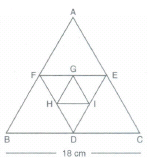
Ref. fig.
(i) As we have studied in previous classes that the line joining the mid points of any two sides of a triangle is half the third side.
\(\therefore\) Sum ofthe perimeters of all the triangle is given by
Sp = 64 + 27 + 13.5 + ... \(\infty\)
= \(\frac{54}{1-\frac{1}{2}}=54\times 2 = 108\) cm.
(ii) We know that the area of the triangle formed by joining the mid points of the sides one-forth of the given triangle.
\(\therefore\) area of equilateral \(\Delta\)ABC
= \(\frac{\sqrt{3}}{4}\times (18)^2=81\sqrt{3}\) cm.
Area of \(\Delta\)DEF = \(\frac{1}{4}\times \) area of \(\Delta\)ABC
= \(\frac{1}{4}\times 81\sqrt{3}=\frac{81}{4}\sqrt{3}\) cm.
and the area of \(\Delta\)GH1 = \(\frac{1}{4}\times \) area of \(\Delta\)DEF
= \(\frac{1}{4}\times \frac{81}{4}\sqrt{3}=\frac{81}{16}\sqrt{3}\) cm.
\(\therefore\) Sum of the areas of all the triangle is
\(S_a=81\sqrt{3}+\frac{81}{4}\sqrt{3}+\frac{81}{16}\sqrt{3}+....\infty\)
Clearly, it is Geometric series whose
\(a=81\sqrt{3}\) and \(r=\frac{1}{4}\)
\(\therefore S_a=\frac{a}{1-r}=\frac{81\sqrt{3}}{1-\frac{1}{4}}=81\sqrt{3}\times \frac{4}{3}\)
= \(108\sqrt{3}\) cm2.
19.
Let a be the first term and d be the common difference of the given A.P. Then
S2n = 5Sn
\(\Rightarrow\) \(\frac { 2n }{ 2 } [2a+(2n-1)d]=5.\frac { n }{ 2 } [2a+(n-1)d]\)
\(\Rightarrow\) 2[2a + (2n - 1)d] = 5[2a + (n - 1)d]
\(\Rightarrow\) 4a + 4nd - 2d = lOa + 5nd - 5d
\(\Rightarrow\) 6a = 4nd - 2d = 5nd - 5d
\(\Rightarrow\) 6a= 3d-nd
\(\Rightarrow\) 6a= (3- n)d
Now \(\frac { { S }_{ 6n } }{ { S }_{ 3n } } =\frac { \frac { 6n }{ 2 } [2a+(6n-1)d] }{ \frac { 3n }{ 2 } [2a+(3n-1)d] } \)
= \(\frac { 6[2a+(6n-1)d] }{ 3[2a+(3n-1)d] } \)
= \(\frac { 12a+36nd-6d }{ 6a+9nd-3d } \)
= \(\frac { 2(3-n)d+36nd-6d }{ (3-n)d+9nd-3d } \)
= \(\frac { 6d-2nd-36nd-6d }{ 3d-nd+9nd-3d } \)
= \(\frac { 34nd }{ 8nd } =\frac { 17 }{ 4 } \)

11th Standard CBSE Syllabus & Materials
11th Standard CBSE
CBSE 11th Business Studies Forms of Business Organisation Sample Question Papers Study Material - QB365 Set A
NEW11th Standard CBSE
CBSE 11th Business Studies Business, Trade and Commerce Sample Question Papers Study Material - QB365 Set A
NEW11th Standard CBSE
CBSE 11th Physics Waves Sample Question Papers Study Material - QB365 Set A
NEW11th Standard CBSE
CBSE 11th Physics Kinetic Theory Sample Question Papers Study Material - QB365 Set A



CBSE 11th Standard CBSE Subjects
CBSE Standards









