
 100% FREE ACCESS
11th Standard CBSE Syllabus & Materials
11th Standard CBSE
CBSE 11th Economics PART-A - Presentation of Data - New Sample Question Papers Study Material - QB365 Set A
NEW11th Standard CBSE
CBSE 11th Economics PART-A - Organisation of Data - New Sample Question Papers Study Material - QB365 Set A
NEW11th Standard CBSE
CBSE 11th Economics PART-A - Collection of Data - New Sample Question Papers Study Material - QB365 Set A
NEW11th Standard CBSE
CBSE 11th Economics PART-A - Introduction to Economics and Statistics - New Sample Question Papers Study Material - QB365 Set A
NEW11th Standard CBSE
CBSE 11th Business Studies International Trade Sample Question Papers Study Material - QB365 Set A
NEW11th Standard CBSE
CBSE 11th Business Studies Evolution and Fundamentals of Business Sample Question Papers Study Material - QB365 Set A

Published on: 20/11/2019
Sets
Download CBSE Class 11th Standard CBSE Mathematics question papers, sample papers, important questions, and previous year solved papers in PDF format. Get free study materials, NCERT solutions, and exam preparation resources for Class 11th Standard CBSE Mathematics
Questions + Answers key
Take MCQ Mathematics Test
1.
Each student in a class of 40, reads atleast one of the subjects Hindi, English and Sanskrit. 16 students read Hindi, 22 read Sanskrit and 26 read English. 5 read Hindi and Sanskrit, 14 read English and Sanskrit and 2 read the three languages. Find the number of students who read.
(i) Hindi and English
(ii) Hindi, English but not Sanskrit.
2.
In a group of 50 people, 30 like to play cricket, 25 like to play football and 32 like to play hockey. Assume that each person in the group likes to play at least one of the three games. If 15 people like to play both cricket and football, 11 like to play football and hockey and 18 like to play cricket and hockey. Find:
(i) How many like to play all three games?
(ii) How many like to play only football?
(iii)How many like to play only hockey?
(iv) How many like to play exactly one game?
3.
Let A, B, C be three sets. If A ∈ Band B ⊂ C, is it true that A ⊂ C?
[Hint: Take A={1},B={{1},2} and C={{1},2,3}]
4.
Which of the following are sets? Justify your answer:
The collection of all odd integers.
5.
Let A = {x :x \(\in\) N}, B= {x : x= 2n, n\(\in\)N, C={x : x = 2n-1, n\(\in\)N} and D= {x :x is a prime natural number}. Find B\(\cap\)C
6.
Let A = {x :x \(\in\) N}, B= {x : x= 2n, n\(\in\)N, C={x : x = 2n-1, n\(\in\)N} and D= {x :x is a prime natural number}. Find A\(\cap\)C
7.
Which of the following sets are finite and which are infinite?
The set of animals living on the Earth.
8.
If U={a,b,c,d,e,f}, A={a,b,c}, B={c,d,e,f}, C={c,d,e}, D={d,e,f}, then tabulate the following set A\(\cap \)C
9.
If X and Y are two sets such that X has 40 elements, X \(\cup \)Y has 60 elements and X\(\cap \)Y has 10 elements, then how many elements does Y have?
Use the formula, n(A\(\cup \)B)=n(A)+n(B)-n(A\(\cap \)B) and simplify it
10.
From the following sets given below, pair the equivalent sets.
A= {1, 2, 3}, B= {t, p, q, r, s}, C= {\(\alpha ,\beta ,\gamma \)} and D= {a, e, i, o, u}
11.
If X={1,2,3} and n represents any member of X, write the following sets containing all numbers represented by n-1
12.
If X={1,2,3} and n represents any member of X, write the following sets containing all numbers represented by \(\frac { n }{ 2 } \)
13.
Draw the Venn diagrams to illustrate the following relationship among sets, E, M and U, where E is the set of students studying English in a school, M is the set of students studying Mathematics in the same school, U is the set of all students in that school.
Some of the students study Mathematics but do not study English, some study English but do not study Mathematics, and some study both.
14.
Let A = {1, 2, {3, 4}, 5}. Which of the following statements are incorrect and why?
(i) {3, 4} ⊂ A
(ii) {3, 4} ∈ A
(iii) {{3, 4}} ⊂ A
(iv) 1 ∈ A
(v) 1⊂ A
(vi) {1, 2, 5} ⊂ A
(vii) {1, 2, 5} ∈ A
(viii) {1, 2, 3} ⊂ A
(ix) ¢ ∈ A
(x) ¢⊂ A
(xi) {¢} ⊂ A.
15.
In a set builder method, the null set is represented by _____.
{}
ф
{x: x\(\ne\)x}
{x : x = x}
16.
If A = {x : x is a multiple of 3} and B = {x : x is a multiple of 5} then A - B is _____.
\(A\cap B\)
\(A-\bar B\)
\(\bar A\cap\bar B\)
\(\overline {A\cap B}\)
17.
If A = {1, 2, 3, 4, 5, 6}then the number of proper sub-sets is _____.
64
36
26
63
18.
If \(A\cap B=B\) then _____.
B⊂A
A=ф
A⊂B
B=ф
19.
For any two sets A and B, \(A\cap(A\cup B)=\)_____.
B
A
ф
none of these
1.
(i) 7
(ii) 5
2.
(i) 7
(ii) 6
(iii) 10
(iv) 20
3.
No
4.
Yes, {..........., -5, -3, -1, 1,3,5,............}
5.
B\(\cap\)C={ } =\(\phi \)
6.
A\(\cap\)C= {x : x = 2n-1, n\(\in\)N} = C
7.
There are finite number of animals living on Earth.
\(\therefore \) It is a finite set.
8.
{c}
9.
Given, n(X)=40, n(X\(\cup \)Y)=60
and n(X\(\cap \)Y) = 10
clearly, n(X\(\cup \)Y)= n(X) + n(Y) - n(X\(\cap \)Y)
\(\Rightarrow \) 60= 40 + n(Y)-10
\(\Rightarrow \) 60= 30 + n(Y)
\(\Rightarrow \) n(Y)= 60-30
\(\therefore\) n(Y)=30
Hence, Y have 30 elements
10.
Given, A= {1, 2, 3} \(\Rightarrow \) n(A) = 3
B= {t, p, q, r, s} \(\Rightarrow \) n(B) = 5
C= {\(\alpha ,\beta ,\gamma \)} \(\Rightarrow \) n(C) = 3
D= {a, e, i, o, u} \(\Rightarrow \) n(D) = 5
Here n(A) = n(C) = 3 and n(B) = n(D) = 5
\(\therefore \) The sets A, C and B, D are equivalent sets.
11.
{0,1,2}
12.
{\(\frac { 1 }{ 2 } ,1,\frac { 3 }{ 2 } \)}
13.
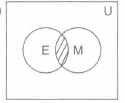
14.
(i) {3, 4} is a member of set A.
\(\therefore\) {3, 4} ∈ A
Hence {3, 4}⊂ A is incorrect.
(ii) {3, 4} is a member of set A.
\(\therefore\){3, 4} ∈ A is correct.
(iii) Here {3, 4} is a member of set A.
\(\therefore\) {{3,4}} is a set
\(\therefore\) {{3,4}} ⊂ A is correct.
(iv) 1 is a member of set A.
\(\therefore\) 1 ∈ A is correct.
(v) 1 is not a set, it is a member of set A.
\(\therefore\) 1⊂ A is incorrect.
(vi) 1, 2, 5 are members of set A.
\(\therefore\) {1, 2, 5} is a subset of set A.
\(\therefore\) {1, 2, 5} ⊂ A is correct.
(vii) 1, 2, 5 are members of set A.
\(\therefore\) {1, 2, 5} is a subset of set A.
\(\therefore\) {1, 2, 5} ∈ A is incorrect.
(viii) 3 is not a member of set A.
\(\therefore\) {1, 2, 3} is not a subset of set A.
\(\therefore\) {1, 2, 3} ⊂ A is incorrect.
(ix) ф is not a member of set A.
\(\therefore\) ф ∈ A is incorrect.
(x) Since ф is subset of every set,
\(\therefore\)ф ⊂ A is correct.
(xi)ф is not a member of set A.
\(\therefore\) {ф} ⊂ A is incorrect.
15.
(c)
{x: x\(\ne\)x}
16.
(b)
\(A-\bar B\)
17.
(d)
63
18.
(a)
B⊂A
19.
(b)
A

11th Standard CBSE Syllabus & Materials
11th Standard CBSE
CBSE 11th Business Studies Forms of Business Organisation Sample Question Papers Study Material - QB365 Set A
NEW11th Standard CBSE
CBSE 11th Business Studies Business, Trade and Commerce Sample Question Papers Study Material - QB365 Set A
NEW11th Standard CBSE
CBSE 11th Physics Waves Sample Question Papers Study Material - QB365 Set A
NEW11th Standard CBSE
CBSE 11th Physics Kinetic Theory Sample Question Papers Study Material - QB365 Set A



CBSE 11th Standard CBSE Subjects
CBSE Standards









