
 100% FREE ACCESS
11th Standard CBSE Syllabus & Materials
11th Standard CBSE
CBSE 11th Economics PART-A - Presentation of Data - New Sample Question Papers Study Material - QB365 Set A
NEW11th Standard CBSE
CBSE 11th Economics PART-A - Organisation of Data - New Sample Question Papers Study Material - QB365 Set A
NEW11th Standard CBSE
CBSE 11th Economics PART-A - Collection of Data - New Sample Question Papers Study Material - QB365 Set A
NEW11th Standard CBSE
CBSE 11th Economics PART-A - Introduction to Economics and Statistics - New Sample Question Papers Study Material - QB365 Set A
NEW11th Standard CBSE
CBSE 11th Business Studies International Trade Sample Question Papers Study Material - QB365 Set A
NEW11th Standard CBSE
CBSE 11th Business Studies Evolution and Fundamentals of Business Sample Question Papers Study Material - QB365 Set A

Published on: 08/10/2019
Straight Lines
Download CBSE Class 11th Standard CBSE Mathematics question papers, sample papers, important questions, and previous year solved papers in PDF format. Get free study materials, NCERT solutions, and exam preparation resources for Class 11th Standard CBSE Mathematics
Questions + Answers key
Take MCQ Mathematics Test
1.
Find the equation of line passing through the origin and the intersection of the line x - y - 7 = 0 and 2x + y - 2 = 0
2.
Find the value of k if the straight line 2x + 3y + 4 + k (6x - y + 12)= 0 is perpendicular to the line 7x + 5y - 4 = 0.
3.
Find the distance of the line 3x - 5y + 8 = 0 from the point (1, 2) along the line 2x - 5y = 0.
4.
The perpendicular from the origin to a line meets it at the point (-3, 5), find the equation of the line.
5.
If the sum of the distance of a moving point in a plane from the axes is 1, then find the locus of the point.
6.
Find the equations of the line through the intersection of lines 3x + 4y = 7 and x - y + 2 = 0 and whose slope is 5
7.
Find the equation of line passing through the intersection of lines 2x-5y+9=0 and x+2y+3=0 and which is parallel to the line 3x + 4y + 7 = 0.
8.
Reduce the lines 6x - 8y + 7 = 0 and 8x - 6y + 11 = 0 to the normal form and hence determine which line is nearer to the origin.
9.
Find the equation of the line passing through the point of intersection of the lines 3x - 5y + 11= 0 and x + 7y - 1 = 0 and which is parallel to x-axis.
10.
Find the area of the triangle formed by the lines y - x = 0, x + y = 0 and x - k = 0.
11.
Reduce the following equations into normal form. Find their perpendicular distances from the origin and angle between perpendicular x-axis.
(i) x - \(\sqrt{3}\)y + 8 = 0,
(ii) y - 2 = 0,
(iii) x - y = 4.
1.
The given equations are x - y - 7 = 0 and 2x + y - 2 = 0
Equation of any line which passes through the intersection of the given lines is
(x - y - 7) + k (2x + y - 2) = 0 ... (i)
If equation (i) also passes through the origin
i.e., (0, 0), we get
-7 -2k= 0
\(∴\ k={7\over 2}\)
Putting the value of k is equation (i), we get
(x - y - 7 ) - \(7\over2\) (2x + y. - 2) = 0
2x - 2y - 14 - 14x - 7y + 14 = 0
⇒ -12x- 9y = 0
⇒ 4x + 3y = 0
2.
The equations of lines are 2x + 3y + 4 + k (6x - y + 12) = 0 and 7x + 5y - 4 = 0.
Let m1 be slope of the line 2x + 3y + 4 + k (6x - y + 12) = 0.
Then \(m_1=-{2+6k\over 3-k}\)
Let m2 be slope of the line 7x + 5y - 4 = 0
Then \(m_2=-{7\over 5}\)
Now m1m2 =-1
\(⇒ \left(-{2+6k\over 3-k}\right)\left(-{7\over5}\right)=-1\)
⇒ 14 + 42k = - 15 + 5k
⇒ 42k - 5k = - 15 - 14
⇒ 37k =- 29
⇒ \(k=-{29\over 37}\)
3.
Here the line 2x - 5y = 0 passes through point B(1, 2) and intersect 3x - 5y + 8 = 0 at point A.
So the coordinates of point A will be obtained by solving 2x- 5y = 0 and 3x- 5y + 18 = 0.
∴ coordinates of point A are \(\left(-8,{-16\over 5}\right)\)
Now PQ =\(\sqrt{(1+8)^2+\left(2+{16\over5}\right)^2 }=\sqrt{81+{676\over25}}\)
\(=\sqrt{20258+676\over 25}=\sqrt{2701\over25}\)
\(={\sqrt{2701}\over 5}\)units
4.
Let m1 be slope of OC then
\(m_1={5-0\over -3-0}=-{5\over3}\)
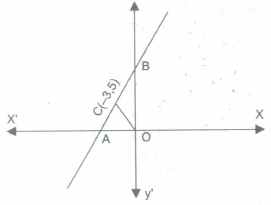
Let mbe slope ofAB then
m x m1 =-1
\(∴\ m\times-{5\over 3}=-1\ ∴\ m={3\over5}\)
The equation of line AB is
y - 5 = \(3\over 5\)[x - (- 3)]
⇒ 5y - 25 = 3x + 9
⇒ 3x - 5y + 34 = 0.
5.
\(\left| x \right| +\left| y \right| =1\),
\(\Rightarrow \pm x\pm y=1\) which forms a square
The locus of the point is a square.
6.
The given equations are 3x + 4y - 7 = 0 and x - y + 2 = 0
Equation of any line passing through the intersection of the given lines is in the form
(3x + 4y - 7) + k (x - y + 2) = 0 ... (i)
⇒ 3x + 4y - 7 + kx - ky + 2k = 0
⇒ (3 + k) x + (4 - k) y - 7 + 2k = 0
Slope= \(-(3+k)\over 4-k\)
∴ \(-{(3+k)\over 4-k}=5\)
⇒ 20 - 5k = -3 - k
⇒ 4k = 23
∴ \(k={23\over 4}\)
Substituting the value of k is equation (i)
\((3x + 4y - 7) +{23\over 4}(x - y + 2) = 0\)
⇒ 12x + 16y - 28 + 23x - 23y + 46 = 0
⇒ 35x - 7y + 18 = 0
7.
The given equation are 2x-5y+9=0 and x+2y+3=0
Equation of any line passing through the point of intersection of the given lines is in the form
(2x-5y+9)+k(x+2y+3) = 0....(i)
\(\Rightarrow\) 2x-5y+9+kx+2ky+3k=0 \(\Rightarrow\) (2+k)x+(2k-5)y+(3k=9)=0
Slope of this line (i) is \(\frac { -(2+k) }{ (2k-5) } ={ m }_{ 1 }\) (Say)
Slope of the given line 3x + 4y + 7 = 0 is =\(\frac { -3 }{ 4 } ={ m }_{ 2 }\) (Say)
If these two lines are parallel to each other
then m1 = m2
\(\Rightarrow -\left( \frac { 2+k }{ 2k-5 } \right) =\frac { -3 }{ 4 } \Rightarrow \) 6k-15=8+4k \(\Rightarrow\) 2k = 23
\(\therefore k=\frac { 23 }{ 2 } \)
Now substituting the value of k in Eq. (1)
(2x-5y+9)+\(\frac { 23 }{ 2 } \)(x+2y+3) = 0
\(\Rightarrow\) 4x-10y+18+23x+46y+69=0
\(\Rightarrow\) 27x + 36y + 87 = 0
which is the required equation.
8.
Here 6x - 8y + 7 = 0
⇒ -6x+ 8y = 7
\(⇒ -{6x\over \sqrt{(-6)^2+(8)^2}}+{8y\over \sqrt{(-6)^2+(8)^2}}\)
\(={7\over \sqrt{(-6)^2+(8)^2}}\)
\(⇒-{6x\over 10}+{8y\over 10}={7\over 10}\)
\(⇒ -{3\over 5}x+{4\over 5}y={7\over 10}\)
Length of perpendicular from origin = \(7\over 10\)
Now 8x - 6y + 11= 0 ⇒ - 8x + 6y = 11
\(⇒ -{8x\over \sqrt{(-8)^2+(6)^2}}+{6y\over \sqrt{(-8)^2+(6)^2}}\)
\(={11\over \sqrt{(-8)^2+(6)^2}}\)
\(⇒ -{8x\over 10}+{6y\over 10}={11\over 10}\)
\(⇒ -{4\over 5}x+{3\over 5}y={11\over 10}\)
Length of perpendicular from origin = \(11\over 10\)
Now \({7\over 10}<{11\over 10}\)
Thus 6x- 8y + 7 = 0 is nearer to the origin.
9.
The equations of the given lines are 3x - 5y + 11 = 0 and x + 7y - 1 = 0
Equation of any line that passes through the intersection of the given lines are in the form
(3x - 5y + 11) + k (x + 7y - 1) = 0 ...(i)
\(\Rightarrow\) (3 + k)x + (-5 + 7k) + 11 - k = 0
Slope of the line is \(\frac{-(3+k)}{(-5+7k)}\)
As the equation (i) is parallel to x-axis
\(\therefore\) Slope is zero
\(\therefore -(\frac{3+k}{-5+7k})=0\)
\(\Rightarrow\) 3 + k = 0
\(\Rightarrow\) k = -3
Now substitute the value of k in equation (i), we get
(3x - 5y + 11) - 3(x + 7y - 1) = 0
\(\Rightarrow\) 3x - 5y + 11 - 3x - 21y + 3 = 0
\(\Rightarrow\) -26y + 14 = 0
\(\Rightarrow\) 13y - 7 = 0.
10.
The equation of lines are
y - x = 0.....(i)
x + y = 0....(ii)
x - k = 0....(iii)
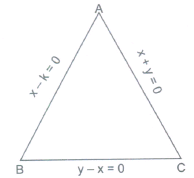
By solving (i) and (ii), we get the coordinates of point C.
\(\therefore\) Coordinate of Care (0, 0).
By solving (ii) and (iii), we get the coordinates of point A.
\(\therefore\) Coordinate of A are (k, - k).
By solving (i) and (iii), we get the coordinates of point B.
\(\therefore\) Coordinates of B are (k, k).
\(\therefore\) Area of \(\Delta ABC=\frac { 1 }{ 2 } \left| \begin{matrix} k & -k & 1 \\ k & k & 1 \\ 0 & 0 & 1 \end{matrix} \right| \)
= \(\frac{1}{2}\)[(k2 + k2) + (0 - 0) + (0 - 0)]
= \(\frac{1}{2}\times\) 2k2 = k2 sq.units.
11.
i) Here x - \(\sqrt{3}\)y + 8 = 0
\(\Rightarrow\) x - \(\sqrt{3}\)y = -8 \(\Rightarrow\) -x + \(\sqrt{3}\)y = 8
Dividing both sides by \(\sqrt{(-1)^2+(\sqrt{3})^2}=2,\) we have
\({-x\over 2}+{\sqrt{3}\over 2}y={8\over 2}\Rightarrow {-1\over 2}x+{\sqrt{3}\over 2}y=4\)
Put \(\cos\alpha={-1\over 2}\) and \(\sin\alpha={\sqrt{3}\over 2}\)
\(\Rightarrow \alpha\) lies on IInd quadrant
\(\therefore \cos\alpha={-1\over 2}\)
= -cos 60 = cos (180 - 60)
\(\Rightarrow\alpha=120^o\)
\(\therefore\) Equation of line in normal from is
\(x\cos{2\pi\over 3}+y\sin{2\pi\over 3}=4\)
Comparing it with \(x\cos \alpha+y\sin\alpha=p,\) we have
\(\alpha={2\pi\over 3}\) and p = 4
ii) Here y - 2 = 0
\(\Rightarrow\) y = 2 \(\Rightarrow\) 0x + y = 2
Dividing both sides by \(\sqrt{(0)^2+(1)^2}=1,\) we have
Put \(\cos\alpha=0\) and \(\sin\alpha =1\)
\(\Rightarrow\) \(\alpha={\pi\over 2}\)
\(\therefore\) Equation of line in normal form is
\(x\cos{\pi\over 2}+y\sin{\pi\over 2}=2\)
Comparing it with \(x\cos\alpha+y\sin\alpha=p,\) we have
\(\alpha={\pi\over 2}\) and p = 2
iii) Here x - y = 4
Dividing both sides by \(\sqrt{(1)^2+(-1)^2}=\sqrt{2},\) we have
\({x\over \sqrt{2}}-{y\over \sqrt{2}}={4\over \sqrt{2}}\)
\(\Rightarrow {1\over\sqrt{2}}x-{1\over\sqrt{2}}y=2\sqrt{2}\)
Put \(\cos\alpha={1\over\sqrt{2}}\) and \(\sin\alpha={-1\over \sqrt{2}}\)
\(\Rightarrow\alpha\) lies in IVth quadrant.
\(\therefore \cos\alpha={1\over \sqrt{2}}=\cos(2\pi-{\pi\over 4})\)
\(\Rightarrow\alpha={7\pi\over 4}\)
\(\therefore\) Equation of line \(x\cos\alpha+y\sin\alpha=p,\) we have
\(\alpha={7\pi\over 4}\) and \(p=2\sqrt{2}\)

11th Standard CBSE Syllabus & Materials
11th Standard CBSE
CBSE 11th Business Studies Forms of Business Organisation Sample Question Papers Study Material - QB365 Set A
NEW11th Standard CBSE
CBSE 11th Business Studies Business, Trade and Commerce Sample Question Papers Study Material - QB365 Set A
NEW11th Standard CBSE
CBSE 11th Physics Waves Sample Question Papers Study Material - QB365 Set A
NEW11th Standard CBSE
CBSE 11th Physics Kinetic Theory Sample Question Papers Study Material - QB365 Set A



CBSE 11th Standard CBSE Subjects
CBSE Standards









