
 100% FREE ACCESS
11th Standard CBSE Syllabus & Materials
11th Standard CBSE
CBSE 11th Economics PART-A - Presentation of Data - New Sample Question Papers Study Material - QB365 Set A
NEW11th Standard CBSE
CBSE 11th Economics PART-A - Organisation of Data - New Sample Question Papers Study Material - QB365 Set A
NEW11th Standard CBSE
CBSE 11th Economics PART-A - Collection of Data - New Sample Question Papers Study Material - QB365 Set A
NEW11th Standard CBSE
CBSE 11th Economics PART-A - Introduction to Economics and Statistics - New Sample Question Papers Study Material - QB365 Set A
NEW11th Standard CBSE
CBSE 11th Business Studies International Trade Sample Question Papers Study Material - QB365 Set A
NEW11th Standard CBSE
CBSE 11th Business Studies Evolution and Fundamentals of Business Sample Question Papers Study Material - QB365 Set A

Published on: 30/09/2019
Trigonometric Functions
Download CBSE Class 11th Standard CBSE Mathematics question papers, sample papers, important questions, and previous year solved papers in PDF format. Get free study materials, NCERT solutions, and exam preparation resources for Class 11th Standard CBSE Mathematics
Questions + Answers key
Take MCQ Mathematics Test
1.
Prove that,
2cos\({\pi\over13}\)cos\({9\pi\over13}\)+cos\({3\pi\over13}\)+cos\({5\pi\over13}\)=0
2.
Find the general solution for each of the following equations
sin 2x + cos x = 0
3.
Prove the following:
\({sin 5x + sin 3x \over cos 5x + cos 3x }=tan 4x\)
4.
Two trees A and B are on the same side of a river. From a point C in the river the distance of trees A and B are 250m and 300m, respectively of the angle C is 450, find the distance between the trees.[use \(\sqrt { 2 } =1.44\)]
5.
The Moon's distance from the Earth is 360000 km and its diameter subtend an angle of 31' at the eye of observer. Find the diameter of the Moon.
6.
Solve sin2x-sin4x+sin6x=0
7.
If sin A=\(\frac { 3 }{ 5 } \), 0
cos (A + B)
8.
If sin A=\(\frac { 3 }{ 5 } \), 0
sin (A - B)
9.
Prove that: \({cos 6\theta +6cos 4\theta+15cos 2\theta+10\over cos5\theta+5cos 3\theta+10cos\theta}=2cos \theta\)
10.
In any ∆ABC, prove that: \(a\quad sin\frac { A }{ 2 } sin\frac { B-C }{ 2 } +b\quad sin\frac { B }{ 2 } sin\frac { C-A }{ 2 } +c\quad sin\frac { C }{ 2 } sin\left( \frac { A-B }{ 2 } \right) =0\)
11.
Find the values of other five trigonometric functions cot x = \(3\over4\) ,x lies in third quadrant.
1.
We have
L.H.S. = 2cos\({\pi\over13}\)cos\({9\pi\over13}\)+cos\({3\pi\over13}\)+cos\({5\pi\over13}\)
\(=cos({9\pi\over13}+{\pi\over13})+cos({{9\pi\over13}-{\pi\over13}})+cos{3\pi\over13}+cos{5\pi\over13}\)
\([\because 2cos\ Acos \ B=cos (A+B)+cos(A-B)]\)
\(=cos{10\pi\over 13}+cos{8\pi\over13}+cos{3\pi\over13}+cos{5\pi\over13}\)
\(=cos({\pi-{3\pi\over13}})+cos({\pi-{5\pi\over13}})+cos{3\pi\over13}+cos{5\pi\over13}\)
[\(\because\)cos (\(\pi\) - \(\theta\)) = - cos \(\theta\)]
\(=-cos{3\pi\over13}-cos{5\pi\over13}+cos{3\pi\over13}+cos{5\pi\over13}=0\)
=R.H.S
2.
sin 2x + cos x = 0
\(\Rightarrow\)2 sin x cos x + cos x = 0
\(\Rightarrow\) cos x (2 sin x + 1) = 0
\(\Rightarrow\)Either cos x = 0 or 2 sin x + 1 = 0
\(\Rightarrow\) X = (2n+ 1)\({\pi\over 2}\) or sin x=\(-{1\over2}=-sin {\pi\over6}=sin(-{\pi\over6}),n \in z\)
X = (2n+ 1)\({\pi\over 2}\) or x= n\(\pi\)+(-1)n\((-{\pi\over6})\)
X = (2n+ 1)\({\pi\over 2}\) or x=n\(\pi\)+(-1)n+1\(({\pi\over6})\)
or x= n \(\pi\) +(-1)n
\(\Rightarrow x=(2n+1){\pi\over2}\) \([\because sin (\pi+{\pi\over6})=-sin{\pi\over 6}]\)
or x = n\(\pi\)+ (-1)n\({7\pi\over6}\),n \(\in\)z
3.
We have
L.H.S. =\({sin 5x + sin 3x \over cos 5x + cos 3x }\)
\(={2sin({5x+3x\over 2})cos({5x-3x\over 2})\over 2cos ({5x+3x\over 2})cos({5x-3x\over 2})}\)
\(\left[\begin{array}{l} \because \sin C+\sin D=2 \sin \left(\frac{\mathbf{C}+\mathbf{D}}{2}\right) \cos \left(\frac{\mathbf{C}-\mathbf{D}}{2}\right) \\ \cos C+\cos \mathbf{D}=2 \cos \left(\frac{\mathbf{C}+\mathbf{D}}{2}\right) \cos \left(\frac{\mathbf{C}-\mathbf{D}}{2}\right) \end{array}\right]\)
\(={2 \sin \ x \cos \ x\over 2 \cos \ 4x \cos \ x}=\tan 4x\)
=R.H.S
4.
According to the given information,
we have the following
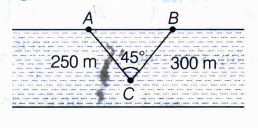
In \(\Delta \)ABC, by cosine rule,
we have
\({ AB }^{ 2 }={ AC }^{ 2 }+{ BC }^{ 2 }-2AC.BC\quad cos\frac { \pi }{ 4 } \)
\(\therefore \quad AB=\sqrt { { (250) }^{ 2 }+{ (300) }^{ 2 }-2\times 250\times 300\times \frac { 1 }{ \sqrt { 2 } } } \)
\(=\sqrt { 62500+90000-75000\sqrt { 2 } } \)
\(=\sqrt { 152500-75000\times 1.44 } \)
\(=\sqrt { 152500-108000 } =\sqrt { 44500 } =210.95m\)
5.
\(\theta =31'=\left( \frac { 31 }{ 60 } \times \frac { \pi }{ 180 } \right) rad\quad and\quad r=360000km\)
\(\because \quad \theta =\frac { l }{ r } \therefore \frac { 31 }{ 60 } \times \frac { \pi }{ 180 } =\frac { 1 }{ 360000 } \)
Ans. 3247.62 km
6.
(sin2x + sin6x)- sin4x=0
\(\Rightarrow\) 2sin4xcos2x-sin4x=0
\(\Rightarrow\) sin4x=0 or cos2x=\(\frac { 1 }{ 2 } \)
Ans
\(x=\frac { n\pi }{ 4 } \quad or\quad n\pi \pm \frac { \pi }{ 6 } \)
7.
\(cos\quad A\quad =\quad \sqrt { 1-\frac { 9 }{ 25 } } =\frac { 4 }{ 5 } ,\)
\(sin\quad B=\quad -\sqrt { 1-\frac { 144 }{ 169 } } =-\frac { 5 }{ 13 }\)
\(cos(A+B)\quad =\quad -\frac { 33 }{ 65 } \)
8.
\(cos\quad A\quad =\quad \sqrt { 1-\frac { 9 }{ 25 } } =\frac { 4 }{ 5 } ,\)
\(sin\quad B=\quad -\sqrt { 1-\frac { 144 }{ 169 } } =-\frac { 5 }{ 13 } \)
\(sin(A-B)\quad =\quad -\frac { 16 }{ 65 } \)
9.
cos 6\(\theta\) + 6 cos 4\(\theta\) + 15 cos 2\(\theta\) + 10
= (cos 6\(\theta\) + cos 4\(\theta\)) + (5 cos 4\(\theta\) + 5 cos 2\(\theta\)) + (10 cos 2\(\theta\) + 10)
= (cos 6\(\theta\) + cos 4\(\theta\)) + 5 (cos 4\(\theta\) + cos 2\(\theta\)) + 10 (cos 2\(\theta\)+ 1)
= 2cos 5\(\theta\) cos \(\theta\) + 5 x 2 cos 3\(\theta\) cos \(\theta\)+ 10 x 2 cos \(\theta\) cos \(\theta\)
= 2cos \(\theta\) [cos5\(\theta\) + 5 cos 3\(\theta\) + 10 cos \(\theta\)]
\(\therefore {cos \theta + 6 cos 4 \theta + 15 cos 2 \theta + 10 \over
cos 5 \theta + 5 cos 3 \theta + 10 cos \theta}=2cos \theta\)
10.
L.H.S a sin\(\frac { A }{ 2 } \) .sin \(\frac { B-C }{ 2 } \)
= a sin\(\left( \frac { \pi }{ 2 } -\frac { B+C }{ 2 } \right) \).sin \(\left( \frac { B-C }{ 2 } \right) \)
= k sin A. cos \(\left( \frac { B+C }{ 2 } \right) \).sin \(\left( \frac { B-C }{ 2 } \right) \)
= k sin A. [sin B-sin C]
= [sin A sin B-sin A sin c] ..(i)
Similarly,
b sin \(\frac { B }{ 2 } sin\left( \frac { C-A }{ 2 } \right) \)
= \(\frac { k }{ 2 } \)[sin B sin C-sin B sin A]... (ii)
and C sin\(\frac { C }{ 2 } \) sin \(\left( \frac { A-B }{ 2 } \right) \)
=\(\frac { k }{ 2 } \) [sin C sin A-sin C sin B] ... (iii)
Adding (i), (ii) and (iii), we get
a sin \(\frac { A }{ 2 } \)sin\(\left( \frac { B-C }{ 2 } \right) \) +b sin\(\frac { B }{ 2 } \)sin \(\left( \frac { C-A }{ 2 } \right) \)+c sin \(\frac { C }{ 2 } \)sin \(\left( \frac { A-B }{ 2 } \right) \)
⇒ \(\frac { k }{ 2 } \) [sin A sin B-sin A sin C] + \(\frac { k }{ 2 } \)[sin B sin C-sin B sin A]+\(\frac { k }{ 2 } \) [sin C sin A-sin C sin B]
⇒ \(\frac { k }{ 2 } \)[sin A sin B-sin A sin C+sin B sin A-sin C sin A-sin C sin B]
⇒ \(\frac { k }{ 2 } \) [0]
⇒ 0 R.H.S
Hence proved
11.
Here cot x = \(3\over4\) tan x =\({1\over cot x}={4\over 3}\)
Now sec2x = 1 + tan2 x
\(\Rightarrow sec^2x=1+({4\over3})^2\)
\(\Rightarrow sec^2x=1+{16\over 9}\)
\(\Rightarrow sec^2 x={25\over 9}\Rightarrow sec \ x= \pm {5\over3}\)
But x lies in third quadrant.
\(\therefore sec \ x ={-5\over 3}\)
\(cos x={1\over sec x}={-3\over5}\)
Also sin2 x + cos2x= 1
\(\Rightarrow sin^2x+({-3\over 5})^2=1\)
\(\Rightarrow sin^2x=1-{9\over 25}\)
\(\Rightarrow sin^2x={16\over25}\Rightarrow sin x=\pm{4\over5}\)
But x lies in third quadrant.
\(\therefore sin \ x={-4\over 5}\)
\(\therefore cosec \ x={1\over sin \ x}={-5\over 4}\)

11th Standard CBSE Syllabus & Materials
11th Standard CBSE
CBSE 11th Business Studies Forms of Business Organisation Sample Question Papers Study Material - QB365 Set A
NEW11th Standard CBSE
CBSE 11th Business Studies Business, Trade and Commerce Sample Question Papers Study Material - QB365 Set A
NEW11th Standard CBSE
CBSE 11th Physics Waves Sample Question Papers Study Material - QB365 Set A
NEW11th Standard CBSE
CBSE 11th Physics Kinetic Theory Sample Question Papers Study Material - QB365 Set A



CBSE 11th Standard CBSE Subjects
CBSE Standards









