
 100% FREE ACCESS
11th Standard CBSE Syllabus & Materials
11th Standard CBSE
CBSE 11th Economics PART-A - Presentation of Data - New Sample Question Papers Study Material - QB365 Set A
NEW11th Standard CBSE
CBSE 11th Economics PART-A - Organisation of Data - New Sample Question Papers Study Material - QB365 Set A
NEW11th Standard CBSE
CBSE 11th Economics PART-A - Collection of Data - New Sample Question Papers Study Material - QB365 Set A
NEW11th Standard CBSE
CBSE 11th Economics PART-A - Introduction to Economics and Statistics - New Sample Question Papers Study Material - QB365 Set A
NEW11th Standard CBSE
CBSE 11th Business Studies International Trade Sample Question Papers Study Material - QB365 Set A
NEW11th Standard CBSE
CBSE 11th Business Studies Evolution and Fundamentals of Business Sample Question Papers Study Material - QB365 Set A

Published on: 18/08/2026
Download CBSE Class 11th Standard CBSE Physics question papers, sample papers, important questions, and previous year solved papers in PDF format. Get free study materials, NCERT solutions, and exam preparation resources for Class 11th Standard CBSE Physics
Questions + Answers key
Take MCQ Physics Test
1.
A block moves with uniform circular motion because a cord tied to the block is anchored at the centre of a circle. Is the power of the force exerted on the block by the cord positive, negative or zero?
2.
Rockets can move in air-free space but jet plane cannot. Why?
3.
If,\(|A+B|=|A-B|\) What is the angle between A and B?
4.
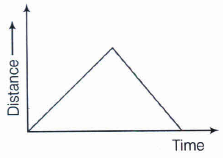
The graph between total path length and time for a particle moving along a straight line as shown in figure is not possible. Explain why?
5.
Class XI students were given as experiment to find diameter of a wire using screw gauge. The teacher asked the students to take number of reading. Ravi took only three readings and finished his practical. Seeing this, his friend Rahul asked him to take more readings as it would give more accuracy to his result and also, they should follow the instruction of his teacher.
What is the need to take large number of readings in the experiment?
6.
A jeweller put a diamond weighing 5.42 g in a box weighing 1.2 Kg. Find the total weight of the box and the diamond to correct number of significant figures.
7.
An accelerating train is passing over a high bridge. A stone is dropped from the train at an instant when its speed is 10 m/s and acceleration is 1 m/s2. Find the horizontal and vertical components of the velocity and acceleration of the stone one second after it is dropped. Take g = 10 m/s2.
8.
A trolley of mass 20 kg rests on a horizontal surface. A massless string tied to the trolley passes over a frictionless pulley and a load of 5 kg is suspended from other end of string. If coefficient of kinetic friction between trolley and surface be 0.1, find the acceleration of trolley and tension in the string. (Take g = 10 m S-2)
9.
Check by the method of dimensional analysis whether the following relations are correct
\(v=\sqrt { \frac { P }{ D } } \) where v = velocityof sound and p = presure, D = density of medium.
(ii) \(n=\frac { 1 }{ 21 } \sqrt { \frac { F }{ m } } \) where n = frequency of vibration
l = length of the string
F = stretching force
m = mass per unit length of the string.
10.
Draw a graph showing variation of potential energy, kinetic energy and the total energy of a body freely falling on Earth from a height h.
11.
A certain automobile manufacturer claims that its super-delux sports car will accelerate from rest to a speed of 42.0 ms:' in 8.0 s. Under the important assumption that the acceleration is constant,
(a) Determine the acceleration of car in ms-2.
(b) Find the distance the car travels in 8.0 s.
(c) Find the distance the car travels in 8th second.
12.
A bullet of mass 0.012 kg and horizontal speed \({ 70ms }^{ -1 }\)srrikes a block of wood of mass 0.4 kg and instantly comes to rest with respect to the block. The block is suspended from the ceiling by means of thin wires. Calculate the height to which the block ries. Also, estimate the amount of heat produced to the block.
13.
Find the maximum speed at which a car can turn around a curve of 30 m radius on a level road, given the coefficient of friction between the tyres and the road is 0.4 [ g = 10 m/s2]
14.
An aeroplane is flying in a horizontal direction with a velocity of 600km/h and at a height of 1960m. when it is vertically above the point A body is dropped from it. The body strikes the ground point B. Calculate the distance AB.
Find the time taken by the body to fall at the given height \(y=h={ u }_{ oy }t+\frac { 1 }{ 2 } { gt }^{ 2 }\) .But initial vertical is zero. Then, find the horizontal distance travelled by the body X.
15.
Determine a unit vector which is perpendicular to both \(A=2\hat { i } +\hat { j } +\hat { k } \) and \(B=\hat { i } -\hat { j } +\hat { k } \)
16.
Calculation of Instantaneous Acceleration
The velocity of a particle is given by v = 2t2 - 3t + 10 m/s.Find the instantaneous acceleration at t = 5s
17.
A particle is acted upon by a force of constant magnitude which is always perpendicular to the velocity of the particle. The motion of the particle takes place in a plane. It follows that _______.
its velocity is constant.
its acceleration is constant.
its KE is constant.
it moves in a circular path.
18.
A body is thrown with a velocity of 10 ms-1 at an angle of 60° with the horizontal. Its velocity at the highest point is
zero
5 ms-1
10 ms -1
8.66 ms -1
19.
A stone is thrown with an initial speed of 4.9 m/s from a bridge in vertically upward direction. It falls down in water after 2 seconds. The height of the bridge is
4.9 m
9.8 m
19.8 m
24.7 m
20.
Which of the following has same dimension as that of Planck constant?
Work
Linear momentum
Angular momentum
Impulse
21.
The mass of the earth is 9 times that Of Mars and the radius of the earth is twice that of Mars. If the escape velocity of the earth is 12km/sec; the escape velocity on Mars is
√2 kms-1
342kms-1
4√2 kms-1
6 kms-1
12 kms-1
22.
If F1 is the magnitude Of the force exerted by the sun on earth and F2 the magnitude of the force exerted by the earth on the sun, then:
F1 > F2
F1 = F2
F1 < F2
F1 = 1000 F2
None
23.
A vehicle moving along a straight line travels a distance of 1500 m in one minute. The speed of the vehicle is
1500 m/s
1500 kmph
25 m/s
25 kmph
None
24.
A particle revolves round a circular path. The acceleration of the particle is :
Along the circumference of the circle
Along the tangent
Along the radius
Zero
25.
KE of a body of mass 1 kg is 18 J. Its momentum is
9 kgm/s
16 kgm/s
6 kgm/s
None
26.
A book is lying on an inclined plane having inclination to the horizontal θo. What is the angle between the weight of the book and the reaction of the plane on the book _______.
0o
θo
180 - θo
180o
27.
The value of g = 10 m/s2, its value in km/hour2 _____.
10800
2100
129600
183600
28.
Which of the following is not a unit of time.
Solar year
Tropical year
Leap year
Light year
29.
(a) Discuss elastic collision in one dimension. Obtain expressions for velocities of the two bodies after such collision.
(b) A railway carriage of mass 9000 kg moving with a speed of 36 km/h collides with a stationary carriage of the same mass. After the collision, the two get coupled and move together. What is the common speed and what type of collision is this?
30.
(a) Discuss the motion of a body in a vertical circle. Find the expressions for the minimum velocity at the lowest and highest points while looping a loop.
(b) A bullet of mass 0.01 kg travelling at a speed of 500 m/s strikes a block of mass 2 kg which is suspended by a string of length 5 m. The centre of gravity of the block is found to rise a vertical distance of 0.1 m. What is the speed of the bullet after it emerges from the block? (g = 9.8 ms-2 )
31.
Prove the following:
(a) For two angles of projection e and (90 - θ) with same velocity v
(i) Range is same,
(ii) Heights are in the ratio tan2θ : 1.
32.
A projectile is fired at an angle θ with the horizontal.
(a) Show that its trajectory is a parabola.
(b) Obtain expression for:
(i) the maximum height attained.
(ii) the time of its flight and
(iii) the horizontal range.
(c) At what value of θ is the horizontal range maximum?
(d) Prove that, for a given velocity of projection, the horizontal range is same for θ and (90o - θ).
33.
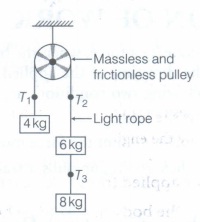
For the system below, find the values of T1 , T2 and T3 . Also, find the acceleration of every block.
34.
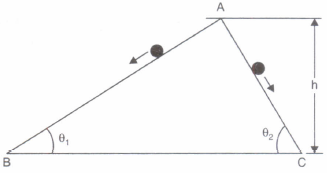
Two inclined frictionless tracks, one gradual and the other steep meet at A from where two stones are allowed to slide down from rest, one on each track (Fig). Will the stones reach the bottom at the same time? Will they reach there with the same speed? Explain. Given \(\theta\)1 = 30°, \(\theta\)2 = 60°, and h = 10 m, what are the speeds and times taken by the two stones?
35.

36.
It must be clearly understood that distance is not the same as displacement. Distance is a scalar quantity and is given by the total length of the path travelled by the body in a certain interval of time. Displacement is a vector quantity and is given by the shortest distance (in a specified direction) between the initial and the final positions of the body. The direction of the displacement vector is from the initial position to the final position of the motion. Speed IS a scalar quantity. The average speed and average velocity are different in many respect. The direction of the velocity vector is the same as that of the displacement vector. Acceleration is defined as the rate of change of velocity and it is a vector quantity.
(i) Mention a condition when displacement and distance are both equal.
(ii) Define average speed and average velocity.
(iii) Draw position-time graph of uniform accelerated motion.
(iv) What does the area under velocity-time graph and time axis signifies?
(v) What does the slope of position-time graph and velocity-time graph represent at any instant?
(vi) Mention a condition when body is at rest but still it has acceleration.
(vii) A body is moving in circular parth with uniform speed. What is the acceleration and average velocity during one complete revolution?
37.
38.
Assertion : When an automobile while going too fast around a curve overturns, its inner wheels leave the ground first.
Reason : For a safe turn the velocity of automobile should be less than the value of safe limit velocity.
Codes:
A) If both assertion and reason are true and the reason is the correct explanation of the assertion.
B) If both assertion and reason are true but reason is not the correct explanation of the assertion.
C) If assertion is true but reason is false.
D) If the assertion and reason both are false.
E) If assertion is false but reason is true.
39.
Assertion: The equation of motion can be applied only if acceleration is along the direction of velocity and is constant.
Reason: If the acceleration of a body is constant then its motion is known as uniform motion.
Codes:
A) If both assertion and reason are true and the reason is the correct explanation of the assertion.
B) If both assertion and reason are true but reason is not the correct explanation of the assertion.
C) If assertion is true but reason is false.
D) If the assertion and reason both are false.
E) If assertion is false but reason is true.
40.
Assertion: A spring has potential energy, both when it is compressed or stretched.
Reason: In compressing or stretching, work is done on the spring against the restoring force.
Codes:
(a) Assertion is correct, reason is correct; reason is a correct explanation for assertion.
(b) Assertion is correct, reason is correct; reason is not a correct explanation for assertion
(c) Assertion is correct, reason is incorrect
(d) Assertion is incorrect, reason is correct.
1.
\(\vec{F} \ and \ \vec{v}\)are perpendicular
So, Power \(=\vec{F} \cdot \vec{v}=F v \cos 90^{\circ}\)
= Zero (∵ cos 90° = 0)
2.
Jet planes use atmospheric oxygen for burning fuel but rockets carry their own fuel and oxygen and do not depend on atmospheric oxygen.
3.
\(|A+B|=|A-B|\)
\( \sqrt { A^{ 2 }+B^{ 2 }+2AB \cos\theta } =\sqrt { A^{ 2 }+B^{ 2 }-2AB \cos\theta }
\)
\(\Rightarrow 4AB \cos\theta =0\Rightarrow \cos\theta =0\)
Hence cos θ = 900 or θ = π/2
4.
The graph shows that 'with the passage of time, total path length first increases and then decreases.
The path length always increases or remains constant with passage of time and it does not decrease with time as shown in figure. Thus, this graph is not possible.
5.
Large number of readings make the result of experiment more accurate.
6.
Weight of diamond = 5.42 g = 0.00542 Kg
Total weight = 1.2 + 0.00542
= 1.20542 kg = 1.2 kg
7.
Horizontal acceleration of the train is not carried by the stone. Horizontal velocity of the stone will remain constant, during the fall of the stone.
| Horizontal component |
Vertical component |
|
| Velocity | 10 m/s | 10 m/s |
| Acceleration | 0 m/s2 | 10 m/s2 |
8.
Here M = 20 kg, m = 5 kg and \(\mu_k\) = 0.1
Here net pulling force F = mg - fk = mg -\(\mu_k\)N
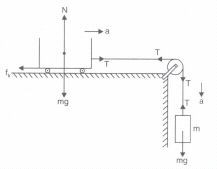
= mg -\(\mu_k\).Mg = 5 x 10 - 0.1 x 20 x 10
= 50 - 20 = 30 N
\(\therefore\)Acceleration of the system a = \({F\over (m+M)}\)
\(={30N\over (5+20)kg}\)
= 1.2 m s-2
\(\therefore\)Tension in string T = mg - ma
= 5 x 10 - 5 x 1.2
= 50 - 6 = 44 N.
9.
(i) [R.H.S] = \(\sqrt { \frac { [P] }{ D] } } \)
\(=\sqrt { \frac { M{ L }^{ -1 }{ T }^{ -2 } }{ M{ L }^{ -3 } } } =L{ T }^{ -1 }\)
[L.H.s] = [v]=LT-1
[R.H.S] = [L.H.S]
Hence, the relation is correct.
(ii) \([R.H.S]=\frac { 1 }{ [l] } \sqrt { \frac { [F] }{ M] } } \)
\(=\frac { 1 }{ L } \sqrt { \frac { ML{ T }^{ -2 } }{ M{ L }^{ -1 } } } =\frac { 1 }{ L } L{ T }^{ -1 }={ T }^{ -1 }\)
[L.H.S] = \(\frac{1}{time}=\frac{1}{T}\) = T-1
10.
Graphs depicting variation of (i) gravitational potential energy (P.E.), (ii) kinetic energy (K.E.),and (iii) the total sum of potential and kinetic energies for a freely falling body are as shown in adjoining Fig. From the graphs, it is clear that:
(a) Gravitational potential energy decreases as the body falls downwards and is zero at the Earth.
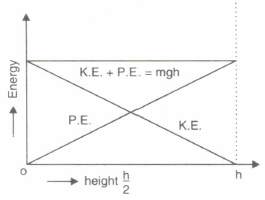
(b) Kinetic energy increases as the body falls downwards and is maximum when the body just strikes the ground.
(c) The sum of kinetic and potential energies remains constant at all points during its free fall.
11.
(a) We are given that u = 0 and velocity after 8 s is 42 m/s, so we can use v = u + at to find acceleration
a = \(\frac { v-u }{ t } =\frac { 42.0-u }{ 8.0 } \)= 5.25ms-2
(b) distance travelled in 8.0 s, we can use , s = ut +\(\frac { 1 }{ 2 } \)at2
= 0 + \(\frac { 1 }{ 2 } \)\(\times \)5.25\(\times \)82 = 168m
(c) distance travelled in 8th second, we have, Sn =u+(2n-1)\(\frac { a }{ 2 } \)
= (2 x 8 - 1) \(\times \frac { 5.25 }{ 2 } \) = 39.375 m.
12.
Here,mass of bullet m = 0.012 kg, initial speed of bullet \(\mu =70{ ms }^{ -1 }\) mass 0.4 kg
As on collision, the bullet comes to rest w.r.t. block, it means that after collision bullet and block are moving with a common speed v.
From conservatio law of momentum mu = (M + m) v
\(\Rightarrow v=\frac { mu }{ (M+m) } =\frac { 0.012\times 70 }{ (0.4+0.012) } =2.04\quad m{ s }^{ -1 }\)
If the block now rises to a maximum height of h, then using conservtion law of mechanical energy, we have \(\frac { 1 }{ 2 } (M+m){ v }^{ 2 }-0=(M+m)\quad gh\)
\(\\ \Rightarrow h=\frac { { v }^{ 2 } }{ 2g } =\frac { { (2.04) }^{ 2 } }{ 2\times 9.8 } =0.212\quad m=21.2cm\)
13.
The maximum speed vmax=μgr =0. 4 × 9. 8 × 30 =10. 84 m/s.
14.
Velocity of the aeroplane in the horizontal direction is
\({ u }_{ oy }=600km/h=600\times \frac { 5 }{ 18 } =\frac { 500 }{ 3 } m/s\)
Velocity remains constant throughout the flight of the body.
uoy = 0 and y = h = 1960m
Let t=time taken by the body to reach the ground
\(y={ u }_{ oy }t+\frac { 1 }{ 2 } g{ t }^{ 2 }\)
\(\\ Here,\quad y=h=1960m,{ u }_{ oy }=0\)
\(\\ \therefore \quad 1960=\frac { 1 }{ 2 } \times 9.8\times { t }^{ 2 }\)
\( \Rightarrow t=\sqrt { \frac { 1960 }{ 4.9 } } =\sqrt { 400 } =20s\)
Distance travelled by the body in the horizontal direction,
\(Ab=x={ v }_{ ax }t=\frac { 500 }{ 3 } \times 20\)
\(\\ =\frac { 10000 }{ 3 } =3333=3.33km\)
15.
Unit vector perpendicular to both
\(\overrightarrow{\mathrm{A}}=2 \hat{i}+\hat{j}+\hat{k} \text { and } \hat{i}-\hat{j}+2 \hat{k}\)
is given by \(\hat{n}=\frac{\overrightarrow{\mathrm{A}} \times \overrightarrow{\mathrm{B}}}{|\overrightarrow{\mathrm{A}} \times \overrightarrow{\mathrm{B}}|}\)
\(=\overrightarrow{\mathrm{A}} \times \overrightarrow{\mathrm{B}}=\left|\begin{array}{rrr}
\hat{i} & \hat{j} & \hat{k} \\
2 & 1 & 1 \\
1 & -1 & 2
\end{array}\right|\)
\(=\hat{i}[2-(-1)]-\hat{j}(4-1)+\hat{k}(-2-1)\)
\(=3 \hat{i}-3 \hat{j}-3 \hat{k}\)
Unit vector is \(\hat{n}=\frac{3 \hat{i}-3 \hat{j}-3 \hat{k}}{\sqrt{9+9+9}}\)
\(\frac { 3\hat { i } -\hat { 3j } +3\hat { k } }{ \sqrt { 27 } } \)
16.
Given \(V={ 2t }^{ 2 }-3t-10m/s\)
\({ a }_{ in }=\frac { dv }{ dt } =4t-3m/{ s }^{ 2 }\)
If t = 5 \({ a }_{ in }=5\times 4-3=17m/{ s }^{ 2 }\)
17.
(c)
its KE is constant.
18.
(b)
5 ms-1
19.
(b)
9.8 m
20.
(c)
Angular momentum
21.
(c)
4√2 kms-1
22.
(b)
F1 = F2
23.
(c)
25 m/s
24.
(c)
Along the radius
25.
(c)
6 kgm/s
26.
(c)
180 - θo
27.
(c)
129600
28.
(d)
Light year
29.
(a) One dimensional elastic collision is one in which both momentum and K.E. are conserved and the body moves in the same line of motion even after the collision.
If m1, m2 are the masses, u1, u2 are the initial velocities and v1, v2 are the final velocities, then
m1u1 + m2u2 = m1v1 + m2 v2 ...(i)
\(\frac{1}{2} m_{1} u_{1}^{2}+\frac{1}{2} m_{2} u_{2}^{2}=\frac{1}{2} m_{1} v_{1}^{2}+\frac{1}{2} m_{2} v_{2}^{2}\) ...(ii)
\(\text { i.e., } \quad m_{1}\left(v_{1}^{2}-u_{1}^{2}\right)=m_{2}\left(v_{2}^{2}-u_{2}^{2}\right)\) from (ii)
\(m_{1}\left(v_{1}-u_{1}\right)=m_{2}\left(v_{2}-u_{2}\right)\) from (i)
Dividing both sides
v1 + u1 = v2 + u2
⇒ v1 = v2 + u 2 - u1
Substituting in (i) we have
m1u1 + m2u2 = ·m1(v2 + u2 - u1) + m2 v2
2m1u1 + u2(m2 - m1) = v2 (m1 + m2 )
\(\therefore \ v_{2}=\frac{u_{2}\left(m_{2}-m_{1}\right)+2 m_{1} u_{1}}{m_{1}+m_{2}}\)
Similarly, \(v_{1}=\frac{u_{1}\left(m_{1}-m_{2}\right)+2 m_{2} u_{2}}{m_{1}+m_{2}}\)
(b) Given, m1 = 9000 kg, u1 = 36 km/h = =10m/s
m2 = 9000 kg, u2 = 0, v1 = v2 = v
By conservation of momentum
m1u1 + m2u2 = (m1 + m2)v
\(9000\times 10\times 9000\times 0=\left( 9000+9000 \right) v\)
or \(v=\frac { 90000 }{ 18000 } =5m/s\)
Total KE before collision = \(\frac { 1 }{ 2 } { m }_{ 1 }{ u }_{ 1 }^{ 2 }+\frac { 1 }{ 2 } { m }_{ 2 }{ u }_{ 2 }^{ 2 }\)
\(=\frac { 1 }{ 2 } \times 9000\times 10\times 10+0\)
\(\\ =450000J\)
Total KE after collision=\(\frac { 1 }{ 2 } \left( { m }_{ 1 }+{ m }_{ 2 } \right) { v }^{ 2 }\)
\(=\frac { 1 }{ 2 } \times 2\times 9000\times { \left( 5 \right) }^{ 2 }\)
ஃ Initial K.E. ≠ Final K.E.
Hence, collision is inelastic.
30.
(a) Consider the mass m attached to a string of length I. Let the lower most and top most points be marked A and B respectively. Consider a point P where the length 1 has turned by θ from the vertical line through A.
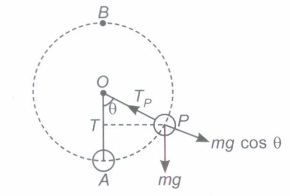
Centripetal force is provided by the tension and mg cos θ acting in opposite directions.
From the diagram, OA = OP = I,
OT = lcos θ, AT = l (1 - cos θ)
(i) If VA and vp are velocities at A and P respectively, using
v 2 = u 2 + 2as, we have
\(v_{P}^{2}=v_{A}^{2}-2 g(A T)\)
\(v_{P}^{2}=v_{A}^{2}-2 g l(1-\cos \theta)\)
Velocity at any point P,
\(v_{P}=\sqrt{v_{A}^{2}-2 g l(1-\cos \theta)}\)
(ii) At P \(T_{P}-\mathrm{mg} \cos \theta=\frac{m v_{P}^{2}}{l}\)
\(T_{P}=m g \cos \theta+\frac{m v_{P}^{2}}{l}\)
ஃ Tp = mgcos θ
\(+\frac{m}{l} \sqrt{v_{A}^{2}-2 g l(1-\cos \theta)}\)
By knowing VA and θ, one can find the velocity and tension at any point.
(iii) To perform verticle circle, the tension should be non-zero till the mass reaches the top most point B
ஃ TB ≥ 0 at θ = 180o
ஃ TB = 0 will be minimum.
Substituting,
TP = 0 at θ = π, we have
\(0=\mathrm{Mg} \cos \pi+\frac{M}{l}\left[v_{A}^{2}-2 g l(1-\cos \pi)\right]\)
\(0=-M g+\frac{M}{l}\left[v_{A}^{2}-2 g l(2)\right]\)
\(v_{A}^{2}-4 g l=g l, v_{A}^{2}=5 g l, v_{A}=\sqrt{5 g l}\)
So, the minimum velocity required at lowermost point to perform verticle circle is \(\sqrt{5 g l}\)
(b) Given: Mass ofa bullet (m) = 0.01 kg
Speed of bullet (v) = 500 m/s
Mass of block (M) = 2 kg
Length of string (I) = 5 m
Vertical height (h) = 0.1 m
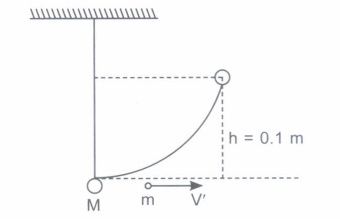
Let V be the velocity acquired by block
\(\frac{1}{2} M V^{2}=M g h\)
\(\Rightarrow \ V=\sqrt{2 g h}\)
\(=\sqrt{2 \times 9.8 \times 0.1}=1.4 \mathrm{~m} / \mathrm{s}\)
If V' is the speed of bullet on emerging out of the block then by the law of conservation of energy.
mv + M x 0 = MV + m V'
\(\Rightarrow \ V^{\prime}=\frac{m v-M V}{m}\)
\(=\frac{0.01 \times 500-2 \times 1.4}{0.01}\)
\(V^{\prime}=\frac{5-2.8}{0.01}=\frac{2.2}{0.01}=220 \mathrm{~m} / \mathrm{s}\)
31.
(a) (i) When an object is projected with velocity u making an angle θ with horizontal direction.
\(R_{1}=\frac{u^{2} \sin 2 \theta}{g}\) .............(i)
When an object is projected with u making an angle (90o - θ)
\(R_{2}=\frac{u^{2} \sin 2\left(90^{\circ}-\theta\right)}{g}\)
\(=\frac{u^{2}}{g} \sin \left(180^{\circ}-2 \theta\right)\)
\(=\frac{u^{2}}{g} \sin 2 \theta\) .............(ii)
From (i) and (ii)
R1 = R2
ஃ The horizontal range is same for two complementary angles.
(ii) For angle of projection θ
Height attained \(=\frac{u^{2} \sin ^{2} \theta}{2 g}=H\)
for angle of projection (90° - θ)
Height attained = \(\frac{u^{2} \sin ^{2}\left(90^{\circ}-\theta\right)}{2 g}\)
\(=\frac{u^{2} \cos ^{2} \theta}{2 g}=H^{\prime}\)
\(\frac{H}{H^{\prime}}=\frac{u^{2} \sin ^{2} \theta}{2 g} \times \frac{2 g}{u^{2} \cos ^{2} \theta}\)
= tan2 θ : 1
(b) Horizontal range \(=\frac{u^{2} \sin 2 \theta}{g}\)
Maximum height = \(\frac{u^{2} \sin ^{2} \theta}{2 g}\)
Horizontal range = Maximum height
\(\frac{u^{2} \sin 2 \theta}{g}=\frac{u^{2} \sin ^{2} \theta}{2 g}\)
2 x 2 sinθ cosθ = sin2 θ
4 = tanθ
or θ = tan-1 4
32.
When a body is projected in the air in any direction, then the body is called a projectile.
(a) Suppose a body is projected with velocity u at an angle θ with the horizontal, P(x, y) is any point on its trajectory at time t.
Horizontal component of velocity is unaffected by gravity, but the vertical component (u sin θ) changes due to gravity.
ஃ x = (u cos θ)t.
\(y=(u \sin \theta) t-\frac{1}{2} g t^{2}\)
\(=u \sin \theta \times \frac{x}{u \cos \theta}-\frac{1}{2} g\left(\frac{x}{u \cos \theta}\right)^{2}\)
\(y=x \tan \theta-\frac{g x^{2}}{2 u^{2} \cos ^{2} \theta}\) ............(i)
(b) The greatest vertical distance attained by the projectile above the horizontal plane from the point of projection is called maximum height.
Maximum height, LN = H
(i) At maximum height
v = 0
\(\therefore \quad v^{2}-u_{y}^{2}=-2 g H, \text { where }\)
uy = u sin θ
or (u sinθ )2 = 2 gH
\(\text { or } \quad H=\frac{u^{2} \sin ^{2} \theta}{2 g}\)
(ii) At maximum height
v = 0
ஃ 0 = u sin θ - gt
\(\text { or } \quad t=\frac{u \sin \theta}{g}\)
But time of flight
\(\mathrm{T}=2 t=\frac{2 u \sin \theta}{g}\)
(iii) When the body returns to the same horizontal level y = 0
\(\therefore \quad 0=x \tan \theta-\frac{g x^{2}}{2 u^{2} \cos ^{2} \theta} \quad[\text { From }(i)]\)
\(\text { or } x \tan \theta=\frac{g x^{2}}{2 u^{2} \cos ^{2} \theta}\)
\(\text { or } \quad x=\frac{2 u^{2} \sin \theta \cos \theta}{g}=\frac{u^{2} \sin 2 \theta}{g}\)
But coordinates of M are (R, 0). Putting x = R,
we have
\(\mathrm{R}=\frac{u^{2} \sin 2 \theta}{g}\)
(c) θ = 45°
(d) When an object is projected with velocity u making an angle θ with horizontal direction
\(R_{1}=\frac{u^{2} \sin 2 \theta}{g}\) ...........(i)
When an object is projected with u making an angle (90o - θ)
\(\mathrm{R}_{2}=\frac{u^{2} \sin 2\left(90^{\circ}-\theta\right)}{g}\)
\(=\frac{u^{2}}{g} \sin \left(180^{\circ}-2 \theta\right)\)
\(=\frac{u^{2}}{g} \sin 2 \theta\) ............(ii)
from (i) and (ii) R1 = R2
ஃ The horizontal range IS same for two complementary angles.
33.
Figure shows the forces acting on masses m1 , m2 and m3 . Tension forces acting on pulley also shown in figure.
Since masses m1 and m2 are moving downward with acceleration a , by applying Newtons second law,
we get the following equations.
( m1 + m2 ) g - T1 = m1 a .........(1)
T1 - T2 = m2 a ......(2)
since masses m2 and m3 are connected by same string , Tension forces T2 and T3 are same
T2 = T3 ...........(3)
By applying Newton's second law on block of mass m3 , we get
T3 - m3 g = m3 a .......(4)
By adding all the above equations (1), (2), (3) and (4), we get
( m1 + m2 - m3 )g = ( m1 + m2 + m3 ) a ....... (5)
Hence acceleration a is obtained from above equation as ,
\(a=\left(\frac{m_1+m_2-m_3}{m_1+m_2+m_3}\right) g \) ....(6)
Tension force T1 is obtained from (1) as , T1 = ( m1 + m2 ) g- m1 a ......(7)
By substituting for acceleration a in eqn.(7) , we get T1 after simplification as
\(T_1=\left(\frac{m_1 m_2+m_2^2+2 m_1 m_3+m_2 m_3}{m_1+m_2+m_3}\right) g\)
Tension force T3 is obtained from (4) as , T3 = m3(a+g) .........(8)
By substituting for acceleration a in eqn.(8) , we get T3 after simplification as
\(T_3=2\left(\frac{\left(m_1+m_2\right) m_3}{m_1+m_2+m_3}\right) g \)
T = T2 + T3 and T2 = T3 . Hence we get T as
\(T=4\left(\frac{\left(m_1+m_2\right) m_3}{m_1+m_2+m_3}\right) g\)
\(T_1=\frac{56}{9} g, T_2=\frac{56}{9} g, T_3=\frac{16}{9} g, a=\frac{5}{9} g\)
34.
\(\frac { 1 }{ 2 } { mv }^{ 2 }=mgh,\ v=\sqrt { 2gh } \)
\(=\sqrt { 2\times 10\times 10 } { ms }^{ -1 }=14.14\ { ms }^{ -1 }\)
\({ v }_{ B }={ v }_{ C }=14.14\ { ms }^{ -1 },\ l=\frac { 1 }{ 2 } (g\ sin\ \theta ){ t }^{ 2 }\)
\(sin\ \theta =\frac { h }{ l } ,l=\frac { h }{ sin\ \theta } \)
\(\therefore \ \frac { h }{ sin\ \theta } =\frac { 1 }{ 2 } g\ sin\ \theta \ { t }^{ 2 }\ or\ t=\sqrt { \frac { 2h }{ g } } .\frac { 1 }{ sin\ \theta } \)
\(\therefore \ \frac { h }{ sin\theta } =\frac { 1 }{ 2 } g\ sin\ \theta \ { t }^{ 2 }\ or\ t=\sqrt { \frac { 2h }{ g } } .\frac { 1 }{ sin\ \theta } \)
\({ t }_{ B }=\sqrt { \frac { 2\times 10 }{ 10 } } .\frac { 1 }{ sin\quad 30° } =2\sqrt { 2 } s\)
\({ t }_{ C }=\sqrt { \frac { 2\times 10 }{ 10 } } .\frac { 1 }{ sin60° } =\frac { 2\sqrt { 2 } }{ \sqrt { 3 } } s.\)
35.
36.
(i) When a body is moving in straight line in a specific direction then both displacement and distance would be equal in magnitude.
(ii) Average speed is the average distance travelled per unit time
\(\text { or } v=\frac{\text { total distance travelled }}{\text { total time taken }}\)
Average velocity is the average displacement covered per unit time. It is a vector quantity.
\(\bar{v}=\frac{\text { net displacement }}{\text { time taken }}\)
(iii)
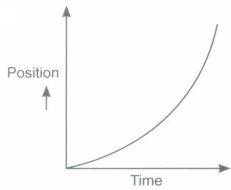
(iv) Area under velocity-time graph and time axis is the measure of displacement in that particular interval of time.
(v) Slope of Position-time at any instant represent instantaneous velocity while that of velocity-time represent instantaneous acceleration.
(vi) A body thrown upward then at highest point body comes to rest momentarily but still acceleration is acrting downward.
(vii) During one complete revolution average displacement and velocity is zero while acceleration is acting radially toward the center of circular path.
37.
38.
B) If both assertion and reason are true but reason is not the correct explanation of the assertion.
When automobile moves in circular path then reaction on inner wheel and outer wheel will be different.\(R_{\text {inner }}=\frac{M}{2}\left[g-\frac{v^{2} h}{r a}\right] \text { and } R_{\text {outer }}=\frac{M}{2}\left[g+\frac{v^{2} h}{r a}\right]\)In critical condition \(v_{\mathrm{safe}}=\sqrt{\frac{g r a}{h}}\) .If v is equal or more that thus critical value then reaction on inner wheel becomes zero. So it leaves the ground first
39.
D) If the assertion and reason both are false.
Equation of motion can be applied if the acceleration is in opposite direction to that of velocity and uniform motion mean the acceleration is zero.
40.
(a) Assertion is correct, reason is correct; reason is a correct explanation for assertion.

11th Standard CBSE Syllabus & Materials
11th Standard CBSE
CBSE 11th Business Studies Forms of Business Organisation Sample Question Papers Study Material - QB365 Set A
NEW11th Standard CBSE
CBSE 11th Business Studies Business, Trade and Commerce Sample Question Papers Study Material - QB365 Set A
NEW11th Standard CBSE
CBSE 11th Physics Waves Sample Question Papers Study Material - QB365 Set A
NEW11th Standard CBSE
CBSE 11th Physics Kinetic Theory Sample Question Papers Study Material - QB365 Set A



NCERT Books

Syllabus

Exam Pattern

Sample Question Papers

Previous year Question Papers

Important Notes

MCQ Practice test

NCERT Exemplers

Case study Questions

Image Based Questions

Passage based Questions

HOT Questions

Value Based Questions

Model Questions Papers
NCERT ( Book Back ) Questions

Assertion and Reason
Important Questions And Answers

CBSE 11th Standard CBSE Subjects
CBSE Standards







