
11th Standard CBSE Syllabus & Materials
11th Standard CBSE
CBSE 11th Economics PART-A - Presentation of Data - New Sample Question Papers Study Material - QB365 Set A
NEW11th Standard CBSE
CBSE 11th Economics PART-A - Organisation of Data - New Sample Question Papers Study Material - QB365 Set A
NEW11th Standard CBSE
CBSE 11th Economics PART-A - Collection of Data - New Sample Question Papers Study Material - QB365 Set A
NEW11th Standard CBSE
CBSE 11th Economics PART-A - Introduction to Economics and Statistics - New Sample Question Papers Study Material - QB365 Set A
NEW11th Standard CBSE
CBSE 11th Business Studies International Trade Sample Question Papers Study Material - QB365 Set A
NEW11th Standard CBSE
CBSE 11th Business Studies Evolution and Fundamentals of Business Sample Question Papers Study Material - QB365 Set A

Published on: 18/08/2026
Download CBSE Class 11th Standard CBSE Physics question papers, sample papers, important questions, and previous year solved papers in PDF format. Get free study materials, NCERT solutions, and exam preparation resources for Class 11th Standard CBSE Physics
Questions + Answers key
Take MCQ Physics Test
1.
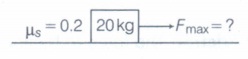
A box is lying on a rough floor. What is the maximum value of Fext so that box do not slip relative to the floor?
2.
What is the angle of friction between two surfaces in contact, if coefficient of friction is \(\sqrt{3}?\)
3.
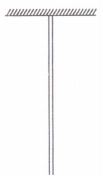
A monkey of mass 40 kg climbs on a rope which can stand a maximum tension of 600 N. In which of the following cases will the rope break: the monkey falls down the rope nearly freely under gravity
(Ignore the mass of the rope).
4.
A monkey of mass 40 kg climbs on a rope which can stand a maximum tension of 600 N. In which of the following cases will the rope break: the monkey climbs up with a uniform speed of 5 ms-1
(Ignore the mass of the rope).
5.
A monkey of mass 40 kg climbs on a rope which can stand a maximum tension of 600 N. In which of the following cases will the rope break: the monkey climbs down with an acceleration of 4 ms-2
(Ignore the mass of the rope).
6.
A monkey of mass 40 kg climbs on a rope which can stand a maximum tension of 600 N. In which of the following cases will the rope break: the monkey climbs up with an acceleration of 6 ms-2
(Ignore the mass of the rope).
7.
A block Slides down a rough incline of angle 30\(^0\) with an acceleration g/4. Find the coefficient of kinetic friction.
8.
A body of mass 2 kg is being dragged with a uniform velocity of 2 ms -1 on a rough horizontal plane. The coefficient of friction between the body and the surface is 0.2. Calculate the amount of heat generated per second. Take g =9.8 ms-2 and J = 1.2Jcal-1
9.
A heavy points mass tied to the end of string is whirled in a horizontal circle of radius 20 cm with a constant angular speed. What is angular speed if the centripetal acceleration is 980 cms-2 ?
10.
What is the acceleration of a train travelling at 50 ms-1 as it goes round a curve of 250m radius?
11.
Why is static friction called a self-adjusting force?
12.
A force of 128 If acts on a mass of 490 g for 10 s. What velocity will it give to the mass ?
13.
A passenger of mass 72.2 kg is riding in an elevator while standing on a platform scale. What does the scale read when the elevator cab is
(i) descending with constant velocity
(ii) ascending with constant acceleration, 3.5 m/s2?
14.
A force of 36 dyne is inclined to the horizontal at an angle of 60\(^0\) . Find the acceleration in a mass of 18 g that moves in a horizontal diraction.
15.
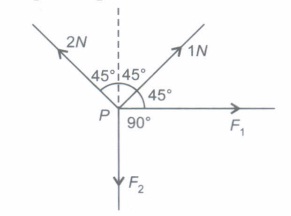
There are four forces acting at a point produced by strings as shown in figure which is at rest. Find the forces F1 and F2.
16.
A horizontal force of 500 N pulls two masses 10 kg and 20 kg (lying on a frictionless table) connected by a light string as shown. What is the tension in the string?
Does the answer depend on which mass the pull is applied?

17.
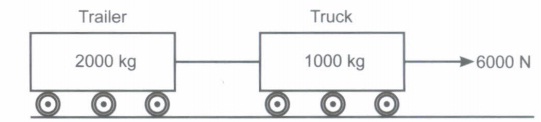
A truck of mass 1000 kg is pulling a trailer of mass 2000 kg as shown. The retarding (frictional) force on the truck is 500 N and that on the trailer is 1000 N. The truck engine exerts a force of 6000 N. Calculate
(i) the acceleration of the truck and the trailer, and
(ii) the tension in the connecting rope.
18.
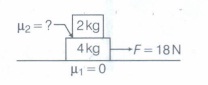
Two blocks are placed over a horizontal smooth plane as shown in the figure. Find the minimum value of \(\mu\)2 , so that block could move together.
19.
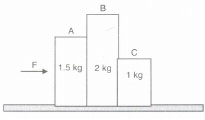
In the system of three blocks A, Band C shown in figure, (i) how large a force F is needed to give the blocks an acceleration of 3 m/s2, if the coefficient of friction between blocks and table is 0.27 (ii) how large a force does the block A exert on the block B?
20.
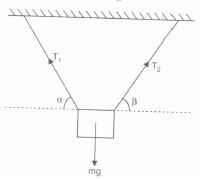
A body of mass m is suspended by two strings making angles\(\alpha\) and \(\beta\) with the horizontal. Calculate the tensions in the two strings.
21.
A body of mass 10 kg is placed on an inclined plane of angle 30\(^0\) . If the coefficient of static friction is \(\frac { 1 }{ \sqrt { 3 } } \) . Find the force required to just push the body up the inclined surface.
22.
Ten one-rupee coins are put on top of each other on a table. Each coin has mass m. Give the magnitude and direction of the reaction of the 6th coin on the 7th coin.(counted from the bottom)
23.
Ten one-rupee coins are put on top of each other on a table. Each coin has mass m. Give the magnitude and direction of the force on the 7th coin by the 8 coin, (counted from the bottom).
24.
Ten one-rupee coins are put on top of each other on a table. Each coin has mass m. Give the magnitude and direction of
(i) the force on the 7th coin (counted from the bottom) due to all the coins on its top
(ii) the force on the 7th coin by the 8 coin, (counted from the bottom)
(iii) the reaction of the 6th coin on the 7th coin.(counted from the bottom)
25.
A pebble of mass 0.05 kg is thrown vertically upwards. Give the direction and magnotude of the net force on the pebble at the highest point where it is momentarily at rest. Do your answer change if the pebble was thrown at an angle 45\(^0\) with the horizontal direction ? Ignore air resistance.
26.
A train rounds an unbanked circular bend of radius 30m at a speed of 54 km/h. The mass of the train is 106kg. What provides the centripetal force requires for this purpose, the engine or the rails? what is the angle of banking required to prevent wearing out of the rail?
27.
A helicopter of mass 1000 kg reises with a vertical acceleration of 15m /s2. The crew and the passengers weigh 300 kg. Give the magnitude and direction of the
(i) force on floor by the crew and passengers.
(ii) action of the rotor of the helicopter on the surrounding air
(iii) force on the helicopter due to the surrounding air, take g = 10 m/s2.
28.
Given the action force, describe the reaction force for each situation.
(i) You push forward on a book with 5.2 N
(ii) A boat exerts a force of 450 N on the water.
(iii) A hockey player hits the boards with a force of 180 N towards the boards.
1.
40 N
2.
Since \(tan \theta =\mu =\sqrt{3}\)
\(\theta =tan ^{-1}(\sqrt{3})\Rightarrow \theta =60^o\)
3.
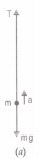
When the monkey is falling freely, it would be a state of weightlessness. So, tension will be zero and the rope will not break.
4.
When the monkey climbs up with uniform speed, then
T = mg = 40 kg x 10 ms-2 = 400 N
The rope will not break.
5.
When the monkey is climbing down with an acceleration, then
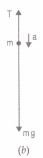
mg - T=ma
\(\Rightarrow\)T=mg - ma = m (g - a)
or T=40 kg x (10 - 4) ms-2 = 240 N
The rope will not break.
6.
When the monkey climbs up with an acceleration a, then
T - mg = ma
where T represents the tension
\(\therefore T=mg+ma=m(g+a)\)
or T = 40 kg (10 + 6) ms-2 = 640 N
But the rope can withstand a maximum tension of 600 N. So the rope will break.
7.
\(1/2\sqrt { 3 }\)
8.
Given, m = 2 kg, u = 2ms-1,\(\mu \) = 0.2
Force of friction, F \(= \mu R\)
\( F=\ \mu mg\ \ \left[ \because R\ =mg \right] \)
\(F=\quad 0.2\times 2\times 9.8\)
\( F=\ 3.92Nx = {-b \pm \sqrt{b^2-4ac} \over 2a}\)
Distance moved per second s = ut
s = \(2\times 1=2\)
Work done by friction per second, W = Fs
W = 3.92\(\times\)2 = 7.84 J
Heat produced, \(H=\frac { W }{ J } \Rightarrow \quad H=\frac { 7.84 }{ 4.2 } \)
H = 1.87 cal
9.
Here, radius r =20 cm
Centripetal acceleration, = 980 cms-2
We know that centripetal acceleration, a = rω2
\(\omega =\sqrt { \frac { a }{ r } } =\sqrt { \frac { 980 }{ 20 } }\)
\(\omega =\sqrt { 49 } =7rad/s\)
10.
Given, velocity, v = 50 ms-1
Radius, r = 250 m
Centripetal accleration, a = v2/r
a = \(\frac{50 \times 50}{250}\)
= 10 ms-1
11.
As the applied force increases, the static friction also increases and becomes equal to the applied force to make the object stationery. That is why static friction is called a self-adjusting force.
12.
25.6 m/s
13.
Given, mass, m = 72.2 kg
Gravity acceleration, g = 9.8 m/s2
Scale reading = apparent weight = R = ?
(i) While descending with constant velocity, a = 0
\(\therefore \) R = mg
R = 72.2 x 9.8
\(\Longrightarrow \) R = 707.56 N
(ii) While ascending with a = 3.2 m/s2
R = m ( g + a )
R = 72.2 ( 9.8 + 3.2 ) = 938.6 N
14.
Given, F = 36 dyne at an angle of 6000 .
∴∴ Component of force along x-direction
Fx = F cos 6000 = 36 x 1/2 = 18 dyne
But Fx = max ,
ax = \(\frac{F_x}{m} =\frac {18}{18} = 1\) cm/s2
15.
Since the point P is at rest.
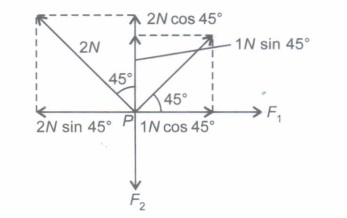
\(F_{2}=1 N \sin 45^{\circ}+2 N \cos 45^{\circ}=\frac{3}{\sqrt{2}} N\)
As F1 + 1N cos 45° = 2Nsin 45o
\(F_{1}=\frac{2}{\sqrt{2}} N-\frac{1}{\sqrt{2}} N=\frac{1}{\sqrt{2}} N\)
16.
The acceleration produced in the body of mass 10 + 20 = 30 kg is given by,
\(a=\frac{F}{m}=\frac{500}{30}=\frac{50}{3} \mathrm{~ms}^{-2}\)
When 500 N pull is applied on 20 kg, tension, TI produced is given by,
T1 = m1a
\(=10 \times \frac{50}{3}=\frac{500}{3}=166.7 \mathrm{~N}\)
When 500 N pull is applied on 10 kg, tension T2 produced is given by,
T2 = m2a
\(=20 \times \frac{50}{3}=\frac{1000}{3}=333.4 \mathrm{~N}\)
Thus the tension depends mass-end on which the pull is applied.
17.
(i) The net force f1 exerted on the trailer in the direction of f1 = (T - 1000)N, where T is tension in the connecting rope.
ஃ T - 1000 = 2000 a ..............(i)
Similarly, the net force f2 exerted by the engine of the truck is given by
f2 = (6000 - 500 - T) = 1000 a
or 5500 - T = 1000 a ..............(ii)
Adding (i) and (ii), we have,
4500 = 3000 a
or \(a=\frac{4500}{3000}=1.5 \mathrm{~ms}^{-2}\)
(ii) Putting the value of 'a' in (i) we have
T = 1000 + 2000 a
= 1000 + 2000 x 1.5
= 4000 N
18.
0.6
19.
(i) Let a be the acceleration of the system to right. All the three frictional forces f1=μm1g, f2 = μm2g, and f3 =μm3g will be directed to the left as the motion of bodies is to the right. Hence, for the whole system
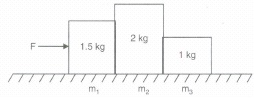
F-μm1g-μm2g-μm3g=(m1+m2+m3)a
F= (m1+m2+m3)(a+μg)
=(1.5 + 2 + 1)(3 + 0.2 x 9.8) = 22.3 N
(ii) The force exerted by the 1.5 kg block on the 2 kg block = F - m1 (a + μg)
= 22.3 - 1.5 (3 + 0.2 x 9.8)
= 22.3 - 7.44 = 14.86 N
20.
Considering components of tensions T1 and T2 along the Horizontal and vertical directions,
we have
- T1cos \(\alpha\) + T2 cos \(\beta\) =0 or
T1 cos \(\alpha\) T2 cos \(\beta\)............ (i)
and T1 sin \(\alpha\) + T2 sin \(\beta\) mg ............(ii)
From (i) T2 =\({T_1cos \alpha \over cos \beta}\) and substituting it in(ii), we get
\(T_1 sin \alpha +({T_1cos \alpha \over cos \beta})sin \beta =mg \ or \ t_1[{ sin \alpha cos \beta +cos \alpha sin \beta \over cos \beta}]=mg\)
\(and \ hence \ T_2 ={T_1 cos \alpha \over cos \beta }={mg \ cos \beta \over sin (\alpha +\beta)}.{cos \alpha\over cos \beta}={mg \ cos \alpha \over sin (\alpha +\beta)}\)
21.
Here, \(m=10 \mathrm{~kg}, \theta=30^{\circ}, \mu=\frac{1}{\sqrt{3}}\)
As is clear from force required just to push the body up the inclined plane is
\( F=m g \sin \theta+f \)
\(=m g \sin \theta+\mu R \)
\(=m g \sin \theta+\mu m g \cos \theta \)
\(=m g(\sin \theta+\mu \cos \theta) \)
\(=10 \times 9.8\left(\sin 30^{\circ}+\frac{1}{\sqrt{3}} \cos 30^{\circ}\right) \)
\( F=98\left(0.5+\frac{1}{\sqrt{3}} \times \frac{\sqrt{3}}{2}\right)=98 N
\)
22.
\(\because \) Mass of each coin = m
Number of total coins = 10
(iii) Reaction of the 6th coin on the 7th coin
= -(force exerted on 6th coin)
= -(weight of 4 coins)
= -4 mg N (vertically upward)
23.
\(\because \) Mass of each coin = m
Number of total coins = 10
Force acting on 7th coin by the 8th coin = weight of the 8 coins + weight of two coins supported by 8 coins.
= mg + 2 mg
= 3 mg N ( downward)
24.
\(\because \) Mass of each coin = m
Number of total coins = 10
(i) Force acting on 7th coin (counted from the bottom)
= Weight of the coins above it
= Weight of 3 coins
= 3 mg N (downward)
(ii) Force acting on 7th coin by the 8th coin = weight of the 8 coins + weight of two coins supported by 8 coins.
= mg + 2 mg
= 3 mg N ( downward)
(iii) Reaction of the 6th coin on the 7th coin
= -(force exerted on 6th coin)
= -(weight of 4 coins)
= -4 mg N (vertically upward)
25.
When an object is thrown vertically upwards or it falls vertically downward under gravity, then an acceleration g = 10 m/s2 acts downward due to the earth's gravitational pull.
Mass of pebble (m) = 0.05 kg
(iii) At the highest point
Net force acting on pebble
(F) = ma = 0.05 x 10 N
= 0.50 N (vertically downward)
If pebble was thrown at an angle of 45\(^0\) with the horizontal direction, then acceleration acting on it and therefore force acting on it wil remain unchanged, i.e. 0.50 N (vertically downward). In case (c), at the highest point the vertical component of velocity will be zero but horizontal component of velocity will not be zero.
26.
Radius of circular bend, r = 30m
Speed of the train, v = 54 km/h
= \(54\times \frac { 5 }{ 18 } { m }/{ s\ \quad \left[ \because 1km/h=\frac { 5 }{ 8 } { m }/{ s } \right] }\)
= 15 m/s
Let \(\theta\) be the angle of banking required to prevent wearing out the rails, then
\(\tan { \theta =\frac { { v }^{ 2 } }{ rg } } =\frac { (15{ ) }^{ 2 } }{ 30\times 9.8 } \)
\(=\quad \frac { 225 }{ 30\times 9.8 } =0.7653\)
\(\\ \theta =\tan { ^{ -1 }\quad (0.7653)=37.{ 4 }^{ o } }\)
27.
\(\because \) Mass of the helicopter, m1 = 1000 kg
Mass of the crew and the passengers, m2 = 300 kg
Acceleration of the helicopter, a = 15 m/ s2
Acceleration due to gravity, g = 10 m/s2
(i) Let R, be the reaction applied by the floor on the crew and the passengers.
-S.png)
R1- m2g = m2a
or
R1= m2g + m2a = m2(g+a)
= 300(10 + 15) = 7500N(upward direction)
(ii) Action of the rotor of the helicopter on the surrounding air
= ( m1 + m2 ) g + ( m1 + m2 ) a
= ( m1 + m2 ) ( g + a )
= ( 1000 + 300 ) x (10 + 15 )
= 1300 x 25 = 32500 N
Force (action ) of the rotor of the helicopter on the surrounding air = 32500 N (downward)
28.
(i) 5.2 N backward
(ii) 450 N on the boat
(iii) 180 N on the hockey stick

11th Standard CBSE Syllabus & Materials
11th Standard CBSE
CBSE 11th Business Studies Forms of Business Organisation Sample Question Papers Study Material - QB365 Set A
NEW11th Standard CBSE
CBSE 11th Business Studies Business, Trade and Commerce Sample Question Papers Study Material - QB365 Set A
NEW11th Standard CBSE
CBSE 11th Physics Waves Sample Question Papers Study Material - QB365 Set A
NEW11th Standard CBSE
CBSE 11th Physics Kinetic Theory Sample Question Papers Study Material - QB365 Set A



NCERT Books

Syllabus

Exam Pattern

Sample Question Papers

Previous year Question Papers

Important Notes

MCQ Practice test

NCERT Exemplers

Case study Questions

Image Based Questions

Passage based Questions

HOT Questions

Value Based Questions

Model Questions Papers
NCERT ( Book Back ) Questions

Assertion and Reason
Important Questions And Answers

CBSE 11th Standard CBSE Subjects
CBSE Standards







