
 100% FREE ACCESS
11th Standard CBSE Syllabus & Materials
11th Standard CBSE
CBSE 11th Economics PART-A - Presentation of Data - New Sample Question Papers Study Material - QB365 Set A
NEW11th Standard CBSE
CBSE 11th Economics PART-A - Organisation of Data - New Sample Question Papers Study Material - QB365 Set A
NEW11th Standard CBSE
CBSE 11th Economics PART-A - Collection of Data - New Sample Question Papers Study Material - QB365 Set A
NEW11th Standard CBSE
CBSE 11th Economics PART-A - Introduction to Economics and Statistics - New Sample Question Papers Study Material - QB365 Set A
NEW11th Standard CBSE
CBSE 11th Business Studies International Trade Sample Question Papers Study Material - QB365 Set A
NEW11th Standard CBSE
CBSE 11th Business Studies Evolution and Fundamentals of Business Sample Question Papers Study Material - QB365 Set A

Published on: 18/08/2026
Download CBSE Class 11th Standard CBSE Physics question papers, sample papers, important questions, and previous year solved papers in PDF format. Get free study materials, NCERT solutions, and exam preparation resources for Class 11th Standard CBSE Physics
Questions + Answers key
Take MCQ Physics Test
1.
The average depth of Indian Ocean is about 3000 m. Calculate the fractional compression, ∆V/V, of water at the bottom of the ocean, given that the bulk modulus of water is 2.2 x 10⁹ N m–2. (Take g = 10 m s–2)
2.
Compute the fractional change in volume of a glass slab, when subjected to a hydraulic pressure of 10 atm.
3.
A rigid bar of mass 15 kg is supported symmetrically by three wires each 2.0 m long. Those at each end are of copper and the middle one is of iron. Determine the ratios of their diameters if each is to have the same tension.
4.
A piece of copper having a rectangular cross-section of 15.2 mm × 19.1 mm is pulled in tension with 44,500 N force, producing only elastic deformation. Calculate the resulting strain?
5.
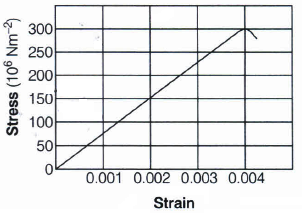
Figure shows the strain-stress curve for a given material. What are (a) Young’s modulus and (b) approximate yield strength for this material?
6.
The stress-strain graphs for materials A and B are shown in Fig. (a) and Fig. (b).
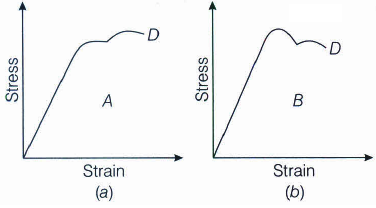
The graphs are drawn to the same scale.
(a) Which of the materials has the greater Young’s modulus?
(b) Which of the two is the stronger material?
7.
A steel cable with a radius of 1.5 cm supports a chairlift at a ski area. If the maximum stress is not to exceed 108 N m–2, what is the maximum load the cable can support ?
8.
How much should the pressure on a litre of water be changed to compress it by 0.10%? carry one quarter of the load.
9.
A square lead slab of side 50 cm and thickness 10 cm is subject to a shearing force (on its narrow face) of 9.0 x 10⁴ N. The lower edge is riveted to the floor. How much will the upper edge be displaced?
10.
A copper wire of length 2.2 m and a steel wire of length 1.6 m, both of diameter 3.0 mm, are connected end to end. When stretched by a load, the net elongation is found to be 0.70 mm. Obtain the load applied.
11.
A structural steel rod has a radius of 10 mm and a length of 1.0 m. A 100 kN force stretches it along its length. Calculate
(a) stress,
(b) elongation, and
(c) strain on the rod. Young’s modulus, of structural steel is 2.0 x 10¹¹ N m-2 .
12.
Read the following two statements below carefully and state, with reasons, if it is true or false.
(a) The Young’s modulus of rubber is greater than that of steel;
(b) The stretching of a coil is determined by its shear modulus.
13.
Determine the volume contraction of a solid copper cube, 10cm on an edge, when subjected to a hydraulic pressure of 7 x 10⁶ Pa. Bulk modulus for copper = 140 x 109 Pa.
14.
A steel wire of length 4.7 m and cross-sectional area 3.0 × 10⁻⁵ m2 stretches by the same amount as a copper wire of length 3.5 m and cross-sectional area of 4.0 × 10⁻⁵ m2 under a given load. What is the ratio of the Young’s modulus of steel to that of copper?
15.
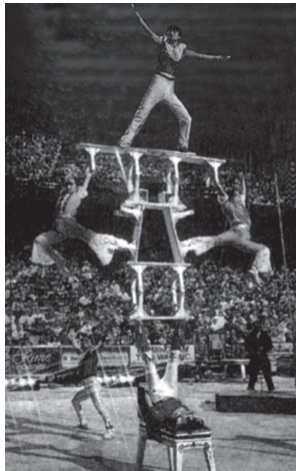
In a human pyramid in a circus, the entire weight of the balanced group is supported by the legs of a performer who is lying on his back (as shown in Fig.). The combined mass of all the persons performing the act, and the tables, plaques etc. involved is 280 kg. The mass of the performer lying on his back at the bottom of the pyramid is 60 kg. Each thighbone (femur) of this performer has a length of 50 cm and an effective radius of 2.0 cm. Determine the amount by which each thighbone gets compressed under the extra load.
16.
What is the density of water at a depth where pressure is 80.0 atm, given that its density at the surface is 1.03 × 10³ kg m–3?
17.
Compute the bulk modulus of water from the following data: Initial volume = 100.0 litre, Pressure increase = 100.0 atm (1 atm = 1.013 x 10⁵ Pa), Final volume = 100.5 litre. Compare the bulk modulus of water with that of air (at constant temperature). Explain in simple terms why the ratio is so large.
18.
Four identical hollow cylindrical columns of mild steel support a big structure of mass 50,000 kg. The inner and outer radii of each column are 30 cm and 60 cm respectively. Assuming the load distribution to be uniform, calculate the compressional strain of each column. Young's modulus, \(\Upsilon \) = 2.0 x 10¹¹ Pa.
19.
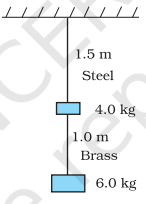
Two wires of diameter 0.25 cm, one made of steel and the other made of brass are loaded as shown in Fig.. The unloaded length of steel wire is 1.5 m and that of brass wire is 1.0 m. Compute the elongations of the steel and the brass wires.
20.
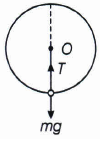
A 14.5 kg mass, fastened to the end of a steel wire of unstretched length 1.0 m, is whirled in a vertical circle with an angular velocity of 2 rev/s at the bottom of the circle. The cross-sectional area of the wire is 0.065 cm2 . Calculate the elongation of the wire when the mass is at the lowest point of its path.
21.
The edge of an aluminium cube is 10 cm long. One face of the cube is firmly fixed to a vertical wall. A mass of 100 kg is then attached to the opposite face of the cube. The shear modulus of aluminium is 25 GPa. What is the vertical deflection of this face?
1.
The pressure exerted by a 3000 m column of water on the bottom layer
p = hρ g = 3000 m x 1000 kg m–3 x 10 m s–2
= 3 x 10⁷ kg m–1 s-2
= 3 x 10⁷ N m–2
Fractional compression ∆V/V, is
∆V/V = stress/B = (3 x 10⁷ N m-2) / (2.2 x 10⁹ N m–2 )
= 1.36 x 10⁻² or 1.36 %
2.
Here, P =10 atm = 10 x 1.013 x 105 Pa; k = 37 x 109 Nm-2
Volumetric strain = \(\frac { \triangle V }{ V } =\frac { P }{ K } =\frac { 10\times 1.013\times 10^{ 5 } }{ 37\times 10^{ 9 } } \) = 2.74 x 10⁻⁵
∴ Fractional change in volume = \(\frac { \triangle V }{ V } \) = 2.74 x 10⁻⁵.
3.
Since each wire is to have same tension therefore, each wire has same extension. Moreover, each wire has the same initial length. So, strain is same for each wire.
Now, \(\Upsilon =\frac { Stress }{ Strain } =\frac { F/\pi D^{ 2 }/4) }{ Strain } \)
or \(\Upsilon \propto \frac { 1 }{ { D }^{ 2 } } \Rightarrow D\propto \frac { 1 }{ \sqrt { \Upsilon } } \)
\(\frac { D_{ copper } }{ D_{ iron } } =\sqrt { \frac { { \Upsilon }_{ iron } }{ { \Upsilon }_{ copper } } } =\sqrt { \frac { 190\times 10^{ 9 } }{ 110\times 10^{ 9 } } } =\sqrt { \frac { 19 }{ 11 } } \)
= 1.14.
4.
Here, A =15.2 x 19.2 x 10-6 m2; F = 44500 N; η = 42 x 109 Nm-2
Strain = \(\frac { Stress }{ modulus\ of\ elasticity } =\frac { F/A }{ \eta } \)
=\(\frac { F }{ A\eta } =\frac { 44500 }{ (15.2\times 19.2\times 10^{ -6 })\times 42\times 10^{ 9 } } \)
= 3.65 x 10⁻³.
5.
(i) Young's modulus of the given material (Y) = Slope of strain-stress curve
Y = \(\frac { 150\times { 10 }^{ 6 } }{ 0.002 } =75\times { 10 }\) N/m2
= 7.5\(\times \)1010 N/m2
(ii) Yield strength of the given material = Maximum stress, the material can sustain
= 300 \(\times \) 106 N/m2 = 3 \(\times \) 108 N/m2
6.
(i) In the two graphs, the slope of graph in Fig. (a) is greater than the slope of graph in Fig. (b), so material A has greater Young's modulus.
(ii) Material A is stronger than material B because it can withstand more load without breaking. For material A, the break even point (D) is higher.
7.
Given, radius of steel cable (r) = 1.5 cm = 1.5 x 10⁻²m
Maximum stress = 108 N/m2
Area of cross-section of steel cable (A) = \(\pi { r }^{ 2 }\)
= 3.14 x (1.5 x 10-2)2 m2
= 3.14 x 2.25 x 10-4 m2
Maximum stress = \(\frac { Maximum\ force }{ Area\ of\ cross-section } \)
or Maximum force = Maximum stress x Area of cross-section
= 108 x (3.14 x 2.25 x 10-4 ) N
= 7.065 x 10⁴ N
= 7.1 x 10⁴ N
8.
Here \(V=1 \text { litre }=10^{-3} m^{3} ;(\Delta \mathrm{V} / \mathrm{V})=\frac{0.10}{100}=10^{-3}\)
\(K=\frac{p v}{\Delta V}\)
\(\text { or } p=k \frac{\triangle V}{V}=\left(2.2 \times 10^{9}\right) \times 10^{-3}=2.2 \times 10^{6} \mathrm{~Pa}\)
9.
The lead slab is fixed and the force is applied parallel to the narrow face as shown in Fig.
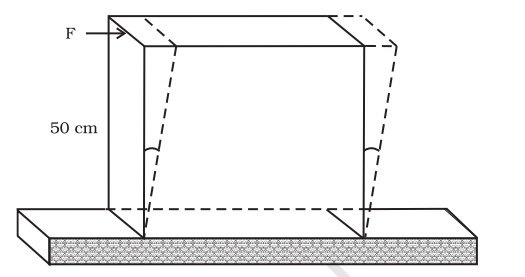
The area of the face parallel to which this force is applied is
A = 50 cm x 10 cm
= 0.5 m x 0.1 m
= 0.05 m2.
Therefore, the stress applied is
= (9.4 x 10⁴ N/0.05 m2 )
= 1.80 x 10⁶ N.m–2
We know that shearing strain = (∆x/L)= Stress /G.
Therefore the displacement ∆x = (Stress x L)/G
= (1.8 x 10⁶ N m–2 x 0.5m)/(5.6 x 109 N m–2)
= 1.6 x 10⁻⁴ m = 0.16 mm
10.
The copper and steel wires are under a tensile stress because they have the same tension (equal to the load W) and the same area of cross-section A. From Eq. we have stress = strain x Young’s modulus. Therefore
W/A = Yc x (∆Lc /Lc ) = Ys x (∆Ls /Ls )
where the subscripts c and s refer to copper and stainless steel respectively. Or,
∆Lc /∆Ls = (Ys /Yc ) x (Lc /Ls )
Given Lc = 2.2 m, Ls = 1.6 m
Yc = 1.1 x 10¹¹ N.m–2, and
Ys = 2.0 x 10¹¹ N.m–2
∆Lc /∆Ls = (2.0 x 10¹¹/1.1 x 1011) x (2.2/1.6) = 2.5
The total elongation is given to be
∆Lc + ∆Ls = 7.0 x 10⁻⁴ m
Solving the above equations
∆Lc = 5.0 x 10⁻⁴ m, and ∆Ls = 2.0 x 10⁻⁴ m
Therefore
W = (A x Yc x ∆Lc )/Lc.
= π (1.5 x 10⁻³) 2 x [(5.0 × 10-4 x 1.1 x 1011)/2.2]
= 1.8 x 10² N
11.
We assume that the rod is held by a clamp at one end, and the force F is applied at the other end, parallel to the length of the rod. Then the stress on the rod is given by
\(\text { Stress }=\frac{F}{A}=\frac{F}{\pi r^{2}}\)
\(=\frac{100 \times 10^{3} \mathrm{~N}}{3.14 \times\left(10^{-2} \mathrm{~m}\right)^{2}}\)
= 3.18 x 10⁸ N m–2
The elongation
\(\Delta L=\frac{(F / A) L}{Y}\)
\(=\frac{\left(3.18 \times 10^{8} \mathrm{~N} \mathrm{~m}^{-2}\right)(1 \mathrm{~m})}{2 \times 10^{11} \mathrm{~N} \mathrm{~m}^{-2}}\)
= 1.59 x 10⁻³ m
= 1.59 mm
The strain is given by
Strain = ∆L/L
= (1.59 x 10⁻³ m)/(1m)
= 1.59 x 10–3
= 0.16 %
12.
(a) False. The Young's modulus is defined as the ratio of stress to the strain within elastic limit. For a given stretching force elongation is more in rubber and quite less in steel. Hence, rubber is less elastic than steel.
(b) True. Stretching of a coil is determined by its shear modulus. When equal and opposite forces are applied at opposite ends of a coil, the distance as well as shape of helicals of the coil change and it involves shear modulus.
13.
Given, each side of cube()=10cm=0.1m
Hydralic pressure (p)=7×10⁶ Pa
Bulk modulus for copper(B)=140×109 Pa
Volume contraction(△V)=?|
Volume of the cube(V)=I3=(0.1)3=1×10⁻³m3
Bulk modulus for copper(B) \(=\frac { p }{ \triangle V/V } \)
\(\\ \triangle V=\frac { pV }{ B }\)
\( \\ \triangle V=\frac { 7\times 10^{ 6 }\times 1\times 10^{ -3 } }{ 140\times 10^{ 9 } } =\frac { 1 }{ 20 } \times 10^{ -6 }m^{ 3 }\)
\(\\ =0.05\times 10^{ -6 }m^{ 3 }=5\times 10^{ -8 }m^{ 3 }\)
14.
Given for steel wireLength (l1) = 4.7 m
Area of cross-section (A1) = 3.0 x 10⁻⁵m2
For copper wire
Length (l2) =3.5 m
Area of crosssection (A2) = 4.0 x 10⁻⁵m2
Let F be the given load under which steel and copper wires be streched by the same amount \(\Delta l\)
Young's modulus \((Y)=\frac { F/A }{ \Delta l/l } =\frac { F\times l }{ A\times \Delta l } \)
For steel \({ Y }_{ s }=\frac { F\times l_{ 1 } }{ { A }_{ 1 }\times { \Delta l } } \)
For copper \({ Y }_{ c }=\frac { F\times l_{ 2 } }{ { A }_{ 2 }\times { \Delta l } } \)
Dividing Eq (i)by Eq(ii) we get
\(\frac { { Y }_{ s } }{ { Y }_{ c } } =\frac { F\times { l }_{ 1 } }{ { A }_{ 1 }\times \Delta l } \times \frac { { A }_{ 2 }\times \Delta l }{ F\times { l }_{ 2 } }\)
\( \\=\frac { { l }_{ 1 } }{ { l }_{ 2 } } \times \frac { { A }_{ 2 } }{ { A }_{ 1 } } =\frac { 4.7 }{ 3.5 } \times \frac { 4.0\times { 10 }^{ -5 } }{ 3.0\times { 10 }^{ -5 } } \)
\( \frac { { Y }_{ s } }{ { Y }_{ c } } =\frac { 18.8 }{ 10.5 } =1.79=1.8\)
15.
Total mass of all the performers, tables, plaques etc. = 280 kg
Mass of the performer = 60 kg
Mass supported by the legs of the performer at the bottom of the pyramid
= 280 – 60 = 220 kg
Weight of this supported mass = 220 kg wt. = 220 x 9.8 N = 2156 N
Weight supported by each thighbone of the performer = ½ (2156) N = 1078 N.
From Table the Young’s modulus for bone is given by
Y = 9.4 x 10⁹ N m–2 .
Length of each thighbone L = 0.5 m
the radius of thighbone = 2.0 cm
Thus the cross-sectional area of the thighbone A = π x (2 x 10⁻²) 2 m2 = 1.26 x 10⁻³ m2 .
Using Eq. = (F x L) /(A x ∆L) the compression in each thighbone (∆L) can be computed as
∆L = [(F x L)/(Y x A)]
= [(1078 x 0.5)/(9.4 x 109 x 1.26 x 10-3)]
= 4.55 x 10⁻⁵ m or 4.55 x 10⁻³ cm.
This is a very small change! The fractional decrease in the thighbone is ∆L/L = 0.000091 or 0.0091%.
16.
Compressibility of water,
k =\(\frac{1}{B}\) = 45.8 x 10⁻¹¹ Pa-1
Change in pressure,
Δp = 80 atm - 1 atm
= 79 atm = 79 x 1.013 x 105 Pa.
\(\rho \)=1.03 x 10³ kg m-3
As B = \(\frac { \triangle p.V }{ \triangle V } \) or \(\frac { \triangle V }{ V } =\frac { \triangle p }{ B } =\triangle p\times \frac { 1 }{ B } \)=Δp x k
or \(\\ \frac { \triangle V }{ V } \)=\(\frac { \triangle V }{ V } =\frac { (M/\rho )-(M/\rho ') }{ (M/\rho ) } =1-\frac { \rho }{ { \rho }^{ ' } } \)
or \(\frac { \rho }{ { \rho }^{ ' } } =1-\frac { \triangle V }{ V } \)
or \({ \rho }^{ ' }=\frac { \rho }{ 1-(\triangle V/V) } \)
or \({ \rho }^{ ' }=\frac { 1.03\times 10^{ 3 } }{ 1-3.665\times 10^{ -3 } } =\frac { 1.03\times 10^{ 3 } }{ 0.996 } \)
= 1.034 x 10³ kg/m3.
17.
P =100 atmosphere
= 100 x 1.013 x 105 Pa (∵ 1 atm = 1.103 x 10⁵ Pa)
Initial volume, V1 = 100 litre = 100 x 10-3 m3
Final volume, V2 = 100.5 litre = 100.5 x 10⁻³ m3
∴ Change in volume = ΔV= V3 - V1
= (100.5 - 100) x 10-3 m3
= 0.5 x 10⁻³ m3.
Using formula of bulk modulus,
B =\(\frac { P }{ \frac { \triangle V }{ V } } =\frac { PV }{ \triangle V } \)
= \(\frac { 100\times 1.013\times 10^{ 5 }\times 100\times 10^{ -3 } }{ 0.5\times 10^{ -3 } } \)
B = 2.026 x 10⁹ Pa
Also we know that the bulk modulus of air = 1.0 x 10⁵ Pa
Now, \(\frac { Bulk\ modulus\ of\ water }{ Bulk\ modulus\ of\ air } =\frac { 2.206\times 10^{ 9 } }{ 1.0\times 10^{ 5 } } \)
= 2.026 x 104
= 20260.
The ratio is too large. This is due to the fact that the strain for air is much larger than for water at the same temperature. In other words, the intermolecular distances in case of liquids are very small as compared to the corresponding distances in the case of gases. Hence there are larger interatomic forces in liquids than in gases.
18.
Here total mass to be supported, M = 50,000 kg
∴ Total weight of the structure to be supported = Mg
= 50,000 x 9.8 N
Since this weight is to be supported by 4 columns,
∴ Compressional force on each column (F) is given by
F = \(\frac { Mg }{ 4 } =\frac { 50,000\times 9.8 }{ 4 } \)N
Inner radius of a column, r1= 30 cm = 0.3 m
Outer radius of a column, r2 = 60 cm = 0.6 m.
∴ Area of cross-section of each column is given by
A = \(\pi ({ r }_{ 2 }^{ 2 }-{ r }_{ 1 }^{ 2 })\)
= \(\pi \)[(0.6)2-(0.3)2] = 0.27\(\pi \) m2.
Young's modulus, \(\Upsilon \) = 2 x 10¹¹ Pa.
Compressional strain of each column =?
\(\Upsilon \)= \(\\ \frac { Compressional\ force \ area }{ Compressional\ Strain } \)
= \(\frac { F/A }{ Compressional\ Strain } \)
or Compressional strain of each column
= \(\frac { F }{ A\gamma } =\frac { 50,000\times 9.8\times 7 }{ 4\times 0.27\times 22\times 2\times 10^{ 11 } } \)
= 0.722 x 10⁻⁶
∴ Compressional strain of all columns is given by
= 0.722 x 10-6 x 4 = 2.88 x 10-6
= 2.88 x 10⁻⁶.
19.
Given, diameter of wires (2r) = 0.25 cm
\(\therefore \) r = 0.125 cm
= 1.25 \(\times\) 10-3 m
For steel wire,
Load (F1) = (4 + 6) kgf
= 10 \(\times\) 9.8N = 98N
Length of steel wire (l1) = 1.5 m
Young's modulus (Y1 ) = 2.0 \(\times\) 1011 Pa
Young's modulus (Y) = \(\frac { { F }_{ 1 }\times { l }_{ 1 } }{ { A }_{ 1 }\times { \Delta l }_{ 1 } } \)
\(\therefore \) Change in length (\({ \Delta l }_{ 1 }\)) = \(\frac { { F }_{ 1 }\times { l }_{ 1 } }{ { A }_{ 1 }\times { Y }_{ 1 } } =\frac { { F }_{ 1 }\times { l }_{ 1 } }{ { \pi }{ r }_{ 1 }^{ 2 }\times { Y }_{ 1 } } \)
= \(\frac { 98\times 1.5 }{ 3.14\times { \left( 1.25\times { 10 }^{ -3 } \right) }^{ 2 }\times 2.0\times { 10 }^{ 11 } } \)
= 1.5\(\times\)10-4 m
For brass wire,
Load (F2) = 6 kgf = 6\(\times\) 9.8N = 58.8 N
Length of brass wire ( l2) = 1.0m
Young's modulus (Y2) = 0.91 \(\times\) 1011Pa
Change in length(\({ \Delta l }_{ 2 }\)) = \(\frac { { F }_{ 2 }\times { l }_{ 2 } }{ { \pi }{ r }_{ 2 }^{ 2 }\times { Y }_{ 2 } } \)
= \(\frac { 58.8\times 1.0 }{ 3.14\times { \left( 1.25\times { 10 }^{ -3 } \right) }^{ 2 }\times 0.91\times { 10 }^{ 11 } } \)
= 1.3\(\times\)10-4 m
20.
Given, mass(m) = 14 .5kg
Length of wire (l ) = 1 m
Angular frequency (v) = 2 revls
Angular velocity (\(\omega \)) = 2\(\pi \)v
= 2\(\pi \)\(\times \)2 rad/s = 4\(\pi \) rad/s
Area of cross-section of wire (A) = 0.065 cm2
= 6.5 \(\times \)10-6 m2
Young's modulus for steel (Y) = 2 \(\times \) 1011 N/m2.
At lowest point of the vertical circle, T - mg = ml\({ \omega }^{ 2 }\)
or T= mg + m\({ \omega }^{ 2 }\)
= (14.5\(\times \)9.8)+14.5\(\times \)1\(\times \)\({ (4\pi ) }^{ 2 }\)
= 14.5(9.8+16\({ \pi }^{ 2 }\))
= 14.5(9.8\(\times \)16\(\times \)9.87) [\(\because \) \({ \pi }^{ 2 }\)=9.87]
= 14.5\(\times \) 167.72N=2431.94 N
Young's modulus (Y) =\(\frac { Stress }{ Strain } =\frac { (T/A) }{ \Delta l/l } =\frac { Tl }{ A.\Delta l } \)
\(\therefore \Delta l=\frac { T.l }{ A.Y } =\frac { 2431.94\times 1 }{ 6.5\times { 10 }^{ -6 }\times 2\times { 10 }^{ 11 } } \)
= 1.87\(\times \)10-3 m =1.87 mm
21.
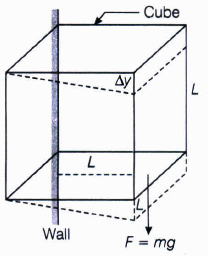
Given, side of a cube (l) = 10 cm = 0.1 m
Area of its each face (A) = l2 = (0.1)2 = 0.01 m2
Load(m) = 100 kg
Tangential force acting on one face of the cube, F = mg = 100\(\times \) 9.8 =980 N
Shear stress acting on this face = \(\frac { F }{ A } \) = \(\frac { 980 }{ 0.01 } \) N/m2
= 9.8 \(\times \)104 N/m2
Shear modulus of aluminium (\(\eta \)) = 25 GPa
= 25\(\times \) 109 N/m2
Shear modulus (\(\eta \))=\(\frac { Shearing\ stress }{ Shearing\ strain } \)
or shearing strain \(\left( \frac { \Delta L }{ L } \right) \) = \(\frac { Shearing\ stress }{ Shear\ modulus } \)
or \(\Delta L\) = \(\frac { Shearing\ stress }{ Shear\ modulus } \) \(\times \) L = \(\frac { 9.8\times { 10 }^{ 4 } }{ 25\times { 10 }^{ 9 } } \)\(\times \) 0.1
= 0.0392 \(\times \)10-5m
= 3.92 \(\times \) 10-7m

11th Standard CBSE Syllabus & Materials
11th Standard CBSE
CBSE 11th Business Studies Forms of Business Organisation Sample Question Papers Study Material - QB365 Set A
NEW11th Standard CBSE
CBSE 11th Business Studies Business, Trade and Commerce Sample Question Papers Study Material - QB365 Set A
NEW11th Standard CBSE
CBSE 11th Physics Waves Sample Question Papers Study Material - QB365 Set A
NEW11th Standard CBSE
CBSE 11th Physics Kinetic Theory Sample Question Papers Study Material - QB365 Set A



NCERT Books

Syllabus

Exam Pattern

Sample Question Papers

Previous year Question Papers

Important Notes

MCQ Practice test

NCERT Exemplers

Case study Questions

Image Based Questions

Passage based Questions

HOT Questions

Value Based Questions

Model Questions Papers
NCERT ( Book Back ) Questions

Assertion and Reason
Important Questions And Answers

CBSE 11th Standard CBSE Subjects
CBSE Standards







