
11th Standard CBSE Syllabus & Materials
11th Standard CBSE
CBSE 11th Economics PART-A - Presentation of Data - New Sample Question Papers Study Material - QB365 Set A
NEW11th Standard CBSE
CBSE 11th Economics PART-A - Organisation of Data - New Sample Question Papers Study Material - QB365 Set A
NEW11th Standard CBSE
CBSE 11th Economics PART-A - Collection of Data - New Sample Question Papers Study Material - QB365 Set A
NEW11th Standard CBSE
CBSE 11th Economics PART-A - Introduction to Economics and Statistics - New Sample Question Papers Study Material - QB365 Set A
NEW11th Standard CBSE
CBSE 11th Business Studies International Trade Sample Question Papers Study Material - QB365 Set A
NEW11th Standard CBSE
CBSE 11th Business Studies Evolution and Fundamentals of Business Sample Question Papers Study Material - QB365 Set A

Published on: 18/08/2026
Download CBSE Class 11th Standard CBSE Physics question papers, sample papers, important questions, and previous year solved papers in PDF format. Get free study materials, NCERT solutions, and exam preparation resources for Class 11th Standard CBSE Physics
Questions + Answers key
Take MCQ Physics Test
1.
Suppose you have two forces \(\overrightarrow{\mathbf{F}}\) and \(\overrightarrow{\mathbf{F}}\). How would you combine them in order to have resultant force of magnitudes (a) zero, (b) 2\(\overrightarrow{\mathbf{F}}\) and (c) \(\overrightarrow{\mathbf{F}}\)?
2.
An aircraft is flying at a height of 3400 m above the ground. If the angle subtended at a ground observation point by the aircraft positions 10.0 s a part is 30°, wat is the speed of the aircraft ?
3.
An aircraft executes a horizontal loop of radius 1.00 km with a steady speed of 900 km/h. Compare its centripetal acceleration with the acceleration due to gravity.
4.
To a person moving eastwards with a velocity of 48km/h, rain appears to fall vertically downwards with a speed of 6.4km/h. Find the actual speed and direction of the rain.
5.
A passenger arriving in a new town wishes to go from the station to a hotel located 10 km away on a straight road from the station. A dishonest cabman takes him along a circuitous path 23 km long and reaches the hotel in 28 min. What is
(a) the average speed of the taxi,
(b) the magnitude of average velocity ? Are the two equal ?
6.
From the top of a tower 100 m in height, a baU is dropped and at the same time another ball is projected vertically upwards from the ground with a velocity of 25 ms-1. Find when and where the two balls will meet? g = 9.8 ms-2.
7.
Establish a relation between linear velocity and angular velocity in a uniform circular motion and explain the direction of linear velocity.
8.
The position of a particle is given by \(\mathbf{r}=3.0 t \hat{\mathbf{i}}+2 \cdot 0 t^{2} \hat{\mathbf{j}}+5.0 \hat{\mathbf{k}}\) where t is in seconds and the coefficients have the proper units for r to be in metres.
(a) Find v(t) and a(t) of the particle.
(b) Find the magnitude and direction of v(t) at t = 1.0 s
9.
Derive a relation for the time taken by a projectile to reach the highest point and the maximum height attained.
10.
The ceiling of a long hall is 25 m high. What is the maximum horizontal distance that a ball thrown with a speed of 40 m s-1 can go without hitting the ceiling of the hall ?
11.
Read each statement below carefully and state with reasons, if it is true or false :
(a) The magnitude of a vector is always a scalar,
(b) each component of a vector is always a scalar,
(c) the total path length is always equal to the magnitude of the displacement vector of a particle.
(d) the average speed of a particle (defined as total path length divided by the time taken to cover the path) is either greater or equal to the magnitude of average velocity of the particle over the same interval of time,
(e) Three vectors not lying in a plane can never add up to give a null vector.
12.
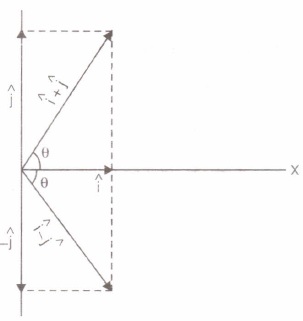
\(\hat { i } \) and \(\hat { j } \) are unit vectors along x- and y- axis respectively. What is the magnitude and direction of the vectors \(\hat { i } \)+\(\hat { j } \) , and \(\hat { i } \)-\(\hat { j } \) ? What are the components of a vector \(\overset\rightarrow{A}\) =2\(\hat { i } \)+3\(\hat { j } \)along the directions \(\hat { i } \) + \(\hat { j } \) and \(\hat { i } \) - \(\hat { j } \) ? [You may use graphical method]
13.
Projectile is the name given to a body thrown with some initial velocity with the horizontal direction and then allowed to move in two dimensions under the action of gravity alone, without being propelled by any engine or fuel. A projectile moves under the combined effect of two velocities: one a uniform velocity in the horizontal direction and other a uniformly changing velocity. It is observed that path of projectile which is known as trajectory is parabolic in shape.
(i) Does the time of flight, horizontal range and maximum height depend on the mass of the projectile?
(ii) State the relation between the maximum height attained by the projectile and the maximum range.
(iii) What is the angle between velocity and acceleration at the highest point of projectile path?
(iv) A body is projected with velocity u at angle e with the horizontal, what would be the angle and speed of projectile when it strike at the ground at same horizontal plane from which it is projected?
(v) What are the angles of projection for same initial velocity of projection at which horizontal range of the projectile is same?
(vi) Write the equation of the path of projectile, projected at angle e with initial velocity u, from a horizontal plane.
1.
(a) If they act at opposite direction, resultant is zero.
(b) If they act in same direction, R = 2F.
(c) For the resultant to be F,
F 2 = F 2 + F 2 + 2F2 cos θ
cosθ = -1/2 or θ = 120°.
2.
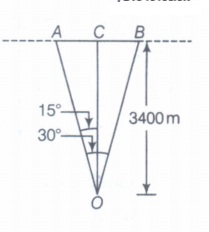
In figure, 0 is the observation point at the ground, A and B are the positions of aircraft for which \(\angle AOB=30°\). Draw a perpendicular OC on AB.Here OC = 3400 m and \(\angle AOC=\angle COB=15°\).Time taken by aircraft from A to B is 10 s.
In \(\Delta \)AOC, AC=OC \(\tan { 15° } \)
= 3400\(\times \)0.2679
= 910.86 m
AB = AC + CB = AC + AC = 2AC
=2\(\times \)910.86 m
Speed of the aircraft
v = \(\frac { distance \ AB }{ time } =\frac { 2\times 910.86 }{ 10 } \)
= 182.17 ms-1 = 182.2 ms-1
3.
Here, r = 1 km = 1000 m,
v = 900 kmh-1 = 900 x (1000m(/(60 x 60s) = 250 ms-1
Centripetal acceleration, a = \(\frac { { v }^{ 2 } }{ r } =\frac { { (250) }^{ 2 } }{ 1000 } \)
Now, \(\frac { a }{ g } =\frac { { (250) }^{ 2 } }{ 1000 } \times\frac { 1 }{ 9.8 } =6.38\)
4.
v = 8km/h, θ = 5307'33''
5.
Here, actual path length travelled, s = 23 km; Displacement = 10 km;
Time taken, t = 28 min = \(\frac{28}{60} h\)
(a) Average speed of taxi = \(\frac{\text { actual path length }}{\text { time taken }}=\frac{23}{\frac{28}{60}} k \frac{m}{h}=49.3 \mathrm{~km} / \mathrm{h}\)
(b) Magnitude of average velocity = \(=\frac{\text { displacement }}{\text { time taken }}=\frac{10}{\frac{28}{60}} \mathrm{~km} / \mathrm{h}=21.4 \mathrm{~km} / \mathrm{h}\)
The average speed is not equal to the magnitude of average velocity. The two are equal for the motion of taxi along a straight path in one direction.
6.
\(x=0+\frac{1}{2} \times 9.8 t^{2}=4.9 t^{2}\) .............(i)
\(100-x=25 t+\frac{1}{2} \times(-9.8) t^{2}\) ...............(ii)
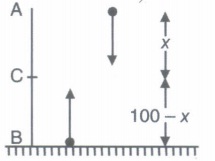
Solving equation (i) and (ii), we get
t = 4 second
x = 4.9 x 16 = 78.4 m
7.
We know that s = r θ if a body covers an arc of length s in a radius r, turning its radial line by θ. Differentiating both sides with respect to time, we have
\(\frac{d s}{d t}=r \frac{d \theta}{d t} \quad \text { i.e., } \quad v=r \omega .\)
Linear velocity = radius x angular velocity.
At each point the body moves along the tangent. The presence of centripetal force mv2/r makes it to pass in the circular path. Thus the direction of velocity is always along the tangent at any point in the circular path.
8.
\(\mathbf{v}(t) =\frac{\mathrm{d} \mathbf{r}}{\mathrm{d} t}=\frac{\mathrm{d}}{\mathrm{d} t}\left(3.0 t \hat{\mathbf{i}}+2.0 t^2 \hat{\mathbf{j}}+5.0 \hat{\mathbf{k}}\right) \)
\(=3.0 \hat{\mathbf{i}}+4.0 t \hat{\mathbf{j}} \)
\(\mathbf{a}(t) =\frac{\mathrm{d} \mathbf{v}}{\mathrm{d} t}=+4.0 \hat{\mathbf{j}} \)
\(a =4.0 \mathrm{~m} \mathrm{~s}^{-2} \text { along } y \text {-direction }\)
At \(t=1.0 \mathrm{~s}, \quad \mathbf{v}=3.0 \hat{\mathbf{i}}+4.0 \hat{\mathbf{j}}\)
It's magnitude is \(v=\sqrt{3^2+4^2}=5.0 \mathrm{~m} \mathrm{~s}^{-1}\) and direction is \(\theta=\tan ^{-1}\left(\frac{v_y}{v_x}\right)=\tan ^{-1}\left(\frac{4}{3}\right) \equiv 53^{\circ} \text { with } x \text {-axis. }\)
9.
Consider a projectile projected at an \(\theta\) angle to the horizontal with velocity u, the horizontal and vertical components initially with velocity u cos \(\theta\) and u sin \(\theta\) respectively. Vertical velocity at highest point is zero, due to gravity acting vertically downwards.
Using, \(\upsilon \)=u+at
we have, 0=u sin \(\theta\) -gt
\(\Rightarrow\) t=\(\frac { u sin\theta }{ g } \)
The time to reach topmost point, t =\(\frac { u sin\theta }{ g } \)
Using \(\upsilon ^{ 2 }\)=u2+2as
we have, 0=u2sin2\(\theta\)-2g hmax
\(\Rightarrow\) hmax=\(\frac { { u }^{ 2 }{ sin }^{ 2 }\theta }{ 2g } \).
10.
Given, initial velocity (u) = 40m/s
Height of the hall (H) = 25m
Let the angle of projection of the ball be \(\theta \), when maximum height attained by it be 25m.
Maximum height attained by the ball
\(H=\frac { { u }^{ 2 }{ sin }^{ 2 }\theta }{ 2g } \Rightarrow 25=\frac { { (40) }^{ 2 }{ sin }^{ 2 }\theta }{ 2\times 9.8 }\)
\(or\ { \sin }^{ 2 }\theta =\frac { 25\times 2\times 9.8 }{ 1600 } =0.3068\)
\(or\ \sin\theta =0.5534=\sin{ 33.6 }^{ 0 }\)
\(or\ \theta ={ 33.6 }^{ 0 }\)
\( \therefore \text{ Horizontal range (R)}=\frac { { u }^{ 2 }\sin2\theta }{ g }\)
\( \\ =\frac { { (40) }^{ 2 }sin2\times { 33.6 }^{ 0 } }{ 9.8 } =\frac { 1600\times sin{ 67.2 }^{ 0 } }{ 9.8 } \)
\(\\ =\frac { 1600\times 0.9219 }{ 9.8 } =150.5m\)
11.
(a) True, The magnitude of a vector is a number. Hence, it is a scalar.
(b) False, each component of a vector is always a vector, not scalar.
(c) False ,Total path length is a scalar quantity, whereas displacement is a vector quantity. Hence, the total path length is always greater than the magnitude of displacement. It becomes equal to the magnitude of displacement only when a particle is moving in a straight line.
(d) True, because the total path length is either greater than or equal to the magnitude of the displacement vector.
(e) True, this is because the resultant of two vectors will not lie in the plane of third vector and hence cannot cancel its effect to give null vector.
12.
(i) \(\hat { i } \) + \(\hat { j } \) =\(\sqrt { \left( 1 \right) ^{ 2 }+\left( 1 \right) ^{ 2 }+2\times 1\times 1\times cos\quad 90^{ 0 } } =\sqrt { 2 } \) = 1.414 units
tan\(\theta \) = \(\frac{1}{1}\)=1, \(\therefore\) \(\theta \) = 45°
So the vector \(\hat { i } \) + \(\hat { j } \) makes an angle of 45° with x-axis.
(ii) \(\left| \hat { i } -\hat { j } \right| \sqrt { \left( 1 \right) ^{ 2 }+\left( 1 \right) ^{ 2 }-2\times 1\times 1\times cos\quad 90^{ 0 } } \)
=\(\sqrt{2}\) = 1.414 units
The vector \(\hat { i } \) - \(\hat { j } \)makes an angle of -45° with .r-axis.
(iii) Let us now determine the component of \(\overset { \rightarrow }{ A } \)= 2\(\hat { i } \)+3\(\hat { j } \)in the direction of \(\hat { i } \) + \(\hat { j } \) .
Let \(\overset { \rightarrow }{ B } \) = \(\hat { i } \) + \(\hat { j } \)
\(\overset { \rightarrow }{ A } \).\(\overset { \rightarrow }{ B } \) cos \(\theta \) =(A cos \(\theta \))B
So the component of \(\overset { \rightarrow }{ A } \) in the direction of \(\overset { \rightarrow }{ B } \) =\(\frac { \overset { \rightarrow }{ A } .\overset { \rightarrow }{ B } }{ B } \)
=\(\frac { \left( 2\hat { i } +3\hat { j } \right) .\left( \hat { i } +\hat { j } \right) }{ \sqrt { \left( 1 \right) ^{ 2 }+\left( 1 \right) ^{ 2 } } } =\frac { 2\hat { i } .\hat { i } +2\hat { i } .\hat { j } .\hat { i } +3\hat { j } .\hat { j } }{ \sqrt { 2 } } =\frac { 5 }{ \sqrt { 2 } } \)units
( iv) Component of \(\overset { \rightarrow }{ A } \) in the direction of \(\hat { i } \) - \(\hat { j } \)=\(\hat { i } -\hat { j } =\frac { \left( 2\hat { i } +3\hat { j } \right) .\left( \hat { i } -\hat { j } \right) }{ \sqrt { 2 } } =-\frac { 1 }{ \sqrt { 2 } } \)units.
13.
(i) Projectile motion is independent of mass, it only depends on angle of projection and initial velocity of projection.
(ii) The maximum height attained by projectile is equal to one fourth of its maximum range.
(iii) At the highest point of projectile path the component of velocity becomes zero, therefore angle between acceleration acting vertically downward and horizontal component of velocity becomes 90°.
(iv) Since projectile follow a prabolic path, it strike back on same horizontal plane with same initial velocity and with same angle at which it was projected.
(v) At complimentary angles of projection i.e., θ and 90 - θ, the horizontal range is same.
(vi) \(y=x \tan \theta-\frac{g x^{2}}{2 u^{2} \cos ^{2} \theta}\)

11th Standard CBSE Syllabus & Materials
11th Standard CBSE
CBSE 11th Business Studies Forms of Business Organisation Sample Question Papers Study Material - QB365 Set A
NEW11th Standard CBSE
CBSE 11th Business Studies Business, Trade and Commerce Sample Question Papers Study Material - QB365 Set A
NEW11th Standard CBSE
CBSE 11th Physics Waves Sample Question Papers Study Material - QB365 Set A
NEW11th Standard CBSE
CBSE 11th Physics Kinetic Theory Sample Question Papers Study Material - QB365 Set A



NCERT Books

Syllabus

Exam Pattern

Sample Question Papers

Previous year Question Papers

Important Notes

MCQ Practice test

NCERT Exemplers

Case study Questions

Image Based Questions

Passage based Questions

HOT Questions

Value Based Questions

Model Questions Papers
NCERT ( Book Back ) Questions

Assertion and Reason
Important Questions And Answers

CBSE 11th Standard CBSE Subjects
CBSE Standards







