
 100% FREE ACCESS
11th Standard CBSE Syllabus & Materials
11th Standard CBSE
CBSE 11th Economics PART-A - Presentation of Data - New Sample Question Papers Study Material - QB365 Set A
NEW11th Standard CBSE
CBSE 11th Economics PART-A - Organisation of Data - New Sample Question Papers Study Material - QB365 Set A
NEW11th Standard CBSE
CBSE 11th Economics PART-A - Collection of Data - New Sample Question Papers Study Material - QB365 Set A
NEW11th Standard CBSE
CBSE 11th Economics PART-A - Introduction to Economics and Statistics - New Sample Question Papers Study Material - QB365 Set A
NEW11th Standard CBSE
CBSE 11th Business Studies International Trade Sample Question Papers Study Material - QB365 Set A
NEW11th Standard CBSE
CBSE 11th Business Studies Evolution and Fundamentals of Business Sample Question Papers Study Material - QB365 Set A

Published on: 18/08/2026
Download CBSE Class 11th Standard CBSE Physics question papers, sample papers, important questions, and previous year solved papers in PDF format. Get free study materials, NCERT solutions, and exam preparation resources for Class 11th Standard CBSE Physics
Questions + Answers key
Take MCQ Physics Test
1.
A cylinder with a movable piston contains 3 moles of hydrogen at standard temperature and pressure. The walls of the cylinder are made of a heat insulator, and the piston is insulated by having a pile of sand on it. By what factor does the pressure of the gas increase if the gas is compressed to half its original volume ?
2.
A geyser heats water flowing at the rate of 3.0 litres per minute from 27 °C to 77 °C. If the geyser operates on a gas burner, what is the rate of consumption of the fuel if its heat of combustion is 4.0 x 10⁴ J/g?
3.
What amount of heat must be supplied to 2.0 × 10⁻² kg of nitrogen (at room temperature) to raise its temperature by 45 °C at constant pressure ? (Molecular mass of N2 = 28, R = 8.3 J mol-1 K-1)
4.
An electric heater supplies heat to a system at a rate of 100W. If system performs work at a rate of 75 joules per second. At what rate is the internal energy increasing?
5.
A thermodynamic system is taken from an original state to an intermediate state by the linear process shown in Fig.
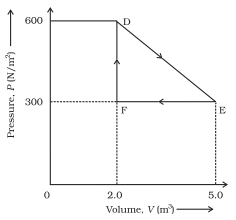
Its volume is then reduced to the original value from E to F by an isobaric process. Calculate the total work done by the gas from D to E to F.
6.
In changing the state of a gas adiabatically from an equilibrium state A to another equilibrium state B, an amount of work equal to 22.3 J is done on the system. If the gas is taken from state A to B via a process in which the net heat absorbed by the system is 9.35 cal, how much is the net work done by the system in the latter case ? (Take 1 cal = 4.19 J)
7.
Explain why
(a) Two bodies at different temperatures T1 and T2 if brought in thermal contact do not necessarily settle to the mean temperature (T1 + T2 )/2.
(b) The coolant in a chemical or a nuclear plant (i.e., the liquid used to prevent the different parts of a plant from getting too hot) should have high specific heat.
(c) Air pressure in a car tyre increases during driving. (d) The climate of a harbour town is more temperate than that of a town in a desert at the same latitude.
8.
Two cylinders A and B of equal capacity are connected to each other via a stopcock. A contains a gas at standard temperature and pressure. B is completely evacuated. The entire system is thermally insulated. The stopcock is suddenly opened. Answer the following :
(a) What is the final pressure of the gas in A and B ?
(b) What is the change in internal energy of the gas ?
(c) What is the change in the temperature of the gas ?
(d) Do the intermediate states of the system (before settling to the final equilibrium state) lie on its P-V-T surface ?
1.
As no heat is allowed to be exchanged, the process is adiabatic.
\(\therefore \) \({ \rho }_{ 2 }V_{ 1 }^{ y }\quad ={ \rho }_{ 1 }V_{ 1 }\quad or\quad \frac { { p }_{ 2 } }{ { p }_{ 1 } } =\left( \frac { { V }_{ 1 } }{ { V }_{ 2 } } \right) ^{ y }\)
As \({ V }_{ 2 }=\frac { 1 }{ 2 } { V }_{ 1 }or\frac { { p }_{ 2 } }{ { p }_{ 1 } } =\left( \frac { { V }_{ 1 } }{ { 1 }/{ 2{ V }_{ 1 } } } \right) ^{ 1.4 }={ 2 }^{ 1.4 }=2.64\)
2.
Here, volume of water heated = 3.0 L/min
Mass of water heated, m = 3000 g/min
Rise in temperature, \(\Delta \)T = 77 - 27 =50oC
Specific heat of water, C = 4.2 J g-1 oC-1
Amount of heat used,\(\Delta \)Q = \(mC\Delta T=3000\times 4.2\times 50\)
\(\\ =63\times 10^{ 4 }\ J/min\)
Heat of combination = 4 \(\times \)104 J/g
Rate of combustion of fuel = \(\frac { 63\times { 10 }^{ 4 } }{ 4\times { 10 }^{ 4 } } \)
= 15.75g / min
3.
Here, mass of gas, m = 2\(\times \)10-2 kg = 20g
Rise in temperature, \(\Delta \)T = 45oC
Heat required,\(\Delta \)Q = ?
Molecular mass, M =28
Number of moles, n =\(\frac { m }{ n } =\frac { 20 }{ 28 } =0.714\)
As nitrogen is a diatomic gas, molar specific heat at constant pressure is
\(C_{ p }=\frac { 7 }{ 2 } R=\frac { 7 }{ 2 } \times 8.3J\quad mol^{ -1 }K^{ -1 }\)
\(\\ As\ \Delta Q=nC_{ p }\Delta T\)
\(\\ \therefore \ \Delta Q=0.714\times \frac { 7 }{ 2 } \times 8.3\times 45J=933.4\ J\)
4.
Heat energy supplied per second by the heater
\(\Delta \)Q = 100 W = 100 J/s
Work done by the system ( \(\Delta \) W) = + 75 Jls
Rate of change in internal energy (\(\Delta \)U) = ?
According to first law of thermodynamics,
\(\Delta \)U = \(\Delta \)Q - \(\Delta \)W
= 100 - 75 = 25 J/s
= 25W
5.
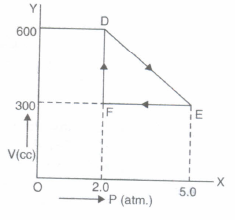
As is clear from Fig.
Change in pressure, Δp = EF = 5.0 - 2.0 = 3.0 atm = 3.0 x 10⁵ Nm-2
Change in volume, ΔV=DF = 600 - 300 = 300 cc = 300 x 10-6 m3
Work done by the gas from 0 to E to F = area of ΔDEF
\(W={1\over 2}\times DF\times EF\)
\(={1\over 2}\times (300 \times 10^{-6})x (3.0 \times 10^5) = 45 J\)
6.
Given, work done (W) = - 22.3 J
Work done is taken negative as work is done on the system.
In an adiabatic change, \(\Delta \)Q = 0
Using first law of thermodynamics
\(\Delta \).U = \(\Delta \)Q - W = 0 -(- 22.3) = 22.3J
For another process between states A and B,
Heat absorbed (\(\Delta \)Q) = + 9.35 cal
= + (9.35 x 4.19) J = + 39.18 J
Change in internal energy between two states via different paths are equal.
\(\because \) \(\Delta \)U = 22.3 J
\(\therefore \) From first law of thermodynamics,
\(\Delta \)U = \(\Delta \)Q - W
or W = \(\Delta \)Q -\(\Delta \)U
= 39.18 - 22.3
= 16.88J \(\approx \)16.9J
7.
(a) When two bodies at different temperatures T1 and T2 are brought in thermal contact, heat flows from the body at the higher temperature to the body at the lower temperature till equilibrium is achieved, i.e., the temperatures of both the bodies become equal. The equilibrium temperature is equal to the mean temperature (T1 + T2)/2 only when the thermal capacities of both the bodies are equal.
(b) The coolant in a chemical or nuclear plant should have a high specific heat. This is because higher the specific heat of the coolant, higher is its heat-absorbing capacity and vice versa. Hence, a liquid having a high specific heat is the best coolant to be used in a nuclear or chemical plant. This would prevent different parts of the plant from getting too hot.
(c) When a car is in motion, the air temperature inside the car increases because of the motion of the air molecules. According to Charles’ law, the temperature is directly proportional to pressure. Hence, if the temperature inside a tyre increases, then the air pressure in it will also increase.
(d) A harbour town has a more temperate climate (i.e., without the extremes of heat or cold) than a town located in a desert at the same latitude. This is because the relative humidity in a harbour town is more than it is in a desert town.
8.
(a) Let capacity of each cylinder be V and atmospheric pressure be p.
p1 = p
Initial volume of gas = Volume of cylinder A
V1 = V
When stopcock is opened, then volume available for gas becomes 2V
V2 = 2V
Final pressure (p2) = ?
As system is thermally insulated, therefore there is no change in temperature during the process and hence it is an isothermal process.
For an isothermal process (according to Boyle's law),
p1V1 = p2 V2
or \({ p }_{ 2 }={ p }_{ 1 }\frac { { V }_{ 1 } }{ { V }_{ 2 } } =pX\frac { V }{ 2V }\)
\( \\ =\frac { p }{ 2 } =\frac { 1 }{ 2 } atm=0.5\ atm\)
(b) Change in internal energy, \(\triangle \)U = 0, as work is done on or by the gas.
(c) Change in temperature of the gas is zero as gas does no work in expansion.
(d) No, because free expansion of gas is rapid and cannot be controlled. The intermediate states are non-equilibrium states and so not satisfy the gas equation. Therefore, the intermediate state of the gas does not be on the p - V - T surface.

11th Standard CBSE Syllabus & Materials
11th Standard CBSE
CBSE 11th Business Studies Forms of Business Organisation Sample Question Papers Study Material - QB365 Set A
NEW11th Standard CBSE
CBSE 11th Business Studies Business, Trade and Commerce Sample Question Papers Study Material - QB365 Set A
NEW11th Standard CBSE
CBSE 11th Physics Waves Sample Question Papers Study Material - QB365 Set A
NEW11th Standard CBSE
CBSE 11th Physics Kinetic Theory Sample Question Papers Study Material - QB365 Set A



NCERT Books

Syllabus

Exam Pattern

Sample Question Papers

Previous year Question Papers

Important Notes

MCQ Practice test

NCERT Exemplers

Case study Questions

Image Based Questions

Passage based Questions

HOT Questions

Value Based Questions

Model Questions Papers
NCERT ( Book Back ) Questions

Assertion and Reason
Important Questions And Answers

CBSE 11th Standard CBSE Subjects
CBSE Standards







