
 100% FREE ACCESS
11th Standard CBSE Syllabus & Materials
11th Standard CBSE
CBSE 11th Economics PART-A - Presentation of Data - New Sample Question Papers Study Material - QB365 Set A
NEW11th Standard CBSE
CBSE 11th Economics PART-A - Organisation of Data - New Sample Question Papers Study Material - QB365 Set A
NEW11th Standard CBSE
CBSE 11th Economics PART-A - Collection of Data - New Sample Question Papers Study Material - QB365 Set A
NEW11th Standard CBSE
CBSE 11th Economics PART-A - Introduction to Economics and Statistics - New Sample Question Papers Study Material - QB365 Set A
NEW11th Standard CBSE
CBSE 11th Business Studies International Trade Sample Question Papers Study Material - QB365 Set A
NEW11th Standard CBSE
CBSE 11th Business Studies Evolution and Fundamentals of Business Sample Question Papers Study Material - QB365 Set A

Published on: 30/12/2018
11th Class Full Test
Download CBSE Class 11th Standard CBSE Physics question papers, sample papers, important questions, and previous year solved papers in PDF format. Get free study materials, NCERT solutions, and exam preparation resources for Class 11th Standard CBSE Physics
Questions + Answers key
Take MCQ Physics Test
1.
Name two major groups of Physics.
2.
The difference between the two specific heat capacities (at constant pressure and volume) of a gas is 5000 J kg-1 k-1 and the ratio of these specific heat capacities is 1.6. Find the two specific heat capacities i.e. Cp and Cv.
3.
Two tuning forks A and B give 5 beats. A resounds with a closed column of air 15 cm long and B with an open column of ar 30.5 cm long. Caluculate their frequencies. Negelct and correction.
4.
A child running a temperature of 101°F is given an antipyrin (i.e. a medicine that lowers fever) which causes an increase in the rate of evaporation of sweat from his body. If the fever is brought down to 98 °F in 20 minutes, what is the average rate of extra evaporation caused, by the drug. Assume the evaporation mechanism to be the only way by which heat is lost. The mass of the child is 30 kg. The specific heat of human body is approximately the same as that of water, and latent heat of evaporation of water at that temperature is about 580 cal g-1
5.
At a point above the surface of the earth, the gravitational potential is \(-5.12\times { 10 }^{ 7 }\ J/kg\) and the acceleration due to gravituy is 0.4 m/s2 .Assuming the mean radius of the earth to be 6400 km, calculate the height of the point above the earth's surface.
6.
trolley of mass 20 kg rests on a horizontal surface. A massless string tied to the trolley passes over a frictionless pulley and a load of 5 kg is suspended from the end of string. If coefficient of kinetic friction between trolley and surface be 0.1, find the acceleration of trolley and tension in the string. ( take g = 10 ms-2 )
7.
A foreigner arrived at Mumbai airport at around 1AM in the moring . She found a text waiting outside. She asked the driver to drop her at the nearby hotel. The taxi driver obliged and drove the foreigner round and round in the city and dropped her at a hotel at around 1:30AM in the morning.
The hotel was only few kilometer away but he charged her one thousand rupees. While driver was arguing with foreigner , a man from the hotel came out to help her. When he heard that drive was charging one thousand rupees, he scolded him and asked him to charge genuinely and not to spoil their country's name. Driver apologised to foreigner and refunded her eight hundred rupees.
The hotel of the foreigner was at a distance of 10 km away from airport on a straight road and dishonest cabman took her along a circuitous path 23 km long and reached the hotel in 28 min. What was the average speed and magnitude of average velocity?
8.
It is a common observation that rain clouds can be at about a kilometre altitude above the ground.
(a) If a rain drop falls from such a height freely under gravity, what will be its speed?Also, calculate in km/h (g = 10 m/s2).
(b) A typical rain drop is about 4 mm diameter.Momentum is mass x speed in magnitude.Estimate its momentum when it hits ground.
(c) Estimate time required to flatten the drop.
(d) Rate of change of momentum is force.Estimate how much force such a drop would exert on you?
(e) Estimate the order of magnitude force on umbrella. Typical lateral separation between two rain drops is 5cm.
9.
A drop of olive oil of radius 0.25 mm spreads into a circular film of radius 10 cm on the water surface. Estimate the molecular size of olive oil.
10.
Can a vector be non-zero if one of its components is zero?
11.
What happens to the time period of a simple pendulum if its length is doubled?
12.
Define the terms 'node' and 'antinode'?
13.
A light body and a heavy body have the same kinetic energy. Which one will have greater momentum?
14.
The ratio of vapour densities of two gases at the same temperature is 6 : 9. Compare the r.m.s. velocities of their molecules.
15.
The displacement of an elastic wave is given by the function y = 3sin \(\omega \)t + 4cos\(\omega \)t Where, y is in cm and t is in second.Calculate the resultant amplitude.
16.
Two simple pendulums of equal length cross each other at mean position. What is their phase difference?
17.
A piece of paper wrapped tightly on a wooden rod is observed to get charred quickly when held over a flame as compared to a similar piece of paper when wrapped on a brass rod. Explain why?
18.
Is it correct to cell heat as the energy as the energy in transit?
19.
Can two streamlines cross each other, why?
20.
A solid sphere of radius R made of a material of bulk modulus B is surrounded by a liqiud in a cylindrical container. A massless piston of area A floats on the surface of the liqiud. When a mass M is placed on the piston on the piston to compress the liqiud, find fractiional change in the radius of the sphere?
21.
What will be the value of g at the bottom of sea 7km deep?Diameter of the earth is 12800 km and g on the surface of the earth is 9.8\({ m }/s^{ 2 }\)
22.
Two billiard balls each of mass 0.5 kg moving in opposite directions with speed 6 m/s collide and rebound with the same speed. What is the impulse imparted to each ball due to the other ?
23.
The distance of venus from sun 1.082 x 10¹¹ is and its period of revolutions is 244.633 days. If the period of revolution of the earth around the sun is 365.247 days. Calculate the distance from the sun.
24.
A simple harmonic motion has an amplitude A and time period T. What is the time taken to travel from x = A to x = \(\frac{A}{2}\)?
25.
The minute hand of a wall clock is 10 em long. Find its displacement and the distance covered from 12.00 noon to 12.30 p.m.
26.
Two sound waves originating from the same source, travel along different paths in air and then meet at a point. If the source vibrates at a frequency of 1 kHz and one path is 83 cm longer than the other, what will be the nature of interference? The speed of sound in air is 332 m/s.
27.
What should be the maximum average velocity of water in a tube of diameter 2 cm so that flow is laminar? The viscosity of water is 0.001 Nm-2 s.
28.
The number of particles crossing per unit area perpendicular to x-axis in unit time N is given by \(N=-D\left(\frac{n_{2}-n_{1}}{x_{2}-x_{1}}\right)\) where n1 and n 2 are the number of particles per unit volume at x1 and x2 respectively. Deduce the dimensional formula for D.
29.
What is the average distance between atoms (interatomic distance) in water? Use the data given in Examples : (i) The density of water is 1000 kgm-3. The density of water vapour at 1000C and 1 atm pressure is 0.6 kgm -3 .The volume of a molecule multiplied by the total number gives ,what is called, molecular volume. Estimate the ratio (or fraction) of the molecular volume to the total volume occupied by the water vapour under the above conditions of temperature and pressure.
(ii) Estimate the volume of a water molecule using the data in Example : The density of water is 1000 kgm-3. The density of water vapour at 1000C and 1 atm pressure is 0.6 kgm -3 .The volume of a molecule multiplied by the total number gives ,what is called, molecular volume. Estimate the ratio (or fraction) of the molecular volume to the total volume occupied by the water vapour under the above conditions of temperature and pressure.
30.
A clock with an iron pendulum keeps correct time at 20o C. How much will it lose or gain per day, if temperature changes to 40o C? Coefficient of cubical expansion of iron is 36 x 10-6 OC-1 .
31.
Assume that if the shear stress in steel exceeds about 4 x 10⁸N/m2 , the steel ruptures. Determine the shearing force necessary to (a) shear a steel bolt 1.00 cm in diameter and (b) punch a 1 cm diameter hole in a steel plate 0.5000 cm thick.
32.
A satellite revolves around a planet in an orbit just above the planet's surface. Find the period of the satellite.
33.
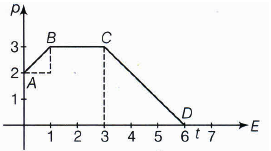
Figure shows momentum versus time graph for a particle moving along x-axis. In which region, force on the particle is large. Why?
34.
Galileo, in his book Two new sciences, stated that “for elevations which exceed or fall short of 45° by equal amounts, the ranges are equal”. Prove this statement.
35.
A particle starts from the origin at t=0 with a velocity of 10.0 \({ j } ^ { \wedge }\)m/s and moves in the x-y plane with a constant acceleration of (8.0\(\overset { \wedge }{ i } \)+2.0\(\overset { \wedge }{ j } \)) ms-2.(a) At what time is the x- coordinate of the particle 16 m? What is the y-coordinate of the particle at that time?
(b) What is the speed of the particle at the time ?
1.
()
The two major groups of physics are microscopic group and macroscopic group.
2.
We know that Cp - Cv = R
Cp - Cv = 5000
Dividing by Cv we get
\({C_P\over C_V}-1={5000\over C_V}\)
\(1.6-1={5000\over C_V}\)
\(0.6={5000\over C_V}\)
\(∴\ C_V={5000\over 0.6}=8333.33 J\ kg^{-1}k^{-1}\)
Now Cp - Cv = 5000
Cp - 8333.33 = 5000
CP = 8333.33 + 5000
= 13333.33 J kg-1 k-1
3.
\(v_{1}=\frac{v}{4 \times 15}, v_{2}=\frac{v}{2 \times 30.5}=\frac{v}{61} \)
\(m=v_{1}-v_{2}=\frac{v}{60}-\frac{v}{61}=v \times \frac{1}{61 \times 60} \)
\(5=\frac{v}{61 \times 60}\)
or = v = 5 x 16 x 60 cm/s
\(\therefore \quad v_{1} =\frac{v}{60}=\frac{5 \times 61 \times 60}{60}=305 \mathrm{~Hz}\)
\(v_{2} =\frac{v}{61}=\frac{5 \times 60 \times 61}{61}=300 \mathrm{~Hz} \)
4.
Mass of child, M = 30kg = 30 x 103g
Fall in temperature,
\(\Delta T=101-98=3^{ 0 }F\)
\(\\ =3\times \frac { 5 }{ 9 } =\frac { 5 }{ 3^{ 0 } } C\)
Specific heat of human body,
c= specific heat of water
= 1 cal g-1 0C-1
Heat lost by child in the form of evaporation of sweat,
\(Q=Mc\Delta T=30\times 10^{ 3 }\times 1\times \frac { 5 }{ 3 } \)
= 50000 cal
If M' gram of sweat evaporates from the body of the child, then heat gained by sweat
Q = M'L= M' x 580 Cal
Heat gained = Heat lost
M' x 580 = 50000
\(\Rightarrow \quad M'=\frac { 50000 }{ 580 } =86.2g\)
Time taken by sweat to evaporate = 20min
Rate of evaporation of sweat = \(\frac { 86.2 }{ 20 } \)
= 4.31g min-1
5.
If r is the distance of the given point from the centre of the earth, then gravitational potential at the point.
\(V=-\frac { GM }{ r } =-5.12\times { 10 }^{ 7 }\quad J/kg\)
Acceleration due to gravity at this point,
\(g=\frac { GM }{ { r }^{ 2 } } =6.4\quad m/{ s }^{ 2 }\)
\(\\ Clearly,\quad \frac { \left| V \right| }{ g } =\frac { GM/r }{ GM/{ r }^{ 2 } } =r\)
\(\\ Thus,\quad r=\frac { 5.12\times { 10 }^{ 7 }J/kg }{ 6.4m/{ s }^{ 2 } } =8\times { 10 }^{ 6 }m=8000\ km\)
Obviously, height of the point from the earth's surface
= (r-R) = 8000km - 6400km = 1600 km.
6.
44 N
7.
Actual length of path travelled =23 km
Displacement = 10 km
Time taken =20 min =28/60 h
Average speed of taxi =\(\frac { actual \ path \ length }{ time \ taken } \)
= \(\frac { 23 }{ 28/60 } =49.3\quad km/h\)
Magnitude of average velocity = \(\frac { displacement }{ time } =\frac { 10 }{ 28/60 } =21.4\quad km/h\)
8.
(a) Here, height(h)=1 km = 1000m, g = 10m/s2
Velocity attained by the rain drop in freely falling through a height h.
\(v=\sqrt { 2gh } =\sqrt { 2\times 10\times 1000 }\)
\( \\ =100\sqrt { 2 } m/s\)
\(\\ =100\sqrt { 2 } \times \frac { 60\times 60 }{ 1000 } Km/h\)
\(\\ =360\sqrt { 2 } km/h\approx 510km/h\)
(b) Diameter of the drop(d) = 2r = 4mm
Radius of the drop(r) = 2mm = 2 x 10⁻³m
Mass of a rain drop(m)=Vx\(\rho \)
\(=\frac { 4 }{ 3 } \pi { r }^{ 3 }\rho =\frac { 4 }{ 3 } \times \frac { 22 }{ 7 } \times (2\times { 10 }^{ -3 })^{ 3 }\times { 10 }^{ 3 }\)
\( \approx 3.4\times { 10 }^{ -5 }kg\)
\(\\ Momentum \ of \ the \ rain \ drop(\rho )=mv \)
\(\\ =3.4\times { 10 }^{ -5 }\times 100\sqrt { 2 }\)
\(\\ \approx 4.7\times { 10 }^{ -3 }{ kg }^{ -m/s }\)
(c) Time required to flatten the drop
= time taken by the drop to travel the distance equal to the diameter of the drop near the ground
\(t=\frac { d }{ v } =\frac { 4\times { 10 }^{ -3 } }{ 100\sqrt { 2 } } =0.028\times { 10 }^{ -3 }s\)
\(\\ =2.8\times { 10 }^{ -5 }s\)
(d) Force exerted by a rain drop
\(F=\frac { Change \ in \ momentum }{ Time } \)
\(=\frac { \rho -0 }{ t } =\frac { 4.7\times { 10 }^{ -3 } }{ 2.8\times { 10 }^{ -5 } } \approx 168N\)
(e) Radius of the umbrella(R) = \(\frac { 1 }{ 2 } m\)
\(\therefore \ Area \ of \ the \ umbrella(A)=\pi { R }^{ 2 }\)
\(\\ =\frac { 22 }{ 7 } \times { (\frac { 1 }{ 2 } ) }^{ 2 }=\frac { 22 }{ 28 } =\frac { 11 }{ 14 } \approx 0.8{ m }^{ 2 }\)
Number of drops striking the umbrella simultaneously with average of 5cm or 5 x 10⁻²m
\(=\frac { 0.8 }{ { (5\times { 10 }^{ -2 }) }^{ 2 } } =320\)
Net force exerted on umbrella
= 320 x 168 = 53760 N
9.
Given, Radius of olive oil, r = 0.25 mm = 0.025 cm
Radius of circular film, R = 10 cm and Molecular size, t = ?
We know that,
\(t=\frac { Volume\ of\ oil\ drop }{ Area\ of\ film } =\frac { \frac { 4 }{ 3 } \pi { r }^{ 3 } }{ \pi { R }^{ 2 } }\)
\( \\ t=\frac { \frac { 4 }{ 3 } \times \pi \times { 0.025 }^{ 3 } }{ \pi { \left( 10 \right) }^{ 2 } }\)
\( \\ =\frac { 4 }{ 3 } \times { \left( 25 \right) }^{ 3 }\times { 10 }^{ -11 }\)
\(\\ =2.08\times { 10 }^{ -7 }cm\)
Thus, the molecular size of olive oil is \(2.08\times { 10 }^{ -7 }cm\)
10.
A vector can be non-zero even if one of its components is zero.
11.
The time period is increased by a factor of \(\sqrt2\)
12.
Node: It is a point on stationary wave at which amplitude of vibration of the particle is zero.
Antinode: It is a point on stationary wave at which amplitude of vibration of the particle is maximum.
13.
Since \(k=\frac { { p }^{ 2 } }{ 2m }\ or\ p=\sqrt { 2mk } \)
As k is same for both bodies, \(p\infty \sqrt { m } \), i.e, heavier body has more momentum than the lighter body.
14.
The ratio of r.m.s velocities is given as
\(\frac { { { C }_{ 1 } } }{ { C }_{ 2 } } =\sqrt { \frac { { M }_{ 2 } }{ { M }_{ 1 } } } =\sqrt { \frac { { \rho }_{ 2 } }{ { \rho }_{ 1 } } } \)
\(\frac { { C }_{ 1 } }{ { C }_{ 2 } } =\sqrt { \frac { 9 }{ 6 } } =\sqrt { 3 } :\sqrt { 2 } \)
15.
The resultant amplitude will be
y=\(\sqrt{y_2^1+y_2^2}=\sqrt{9+16}=\sqrt{25}=\)5cm
16.
π rad,i.e.180o
17.
Brass is a good conductor of heat. It quickly conducts away the heat. So, the paper does not alter its ignition point easily. On the other hand, wood is a bad conductor of heat and is unable to conduct away the heat. So, the paper quickly reaches its ignition point and is charred.
18.
Yes, it is perfect correct to call heat as the energy in transit because it is continuously flowing on account of temperature different between bodies or parts of a system.
19.
Two streamlines can never cross each other because if they cross them at the point of intersection, there will be two possible direction of flow of fluid which is impossible for streamlines.
20.
When mass M is placed on the piston, the excess pressure, p=Mg/A. As the pressure is equally applicable from all the direction on the sphere, hence there will be decrease in volume due to decrease in raius sphere. Volume of the sphere, \(V=\frac { 3 }{ 4 } \pi { R }^{ 3 }\)
Differentiating it , we get,
\(\Delta V=\frac { 4 }{ 3 } \pi (3{ R }^{ 2 })\Delta R=4\pi { R }^{ 2 }\Delta R\)
\(\\ \frac { \Delta V }{ V } =\frac { 4\pi { R }^{ 2 }\Delta R }{ \frac { 4 }{ 3 } \pi { R }^{ 3 } } =\frac { 3\Delta R }{ R } \)
We know that, \(B=\frac { P }{ dV/V } =\frac { Mg }{ A } \diagup \frac { 3\Delta R }{ R } \)
\(or\ \frac { \Delta R }{ R } =\frac { Mg }{ 3BA } \)
21.
9.789\({ m }/s^{ 2 }\)
22.
Given: The mass of each ball is 0.05 kg and the magnitude of speed of each ball is 6 ms-1 .
Initial momentum of each ball is given as,
p i =mv
Where, m is the mass of each ball and v is the velocity of each ball.
By substituting the given values in the above expression, we get
p i =mv =0.05×6 =0.3 kgms-1
After collision, the balls change their directions of motion without changing the magnitudes of their velocity.
Final momentum of each ball is given as,
p f =− p i
By substituting the given values in the above expression, we get
p f =−0.3 kgms-1
Impulse imparted to each ball is given as,
I=Δp = p f − p i
By substituting the given values in the above expression, we get
I=−0.3−0.3 =−0.6 kgms-1
The negative sign indicates that the impulses imparted to the balls are opposite in direction.
Thus, the impulse imparted to each ball is −0.6 kgms-1.
23.
1.496 x 10¹¹m
24.
Displacement from mean position.
\(=A-\frac { A }{ 2 } =\frac { A }{ 2 } \)
Now y=A cos ωt
\(or\quad \frac { A }{ 2 } =Acos\frac { 2\pi }{ T } t\)
\(or\quad cos\frac { 2\pi }{ T } t=\frac { 1 }{ 2 } \)
\(\Rightarrow cos\frac { 2\pi }{ T } t=cos\frac { \pi }{ 3 } \)
\(or\quad \frac { 2\pi }{ T } t=\frac { \pi }{ 3 } \)
\(\therefore \quad t=\frac { T }{ 6 } \)
25.
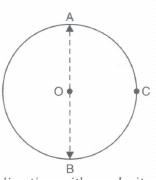
Length of minute hand = radius of circle described by minute hand r = 10 cm = 0.1 m.
From 12.00 noon to 12.30 p.m., the tip of minute hand covers a net displacement equal to the diameter of circle. Hence
Displacement \(\overline{AOB}\) = 2 x r = 2 x 0.1 m = 0.2 m
During the same time total distance covered by tip of minute hand = semicircular path ACB = \(\pi r\) = 3.14 x 0.1 = 0.31 m.
26.
Wavelength of sound wave is \(\lambda = \frac{\upsilon }{v} = \frac{332}{1 \times 10^{3}}= 0.332 m\)
Phase difference between the waves arriving at point of observation is
\(\phi = \frac{2\pi}{\lambda} \Delta x= \frac{2\pi \times 0.83}{0.332}=5 \pi\)
Since phase difference is an odd multiple of π, the interference is destructive.
27.
D = 2 cm = 0.02 m
\(\rho\) = 103 kg m-3
\(\eta\) = 0.001 Nm-2 s = 10-3 Nm-2s
Flow of water will be laminar if
NR = 1000 where NR is Reynold number
Let v = maximum average velocity
\(\therefore\) Using the relation
\(N_R=\frac{\rho vD}{\eta}\)
or \(v=\frac{N_R\eta}{\rho D}=\frac{1000\times 0.001}{1000\times 0.02}\) = 0.5 ms-1.
28.
\(D=-N\left( \frac { { x }_{ 2 }-{ x }_{ 1 } }{ { n }_{ 2 }-{ n }_{ 1 } } \right) \)
\(\\ [N]=\frac { { N }_{ 0 } }{ { [L }^{ 2 }T] } =[{ L }^{ -2 }{ T }^{ -1 }]\)
\(\\ [D]=\frac { [{ L }^{ -2 }{ T }^{ -1 }L] }{ [{ L }^{ -3 }] } =[{ L }^{ 2 }{ T }^{ -1 }]\)
\(\\ [{ x }_{ 2 }]=[{ x }_{ 1 }]=[L]\ \)
\(\ [{ n }_{ 2 }]=[{ n }_{ 1 }]=\frac { { N }_{ 0 } }{ [{ L }^{ 3 }] } =[{ L }^{ -3 }]\)
29.
A given mass of water in vapour state has 1.67×10³ times the volume of the same mass of water in liquid state : For a given mass of water molecules, the density is less if volume is large. So the volume of the vapour is 1000/0.6 = 1/(6 × 10 -4 ) times larger. If densities of bulk water and water molecules are same, then the fraction of molecular volume to the total volume in liquid state is 1. As volume in vapour state has increased, the fractional volume is less by the same amount, i.e. 6×10⁻⁴ .
This is also the increase in the amount of volume available for each molecule of water. When volume increases by 103 times the radius increases by V1/3 or 10 times, i.e., 10 × 2 Å = 20 Å. So the average distance is 2 × 20 = 40 Å.
30.
The correct options are
B Pendulum will lose 1.2×10⁻⁴ seconds per each second.
D Pendulum will lose 10.368 seconds/day.
Time period of pendulum at 20∘C
T20=2π√l/g
where l is the length of pendulum at 20∘C.
Time period at 40∘C
\(T_{40}=2 \pi \sqrt{\frac{I(1+a \Delta T)}{g}}\)
therefore Change in time period.
\( T_{40}-T_{20}=2 \pi \sqrt{\frac{1(1+a \Delta T)}{g}}-2 \pi \sqrt{\frac{T}{g}} \)
\( =2 \pi \sqrt{ } \frac{T}{g}(\sqrt{1+a \Delta T}-1)\)
\( \Rightarrow \frac{T_{40}-T_2}{T_{20}}=\sqrt{1+a \Delta T}-1\)
Using binomial expansion, \(\sqrt{1+a \Delta T}=1+\frac{1}{2} a \Delta T\)
\(\Rightarrow \frac{\mathrm{T}_{40}-\mathrm{T}_2 \mathrm{Q}}{\mathrm{T}_{20}}=\frac{1}{2} \mathrm{a} \Delta \mathrm{T}\)
Since the time period increases, pendulum will lose time.
Loss of time per 1 second
\( =\frac{1}{2} \times 0.000012 \times 20=1.2 \times 10^{-4} \mathrm{~s} \)
\( \text { Loss in } 24 \mathrm{hr}=1.2 \times 10^{-4} \times 60 \times 60 \times 24 =10.368 \mathrm{~s}
\)
31.
Shear force needed to rupture a bolt
F= Stress×(A)
⇒F=(4.00×10⁸ N/m2) ×π(5.00×10⁻³ m)2
=3.14×10⁴ N
3.14 x 10⁴N, 6.28 x 10⁴N
32.
\(T =2 \pi \sqrt{\frac{R^3}{G M}}=2 \pi \sqrt{\left\{\frac{R^3}{\left(G \frac{4}{3} \pi R^3 \rho\right)}\right\}}=\sqrt{\frac{3 \pi}{G \rho}} \)
\(=\sqrt{\frac{3 \times 3.14}{6.67 \times 10^{-11} \times 8000}} \approx 4202 s
\)
33.
Net force is given by Fnet =\(\frac { dp }{ dt } \)
Also, rate of change of momentum = slope of graph.
As from graph, slope AB= slope CD
And slope (BC) = slope (DE) =0
So, force acting on the particle is equal in regions AB and CD and in regions BC and DE (which is zero).
34.
For a projectile launched with velocity \(v _{ 0 }\)at an angle \(\theta _{ 0 }\), the range is given by \(R=\frac { { v }_{ 0 }^{ 2 }sin2\theta _{ 0 } }{ g } \).
Now, for angles, (45° + α) and ( 45° – α), 2θo is (90° + 2α) and ( 90° – 2α) , respectively. The values of sin (90° + 2α) and sin (90° – 2α) are the same, equal to that of cos 2α. Therefore, ranges are equal for elevations which exceed or fall short of 45° by equal amounts α.
35.
Here, u = 10.0\(\overset { \wedge }{ j } \) ms-1 at t = 0.
(a)\(a=\frac { dv }{ dt } =(8.0\overset { \wedge }{ i } +2.0\overset { \wedge }{ j } ){ ms }^{ -2 }\)
\(\\ so,\quad dv=(8.0\overset { \wedge }{ i } +2.0\overset { \wedge }{ j } )dt\)
Integrating it within the conditions of motion i.e. as time changes from 0 to t, displacement is from 0 to r, we have
\(r=ut+\frac { 1 }{ 2 } \times 8.0{ t }^{ 2 }\overset { \wedge }{ i } +\frac { 1 }{ 2 } \times 2.0{ t }^{ 2 }\overset { \wedge }{ j }\)
\( \\ or\quad x\overset { \wedge }{ i } +y\overset { \wedge }{ j } =10\overset { \wedge }{ j } t+4.0{ t }^{ 2 }\overset { \wedge }{ i } +{ t }^{ 2 }\overset { \wedge }{ j }\)
\( \\ =4.0{ t }^{ 2 }\overset { \wedge }{ i } +)(10t+{ t }^{ 2 })\overset { \wedge }{ j } \)
\(\\ Here, \ we \ have, \ x=4.0{ t }^{ 2 } \ and \ y=10t+{ t }^{ 2 }\)
\(\\ \therefore \quad t={ (x/4) }^{ \frac { 1 }{ 2 } }\)
At x = 16m, t = (16/4)1/2 = 2s
y = 10 x2 + 22= 24m
(b) Velocity of particle at t= 2 s along x-axis
\(v_{x}=u_{x}+a_{x} t=0+8.0 \times 2=16.0 \mathrm{~m} / \mathrm{s}\)
and along y-axis \(v_{y}=u_{y}+a_{y} t=10.0+2.0 \times 2=14.0 \mathrm{~m} / \mathrm{s}\)
\(\therefore\) Speed of particle at t = 2s
\(v=\sqrt{v_{x}^{2}+v_{y}^{2}}=\sqrt{(16.0)^{2}+(14.0)^{2}}=21.26 \mathrm{~ms}^{-1}\)

11th Standard CBSE Syllabus & Materials
11th Standard CBSE
CBSE 11th Business Studies Forms of Business Organisation Sample Question Papers Study Material - QB365 Set A
NEW11th Standard CBSE
CBSE 11th Business Studies Business, Trade and Commerce Sample Question Papers Study Material - QB365 Set A
NEW11th Standard CBSE
CBSE 11th Physics Waves Sample Question Papers Study Material - QB365 Set A
NEW11th Standard CBSE
CBSE 11th Physics Kinetic Theory Sample Question Papers Study Material - QB365 Set A



CBSE 11th Standard CBSE Subjects
CBSE Standards









