
 100% FREE ACCESS
11th Standard CBSE Syllabus & Materials
11th Standard CBSE
CBSE 11th Economics PART-A - Presentation of Data - New Sample Question Papers Study Material - QB365 Set A
NEW11th Standard CBSE
CBSE 11th Economics PART-A - Organisation of Data - New Sample Question Papers Study Material - QB365 Set A
NEW11th Standard CBSE
CBSE 11th Economics PART-A - Collection of Data - New Sample Question Papers Study Material - QB365 Set A
NEW11th Standard CBSE
CBSE 11th Economics PART-A - Introduction to Economics and Statistics - New Sample Question Papers Study Material - QB365 Set A
NEW11th Standard CBSE
CBSE 11th Business Studies International Trade Sample Question Papers Study Material - QB365 Set A
NEW11th Standard CBSE
CBSE 11th Business Studies Evolution and Fundamentals of Business Sample Question Papers Study Material - QB365 Set A

Published on: 02/11/2019
Download CBSE Class 11th Standard CBSE Physics question papers, sample papers, important questions, and previous year solved papers in PDF format. Get free study materials, NCERT solutions, and exam preparation resources for Class 11th Standard CBSE Physics
Questions + Answers key
Take MCQ Physics Test
1.
What do you mean by the term "equilibrium"? What are equilibrium of rest and equilibrium of motion? State the conditions for complete equilibrium of a body
2.
State Newton's second law of motion. How does it help to measure force? Also state the units of force.
3.
Derive the three basic kinematic equations by calculus method.
4.
Briefly explain how you will estimate the molecular diameter of oleic acid.
5.
Two particles A and B of masses m and 2m, are moving along the X and Y-axes, respectively with the same speed of v. They collide at the origin and coalesce into one body after the collision. What is the velocity of the coulesced mass? What is the loss of energy during this collission?
6.
The speed-time graph of a particle moving along a fixed direction is shown in Fig. Obtain the distance traversed by the particle between
(a) t = 0 s to 10 s.
(b) t = 2 s to 6 s.
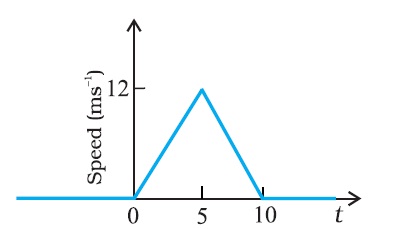
What is the average speed of the particle over the intervals in (a) and (b)?
7.
If the linear momentum of a body increases by 20% what will be the % increase in the kinetic energy of the body?
8.
Find an expression for viscous force F acting on a tiny steel ball of radius r moving in a viscous liquid of viscosity \(\eta \) with a constant speed v by the method of dimensional analysis.
9.
One mole of an ideal gas at standard temperature and pressure occupies 22.4 L (molar volume). What is the ratio of molar volume to the atomic volume of a mole of hydrogen ? (Take the size of hydrogen molecule to be about 1 Å). Why is this ratio so large ?
1.
Equilibrium: A body or a system of particles is said to be in a state of equilibrium if inspite of a number of forces-or torques acting on it, the body or the system of particles remains in its original state of rest or of uniform motion (translational or rotational or both). Thus, equilibrium state means that acceleration (both linear as well as angular) of the body/system must be zero. Hence, equilibrium is of two types:
(i) Equilibrium of rest: If a given system remains in a state of rest and does not change its position inspite of number of forces acting on it, it is said to be in an equilibrium of rest e.g., our house, our school etc.
(ii) Equilibrium of motion: If a given system maintains its state of uniform motion, translational or rotational or combined, under the action of a number of forces then it is said to be in an "equilibrium of motion" e.g., our Earth, the planetary system, electrons revolving around the nucleus of an atom. For a state of equilibrium of motion, the value of linear momentum and/ or angular momentum of the system should have a finite and constant value.
Conditions for complete equilibrium: For complete equilibrium condition for translational equilibrium and condition for rotational equilibrium both must be fulfilled. The conditions are
(a) For translational motion we know that \(\frac { d\vec { p } }{ dt } =\sum { \vec { F_{ ext } } } \)
For equilibrium \(\vec { p } \) = a constant or \(\frac { d\vec { p } }{ dt } \)=0 or \(\sum { \vec { F_{ ext } } } =0\)
Hence for translational equilibrium, the vector sum of all the external forces acting on the system/ body under discussion must be zero
(b) For rotational motion, we that \(\frac { d\vec { L } }{ dt } =\sum { \vec { \tau _{ ext } } } \)
For equilibrium \(\vec { L} \) = a constant or \(\frac { d\vec { L } }{ dt } =0\quad or\quad \sum { \vec { { \tau } } _{ ext } } =0\)
Hence for rotational equilibrium, the vector sum of all the external torques acting on the system/body must be zero
2.
Newton's second law of motion states that the rate of change of momentum of a rigid body is directly proportional to the force applied on it.
The law implies that when a bigger force is applied on a body of given mass, its linear momentum changes faster and vice-versa. The momentum will change in the direction of the applied force.
Let, m = mass of a body,
\(\overrightarrow{v}\)= velocity of the body
\(\therefore\)The linear momentum of the body
\(\overrightarrow{p}=m\overrightarrow{v}\) .............(i)
Now, suppose \(\overrightarrow{F}\) = external force applied on the body in the direction of motion of the body.
\(\triangle \overrightarrow{p}\)= a small change in linear momentum of the body in a small time \(\triangle t\).
Rate of change of linear momentum of the body = \({\triangle \overrightarrow{p}\over \triangle t}\)
According to Newton's second law,
\({\triangle \overrightarrow{p}\over \triangle t} \propto \overrightarrow{F} \ or \ \overrightarrow{F} \propto {\triangle \overrightarrow{p}\over \triangle t} \)
or \(\overrightarrow {F}=k{\triangle \overrightarrow{p}\over \triangle t}\) ..................(ii)
where k is a constant of proportionality.
Taking the\(\triangle t \rightarrow 0,\) the term \(={\triangle \overrightarrow{p}\over \triangle t}\) becomes the derivative or differential coefficient of \(\overrightarrow{p}\) w.r.t. time t. It is denoted by \({d\overrightarrow{p}\over dt}\) .
\(\therefore \overrightarrow{F}=k{d\overrightarrow p \over dt}\)
Using eqn (i), \(\overrightarrow{F}=k{d \over dt}(m\overrightarrow{v})=km{d\overrightarrow{v}\over dt}\)
\(\overrightarrow {F}=km\overrightarrow{a}\)
where \(\overrightarrow{a}={d\overrightarrow{v}\over dt}\) represents acceleration of the body
The value of constant of proportionality k depends on the units adopted for measuring the force.
Now, putting k=1
\(\overrightarrow{F}=m\overrightarrow{a},\) This gives mean of measuring force.
Units of Force: Force in SI units is measured in 'newton' or N. From the relation \(\overrightarrow{F}=m\overrightarrow{a},\) we can see that a newton force is that force which produces 1 ms-2 acceleration in a body of mass 1 kg.
1 newton = 1 kilogram x 1 metre/ second2
\(\Rightarrow\) 1 N = 1 kg x 1 ms-2 = 1 kg x ms-2=1kg ms-2
In CGS system, force is measured in 'dyne'.
1 dyne = 1 gram x 1 cm s-2 = 1 g cm s-2
Since 1 N = 1 kg ms-2 = 1000 g x 100 cm s-2
= 105 g cm s-2= 105 dyne.
\(\Rightarrow\)IN = 105 dyne.
or 1 dyne = 10-5 N.
3.
(i) Velocity attained by a particle after time t:
Let dt: be the change in velocity of the particle in time dt. Therefore, the acceleration of the particle is given by
\(a=\frac{dv}{dt} \ or \ dv=a \ dt\)
By integrating both sides, we get
\(\int{dv}= \int{a dt}\)
or \(\int{dv}= a \int{ dt}\)
or v = at + k --- (i)
where k is constant of integration.
when t = 0, v = u
Putting these values in equation (i), we get
k = u
Now putting the value of k in equation (i), we get
v = u + at
(ii) Displacement of the particle after time t:
Let dx be the displacement of the particle in time dt. Therefore, the velocity of the particle is given by
\(v=\frac{dx}{dt}\ or \ dx=vdt\)
Since v =u + at
∴ dx=(u+at)dt
Integrating both sides, we get
\(\int{dx}=\int{(u+at)}dt\)
or \(\int{dx}=\int{u}dt+\int{at \ dt}\)
\(x= u\int{dt}+a \int{t\ dt}\) [∵ u and a are constants]
or \(x=ut+a \frac{t^{2}}{2}+k\)
where k is constant of proportionality
where t = 0, x = x0
∴ from equation (ii), we get
\(x=x_{0}+ut+\frac{1}{2}at^{2}\)
or \(x-x_{0}=ut+\frac{1}{2}at^{2}\)
since x-x0= S, displacement of the particle in the time interval t.
S = \(ut+\frac{1}{2}at^{2}\)
(iii) Velocity attained by a particle after travelling a distance S:
We know, \(v=\frac{dx}{dt}\)
Multiplying and dividing R.H.S. by dv, we get
\(v=\frac{dx}{dt}.\frac{dv}{dv}=\frac{dx}{dv}.\frac{dv}{dt}\)
As \(\frac{dv}{dt}=a (acceleration)\)
∴ v = a\(\frac { dx }{ dv } \) or v dv=a dx
Integrating both sides, we get \(\int { v\ dv=\int { a\ dx=a\int { dx } } } \)
or = \(\frac { v^{ 2 } }{ 2 } \)ax+k
when x = 0,v = u
Then,from eqn.(i),k = \(\frac { u^{ 2 } }{ 2 } \)
Putting the value of k in eqn. (i), we get
\(\frac { v^{ 2 } }{ 2 } \)-ax+\(\frac { u^{ 2 } }{ 2 } \)
or \(\frac { v^{ 2 } }{ 2 } -\frac { u^{ 2 } }{ 2 } =ax\)
or v2-u2= 2ax
x = s, then
v2-u2 = 2 aS.
4.
To determine the molecular diameter of oleic acid, we first of all dissolve 1 mL of oleic acid in 20 mL of alcohol. Then redissolve 1 mL of this solution in 20 mL of alcohol. Hence, the concentration of final solution is
\(\frac { 1 }{ 20 } \times \frac { 1 }{ 20 } =\frac { 1 }{ 400 } \)th part of oleic acid in alcohol.
Now take a large sized trough filled with water. Lightly sprinkle lycopodium powder on water surface. Using a dropper of fine bore gently put few drops (say n) of the solution prepared on to water. The solution drops spread into a thin, large and roughly circular film of molecular thickness on water surface. Quickly measure the diameter of thin circular film and calculate its surface area S.
If volume of each drop of solution be V, then volume of n drops = n V
Volume of oleic acid in this volume of solution = \(\frac{n V}{100}\)
It t be the thickness of oleic acid film formed over water surface then the volume of oleic acid film = St.
\(\therefore\) st = \(\frac{n V}{100}\)|
t = \(\frac{n V}{100}\)
As the film is extremely thin, this thickness t may be considered to be the size of one molecule of oleic acid i.e., t is the molecular diameter of oleic acid. Experimentally, molecular diameter of oleic acid is found to be of the order of 10-9 m.
5.
Let a be the angle of scattering of the coalesced mass (m + 2m) i.e. 3m and V be the velocity after the collision at the origin.
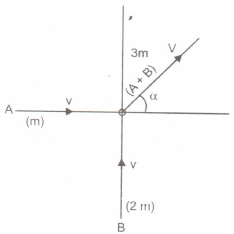
\(\therefore\) According to law of conservation of momentum, for x-component.
mv = 3mV cos \(\alpha\)
v = 3V cos \(\alpha\) (i)
For y-component
2mv = 3mV sin \(\alpha\)
2v = 3V sin \(\alpha\) (ii)
Dividing eq. (ii) by eq. (i) we get
\({ tan\quad \alpha =\frac { 2mv }{ mv } =2 }\)
\(\therefore \quad \alpha ={ tan }^{ -1 }(2)\)
= 63.4°
Squaring eq. (i) and eq. (ii) we get,
v2 + (2v)2 = (3V cos \(\alpha\))2 + (3V sin \(\alpha\))2
\(\Rightarrow\) v2 + 4v2 = 9V2 cos2 \(\alpha\) + 9 V2 sin2 \(\alpha\)
\(\Rightarrow\) 5v2 = 9V2
\(\therefore\) \({ V }^{ 2 }=\frac { 5 }{ 9 } { v }^{ 2 }\)
or \(V=\frac { \sqrt { 5 } }{ 3 } v\) (iii)
Now the K.E. before the collision = \(\frac { 1 }{ 2 } { mv }^{ 2 }+\frac { 1 }{ 2 } (2m){ v }^{ 2 }\)
\(=\frac { 3 }{ 2 } { mv }^{ 2 }\)
and the K.E. after the collision \(=\frac { 1 }{ 2 } (3m){ V }^{ 2 }\)
\(=\frac { 1 }{ 2 } \times 3m\times \frac { 5 }{ 9 } { v }^{ 2 }\) [From (iii)]
\(=\frac { 5 }{ 6 } { mv }^{ 2 }\)
\(\therefore\) Loss of K.E. during the collission = \(\frac { 3 }{ 2 } { mv }^{ 2 }-\frac { 5 }{ 6 } { m }^{ 2 }\)
\(=\frac { 2 }{ 3 } { mv }^{ 2 }\)
6.
(a) Distance travelled by the particle between t = 0 s to 10 s
= area of \(\Delta \)DAB = \(\frac { 1 }{ 2 } \) base x height
=\(\frac { 1 }{ 2 } \)x 10 x 12 = 60m
\(\therefore \) Average speed of particle vav = \(\frac { 60m }{ 10s } \)= 6 ms-1
(b) The distance traversed by the particle between
t = 2s to t = 6 s
= distance from 2 to 5 s (s1) + distance in 6th second (s2)
Now, u = 0, t = 5, v = 12 ms-1
\(\therefore \) Acceleration for 0 - 5 s, a =\(\frac { v-u }{ t } =\frac { 12-0 }{ 5 } \) ms-2 = 2.4 ms-2
∴ Distance covered from 2 to 5 s = distance covered in 5 s - distance covered in 2 s
S1 = \(\frac { 1 }{ 2 } a(5)^{ 2 }-\frac { 1 }{ 2 } a(2)^{ 2 }=\frac { 1 }{ 2 } \times 2.4\times \left[ (5)^{ 2 }-(2)^{ 2 } \right] \)
= 25.2 m.
For motion from 5 to 10 s, u = +12 ms-1 and a = -2.4 ms-2 and interval t = 5 s to t = 6 s means n = 1 for this motion.
∴ Distance covered in 6th second 52 = u + \(\frac { 1 }{ 2 } \)a (2n -1)
= 12 - \(\frac { 2.4 }{ 2 } \) (2 x 1-1 ) = 10.8 m
∴ Total distance covered from t = 2 s to 6 s = S1 + S2
= 25.2 + 10.8 = 36 m and average speed =\(\frac { 36M }{ (6-2)S } \) 9 ms-1.
7.
From \(K E=\frac{p^2}{2 m}\)
as m is constant, therefore, \(\frac{E_2}{E_1}=\left(\frac{p_2}{p_1}\right)^2\)
Now, \(\frac{p_2}{p_2}=\frac{120}{100}=\frac{6}{5}\) Itbr \(>\therefore \frac{E_2}{E_1}=\left(\frac{6}{5}\right)^2=\frac{36}{25}\)
% age increase in KE.
\(=\frac{\left(E_2-E_1\right) 100}{E_1}=\frac{(36-25) 100}{25}=44 \%\)
8.
It is given that viscous force F depends on (i) radius r of steel ball, (ii) coefficient of viscosity \(\eta \) of viscous liquid (iii) Speed v of the ball
i.e., F = kra\(\eta \)bvc, where k is dimensionless constant Dimensional formula of force
F = [MLT-2], r=[L]
\(\eta \) = [M1L-1T-1] and v=[LT-1], we have
[MLT-2] = [L]a[M1L-1T-1]b[LT-1]c
= [MaLa-b+cT-b-c]
Comparing powers of M,L and T on either side of equation, we get
a =1
a - b + c = 1
-b - c = -2
On solving, these above equations, we get
a = 1, b = 1 and c = 1
Hence, the relation becomes
F = kr\(\eta \)v
9.
Given, molar volume of one mole of hydrogen
= 22.4 L = \(22.4\times { 10 }^{ -3 }{ m }^{ 3 }\)
Diameter of hydrogen molecules (d) = 1\(\mathring{A}\) = 10-10m
\(\therefore \) Radius of hydrogen molecule (r) = \(\frac { d }{ 2 } =\frac { { 10 }^{ -10 } }{ 2 } \)
\(=0.5\times { 10 }^{ -10 }m\)
Volume of one molecule of hydrogen = \(\frac { 4 }{ 3 } \pi { r }^{ 3 }\)
\(=\frac { 4 }{ 3 } \times 3.14\times (0.5\times { 10 }^{ -10 })\)
\(=5.234\times { 10 }^{ -31 }{ m }^{ 3 }\)
Number of molecules in one mole hydrogen = Avogadro's number (N) = \(6.023\times { 10 }^{ 23 }\)
\(\therefore \) Atomic volume of one mole of hydrogen = Number of molecules in one mole of hydrogen \(\times \) Volume of one molecule of hydrogen
\(=6.023\times { 10 }^{ 23 }\times 5.234\times { 10 }^{ -31 }\)
\(\\ =3.152\times { 10 }^{ -7 }{ m }^{ 3 }\)
\(\therefore \ \frac { Molar \ Volume }{ Atomic \ Volume } =\frac { 22.4\times { 10 }^{ -3 } }{ 3.152\times { 10 }^{ -7 } } = 7.1\times { 10 }^{ 4 }\)
This ratio is very large, which shows that the intermolecular separation in a gas is much larger than the size of a molecule.

11th Standard CBSE Syllabus & Materials
11th Standard CBSE
CBSE 11th Business Studies Forms of Business Organisation Sample Question Papers Study Material - QB365 Set A
NEW11th Standard CBSE
CBSE 11th Business Studies Business, Trade and Commerce Sample Question Papers Study Material - QB365 Set A
NEW11th Standard CBSE
CBSE 11th Physics Waves Sample Question Papers Study Material - QB365 Set A
NEW11th Standard CBSE
CBSE 11th Physics Kinetic Theory Sample Question Papers Study Material - QB365 Set A



CBSE 11th Standard CBSE Subjects
CBSE Standards









