
 100% FREE ACCESS
11th Standard CBSE Syllabus & Materials
11th Standard CBSE
CBSE 11th Economics PART-A - Presentation of Data - New Sample Question Papers Study Material - QB365 Set A
NEW11th Standard CBSE
CBSE 11th Economics PART-A - Organisation of Data - New Sample Question Papers Study Material - QB365 Set A
NEW11th Standard CBSE
CBSE 11th Economics PART-A - Collection of Data - New Sample Question Papers Study Material - QB365 Set A
NEW11th Standard CBSE
CBSE 11th Economics PART-A - Introduction to Economics and Statistics - New Sample Question Papers Study Material - QB365 Set A
NEW11th Standard CBSE
CBSE 11th Business Studies International Trade Sample Question Papers Study Material - QB365 Set A
NEW11th Standard CBSE
CBSE 11th Business Studies Evolution and Fundamentals of Business Sample Question Papers Study Material - QB365 Set A

Published on: 04/11/2019
Download CBSE Class 11th Standard CBSE Physics question papers, sample papers, important questions, and previous year solved papers in PDF format. Get free study materials, NCERT solutions, and exam preparation resources for Class 11th Standard CBSE Physics
Questions + Answers key
Take MCQ Physics Test
1.
A plane is indined at an angle of 30° with horizontal. The magnitude of component of a vector \(\overset\rightarrow{A}\)=-10\(\hat{k} \) perpendicular to this plane is (here z-direction is vertically upwards
5\(\sqrt{2}\)
5\(\sqrt{3}\)
5
2.5
2.
From the top of a tower of height 40 m, a ball is projected upwards with a speed of 20 m/ s at an angle of elevation of 30°. The ratio of the total time taken by the ball to hit the ground to its time of flight (time taken to come back to the same elevation) is (Take g = 10 m/s2)
2:1
3:1
3:2
1.5:1
3.
A particle moves on a given line with a constant speed \(\upsilon \). At a certain time it is at a point P on its straight line path. O is fixed point. The value of \(\overrightarrow { OP } \times \overrightarrow { \upsilon } \) is (where y is perpendicular distance from O to given line)
- y\(\upsilon \)\(\hat{k}\)
-2y\(\upsilon \)\(\hat{k}\)
-3y \(\upsilon \)\(\hat{k}\)
none
4.
The radius of gyration of a uniform rod of length L about an axis passing through its centre of mass is:
\(\frac { L }{ \sqrt { 12 } } \)
\(\frac { l }{ \sqrt { 2 } } \)
\(\frac { { L }^{ 2 } }{ 12 } \)
\(\frac { { L }^{ 2 } }{ \sqrt { 3 } } \)
5.
A body is projected horizontally with a velocity of 4 ms-1. The velocity of the body after 0.7 s is nearly (take g = 10 ms=-2)
10 ms-1
8 ms-1
19.2 ms-1
11 ms-1
6.
A vector is of magnitude 10\(\sqrt{3}\) units and making equal angles with the positive direction of x, y and z axis is
10\(\left( \hat { i } +\hat { j } +\hat { k } \right) \)
10\(\left( \hat { i } +{2}\hat { j } +{3}\hat { k } \right) \)
10\(\left( \hat { i } -\hat { j } -\hat { k } \right) \)
10\(\left( \hat { i } -\hat { j } +\hat { k } \right) \)
7.
If the resultant of three forces \(\overrightarrow { F } _{ 1 }=p\hat { i } +3\hat { j } -\hat { k } ,\overrightarrow { F } _{ 2 }\)and \(\overrightarrow { F } _{ 3 }=6\hat { i } -\hat { k } \) acting on a particle has a magnitude equal to 5 units, then the value of p is
-6
-4
3
4
8.
The sum of magnitudes of two forces acting at a point is 18 units and the magnitude of their resultant is 12 units. The resultant is at 90° with the force of the smaller magnitude. The magnitude of the individual forces is
5, 12
5, 13
6,14
none of these
9.
If \(\overrightarrow { { a }_{ 1 } } \) and \(\overrightarrow { { a }_{ 2 } } \) are two non collinear unit vectors and if \(\left| \overrightarrow { { a }_{ 1 } } +\overrightarrow { { a }_{ 2 } } \right| \) =\(\sqrt{3}\), then the value of \(\left( \overrightarrow { { a }_{ 1 } } -\overrightarrow { { a }_{ 2 } } \right) .\left( 2\overrightarrow { { a }_{ 1 } } +\overrightarrow { { a }_{ 2 } } \right) \) is
2
\(\frac{3}{2}\)
\(\frac{1}{2}\)
1
10.
One end of a thin uniform rod of length L and mass M1 is riveted to the centre of a uniform circular disc of radius r and mass M2 so that both are coplanar. The centre of mass of the combinsiion from the centre of the disc is (assume that the point of attachment is at the origin).
\(\frac { L({ M }_{ 1 }+M_{ 2 }) }{ 2{ M }_{ 1 } } \)
\(\frac { { LM }_{ 1 } }{ 2({ M }_{ 1 }+{ M }_{ 2 }) } \)
\(\frac { 2({ M }_{ 1 }+{ M }_{ 2 }) }{ { LM }_{ 1 } } \)
\(\frac { 2L{ M }_{ 1 } }{ ({ M }_{ 1 }+{ M }_{ 2 }) } \)
11.
A loaded spring gun of mass M fires a 'shot' of mass m with a velocity \(\vartheta \) at an angle of elevation \(\theta\). The gun is initially at rest on a horizontal frictionless surface. After firing, the centre of mass of the gun-shot system
moves with a velocity \(\vartheta \) m / M
moves with velocity \(\frac { \vartheta m }{ M } \)cos \(\theta\) in the horizontal direction
remains at rest
moves with a velocity \(\frac { \vartheta (M-m) }{ (M+m) } \) in the horizontaI direction.
12.
A particle performing uniform circular motion has angular momentum L. If its angular frequency is doubled and its kinetic energy halved, then the new angular momentum is
4L
\(\frac { L }{ 2 } \)
\(\frac { L }{ 4 } \)
2L
13.
A man of mass M is standing at the centre of a rotating turn table rotating with an angular velocity w. The man holds two 'dumb bells' of mass M/4 each in each of his two hands. If he stretches his arms to a horizontal position, the turn table acquires a new angular velocity w' where
\(\omega\)' = 2 \(\omega\)
\(\omega\)' =\(\omega\)/2
\(\omega\)' > \(\omega\)
\(\omega\)' < \(\omega\)
14.
Oxygen and hydrogen gases are at the same temperature T. The kinetic energy of an oxygen molecule will be equal to
16 times the kinetic energy of a hydrogen molecule
5 times the kinetic energy of a hydrogen molecule
the kinetic energy of a hydrogen molecule
one-fourth the kinetic energy of a hydrogen molecule
15.
The energy density \(\frac { u }{ v } \)of an ideal gas is related to its pressure P as
\(\frac { u }{ v } \)=3p
\(\frac { u }{ v } =\frac { 3 }{ 2 } p\)
\(\frac { u }{ v } =\frac { 1 }{ 3 } p\)
\(\frac { u }{ v } =\frac { 2 }{ 3 } p\)
16.
Two vessels having equal volume contain molecular hydrogen at one atmosphere and helium at two atmosphere pressure respectively.If both samples are at the same temperature the mean velocity of hydrogen molecule is
equal to that of helium
twice that of helium
half that of helium
\(\sqrt { 2 } \) times that of helium
17.
During an adiabatic process, the pressure of a gas is proportional to the cube of its absolute temperature. The value of Cp/ C v for that gas is
3/5
4/3
5/3
3/2
18.
A sealed container with negligible thermal coefficient of expansion contains helium (a monoatomic gas). When it is heated from 300 to 600 K, the average kinetic energy of the helium atom is
halved
left unchanged
doubled
becomes \(\sqrt { 2 } \)times
19.
The speed of sound in a gas is v. The rms speed of molecules of this gas is C. If \(\Upsilon =\frac { { C }_{ P } }{ C_{ V } } \) then the ratio of v and C is
\(\frac { 3 }{ \Upsilon } \)
0.33 \(\Upsilon \)
\(\sqrt { \frac { 3 }{ \Upsilon } } \)
\(\sqrt { \frac { \Upsilon }{ 3 } } \)
20.
According to kinetic theory of gases the r.m.s. velocity of the gas molecules is directly proportional to
\(\sqrt { T } \)
T4
T
T2
21.
A cylindrical solid of mass M has raidus R and length L. Its moment of inertia about a generator is:
\(N\left( \frac { L }{ R } +\frac { { R }^{ 2 } }{ 4 } \right) \)
\(\frac { 1 }{ 2 } { MR }^{ 2 }\)
\(\frac { 3 }{ 2 } { MR }^{ 2 }\)
\(M\left( \frac { { L }^{ 2 } }{ 3 } +\frac { { R }^{ 2 } }{ 4 } \right) \)
22.
A couple produces a:
pure linear motion
pure rotational motion
none of the above.
both linear and rotational motion
23.
Identify one dimensional motion out of the following:
A honey bee dancing in air
A teacher writing on a blackboard
A scooterist speeding on a level road
A kite flying in sky.
24.
In case of a moving body
displacement > distance
displacement < distance
displacement ≥ distance
displacement ≤ distance
25.
When the distance travelled by a body is directly proportional to the time, the body is said to have a
zero speed
uniform acceleration
zero velocity
uniform speed
26.
The area under the velocity time graph between any two instants t = t1 and t = t2 gives the distance covered in a time \(\delta \) t = t2 - t1.
only if the particle moves with a uniform acceleration
only if the particle moves with a uniform velocity.
only if the particle moves with an acceleration increasing at a uniform rate.
in all cases irrespective of whether the motion is one of uniform velocity, or of uniform acceleration or of variable acceleration
27.
The displacement of an object at any instant is given by x = 30 + 20 t2, where x is in metres and t in seconds. The acceleration of the object will be
40 ms-2
50 ms-2
30 ms-2
zero
28.
What is the dimensions of power:
[MLT-2]
[ML2T]
[ML2T2]
[MLT-3]
29.
The work done by the external forces on a system equals the change in
total energy
kinetic energy
potential energy
none of these
30.
Two bodies of masses m and 4 m are moving with equal linear momentum. The ratio of their kinetic energies is
1 : 4
4 : 1
1 : 1
1 : 2
31.
Two bodies of masses m and 4 m are moving with equal kinetic energy. The ratio of their linear momenta is
1 : 4
4 : 1
1 : 2
1 : 1
32.
A heavy stone is thrown from a cliff of height h with a speed v. The stone will hit the ground with maximum speed if it is thrown
vertically downward
vertically upward
horizontally
the speed does not depend on the initial direction
33.
The work done by all the forces (external and internal) on a system equals the change in
total energy
kinetic energy
potential energy
none of these
34.
Equal masses (m each) are attached at the two ends of a string passing over two pulleys. Another mass is attached at the centre of the string. In order that there is no sag in the string, this mass should be
m
m/2
2 m
Zero
35.
Two particles P and Q describe SHM of same amplitude a and frequency v along the same straight line. The maximum distance between two particles is √2 a. The phase difference between the particles is
zero
π/2
π/6
π/3
36.
A particle executes simple harmonic motion between x = - A and x = + A. The time taken for it to go from 0 to \(A\over 2\) is T1 and to go from \(A\over 2\) to A is T2. Then
T1 < T2
T1 > T2
T1 = T2
T1 = 2T2
37.
A heavy brass sphere is hung from a spring and it executes vertical vibrations with period T. The sphere is now immersed in a non-viscous liquid with a density (1/10)th that of brass. When set into vertical vibrations with the sphere remaining inside liquid all the time, the time period will be
\(\sqrt{9\over 10T}\)
\(\sqrt{10\over 9T}\)
\(\sqrt{\left(9\over 10\right)r}\)
unchanged
38.
The following are the quantities associated with a body performing SHM.
1. The velocity of the body.
2. The accelerating of the body.
3. The accelerating force acting on the body.
Which of these quantities are exactly in phase with each other?
None of these
1 and 2 only
1 and 3 only
2 and 3 only
1, 2 and 3 only
39.
Masses in and 3m are attached to the two ends of a spring of constant k. If the system vibrates freely, the period of oscillation will be
\(\pi\sqrt{m\over k}\)
\(\pi\sqrt{3m\over 2k}\)
\(\pi\sqrt{3m\over k}\)
\(\pi\sqrt{4m\over 3k}\)
40.
A particle executing simple harmonic motion along y-axis has its motion described by the equation y = A sin (ωt) + B. The amplitude of the simple harmonic motion is
A
B
A+B
\(\sqrt{A+B}\)
41.
The length of a simple pendulum is increased by 44%. What is the percentage increase in its time period?
10%
20%
40%
44%
42.
A simple pendulum of frequency n is taken upto a certain height above the ground and then dropped along with its support so that it falls freely under gravity. The frequency of oscillations of the falling pendulum will
become greater than n
become zero
remain equal to n
become less than n
43.
The dimensions of entropy are _____.
M0L-1T0K
M0L-2T0K2
MLT-2K
ML2T-2K-1
44.
A wire has a mass 0.3 ± 0.003 g, radius 0.5 ± 0.005 mill and length 6 ± 0.06 cm. The maximum percentage error in the measurement of its density is _____.
1
2
3
4
45.
The density of a cube is measured by measuring its mass and the length of its sides. If the maximum errors in the measurement of mass and length are 3% and 2% respectively, then the maximum error in the measurement of density is _____.
9%
9%
9%
9%
46.
The dimensions of energy per unit volume are the same as those of _____.
pressure
force
modulus of elasticity
all the above
47.
The SI units of magnetic field is _____.
weber per metre2
newton per coulomb per (metre per second)
newton per ampere per metre
all the above
48.
A string is stretched between fixed points separated by 75.0 cm. It is observed to have resonant frequencies of 420 Hz and 315 Hz. There are no other resonant frequencies between these two. Then the lowest resonance frequency for this string is
1.05 Hz
1050 Hz
10.5 Hz
105 Hz
49.
The whistle of a railway engine is heard in winter at much longer distances. This is due to
decrease in velocity of sound in winter.
decrease in the density of air w.r.t. height from the surface of the earth
cold air absorbs much smaller energy from-sound waves
increase in the density of air w.r.t. height from the surface of the earth.
50.
Two sound waves with wavelength 5.0m and 5.5m respectively, each propagate in a gas with velocity 330 m/ s. We expect the following number of beats/ sec.
6
12
0
1
51.
A source X of unknown frequency produces 8 beats per second with a source of 250 Hz and 12 beats per second with a source of 270 Hz. The frequency of the source X is
242 Hz
258 Hz
282 Hz
262 Hz
52.
Which of the following statements is true?
Both light and sound waves can travel in vacuum
Both light and sound waves in air are transverse
The sound waves in air are longitudinal, while the light waves are transverse
Both light and sound waves in air are longitudinal.
53.
Two waves represented by y1=a sinωt and \(y_{2}=a sin(\omega t+\phi)\) with \(\phi = \frac{\pi}{2}\) are superposed at any point at a particular instant. The resultant amplitude is:
a
4a
\(\sqrt{2}a\)
zero
54.
A transverse wave propagating along X-axis is represented by y(x, t) = 8.0 sin(0.5 πx-4πt-π/4) where x is in metre and t is in seconds. The speed of the wave is
8 m/s
4π m/s
0.5π m/s
\(\frac{\pi}{4}\) m/s
55.
Two pulses in a stretched string whose centres are initially 8 cm apart are moving towards each other as shown in figure. The speed of each pulse is 2 cms-1. After 2 second, the total energy of the pulses will be
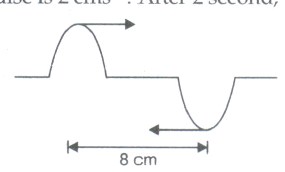
zero
purely kinetic
purely potential
Partly kinetic and partly potential
56.
The time period ofmass suspended from a spring is T. Ifthe spring is cut into four equal parts and the same mass is suspended from one of the parts, then the new time period will be
T/4
T
T/2
2T
57.
An empty vessel is partially filled with water. The frequency of vibration of air column in the vessel
decreases
increases
depends on the purity of water
remains the same.
58.
The rates of cooling of two different liquids put in exactly similar calorimeters and kept in identical surroundings are the same if
the masses of the liquids are equal
equal masses of the liquids at the same temperature are taken
different volumes of the liquids at the same temperature are taken
equal volumes of the liquids at the same temperature are taken
59.
The scale on a steel meter rod is calibrated at 20°C. What will be the error in the reading of 50 ern at 27°C? Take, a = 1.2 x 10.5 °C-1
0.042CM
0.0042
0.021 CM
0.0021 CM
60.
If there are no heat losses, the heat released by the condensation of x gram of steam at 100°C into water at 100 °C can be used to convert y gram of ice at 0 °C into water at 100 0C. Then the ratio y : x is nearly
1 : 1
2 : 1
3 : 1
25 : 1
61.
Dimensional formula of specific heat capacity is
[ML2T-2L-1]
[MLT-2K-1]
[M0L2T-2K-1]
[ML2T-2K]
62.
At about 4°C, a certain amount of water has maximum
energy
specific heat
density
Volume
63.
Young's modulus of a wire depends on
its material
its length
its area of cross-section
both (b) and (c)
64.
A spring of force constant k is cut into two equal parts. The force constant of each part is
k/2
k
2k
4k
65.
A wire suspended vertically from one end, is stretched by attaching a weight 200 N to the lower end. The weight stretches the wire by 1 mm. The energy gained by the wire is
0.1 J
0.2 J
0.4 J
4 k
66.
Young's modulus of a material has the same unit as
stress
energy
compressibility
pressure
67.
Dimensional formula of stress is same as that of
impulse
strain
force
pressure
68.
A satellite is launched into a circular orbit of radius R around the earth. A second satellite launched into an orbit of radius 1.01 R. The time period of the second satellite is larger than that of the first one by approximately
0.5%
1.5%
1%
3.0%
69.
If M is the mass of the earth and R its radius, the ratio of the gravitational acceleration and the gravitational constant is
\(\frac{R^2}{M}\)
\(\frac{M}{R^2}\)
MR2
\(\frac{M}{R}\)
70.
If a particle is fired vertically upwards from the surface of earth and reaches a height of 6400 km, the initial velocity of the particle is (assume R = 6400 km and g = 10 ms-2)
4 km/ sec
2 km/ sec
8 km/ sec
16 km/ sec
71.
Mars has about 1/10th as much mass as the earth and half as great a diameter. TI1e acceleration of a falling body on Mars is about
9.8 m s-2
1.96 ms-2
3.92 m s-2
4.9 m s-2
72.
A satellite of mass m revolves around the earth of radius R at a height x from its surface. If g is the acceleration due to gravity on the surface of the earth, the orbital speed of the satellite is
gx
\(\frac{gR}{R-x}\)
\(\frac{gR^2}{R+x}\)
\((\frac{gR^2}{R+x})^{\frac{1}{2}}\)
73.
If three uniform spheres, each having mass M and radius r, are kept in such a way that each touches the other two, the magnitude of the gravitational force on any sphere due to the other two is
\(\frac{GM^2}{4r^2}\)
\(\frac{2GM^2}{r^2}\)
\(\frac{2GM^2}{4r^2}\)
\(\frac{\sqrt 3GM^2}{4r^2}\)
74.
If g is the acceleration due to gravity on the earth's surface, the gain in the potential energy of an object of mass m raised from the earth's surface to a height equal to the radius R of the earth,is
\(\frac{1}{2}mgR\)
2mgR
mgR
\(\frac{1}{4}mgR\)
75.
A satellite is orbiting the earth. If its distance from the earth is increased, its
angular velocity would increase
linear velocity would increase
angular velocity would decrease
time period would increase
76.
At which of the following temperature, the value of surface tension of water is minimum?
4°C
25°C
50°C
75°C
77.
Application of Bernaull's Theorem can be seen in
dynamic lift of aeroplane
hydraullic press
helicopter
none of the above
78.
What is the shape when a non-wetting liquid in displaced in a capillary tube?
Concave upwards
Convex upwards
Concave downwards
Convex downwards
79.
A cylindrical vessel is filled with water upto height H. A hole is bored in the wall at a depth h from the free surface of water. For maximum range, h is equal to
H/4
H/2
3H/4
H
80.
For a ball falling in a liquid with constant velocity, ratio of resistance force due to the liquid to that due to gravity is
1
\(\frac{2a^2\rho g}{9\eta^2}\)
\(\frac{2a^2(\rho-\sigma)g}{9\eta}\)
none
81.
Two small drops of mercury, each of radius R, coalesce to form a single large drop. The ratio of the total surface energies before and after the change is:
1: 21/3
22/3 : 1
2: 1
1: 2
82.
The mass of water rises in capillary tube of radius R is M. The mass of water that rises in tube of radius 2R is
M
M/2
2M
4M
83.
The Bernauli's Theorem is based on the conservation of:
mass
energy
momentum
all
84.
The pulley in the diagram is smooth and light. The masses of A and B are 5 kg and 2 kg. The acceleration of the system is _______.
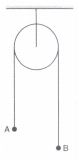
g
\({7\over3}g\)
\({3\over7}g\)
\({1\over7}g\)
85.
An insect is crawling up on the concave surface of a fixed hemispherical bowl of radius R. If the coefficient of friction is \({1\over3}\) then the height up to which the insect can crawl is nearly,_______.
5% of R
6% of R
6.5% of R
7.5% of R
86.
Action and reaction _______.
act on two different objects
have equal magnitude
have opposite directions
all are correct
87.
A particle of mass 5 kg is pulled along a smooth horizontal surface by a horizontal string. The acceleration of the particle is 10 ms-2. The tension in the string is_______.
2 N
50 N
15 N
10 N
88.
If the tension in the cable supporting an elevator is equal to the weight of the elevator, the elevator may _______.
going up with uniform speed
going down with non-uniform speed
going up with increasing speed
going down with increasing speed
89.
An ideal gas heat engine operates in a Carnot cycle between 227°C and 127°C.It absorbs 6 k cal of heat at higher temperature. The amount of heat in k cal rejected to sink is _______.
4.8
2.4
1.2
6.0
90.
A black body is at 727°C. It emits energy at a rate which is proportional to _______.
(1000)4
(1000)2
(727)4
(727)2
91.
The S.l. unit of mechanical equivelent of heat is _______.
Joule/Calorie
Calorie
Calorie x erg
erg/calorie
92.
An ideal heat engine exhosting heat at 27°C is to have 25%efficiency. It must take heat at: _______.
127°C
227°C
327°C
673°C
93.
The internal energy of an ideal gas depends on: _______.
Pressure
Volume
Temperature
Sizeof molecules
94.
Who discovers famous theory of relativity?
Einstein
J.C Bose
Newton
J.J Thomson
95.
Who did not discover radioactivity?
Becqurel
Pierre curie
Marie curie
Rutherford
96.
Who proposed the wave theory?
Maxwell
Huygens
M. Plank
G.P. Thomson
97.
Who proposed the wave theory of light?
G. P. Thomson
Huygens
M. Planck
Maxwell
98.
Which scientific principle is steam engine based on:
Motion of charged particles in electric and magnetic field
newton's laws of motion
Thermodynamics
Propagation of electromagnetic waves
99.
A body is initially at rest. It undergoes one-dimensional motion with constant acceleration. The power delivered to it at time t is proportional to
t1/2
t
t3/2
t2
1.
(b)
5\(\sqrt{3}\)
2.
(a)
2:1
3.
(a)
- y\(\upsilon \)\(\hat{k}\)
4.
(a)
\(\frac { L }{ \sqrt { 12 } } \)
5.
(b)
8 ms-1
6.
(a)
10\(\left( \hat { i } +\hat { j } +\hat { k } \right) \)
7.
(c)
3
8.
(b)
5, 13
9.
(c)
\(\frac{1}{2}\)
10.
(b)
\(\frac { { LM }_{ 1 } }{ 2({ M }_{ 1 }+{ M }_{ 2 }) } \)
11.
(c)
remains at rest
12.
(c)
\(\frac { L }{ 4 } \)
13.
(d)
\(\omega\)' < \(\omega\)
14.
(c)
the kinetic energy of a hydrogen molecule
15.
(b)
\(\frac { u }{ v } =\frac { 3 }{ 2 } p\)
16.
(d)
\(\sqrt { 2 } \) times that of helium
17.
(d)
3/2
18.
(c)
doubled
19.
(d)
\(\sqrt { \frac { \Upsilon }{ 3 } } \)
20.
(c)
T
21.
(c)
\(\frac { 3 }{ 2 } { MR }^{ 2 }\)
22.
(b)
pure rotational motion
23.
(c)
A scooterist speeding on a level road
24.
(d)
displacement ≤ distance
25.
(d)
uniform speed
26.
(d)
in all cases irrespective of whether the motion is one of uniform velocity, or of uniform acceleration or of variable acceleration
27.
(c)
30 ms-2
28.
(d)
[MLT-3]
29.
(a)
total energy
30.
(b)
4 : 1
31.
(c)
1 : 2
32.
(d)
the speed does not depend on the initial direction
33.
(b)
kinetic energy
34.
(d)
Zero
35.
(a)
zero
36.
(a)
T1 < T2
37.
(b)
\(\sqrt{10\over 9T}\)
38.
(d)
2 and 3 only
39.
(c)
\(\pi\sqrt{3m\over k}\)
40.
(a)
A
41.
(b)
20%
42.
(b)
become zero
43.
(d)
ML2T-2K-1
44.
(d)
4
45.
(d)
9%
46.
(d)
all the above
47.
(d)
all the above
48.
(d)
105 Hz
49.
(a)
decrease in velocity of sound in winter.
50.
(a)
6
51.
(b)
258 Hz
52.
(d)
Both light and sound waves in air are longitudinal.
53.
(c)
\(\sqrt{2}a\)
54.
(d)
\(\frac{\pi}{4}\) m/s
55.
(b)
purely kinetic
56.
(d)
2T
57.
(a)
decreases
58.
(d)
equal volumes of the liquids at the same temperature are taken
59.
(b)
0.0042
60.
(c)
3 : 1
61.
(c)
[M0L2T-2K-1]
62.
(c)
density
63.
(a)
its material
64.
(c)
2k
65.
(a)
0.1 J
66.
(a)
stress
67.
(d)
pressure
68.
(b)
1.5%
69.
(b)
\(\frac{M}{R^2}\)
70.
(c)
8 km/ sec
71.
(c)
3.92 m s-2
72.
(d)
\((\frac{gR^2}{R+x})^{\frac{1}{2}}\)
73.
(d)
\(\frac{\sqrt 3GM^2}{4r^2}\)
74.
(a)
\(\frac{1}{2}mgR\)
75.
(a)
angular velocity would increase
76.
(d)
75°C
77.
(a)
dynamic lift of aeroplane
78.
(c)
Concave downwards
79.
(b)
H/2
80.
(a)
1
81.
(b)
22/3 : 1
82.
(b)
M/2
83.
(b)
energy
84.
(c)
\({3\over7}g\)
85.
(a)
5% of R
86.
(d)
all are correct
87.
(b)
50 N
88.
(a)
going up with uniform speed
89.
(a)
4.8
90.
(a)
(1000)4
91.
(a)
Joule/Calorie
92.
(a)
127°C
93.
(c)
Temperature
94.
(a)
Einstein
95.
(d)
Rutherford
96.
(b)
Huygens
97.
(b)
Huygens
98.
(c)
Thermodynamics
99.
(b)
t

11th Standard CBSE Syllabus & Materials
11th Standard CBSE
CBSE 11th Business Studies Forms of Business Organisation Sample Question Papers Study Material - QB365 Set A
NEW11th Standard CBSE
CBSE 11th Business Studies Business, Trade and Commerce Sample Question Papers Study Material - QB365 Set A
NEW11th Standard CBSE
CBSE 11th Physics Waves Sample Question Papers Study Material - QB365 Set A
NEW11th Standard CBSE
CBSE 11th Physics Kinetic Theory Sample Question Papers Study Material - QB365 Set A



CBSE 11th Standard CBSE Subjects
CBSE Standards









