
 100% FREE ACCESS
11th Standard CBSE Syllabus & Materials
11th Standard CBSE
CBSE 11th Economics PART-A - Presentation of Data - New Sample Question Papers Study Material - QB365 Set A
NEW11th Standard CBSE
CBSE 11th Economics PART-A - Organisation of Data - New Sample Question Papers Study Material - QB365 Set A
NEW11th Standard CBSE
CBSE 11th Economics PART-A - Collection of Data - New Sample Question Papers Study Material - QB365 Set A
NEW11th Standard CBSE
CBSE 11th Economics PART-A - Introduction to Economics and Statistics - New Sample Question Papers Study Material - QB365 Set A
NEW11th Standard CBSE
CBSE 11th Business Studies International Trade Sample Question Papers Study Material - QB365 Set A
NEW11th Standard CBSE
CBSE 11th Business Studies Evolution and Fundamentals of Business Sample Question Papers Study Material - QB365 Set A

Published on: 05/10/2019
Gravitation
Download CBSE Class 11th Standard CBSE Physics question papers, sample papers, important questions, and previous year solved papers in PDF format. Get free study materials, NCERT solutions, and exam preparation resources for Class 11th Standard CBSE Physics
Questions + Answers key
Take MCQ Physics Test
1.
Two bodies of masses M1 and M2 are placed at a distance d apart. What is the potential at the position where the gravitational field due to them is zero?
2.
A rocket is fired from the earth towards the sun. At what distance from the earth's centre is the gravitational force on the rocket zero? Mass of the sun = 2 x 1030 kg, mass of the earth = 6 x 1024 kg. Neglect the effect of other planets etc. (orbital radius = 1.5 x 10¹¹ m).
3.
Io, one of the satellites of jupiter, has an orbital period of 1.769 days and the radius of the orbit is 4.22 x 10⁸ m. Show that the mass of jupiter is about one-thousandth that of the sun.
4.
A body weighs 90kg on the surface of the earth. How much will it weigh on the surface of the mass whose mass is \(\frac { 1 }{ 9 } th\)and radius \(\frac { 1 }{ 2 } \)of that of the earth?
5.
Two steel balls whose masses are 502 kg and 0.25 kg are placed with their centres half a metre apart with what force do they attract each other?
6.
Calculate the period of revolution of the Neptune around the sun. Given that radius of its orbit is 30 times the earth's orbital radius around the sun.
7.
Arjun was a student of class IX. He was sitting in a garden along with his grandmother, who was a retired physics teacher. Suddenly he saw an orange falling from the tree. Immediately he asked his grandmother that both of the orange and earth experience equal and opposite forces of gravitation, then why it is the orange that falls towards the earth and not the earth towards the orange. His grandmother explained him the reason in a simple way.
(i) What are the values being displayed by Arjun?
(ii) What in your opinion may be the reason for this observation?
8.
Shweta was reading a book on the biography of Issac Newton. She read that Newton was sitting under an apple tree when a falling apple led him to develop a whole new science of gravity. After reading the book, shweta realised that every phenomenon in universe has some scientific fact associated with it, it depends on us whether we look for a scientific fact or associate a superstition with it.
How can you find the mass of the earth using law of gravitation?
9.
An earth's satellite has a period of 90 min.Assuming the orbit to be circular, calculate its height.Take radius of the earth equal to 6380 km and g at the surface of the earth equal 9.8m/s2 .
10.
As you will learn in the text, a geostationary satellite orbits the earth at a height of nearby 36000 km from the surface of the earth.What is the potential due to the earth's gravity at the site of this satellite?(take the potential energy at infinity to be zero).Mass of the earth = \(6.0\times { 10 }^{ 24 }\)kg, radius = 6400 km.
11.
What will be the value of g at the bottom of sea 7 km deep?Diameter of the earth is 12800 km and g on the surface of the earth is 9.8 ms-2 .
1.
Let the field be zero at a point at distance x from M1.
\(\therefore \frac{GM_1}{x^2}=\frac{GM_2}{(d-x)^2}\)
\(\therefore \frac{x}{d-x}=\sqrt {\frac{M_1}{M_2}}\Rightarrow x\sqrt {M_2}=\sqrt {M_1}.d-x\sqrt {M_1}\)
\(x[\sqrt {M_!}+\sqrt {M_2}]=\sqrt {M_1}.d\)
\(x=\frac{d\sqrt {M_2}}{\sqrt {M_1}+\sqrt {M_2}}\)
\(d-x=\frac{d\sqrt {M_2}}{\sqrt {M_1}+\sqrt {M_2}}\)
Potential at this point due to both the masses will be
\(=-\frac{GM_1}{x}-\frac{GM_2}{(d-x)}=-G[\frac{M_1(\sqrt {M_1}+\sqrt {M_2})}{d\sqrt {M_1}}+\frac{M_2(\sqrt {M_1}+\sqrt {M_2})}{d\sqrt {M_2}}]\)
\(=-\frac{G}{d}(\sqrt {M_1}+\sqrt {M_2})^2=\frac{G}{d}(M_1+M_2+2\sqrt {M_1}\sqrt {M_2}).\)
2.
Mass of Sun, M = 2 x 1030 kg; Mass of Earth, m = 6 x 1024 kg
Distance between Sun and Earth, r = 1.5 x 10¹¹ m
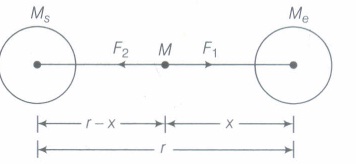
Let at the point P, the gravitational force on the rocket due to Earth
= gravitational force on the rocket due to Sun
Let x = distance of the point P from the Earth
Then \(\frac{G_m}{x^2}=\frac{GM}{(r-x)^2}\)
\(\Rightarrow\frac{(r-x)^2}{x^2}=\frac{M}{m}=\frac{2\times10^{30}}{6\times10^{24}}=\frac{10^6}{3}\)
\(\frac{r-x}{x}=\frac{10^3}{\sqrt 3}\Rightarrow \frac{r}{x}=\frac{10^3}{\sqrt 3}+1\simeq\frac{10^3}{\sqrt 3}\)
\(x=\frac{\sqrt 3 r}{10^3}=\frac{1.732\times1.5\times10^{11}}{10^3}=2.6\times10^8m.\)
3.
For a satellite of jupiter, orbital period,T1= 1.769 days = 1.769 x 24 x 60 x 60s
Radius of the orbit of satellite, r1 = 4.22 x 10⁸m
Mass of Jupiter, M1 is given by M1 = \(\frac{4\pi^2r_1^3}{GT_1^2}=\frac{4\pi^2\times(4.22\times10^8)}{G\times(1.769\times24\times60\times60)^2}\) ...(1)
We know that the orbital period of earth around the sun, T=1 year=365.25 x 24 x 60 x 60s
orbital radius,r = 1 A.U.= 1.496 x 10¹¹m
Mass of sun is given by \(M=\frac{4\pi^2r^3}{GT^2}=\frac{4\pi^2\times(1.496\times10^{11})^3}{G\times(365.25\times24\times60\times60)^2}\) ....(2)
Dividing eqn. (ii) by (i), we get
\(\frac{M}{M_1}=\frac{4\pi^2\times(1.496\times10^{11})^3}{G\times(365.25\times24\times60\times60)^2}\times\frac{G\times(1.769\times24\times60\times60)^2}{4\pi^2\times(4.22\times10^8)}=1046\)
or \(\frac{M}{M_1}=\frac{1}{1046}=\frac{1}{1000}\Rightarrow m_1=\frac{1}{1000}M.\)
4.
40 kg
5.
\(3.468\times 10^{ -10 }N\)
6.
As discussed in the hint section, Kepler’s law states that
\([{{T}^{2}}=k\times {{a}^{3}}]\) where [T] is the period of revolution of a planet, [a] is the semi-major axis of the planet and [K] is a constant of proportionality
Upon researching, we found that
The semi-major axis of the earth \([\left( {{a}_{earth}} \right)=149.6\times {{10}^{6}}km]\). Similarly, the semi-major axis of Neptune \([\left( {{a}_{neptune}} \right)=4495.06\times {{10}^{6}}km]\)
The period of revolution of the earth around the sun is one year. Substituting these values, we get the expression of Kepler’s Law for both planets as follows
\({{\left( {{T}_{earth}} \right)}^{2}}=k\times {{\left( {{a}_{earth}} \right)}^{3}}\) ...(1)
\( {{\left( {{T}_{neptune}} \right)}^{2}}=k\times {{\left( {{a}_{neptune}} \right)}^{3}}\) ....(2)
Dividing the two equations, we get
\([{{\left( \dfrac{{{T}_{neptune}}}{{{T}_{earth}}} \right)}^{2}}={{\left( \dfrac{{{a}_{neptune}}}{{{a}_{earth}}} \right)}^{3}}]\)
Substituting the values of the semi-major axis of the planets and the period of revolution of the earth, we get
\( {{\left( \dfrac{{{T}_{neptune}}}{1year} \right)}^{2}}={{\left( \dfrac{4495.06\times {{10}^{6}}km}{149.6\times {{10}^{6}}km} \right)}^{3}} \)
\( \Rightarrow {{\left( \dfrac{{{T}_{neptune}}}{1} \right)}^{2}}={{(30.05)}^{3}} \)
\( \Rightarrow {{T}_{neptune}}={{(30.05)}^{\frac{3}{2}}}=164.72years \)
7.
(i)\({ R }_{ 2 }\approx 30{ R }_{ 1 }\)
(ii)\({ R }_{ 2 }\approx 30{ R }_{ 1 }\)
8.
From law of gravitation, \(F=\frac { GMm }{ { R }^{ 2 } } \)
Where, m = mass of object on surface of the earth.
R = radius of the earth.
M = mass of the earth.
Force experienced by object, F = mg
Using the two forces, we have
\(mg=\frac { GMm }{ { R }^{ 2 } } \quad or\quad M=\frac { gR^{ 2 } }{ G } \)
9.
Height of the earth's satellite\(h=\left( \frac { { T }^{ 2 }R^{ 2 }g }{ 4\pi ^{ 2 } } \right) -R\)
Given,T= 90 min = \(90\times 60=5400s,R=6380km\)
\(g=9.8m/{ s }^{ 2 }=9.8\times { 10 }^{ -3 }km/{ s }^{ 2 }\)
Thus
\(h=\left[ \frac { (5400)^{ 2 }\times (6380)^{ 2 }\times (9.8\times { 10 }^{ -3 } }{ 4\times 9.87 } \right] ^{ 1/3 }km-6380\quad km\)
or h = (6655 - 6380)km = 275 km
10.
We are given that
Mass of the earth, M = \(6.0\times { 10 }^{ 24 }\)kg
Radius of the earth, R = 6400 km
Height of the satellite from the earth's surface.
h = 36000 km
Distance of the satellite from the centre of the earth.
r = R + h = 6400km + 36000km
r = 42400km = \(4.24\times { 10 }^{ 7 }\)m
If V is the potential at the site of the satellite.
\(V=-\frac { GM }{ r } =-5.12\times { 10 }^{ 7\ }J/kg\)
\(\\ V=-9.4\times { 10 }^{ 6 }J/kg\)
11.
Depth of sea, d =7 km, g = 9.8 ms-2
Radius of the earth, \(R=\frac { D }{ 2 } =\frac { 12800 }{ 2 } km=6400km\)
Value of g at bottom of sea
\({ g }_{ d }=g\left( 1-\frac { d }{ R } \right) =9.8(1-\frac { 7 }{ 6400 } ){ ms }^{ -2 }\)
\(\\ { g }_{ d }=\frac { 9.8\times 6393 }{ 6400 } { ms }^{ -2 }=9.789{ ms }^{ -2 }\)
Note: Acceleration due to gravity also vary due to the rotation of earth, if a body of mass m lying at a point whose latitude is \(\lambda \) , then rotation of earth(angular speed \(\omega \) ), the apparent acceleration due to gravity on body is given by \({ g }^{ ' }=g-{ \omega }^{ 2 }R{ cos }^{ 2 }\lambda \)

11th Standard CBSE Syllabus & Materials
11th Standard CBSE
CBSE 11th Business Studies Forms of Business Organisation Sample Question Papers Study Material - QB365 Set A
NEW11th Standard CBSE
CBSE 11th Business Studies Business, Trade and Commerce Sample Question Papers Study Material - QB365 Set A
NEW11th Standard CBSE
CBSE 11th Physics Waves Sample Question Papers Study Material - QB365 Set A
NEW11th Standard CBSE
CBSE 11th Physics Kinetic Theory Sample Question Papers Study Material - QB365 Set A



CBSE 11th Standard CBSE Subjects
CBSE Standards









