
 100% FREE ACCESS
11th Standard CBSE Syllabus & Materials
11th Standard CBSE
CBSE 11th Economics PART-A - Presentation of Data - New Sample Question Papers Study Material - QB365 Set A
NEW11th Standard CBSE
CBSE 11th Economics PART-A - Organisation of Data - New Sample Question Papers Study Material - QB365 Set A
NEW11th Standard CBSE
CBSE 11th Economics PART-A - Collection of Data - New Sample Question Papers Study Material - QB365 Set A
NEW11th Standard CBSE
CBSE 11th Economics PART-A - Introduction to Economics and Statistics - New Sample Question Papers Study Material - QB365 Set A
NEW11th Standard CBSE
CBSE 11th Business Studies International Trade Sample Question Papers Study Material - QB365 Set A
NEW11th Standard CBSE
CBSE 11th Business Studies Evolution and Fundamentals of Business Sample Question Papers Study Material - QB365 Set A

Published on: 04/12/2019
Gravitation
Download CBSE Class 11th Standard CBSE Physics question papers, sample papers, important questions, and previous year solved papers in PDF format. Get free study materials, NCERT solutions, and exam preparation resources for Class 11th Standard CBSE Physics
Questions + Answers key
Take MCQ Physics Test
1.
Two artificial satellites, one of mass 400 kg and another of mass 2500 kg, are set in the same orbit around a planet. What is the ratio of their (i) orbital velocities, (ii) time periods?
2.
A satellite does not need any fuel to circle around the earth.Why?
3.
The orbiting velocity of an earth-satellite is 8 kms-1 .What will be the escape velocity?
4.
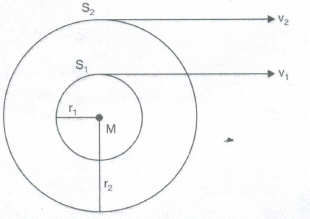
A plant moving along an elliptical orbit is closet to the Sun at a distance r1 and farthest away at a distance of r2 . If V1 and V2 are the linear velocities at these points respectively, then find the ratio v1/v2
5.
Two satellites S1 and S2 revolve round a planet in coplanar circular orbit in the same sense. Their periods of revolution are one hour and 8 hours respectively. The radius of the orbit of S1 is 104 km. When S2 is close to S1 find
(i) the speed of S2 relative to S1
(ii) the angular speed of S2 as actually observed by an astronaut in S1.
6.
Choose the correct alternatives.
Acceleration due to gravity increases/decreases with increasing depth(assume the earth to be a sphere of uniform density).
7.
An earth's satellite has a period of 90 min.Assuming the orbit to be circular, calculate its height.Take radius of the earth equal to 6380 km and g at the surface of the earth equal 9.8m/s2 .
8.
What is the height at which the value of g is the same as at a depth of \(\frac{R}{2}?\)
9.
Does the escape speed of a body from the earth depends on the direction of the projection
10.
Does the escape speed of a body from the earth depends on the location from where it is projected
11.
If the earth is 1/4 of its present distance from the sun, then what is the duration of he year?
12.
The distances of two planets from the sun are 1013 m and 1012 m, respectively. Calculate the ratio of time period and the speeds of the two planets
13.
A satellite is launched into a circular orbit of radius R around the earth. A second satellite launched into an orbit of radius 1.01 R. The time period of the second satellite is larger than that of the first one by approximately
0.5%
1.5%
1%
3.0%
14.
If M is the mass of the earth and R its radius, the ratio of the gravitational acceleration and the gravitational constant is
\(\frac{R^2}{M}\)
\(\frac{M}{R^2}\)
MR2
\(\frac{M}{R}\)
15.
If a particle is fired vertically upwards from the surface of earth and reaches a height of 6400 km, the initial velocity of the particle is (assume R = 6400 km and g = 10 ms-2)
4 km/ sec
2 km/ sec
8 km/ sec
16 km/ sec
16.
A satellite of mass m revolves around the earth of radius R at a height x from its surface. If g is the acceleration due to gravity on the surface of the earth, the orbital speed of the satellite is
gx
\(\frac{gR}{R-x}\)
\(\frac{gR^2}{R+x}\)
\((\frac{gR^2}{R+x})^{\frac{1}{2}}\)
17.
If three uniform spheres, each having mass M and radius r, are kept in such a way that each touches the other two, the magnitude of the gravitational force on any sphere due to the other two is
\(\frac{GM^2}{4r^2}\)
\(\frac{2GM^2}{r^2}\)
\(\frac{2GM^2}{4r^2}\)
\(\frac{\sqrt 3GM^2}{4r^2}\)
18.
If g is the acceleration due to gravity on the earth's surface, the gain in the potential energy of an object of mass m raised from the earth's surface to a height equal to the radius R of the earth,is
\(\frac{1}{2}mgR\)
2mgR
mgR
\(\frac{1}{4}mgR\)
19.
A satellite is orbiting the earth. If its distance from the earth is increased, its
angular velocity would increase
linear velocity would increase
angular velocity would decrease
time period would increase
1.
\(\frac{v_1}{v_2}=\frac{T_1}{T_2}=1\) because both satellites are revolving in same orbit and for a given orbit the orbital velocity, as well as time period, is independent of the mass of satellite.
2.
The gravitation force between satellite and the earth provides the centripetal force required by the satellite to move in a circular orbit.The satellite orbits around earth at such a higher height where air friction is neglible.
3.
Escape velocity,
\({ v }_{ e }=\sqrt { 2 } { v }_{ 0 }\)
\({ v }_{ e }=\sqrt { 2 } \times 8=11.31kms^{ -1 }\)
4.
From the law of conservation of angular momentum
\(m{ r }_{ 1 }{ v }_{ 1 }=m{ r }_{ 2 }{ v }_{ 2 }\quad \Rightarrow \quad { r }_{ 1 }{ v }_{ 1 }={ r }_{ 2 }{ v }_{ 2 }\ \ or\quad \frac { { v }_{ 1 } }{ { v }_{ 2 } } =\frac { { r }_{ 2 } }{ { r }_{ 1 } } \)
5.
The centripetal force required by a satellite of mass m revolving in a circular orbit of radius r with a speed v is supplied by the gravitational force extended by the planet of mass M on the satellite. Thus
\(\frac{Mv^2}{r}=G\frac{Mm}{r^2}\)
\(v=\sqrt {\frac{Gm}{r}}\)
The period of revolution of the satellite is
\(T=\frac{2\pi r}{v}=2\pi\sqrt {\frac{r^3}{GM}}\)
For satellite S1 let T=T1,r=r1,v=v1
Then \(T_1^2=\frac{4\pi^2r_1^3}{GM}\)
For satellite S2 , \(T_2^2=\frac{4\pi^2r_2^2}{GM}\therefore \frac{T_1^2}{T_2^2}=\frac{r_1^3}{r_2^3}\)
\(r_2=r_1(\frac{T_2}{T_1})^{\frac{2}{3}}\)
\(=10^4(\frac{8}{1})^{\frac{2}{3}}\)
\(=4\times10^4\ km\)
\(v_1=\frac{2\pi r_1}{T_1}\)
\(=\frac{2\pi\times10^4}{1}=2\pi\times10^4\ km/hr\)
\(v_2=\frac{2\pi r_2}{T_2}\)
\(=\frac{2\pi\times4\times10^4}{8}\)
\(=\pi\times10^4\ km/hour\)
Velocity of S2 relative to \(S_1=v_2-c_1=\theta_r(say)\)
\(v_r=(\pi\times10^4-2\pi\times10^4)\ km/hr\)
\(=-\pi\times10^4\ km/hour\)
Let r2-r1 = r
The angular velocity of S2 relative to S1 is given by
\(\omega=\frac{v_r}{r}=\frac{\pi\times10^4}{(4-1)10^4}\ rad/hour\)
\(\omega=\frac{\pi}{3}\ rad/hour\)
6.
Acceleration due to gravity at depth d from the earth's surface is given by
\({ g }^{ ' }=g\left( 1-\frac { d }{ { R }_{ e } } \right) \)
Therefore, acceleration due to gravity decreases with increasing depth.
7.
Height of the earth's satellite\(h=\left( \frac { { T }^{ 2 }R^{ 2 }g }{ 4\pi ^{ 2 } } \right) -R\)
Given,T= 90 min = \(90\times 60=5400s,R=6380km\)
\(g=9.8m/{ s }^{ 2 }=9.8\times { 10 }^{ -3 }km/{ s }^{ 2 }\)
Thus
\(h=\left[ \frac { (5400)^{ 2 }\times (6380)^{ 2 }\times (9.8\times { 10 }^{ -3 } }{ 4\times 9.87 } \right] ^{ 1/3 }km-6380\quad km\)
or h = (6655 - 6380)km = 275 km
8.
At depth \(=\frac{R}{2}\) value of acceleration due to gravity,
\(g'=g(1-\frac{R}{2R})=\frac{g}{2}\)
At height x,
\(g'=g(1-\frac{2x}{R})\)
\(\therefore g(1-\frac{2x}{R})=\frac{g}{2}\)
\(\frac{1}{2}=\frac{2x}{R}\Rightarrow x=\frac{R}{4}.\)
9.
No, escape velocity is independent of the direction of projection
10.
Yes,escape velocity depends (through slightly) on the location from where the body is projected because with location g changes and so should \({ v }_{ e }(=\sqrt { 2gR) } \) change.
11.
One-eighth the present year
Since \(T^2 \propto r^3 \therefore\left(\frac{T}{T}\right)^2=\left(\frac{1}{4}\right)^3 \Rightarrow T^{\prime}=\frac{1}{8} T\)
12.
\( T \propto r^{3 / 2} \)
\( \therefore \frac{T_1}{T_2}=\left(\frac{10^{13}}{10^{12}}\right)^{3 / 2}=10 \sqrt{10} .
\)
13.
(b)
1.5%
14.
(b)
\(\frac{M}{R^2}\)
15.
(c)
8 km/ sec
16.
(d)
\((\frac{gR^2}{R+x})^{\frac{1}{2}}\)
17.
(d)
\(\frac{\sqrt 3GM^2}{4r^2}\)
18.
(a)
\(\frac{1}{2}mgR\)
19.
(a)
angular velocity would increase

11th Standard CBSE Syllabus & Materials
11th Standard CBSE
CBSE 11th Business Studies Forms of Business Organisation Sample Question Papers Study Material - QB365 Set A
NEW11th Standard CBSE
CBSE 11th Business Studies Business, Trade and Commerce Sample Question Papers Study Material - QB365 Set A
NEW11th Standard CBSE
CBSE 11th Physics Waves Sample Question Papers Study Material - QB365 Set A
NEW11th Standard CBSE
CBSE 11th Physics Kinetic Theory Sample Question Papers Study Material - QB365 Set A



CBSE 11th Standard CBSE Subjects
CBSE Standards









