
 100% FREE ACCESS
11th Standard CBSE Syllabus & Materials
11th Standard CBSE
CBSE 11th Economics PART-A - Presentation of Data - New Sample Question Papers Study Material - QB365 Set A
NEW11th Standard CBSE
CBSE 11th Economics PART-A - Organisation of Data - New Sample Question Papers Study Material - QB365 Set A
NEW11th Standard CBSE
CBSE 11th Economics PART-A - Collection of Data - New Sample Question Papers Study Material - QB365 Set A
NEW11th Standard CBSE
CBSE 11th Economics PART-A - Introduction to Economics and Statistics - New Sample Question Papers Study Material - QB365 Set A
NEW11th Standard CBSE
CBSE 11th Business Studies International Trade Sample Question Papers Study Material - QB365 Set A
NEW11th Standard CBSE
CBSE 11th Business Studies Evolution and Fundamentals of Business Sample Question Papers Study Material - QB365 Set A

Published on: 30/12/2018
11th Half yearly model Exam
Download CBSE Class 11th Standard CBSE Physics question papers, sample papers, important questions, and previous year solved papers in PDF format. Get free study materials, NCERT solutions, and exam preparation resources for Class 11th Standard CBSE Physics
Questions + Answers key
Take MCQ Physics Test
1.
At which point of the trajectory is the speed of motion minimum?
2.
What is the phase difference between particle velocity and particle acceleration in SHM?
3.
Which of the following is a scalar quantity? Inertia, force and linear momentum.
4.
Give the characteristics of inelastic collision.
5.
Is it possible to have interference between the waves produced by two violins? Why?
6.
Name three physical properties which can have different values in different directions.
7.
What happens to surface tension, when impurity is mixed in liquid?
8.
A boy standing on a stationary lift (open from above) throws a ball upwards with the maximum initial speed he can, equal to 49 m s-1. How much time does the ball take to return to his hands? If the lift starts moving up with a unifornt speed of 5 m s-1 and the boy again throws the ball up with the maximum speed he can, how long does the ball take to return to his hands?
9.
Gas thermometer are more sensitive than mercury thermometer. Why?
10.
Place a safety pin on a sheet of paper. Hold the sheet over a burning candle, until the paper becomes yellow and charr. On removing the pin, its white trace is observed on the paper. Why?
11.
On what factors does the critical speed of fluid flow depend?
12.
A mass of 1 g is separated from another mass of 1 g by a distance of 1 cm. How many g-wt of force exists between them?
13.
A body is projected with speed u at an angle \(\theta \) to the horizontal to have maximum range. What is the velocity at the highest point?
14.
Write the dimensional formula of wavelength and frequency of a wave.
15.
Round off the following number as indicated
321.1355 upto 5 digits
16.
Show that there are two values of time fur same height during the Course of flight of a projectile and the sum of these times is equal to the total time of flight.
17.
A particle of 10 kg mass is moving in a circle of 4 m radius with a constant speed of 5 m/sec. What is its angular momentum about (i) the centre of circle (ii) a point on the axis of the circle and 3 m distant from its centre?
18.
What do you mean by compressibility? Why are solids least compressible and gases most compressible?
19.
When two bodies having temperatures T; and Tz are brought in contact, then the temperature of this system may not be \(\frac { \left( { T }_{ 1 }+{ T }_{ 2 } \right) }{ 2 } \) Explain why?
20.
The motion of a simple pendulum is approximately simple harmonic for small angle oscillations. For larger angles of oscillation, a more involved analysis sjows that T is greater than \(2\pi \sqrt { \frac { l }{ g } } \) .Think of a qualitative argument to appreciate this result.
21.
Calculate the molecular kinetic energy of 1 g of helium (molecular weight 4) at 1270C. Given, R=8.31 Jmol-1K-1.
22.
Calculate the earth's surface potential from the following data.
(i) Radius of the earth, \(R=6.63\times { 10 }^{ 6 }\quad m\)
(ii) Mean density of the earth, \(\rho =5.57\times 10^{ 3 }kgm^{ -3 }\)
(iii) \(G=6.67\times 10^{ -11 }Nm^{ 2 }kg^{ -2 }\)
23.
The length,breadth and height of a rectangular block of wood were measured to be
\(l=12.13\pm 0.02cm,\quad b=8.16\pm 0.01cm\quad \) \(\\ and\quad h=3.46\pm 0.01cm\)
Determine the percentage error in the volume of the block.
24.
A ball of mass 100 g is projected vertically upwards from the ground with a velocity of 49 m/ s. At the same time another identical ball is dropped from a height of 98 m fo fall freely along the same path as followed by the first ball. After sometime, the two balls collide and stick together and finally fall together. Find the time of fliglIt of the masses.
25.
A truck starts from rest and accelerates uniformly at 2.0 m s-2. At t = 10 s, a stone is dropped by a person standing on the top of the truck (6 m high from the ground). What are the (a) velocity, and (b) acceleration of the stone at t = 11s ? (Neglect air resistance.)
26.
Explain why (or how) bats can ascertain distance, directions, nature and sizes of the obstacles without any eyes?
27.
By using a refrigerator machine, 1g of water 00 C is to be freezed.If the temperature of the surrounding is 270C. Calculate least amount of work done.
28.
Explain why an optical pyrometer (for measuring high temperature) calibrated for an ideal black body radiation gives too low a value for the temperature of a red hot iron piece in the open, but gives a correct value for the temperature when the same piece is in the furnace.
29.
The planet Mars has two moons, phobos and delmos.
(i) phobos has a period 7 hours, 39 minutes and an orbital radius of 9.4 × 10³ km. Calculate the mass of mars.
(ii) Assume that earth and mars move in circular orbits around the sun, with the martian orbit being 1.52 times the orbital radius of the earth. What is the length of the martian year in days ?
30.
A man can swim with a speed of 4 km/h in still water. How long does he take to cross a river 1 km wide, if the river flows steadily, 3 km/h and he makes his strokes normal to the river current? How far down t,he river does he go when he reaches the other bank?
1.
Minimum speed is at the highest point, since the vertical component of velocity is zero.
2.
\(\frac{\pi}{2}\) radians.
3.
Inertia of linear motion is measured by mass of the body, which is a scalar quantity.
4.
(i) Kinetic energy does not remain conserved.
(ii) Linear momentum of the system remains conserved.
5.
No. This is because the sounds produced will not have a constant phase difference.
6.
Thermal conductivity, electrical conductivity and compressibility.
7.
Surface tension of the liquid decreases.
8.
When either the lift is at rest or the lift is moving either vertically upward or downward with a constant speed, we can apply three simple kinetnatic motion equations presuming a = ± g (as the case may be).
In present case u = 49 ms-1 (upward) a = g = 9.8 ms-2 (downward)
If the ball returns to boy's hands after a time t, then displacement of ball relative to boy is zero
i.e., s = O. Hence, using equation s = ut + \(\frac{1}{2}\) at2, we have
0 = 49 ± - \(\frac {1} {2}\) x 9.8 x t2
\(\Rightarrow\) 4.9 t2 - 49t = 0 \(\Rightarrow\) t = 0 or 10 s
As t = 0 is physically not possible, hence time t = 10 s.
9.
The coefficient of increase of pressure (or volume) of a gas is It is very large as compared to coefficient of expansion of mercury. Therefore, for a certain increase in volume of the gas will be compared to that of mercury and hence a gas thermometer is more sensitive.
10.
The safety pin is made of steel which is good conductor of heat. So, the safety pin takes heat from the paper under it and transfer it away to the surroundings. The portion of the paper under the safety pin remains comparatively colder than the remaining part.
11.
The critical speed of a fluid depends on ( a ) diameter of tube, ( b ) density of fluid, ( c ) coefficient of viscosity of the fluid.
12.
\(F=G\frac { { m }_{ 1 }{ m }_{ 2 } }{ { r }^{ 2 } }\)
\( \\ =6.67\times 10^{ -8 })\left( \frac { 1\times 1 }{ 1^{ 2 } } \right) dyne\)
\(\\ =6.67\times 10^{ -8 }\quad dyne=\frac { 6.67\times 10^{ -8 } }{ 980 } \)
\(=7\times 10^{ -11 }g-wt\)
13.
for maximum horizontal range, θ = 45º, Velocity at highest point = Horizontal component of velocity = ucos 45º = u /√2
14.
Wavelength [λ]=[L]
Frequency [ν]=[T−1]
15.
321.14
16.
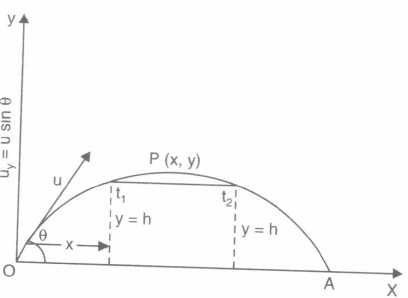
We know, the vertical distance travelled by a projectile in time t is given by,
Y = u sin \(\theta\)\(\times\)t- \(\frac{1}{2}\)gt2
If h be the height of point p, then for y = It,
we have h = u sin \(\theta\)\(\times\)t-\(\frac{1}{2}\)gt2
or \(\frac{1}{2}\)gt2 - u sin \(\theta\)\(\times\)t + h = 0
or t2-\(\frac { 2u\quad sin\theta }{ g } .t+\frac { 2h }{ g } \)
This equation is quadratic in t and has two roots t1 and t2. Thus there are two values of time for which the height of the projectile is same during flight of projectile.
\(t=\frac { \frac { 2u\quad sin\theta }{ g } \pm \sqrt { \left( \frac { 2u\ sin\theta }{ g } \right) ^{ 2 }-\frac { 8h }{ g } } }{ 2 } \)
\(t=\ \frac { usin\theta }{ g } \pm \sqrt { \frac { { u }^{ 2 }{ sin }^{ 2 }\theta }{ { g }^{ 2 } } -\frac { 2h }{ g } } \)
\(\therefore { t }_{ 1 }=\frac { usin\theta }{ g } \pm \sqrt { \frac { { u }^{ 2 }{ sin }^{ 2 }\theta }{ { g }^{ 2 } } -\frac { 2h }{ g } } \)
and \({ t }_{ 2 }=\frac { usin\theta }{ g } -\sqrt { \frac { { u }^{ 2 }{ sin }^{ 2 }\theta }{ { g }^{ 2 } } -\frac { 2h }{ g } } \)
Now \({ t }_{ 1 }+{ t }_{ 2 }=\frac { 2usin\theta }{ g } \)(Time during the course of flight).
Thus, the sum of times for the same height is equal to the total time of flight.
17.
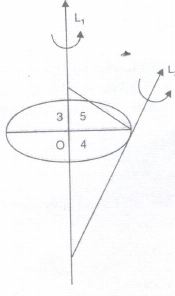
The situation is shown in Fig
(a) We know that \(\vec { L } =\vec { r } \times m\vec { v } \)
L= m
18.
Compressibility of the material of a body is defined as the reciprocal of its bulk modulus. It is, thus, defined as the fractional change in volume per unit increase in pressure.
Compressibility, K=\(\frac { 1 }{ B } =-\left( \frac { \triangle V }{ V } \right) \times \frac { 1 }{ P } \)
The solids are least compressible whereas gases are most compressible. It is on account of the fact that in solids neighbouring atoms are tightly coupled but molecules in gases are very poorly coupled to their neighbours.
19.
If two bodies made of same material and have the same mass but different temperatures T1; and T2 ' then their equilibrium temperature T when they are brought in thermal contact will be \(\frac { \left( { T }_{ 1 }+{ T }_{ 2 } \right) }{ 2 } \)
[\(\because\) Heat lost = Heat gained]
The equilibrium temperature T will not be necessarily \(\frac { \left( { T }_{ 1 }+{ T }_{ 2 } \right) }{ 2 } \) if two bodies in thermal equilibrium have different heat capacities
20.
If we replace \(sin\theta \approx \theta \) for large angles, then actually \(sin\theta <\theta \)
Now since this factor is multiplied to the restoring force mg\(sin\theta \) is replaced by \(mg\theta \) which means ana effective reduction in g for large angles. hence, there is an increase in time period T over that given by the formula \(T=2\pi \sqrt { \frac { l }{ g } } \) as compared to the acse which it is assumed \(sin\theta \simeq \theta \)
21.
Given, T = 273 + 127 = 400 K
Average K.E. per mole of Helium = \(\frac{3}{2} \mathrm{RT}\)
Average K.E. of I gram of Helium = \(\frac{3}{2} \frac{\mathrm{RT}}{\mathrm{M}}=\frac{3 \times 8.31 \times 400}{2 \times 4}\)
= 1246.5 J.
22.
\(-6.84\times 10^{ 7 }Jkg^{ -1 }\)
23.
Volume of block, V-lbh
The percentage error in the volume is given by
\(\frac { \triangle V }{ V } \times 100=\left( \frac { \triangle l }{ l } +\frac { \triangle b }{ b } +\frac { \triangle h }{ h } \right) \times 100\)
\(=\left( \frac { 0.02 }{ 12.13 } +\frac { 0.01 }{ 8.16 } +\frac { 0.01 }{ 3.46 } \right) \times 100\)
\(=\frac { 200 }{ 1213 } +\frac { 100 }{ 816 } +\frac { 100 }{ 346 } \)
\(=0.1649+0.1225+0.2890\)
\( =0.58%\)
24.
We first find when and where the two balls collide. Let them collide at an instant f seconds after they start their respective motion. Clearly the two balls are at the same height above the ground at this instant.
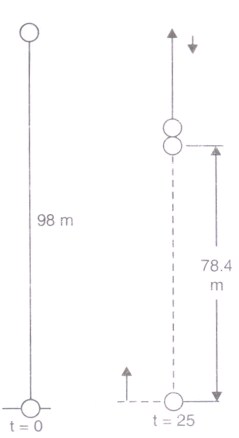
The height of the first ball after t seconds = 49 t - 1/2 x 9.8t2 = 4.9 t (10 - t)
Also the height of the second ball after t seconds = 98 - downward distance moved by it in t seconds.
= \(98-\frac{1}{2}\times 9.8 t^{2}=4.9(20-t^{2})\)
∴ \(4.9 t (100-t)=4.9(20-t^{2}) \)
or \(10t-t^{2}=20-t^{2}\ or \ t=2s\)
The balls thus collide two seconds after the start of their motion. Their velocities at this instant are
First ball: \(v_{1}=(49-9.8 \times 2) m/s\)
= 29.4 m/ s directed upwards
Second ball: v2 = \((0+9.8 \times 2)\) m/s
= 19.6 m/s directed downwards
if v is the velocity of the combined mass of the two balls after they stick together folluwing
their collision, we have, by principle of conservation of momentum.
\(200\times v=100 \times 29.4 -100 \times 19.6\)
∴ v = 4.9 m/s
The 'combined mass' thus moves upward, after collision with a velocity of 4.9 m/s. Its height above the ground at this instant is (considering the position of either of the two balls before collision)
\((98-\frac{1}{2}\times 9.8 \times 2^{2})m= (98-19.6)m = 78.4 m\)
We can now find the time t' taken by the 'combined mass' of the two balls to fall to ground.
We have for this 'combined mass',
u = 4.9 m/s ,s = -78.4 m, a = - g = -9.8 ms-2
ஃ -78.4= 4.9t'+1/2 (-9.8)t'2
or t'2-t'-16=0
ஃ \(t^{'}=\frac{1\pm \sqrt{1+64}}{2} = \frac{1\pm 8.06}{2}\)
= 4.532 s (leaving out the negative solution)
The 'combined mass' thus takes 4.53 s to fall to the ground. Since the balls collided
2 s after they started their motion, their total time of flight is (2 + 4.53) s = 6.53 s.
25.
u = 0, a = 2 ms-2, t = 10s
Using equation, v = u + at, we get
v = 0 + 2 x 10 = 20 ms-1
(a) Let us first consider horizontal motion. The only force acting on the stone is force of gravity which acts vertically downwards.
Its horizontal component is zero. Moreover, air resistance is to be neglected. So, horizontal motion is uniform motion.
\(\therefore\)v x = v = 20 ms-1
Let us now consider vertical motion which is controlled by force of gravity.
u=0, a = g = 10 ms-2, t = (11 - 10) s = 1s
Using v =u + at, vy = 0 + 10 x 1 = 10 ms-1
Resultant velocity,
\(v=\sqrt{V^2_x+V^2_y}\)
\(v=\sqrt{20^2+10^2}ms^{-1}\)
\(=\sqrt{500}ms^{-1}\)
= 22.36 ms-1
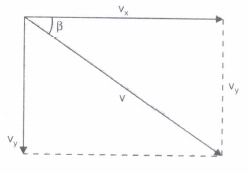
\(tan \beta ={v_y\over v_x}={10\over20}={1\over2}=0.5\)
or \(\beta =\)tan-1 (0.5) = 26.56°
or \(\beta =\) 26° 34'. This angle is with the horizontal.
(b) The moment the stone is dropped from the car, horizontal force on the stone is zero. The only acceleration of the stone is that due to gravity. This gives a vertically downward acceleration of 10 ms-2. This is also the net acceleration of the stone.
26.
Bats emit ultrasonic waves of large frequencies. These waves will be reflected by the obstacles in their path. The reflected rays received by the bat will give idea about the obstacle, i.e. distance, direction, size and nature.
27.
Given, T1 = 270C = 27 + 273 = 300K
T2 = 00 C = 0 + 273
= 273K
As we know, to freeze one gram of water 00C, 80cal of heat must be transferred from water at 0oC to the surrounding at 270C.
Q2 = 80 cal
The coefficient of performance of a refrigerator,
\(\beta =\frac { { Q }_{ 2 } }{ W } =\frac { { T }_{ 2 } }{ { T }_{ 1 }-{ T }_{ 2 } } \Rightarrow \frac { 80 }{ W } =\frac { 273 }{ 300-273 } \)
\(\\ \Rightarrow 7.91\ cal\)
28.
Let T be the temperature of the hot iron in the furnace. Heat radiated per second per unit area, E = \(\sigma \)T4 . When the body is placed in the open at temperature T0 , the heat radiated/Second/unit area,
E' = \(\sigma \)(T4-T04)
Clearly, E' < E. So, the optical pyrometer gives too low a value for the temperature in the open.
29.
(i) We employ with the sun’s mass replaced by the martian mass Mm
\({ T^{ 2 }=\frac { { 4\pi }^{ 2 } }{ GM_m } { R }^{ 3 } }\)
\({ M }_{ m }=\frac { { 4\pi }^{ 2 } }{ g } .\frac { { R }^{ 3 } }{ T^{ 2 } }\)
\(=\frac { 4\times (3.14)^{ 2 }\times (9.4)^{ 3 }\times 10^{ 18 } }{ 6.67\times { 10 }^{ -11 }\times (459\times 60)^2 }\)
\(=\frac { 4\times (3.14)^{ 2 }\times (9.4)^{ 3 }\times 10^{ 18 } }{ 6.67\times (459\times 60)^2\times 10^{-5} }\)
\(=6.48\times { 10 }^{ 23 }kg\)
(ii) Once again Kepler’s third law comes to our aid,
\(\frac { { T }_{ m }^{ 2 } }{ { T }^{ 2 } } =\frac { { R }_{ MS }^{ 3 } }{ { R }_{ ES }^{ 3 } } \)
Where RMS is the mass-sun distance and RES is the earth-sun distance
\(\therefore \ \ \ { T }_{ m }=(1.52)^{ 3/2 }\times 365=648\ days\)
We note that the orbits of all planets except Mercury and Mars are very close to being circular. For example, the ratio of the semiminor to semi-major axis for our Earth is, b/a = 0.99986.
30.
Given, speed of man (vm) = 4 km/h
Speed of river (vr) = 3 km
Width of the river (d) = 1 km
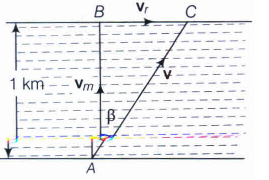
Time taken by the man to cross the river
t = \(\frac { Width\ of\ the\ river }{ Speed\ of\ the\ man } =\frac { 1\ km }{ 4\ km/h } =\frac { 1 }{ 4 } \)h =\(\frac { 1 }{ 4 } \times 60\) = 15 min
Distance travelled along the river = vr\(\times \) t
= \(3\times \frac { 1 }{ 4 } =\frac { 3 }{ 4 } \quad \)km = \(\frac { 3000 }{ 4 } \)
= 750 m

11th Standard CBSE Syllabus & Materials
11th Standard CBSE
CBSE 11th Business Studies Forms of Business Organisation Sample Question Papers Study Material - QB365 Set A
NEW11th Standard CBSE
CBSE 11th Business Studies Business, Trade and Commerce Sample Question Papers Study Material - QB365 Set A
NEW11th Standard CBSE
CBSE 11th Physics Waves Sample Question Papers Study Material - QB365 Set A
NEW11th Standard CBSE
CBSE 11th Physics Kinetic Theory Sample Question Papers Study Material - QB365 Set A



CBSE 11th Standard CBSE Subjects
CBSE Standards









