
 100% FREE ACCESS
11th Standard CBSE Syllabus & Materials
11th Standard CBSE
CBSE 11th Economics PART-A - Presentation of Data - New Sample Question Papers Study Material - QB365 Set A
NEW11th Standard CBSE
CBSE 11th Economics PART-A - Organisation of Data - New Sample Question Papers Study Material - QB365 Set A
NEW11th Standard CBSE
CBSE 11th Economics PART-A - Collection of Data - New Sample Question Papers Study Material - QB365 Set A
NEW11th Standard CBSE
CBSE 11th Economics PART-A - Introduction to Economics and Statistics - New Sample Question Papers Study Material - QB365 Set A
NEW11th Standard CBSE
CBSE 11th Business Studies International Trade Sample Question Papers Study Material - QB365 Set A
NEW11th Standard CBSE
CBSE 11th Business Studies Evolution and Fundamentals of Business Sample Question Papers Study Material - QB365 Set A

Published on: 21/09/2019
Laws of Motion in Two Variables
Download CBSE Class 11th Standard CBSE Physics question papers, sample papers, important questions, and previous year solved papers in PDF format. Get free study materials, NCERT solutions, and exam preparation resources for Class 11th Standard CBSE Physics
Questions + Answers key
Take MCQ Physics Test
1.
Vipul was driving on the road with his old Grandmother. She was sitting on the front seat with him. When Vipul was about to reach his destination, he stopped the engine and did not apply the brakes. Even then the car was running on the road for sometimes. His grandmother surprised and asked her grandson the reason of the car running without the engine on. Vipul was the student of Science studying is class XI. He explained his grandmother that it is only the momentum due to which the car is going on:
(i) What values Vipul exhibit here?
(ii) What is momentum and on which factors it depends?
2.
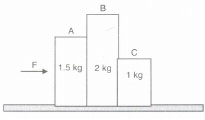
In the system of three blocks A, Band C shown in figure, (i) how large a force F is needed to give the blocks an acceleration of 3 m/s2, if the coefficient of friction between blocks and table is 0.27 (ii) how large a force does the block A exert on the block B?
3.
A trolley of mass 20 kg rests on a horizontal surface. A massless string tied to the trolley passes over a frictionless pulley and a load of 5 kg is suspended from other end of string. If coefficient of kinetic friction between trolley and surface be 0.1, find the acceleration of trolley and tension in the string. (Take g = 10 m S-2)
4.
A cricket ball of mass 150 g is moving with a velocity of 12 ms-1 and is hit by a bat so that the ball is turned back with a velocity of 20 ms-1. The force of the blow acts for 0.01 s. Find the average force exerted on the ball by the bat.
5.
Give one argument in favour of the fact that frictional force is a non-conservative force.
6.
An object weighing 70 kg is kept in a lift. Find its weight as recorded by a spring balance when the lift
(a) moves upwards with a uniform velocity of 5 ms-1,
(b) moves upwards with a uniform acceleration of 2.2 ms-2,
(c) moves downwards with a uniform acceleration of 2.8 ms-2 and
(d) falls freely under gravity.
7.
A body m1 of mass 9 kg and another body m2 of mass 6 kg are connected by a light inextensible string, Consider a smooth inclined plane of inclination 30° over which one of them can be placed while the other hangs vertically and freely, Show that m1 will drag m2 up the whole length of the plane in half the time that m2 hanging vertically would take to draw m1 up the plane.
8.
The driver of a truck travelling with a velocity v suddenly notices a brick wall in front of him at a distance d. Is it better for him to apply brakes or to make a circular turn without applying brakes in order to just avoid crashing into the wall? Why?
9.
A force of 400 N acting horizontal pushes up a 20 kg block placed 'On a rough inclined plane which makes an angle of 45° with the horizontal. The acceleration experienced by the block is 0.6 m/s2, Find the coefficient of sliding friction between the box and incline.
10.
Is a 'single isolated force' possible in nature?
11.
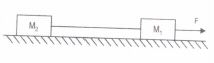
A light, inextensible string connects two blocks of mass M1, and M2. A force Facts upon MI. Find acceleration of the system and tension in siring.
12.
Ten one-rupee coins are put on top of each other on a table. Each coin has mass m. Give the magnitude and direction of the reaction of the 6th coin on the 7th coin.(counted from the bottom)
13.
An aircraft executes a horizontal loop at a speed of 720km/h with its wings banked at 15o . What is the radius of the loop?
14.
A stone of mass 0.25 kg tied to the end of a string is whirled round in a circle of radius 1.5 m with a speed of 40 rev./min in a horizontal plane. What is the tension in the string ? What is the maximum speed with which the stone can be whirled around if the string can withstand a maximum tension of 200 N ?
15.
A helicopter of mass 1000 kg reises with a vertical acceleration of 15m /s2. The crew and the passengers weigh 300 kg. Give the magnitude and direction of the force on the helicopter due to the surrounding air, take g = 10 m/s2.
1.
(i) The values displayed by Vipul were intelligent, helping nature, awareness and sympathy.
(ii) Momentum of a body is defined as the product of its mass and the velocity with which it is moving.
Momentum = Mass x Velocity Momentum of a body depends upon it mass and the velocity.
2.
(i) Let a be the acceleration of the system to right. All the three frictional forces f1=μm1g, f2 = μm2g, and f3 =μm3g will be directed to the left as the motion of bodies is to the right. Hence, for the whole system
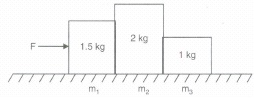
F-μm1g-μm2g-μm3g=(m1+m2+m3)a
F= (m1+m2+m3)(a+μg)
=(1.5 + 2 + 1)(3 + 0.2 x 9.8) = 22.3 N
(ii) The force exerted by the 1.5 kg block on the 2 kg block = F - m1 (a + μg)
= 22.3 - 1.5 (3 + 0.2 x 9.8)
= 22.3 - 7.44 = 14.86 N
3.
Here M = 20 kg, m = 5 kg and \(\mu_k\) = 0.1
Here net pulling force F = mg - fk = mg -\(\mu_k\)N
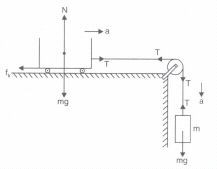
= mg -\(\mu_k\).Mg = 5 x 10 - 0.1 x 20 x 10
= 50 - 20 = 30 N
\(\therefore\)Acceleration of the system a = \({F\over (m+M)}\)
\(={30N\over (5+20)kg}\)
= 1.2 m s-2
\(\therefore\)Tension in string T = mg - ma
= 5 x 10 - 5 x 1.2
= 50 - 6 = 44 N.
4.
The impulse of the force exerted by the bat is given by the change in the momentum of the ball. Now
Initial momentum of the ball = \({150\over 1000}\times 12Kg \ ms^{-1}=1.8Kg \ ms^{-1}\)
Final momentum of the ball =\(-{150\over 1000}\times 20Kg \ ms^{-1}=-3.0Kg \ ms^{-1}\)
Change in the momentum of the ball = [1.8 - (- 3.0)] kg ms-1 = 4.8 kg ms-1
This equals the impulse of the force exerted by the bat. Since
Impulse = force x time
we have
Average force exerted =\({Impulse \over time}\)
\(={4.8Kg \ ms^{-1}\over 0.01s}=480Kg \ ms^{-1}=480N\)
5.
The direction of the frictional force is opposite to the direction of motion. When a body is moved, say from A to B and then back to A, work is required to be done both during forward and backward motion. So, the net work done in a round trip is not zero. Hence, the frictional force is a non-conservative force.
6.
(a) When the lift is moving upwards with a uniform velocity 5 ms-1 (acceleration is zero), the reaction R or the pressure on the base is
R = mg = 70 x 9.8 N = 686 N
(b) When the lift is moving upwards with a uniform acceleration of 2.2ms-2 , the reaction R' or the pressure on the base increases and is given by
R' = m (g + a) = 70 (9.8 + 2.2) N = 840 N
(c) When the lift descends with a uniform acceleration of 2.8 ms-2, the reaction R" is given by
R" = m (g - a) = 70 (9.8 - 2.8) N = 490 N
(d) When the lift falls freely under gravity, the reaction R'" is given by
R'" = m (g - g) = 0
i.e., the object appears to have become weightless.
7.
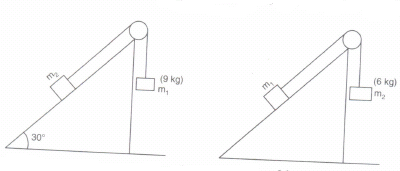
Case (i):Let a1 be the acceleration of the system when 9 kg mass hangs freely and T the tension in the string.
M1 g- T = m1 a1
T -m2g sin 30° = m2a1
\(\Rightarrow g(m_1-m_2 sin 30^o)=\)a1(m1+m2)
\(\Rightarrow a_1={g({9-6\times{1\over2}\over 15})}={6g\over 15}={2g\over 5}\)
Case (ii): Let a2 be the acceleration of the system when 6 kg mass hangs freely and T'the tension in the string.
m2g-T' = m2a2
T'-m1gsin 30o = m1a2
\(\Rightarrow\) g(m2-m1 sin 30o) = a2(m2 + m1)
\(\Rightarrow\) \(g(6-9\times{1\over 2})=a_2(6+9)\)
\(\Rightarrow a_2={3g\over 30}={g\over 10}\)
If S is the length of the plane,
In case (i), \(s={1\over 2}a_1t^2_1\)
In case (ii), \(s={1\over 2}a_2t^2_2\)
\(\Rightarrow a_1t^2_1=a_2t^2_1\)
\(\Rightarrow {t_1\over t_2}=\sqrt{a_2\over a_1}=\sqrt{g/10\over 2g/ 5}=\sqrt{1\over4}\Rightarrow t_1:t_2=1:2\)
8.
In applying brakes, suppose FB is the force required to stop the truck in distance (d)
\(\therefore F_B \times d ={1\over 2}mv^2 or F_B={1\over2}Fr\)
In taking a turn of radius d, the force required is
\(F_r ={mv^2\over d}=2F_B \ or \ F_B={1\over2}F_r\)
Therefore, it is better to apply brakes.
9.
The horizontally directed force 400 N and weight 20 kg of the block are resolved into two mutually perpendicular components, parallel and perpendicular to the plane as shown.
N =20 g cos 45° + 400 sin 45° = 421.4 N
The frictional force experienced by the block F = \(\mu\)N =\(\mu\) x 421.4 = 421.4 \(\mu\)N.
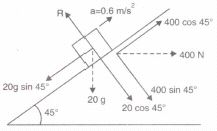
As the accelerated motion is taking place up the plane.
400 cos 45° - 20g sin 45° - f = 20a
\({400\over \sqrt{2}}-{20\times 9.8\over \sqrt{2}}-421.4\mu=20a=20\)
\(\mu=({400\over \sqrt{2}}-{196\over \sqrt{2}}-12)\times {1\over 421.4}\)
\(={282.8-138.6-12\over 421.4}=0.3137\)
The coefficient of sliding friction between the block and the incline = 0.3137
10.
A single isolated force is not possible. This follows from Newton's third law of motion, according to which to every action, there is an equal and opposite reaction. So, the forces must always exist in pairs. When we talk of a single force, we are considering only one aspect of mutual interaction.
11.
Here as the string is inextensible, acceleration of two blocks will be same. Also, string is massless so tension throughout the string will be same. Contact force will be normal force only.
Let acceleration of each block is a, tension in string is T and contact force between M1, and surface is N2 and contact force between M2 and surface is N2.
Applying Newton's second law for the blocks;
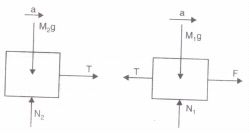
For M1, F - T Ml a ..........(i)
M1 g - N1= 0 ..........(ii)
For M2 T=M2 a ...........(iii)
M2 g- N2 = 0 .............(iv)
Solving equations (i) and (iii)
\(a={F\over M_1+M_2} and \ T={M_2F\over M_1+M_2}\).
12.
\(\because \) Mass of each coin = m
Number of total coins = 10
(iii) Reaction of the 6th coin on the 7th coin
= -(force exerted on 6th coin)
= -(weight of 4 coins)
= -4 mg N (vertically upward)
13.
Speed of the aircraft, v = 720 km/h
\(=720\times \frac { 5 }{ 18 } { m }/{ s }\quad \quad \quad \left[ \because 1km/h=\frac { 5 }{ 18 } { m }/{ s } \right] \)
= 200 m/s
Angel of banking, \(\theta \) = 15o
Acceleration due to gravity, g = 9.8m/s2
At turn, \(\tan { \theta } \) = \(\frac { { v }^{ 2 } }{ rg } \)
or \(r=\frac { { v }^{ 2 } }{ g\tan { \theta } } =\frac { (200)^{ 2 } }{ 9.8\times \tan { 15^{ 0 } } } =\frac { 40000 }{ 9.8\times 0.2679 } \)
\(\\ r=15420m=15.24\times 10^{ 3 }m=15.24km\)
14.
Mass of stone, m = 0.25 kg, Radius of the string, r = 1.5 m
Frequency, v = 40rev/min = \(\frac { 40 }{ 60 } \) rev/s = \(\frac { 2 }{ 3 } \) rev/s
Centripetal force required for circular motion is obtained from the tension in the string.
\(\therefore \) Tension in the string = Centripetal force
T = \(mr{ \omega }^{ 2 }\)
\(= mr\left( 2\pi n \right) ^{ 2 } \ \left[ \therefore \omega =2\pi v \right] \)
\(= mr4\pi ^{ 2 }{ v }^{ 2 }\)
\(T=0.25\times 1.5\times 4\times \left( \frac { 22 }{ 7 } \right) ^{ 2 }\times \left( \frac { 2 }{ 3 } \right) ^{ 2 }= 6.6N\)
Maximum tension which can be withstand by the string
\({ T }_{ max }=200\quad N=\frac { mv^{ 2 }max }{ r } \)
\(\\ { v }_{ max }=\sqrt { \frac { { T }_{ max }\times r }{ m } } =\sqrt { \frac { 200\times 1.5 }{ 0.25 } } =34.6{ m }/{ s }\)
15.
\(\because \) Mass of the helicopter, m1 = 1000 kg
Mass of the crew and the passengers, m2 = 300 kg
Acceleration of the helicopter, a = 15 m/ s2
Acceleration due to gravity, g = 10 m/s2
According to Newton's third law of motion, for every action there is an equal and opposite reaction.
\(\therefore \) Force on the helicopter due to the surrounding air
= 32500 N ( upward direction)

11th Standard CBSE Syllabus & Materials
11th Standard CBSE
CBSE 11th Business Studies Forms of Business Organisation Sample Question Papers Study Material - QB365 Set A
NEW11th Standard CBSE
CBSE 11th Business Studies Business, Trade and Commerce Sample Question Papers Study Material - QB365 Set A
NEW11th Standard CBSE
CBSE 11th Physics Waves Sample Question Papers Study Material - QB365 Set A
NEW11th Standard CBSE
CBSE 11th Physics Kinetic Theory Sample Question Papers Study Material - QB365 Set A



CBSE 11th Standard CBSE Subjects
CBSE Standards









