
 100% FREE ACCESS
11th Standard CBSE Syllabus & Materials
11th Standard CBSE
CBSE 11th Economics PART-A - Presentation of Data - New Sample Question Papers Study Material - QB365 Set A
NEW11th Standard CBSE
CBSE 11th Economics PART-A - Organisation of Data - New Sample Question Papers Study Material - QB365 Set A
NEW11th Standard CBSE
CBSE 11th Economics PART-A - Collection of Data - New Sample Question Papers Study Material - QB365 Set A
NEW11th Standard CBSE
CBSE 11th Economics PART-A - Introduction to Economics and Statistics - New Sample Question Papers Study Material - QB365 Set A
NEW11th Standard CBSE
CBSE 11th Business Studies International Trade Sample Question Papers Study Material - QB365 Set A
NEW11th Standard CBSE
CBSE 11th Business Studies Evolution and Fundamentals of Business Sample Question Papers Study Material - QB365 Set A

Published on: 04/12/2019
Laws of Motion
Download CBSE Class 11th Standard CBSE Physics question papers, sample papers, important questions, and previous year solved papers in PDF format. Get free study materials, NCERT solutions, and exam preparation resources for Class 11th Standard CBSE Physics
Questions + Answers key
Take MCQ Physics Test
1.
In a circus, the diameter of globe of death is 30 m. From what minimum height must a cyclist start in order to roll down the inclined and go round the globe successfully?
2.
A 20 kg box is gently placed on a rough inclined plane of inclination 30° with horizontal. The coefficient of sliding friction between the box and the plane is 0.4. Find the acceleration of the box down the incline.
3.
Show that the total linear momentum of an isolated system of interacting particles is conserved.
4.
Ten one-rupee coins are put on top of each other on a table. Each coin has mass m. Give the magnitude and direction of the force on the 7th coin by the 8 coin, (counted from the bottom).
5.
A helicopter of mass 1000 kg reises with a vertical acceleration of 15m /s2. The crew and the passengers weigh 300 kg. Give the magnitude and direction of the
(i) force on floor by the crew and passengers.
(ii) action of the rotor of the helicopter on the surrounding air
(iii) force on the helicopter due to the surrounding air, take g = 10 m/s2.
6.
A bend in a level road has a radius of 100 m. Find the maximum speed which a car turning this bend may have without skidding if the coefficient of friction between the tyres and road is 0.8.
7.
An artificial satellite of mass 2500 kg is orbiting around the earth with a speed of 4 kms-1 at a distance of 10-4 from the earth. Calculate the centripetal force action on it.
8.
Rubber tyres are preferred over steel tyres. Why?
9.
Which law of motion is involved in rocket propulsion?
10.
What is the apparent weight felt by a person in an elevator, when it is accelerating: (i) upward (ii) downward?
11.
If the speed of stone is increased beyond the maximum permissible value and the string breaks suddenly, which of the following correctly describes the trajectory of the stone after the string breaks the stone flies off tangentially from the instant the string breaks
12.
The physical quantity which is equal to the change in momentum of a body is known as _______.
acceleration
Impulse
reaction
force
13.
Water is poured from a height of 10m into an empty barrel at the rate of 1 litre per second. If the weight of the barrel is 10 kg, the weight indicated at time t = 60 s will be _______.
71.4 kg
68.6 kg
70.0 kg
84.0 kg.
14.
An insect is crawling up on the concave surface of a fixed hemispherical bowl of radius R. If the coefficient of friction is \({1\over3}\) then the height up to which the insect can crawl is nearly,_______.
5% of R
6% of R
6.5% of R
7.5% of R
15.
A block of mass m is placed on a smooth inclined plane of inclination \(\theta\) with the horizontal. The force exerted by the plane on the block has a magnitude _______.
mg cos \(\theta\)
mg tan \(\theta\)
mg/cos \(\theta\)
mg
16.
A force of 200 N is required to push a car of mass 500 kg slowly at constant speed on a level road. If a force of 500 N is applied, the acceleration of the car (in m S-2) will be_______.
zero
0.2
0.6
1.0.
17.
The dimension of Impulse is _______.
MLT-2
MLT-1
MLT-3
MLT
18.
If the tension in the cable supporting an elevator is equal to the weight of the elevator, the elevator may _______.
going up with uniform speed
going down with non-uniform speed
going up with increasing speed
going down with increasing speed
1.
Diameter of globe = 30 m
Radius of globe, r = 15 m
Let 'h' be the minimum height from which the cyclist after rolling down an incline will acquire velocity =\(\sqrt{2gh}\)
For looping the loop, the minimum velocity at the lowest point should be\(\sqrt{5gr}\) .
\(\therefore \sqrt{5gh} =\sqrt{2gh}\)
or h = \({5r\over 2}={5\times 15\over 2}=37.5m\)
2.
In solving inclined plane problems, the x and y directions along which the forces are to be considered, may be taken as shown. The components of weight of the box are
(i) mg sin \(\alpha\)acting down the plane and
(ii) mg cos \(\alpha\) acting perpendicular to the plane.
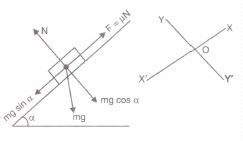
N = mg cos \(\alpha\)
mg sin \(\alpha\) -\(\mu\) N =ma
mg sin \(\alpha\) -\(\mu\) mg cos \(\alpha\) =ma
a = g sin \(\alpha\) -\(\mu\)g cos \(\alpha\)
= g (sin \(\alpha\) - \(\mu\)cos \(\alpha\))
= 9.8 ( \({1\over 2}\) - 0.4 x\({\sqrt{3}\over 2}\))
= 4.9 x 0.3072 = 1.505 m/S2
The box accelerates down the plane at 1.505 m/S2
3.
Consider two bodies A and B, with inital momenta \(\overrightarrow{p}\)A and \(\overrightarrow{p}\) B respectively. Let the two bodies collide, get apart and have final momenta\(\overrightarrow{p}\) A and \(\overrightarrow{p}\) B respectively. By the second law of motion:
Change in momentum of body A, \(\overrightarrow{p}\) A - \(\overrightarrow{p}\)A =\(\overrightarrow{F}\)AB \(\triangle t\).......(i)
where \(\overrightarrow{F}\)AB is the force acting on A due to action of B for a time\(\triangle t\).
Similarly change in momentum of body B, \(\overrightarrow{p}\)B - \(\overrightarrow{p}\)B = \(\overrightarrow{F}\)BA \(\triangle t\) ........(ii)
Here time \(\triangle t\), the time for which two bodies A and B are in contact and interact, is same for both the forces.
Moreover, from third law of motion \(\overrightarrow{F}\)AB - \(\overrightarrow{F}\)BA
Hence, adding (i) and (ii), we obtain
(\(\overrightarrow{p}\)A -\(\overrightarrow{p}\) A ) + (\(\overrightarrow{p}\)B - \(\overrightarrow{p}\)B ) = \(\overrightarrow{F}\)AB\(\triangle t\)+ \(\overrightarrow{F}\)BA\(\triangle t\)=- \(\overrightarrow{F}\)BA\(\triangle t\)+ \(\overrightarrow{F}\)BA\(\triangle t\)=0
\(\Rightarrow\)\(\overrightarrow{p'}\) A + \(\overrightarrow{p'}\)B = \(\overrightarrow{p}\) A + \(\overrightarrow{p}\) B
which shows that the total final momentum of the isolated system is exactly same as its initial momentum. Thus, it is proved that total momentum of an isolated system remains conserved.
4.
\(\because \) Mass of each coin = m
Number of total coins = 10
Force acting on 7th coin by the 8th coin = weight of the 8 coins + weight of two coins supported by 8 coins.
= mg + 2 mg
= 3 mg N ( downward)
5.
\(\because \) Mass of the helicopter, m1 = 1000 kg
Mass of the crew and the passengers, m2 = 300 kg
Acceleration of the helicopter, a = 15 m/ s2
Acceleration due to gravity, g = 10 m/s2
(i) Let R, be the reaction applied by the floor on the crew and the passengers.
-S.png)
R1- m2g = m2a
or
R1= m2g + m2a = m2(g+a)
= 300(10 + 15) = 7500N(upward direction)
(ii) Action of the rotor of the helicopter on the surrounding air
= ( m1 + m2 ) g + ( m1 + m2 ) a
= ( m1 + m2 ) ( g + a )
= ( 1000 + 300 ) x (10 + 15 )
= 1300 x 25 = 32500 N
Force (action ) of the rotor of the helicopter on the surrounding air = 32500 N (downward)
6.
The maximum speed which the car can have without skidding is given by
\(\mu =\frac { { v }^{ 2 } }{ rg } \Rightarrow v=\sqrt { \mu rg }\)
\( \\ Here,\ r=100m,\mu =0.8,g=9.8m{ s }^{ -2 }\)
\(\\ v =\sqrt { 0.8\times 100\times 9.8 } =\sqrt { 4\times 2\times 2\times 49 } \)
\(\\ v\ =\ 2\times 2\times 7\ = 28{ m }/{ s }\)
7.
Given, r =104 km = 104 \(\times \) 1000 m = 107 m,
m = 2500 kg
v = 4 kms-1 = 4\(\times \)103 ms-1
Now,centripeta force is F = \(\frac { m{ v }^{ 2 } }{ r } \)
F = \(\frac { 2500\times (4\times { 10 }^{ 3 }{ ) }^{ 2 } }{ { 10 }^{ 7 } } =\frac { 2500\times 16\times { 10 }^{ 6 } }{ { 10 }^{ 7 } }\)
\( \\ F=\quad \frac { 250\times 16\times { 10 }^{ 7 } }{ { 10 }^{ 7 } }\)
\(= 4000N\)
8.
Rubber tyres are preferred because coefficient of friction between rubber and road is less than that between steel and road.
9.
Newton's third law of motion
10.
(i) Apparent weight = m (g + a)
(ii) Apparent weight = m (g - a).
11.
The part correctly describes the trajectory of the stone after the spring breaks because when a stone tied to one end of a string is whirled round in a circle then velocity of the stone at any point is along the tangent at that point. If the string breaks suddenly, then stone flies off tangentially, along the direction of its velocity.
12.
(b)
Impulse
13.
(a)
71.4 kg
14.
(a)
5% of R
15.
(c)
mg/cos \(\theta\)
16.
(d)
1.0.
17.
(b)
MLT-1
18.
(a)
going up with uniform speed

11th Standard CBSE Syllabus & Materials
11th Standard CBSE
CBSE 11th Business Studies Forms of Business Organisation Sample Question Papers Study Material - QB365 Set A
NEW11th Standard CBSE
CBSE 11th Business Studies Business, Trade and Commerce Sample Question Papers Study Material - QB365 Set A
NEW11th Standard CBSE
CBSE 11th Physics Waves Sample Question Papers Study Material - QB365 Set A
NEW11th Standard CBSE
CBSE 11th Physics Kinetic Theory Sample Question Papers Study Material - QB365 Set A



CBSE 11th Standard CBSE Subjects
CBSE Standards









