
 100% FREE ACCESS
11th Standard CBSE Syllabus & Materials
11th Standard CBSE
CBSE 11th Economics PART-A - Presentation of Data - New Sample Question Papers Study Material - QB365 Set A
NEW11th Standard CBSE
CBSE 11th Economics PART-A - Organisation of Data - New Sample Question Papers Study Material - QB365 Set A
NEW11th Standard CBSE
CBSE 11th Economics PART-A - Collection of Data - New Sample Question Papers Study Material - QB365 Set A
NEW11th Standard CBSE
CBSE 11th Economics PART-A - Introduction to Economics and Statistics - New Sample Question Papers Study Material - QB365 Set A
NEW11th Standard CBSE
CBSE 11th Business Studies International Trade Sample Question Papers Study Material - QB365 Set A
NEW11th Standard CBSE
CBSE 11th Business Studies Evolution and Fundamentals of Business Sample Question Papers Study Material - QB365 Set A

Published on: 05/10/2019
Mechanical Properties of Fluids
Download CBSE Class 11th Standard CBSE Physics question papers, sample papers, important questions, and previous year solved papers in PDF format. Get free study materials, NCERT solutions, and exam preparation resources for Class 11th Standard CBSE Physics
Questions + Answers key
Take MCQ Physics Test
1.
Water stands at a depth H in a tank, whose side walls are vertical. A hole is made on one of the walls at a depth h below the water surface. Find at what distance from the foot of the wall does the emerging stream of water strike the floor and for what value of h this range is maximum.
2.
What are the three forms of energy possessed by a flowing fluid? Find their expressions.
3.
State law of floatation.
Compute the volume in m3 of a life preserver of SG 0.20, which, when worn by a boy.weighing 60 kg and having SG equal to 0.9, will just support him, if 3/4 of his body is submerged in fresh water of density 1000 kg m-3. Assume that the life preserver is completely submerged.
4.
Derive the expression for excess pressure inside:
(a) a liquid drop
(b) a liquid bubble
(c) an air bubble.
5.
The flow rate of water is 0.58 L/mm from a tap of diameter of 1.30 cm. After some times, the flow rate is increased to 4 L/min. Determine the nature of the flow for both the flow rates. The coefficient of visocity of water is 10-3 Pa-s and the density of water is 103 kg/m3.
6.
If 27 drops of rain were to be combine to form one new large spherical drop, then what should be the velocity of this large spherical drop? Consider the terminal velocity of 27 drops of equal size falling through the air is 0.20 ms-1
7.
Near the surface of the river, the velocity of water is 160 kmh -1 .Find the shearing stress between horizontal layers of waters, if the river is 6 m deep and the coefficient of viscosity of water is 10-2 poise.
8.
A fully loaded Boeing aircraft has a mass of 3.3\(\times \)105 kg. Its total wing area is 500 m2. It is in level flight with a speed of 960 km/h
Estimate the fractional increase in the speed of the air on the upper surface of the wing relative to the lower surface.[The density of air is \(\rho \)= 1.2 kgm-3
9.
The flow of blood in a larger artery of an anesthetised dog is diverted through a venturimeter. The wider part of the meter has a cross-sectional area equal to that of the artery, a1 = 8mm2. The narrow part has an area a2 = 4mm2. The pressure drop in the artery is 24 Pa. What is the speed of the blood in the artery?
10.
Water flows through a horizontal pipe whose internal diameter is 2.0 cm , at speed of 1.0 ms-1 . What should be the diameter of the nozzle, if the water is to emerge at a speed of 4.0 ms-1 ?
11.
A liquid is kept in cylindrical vessel which is rotated along its axis. The liquid rises at the sides. If the radius of vessel is 0.05 m and the speed of rotation is 2 rev/s, find the difference in height of the liquid at the centre of the vessel and its sides.
1.
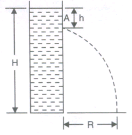
The situation is shown in fig. Here, we have
\(v_A=\sqrt{2gh}\) .............(1)
and (H - h) = \(\frac{1}{2}gt^2\) ..............(2)
The distance R is given by
R = vA x t ........................(3)
From equation (2) t = \(\sqrt{\frac{2(H-h)}{g}}\) ...............(4)
Substituting the value of vA from equation (1) and the value of t from equation (4) in equation (3), we get
R = \(\sqrt{(2gh)}\times \sqrt{\left\{2(H-h)/g \right\} }\)
= \(2\sqrt{\left\{ h(H-h)\right\} }\)
The range R will be maximum when
dR/dh = 0.
\(\therefore 22.\frac{1}{2}h^{-1/2}-2h^{1/2}.{1\over 2}(H-h)^{1/2}=0\)
Saving, we get h = H/2.
2.
Three forms of energy possessed by a flowing fluid are as follows:
1. Pressure energy:
Let an ideal fluid of density P be contained in a rectangular vessel, provided with a small side tube at a depth ho below the free surface of fluid in the vessel. At the level of side tube, pressure of fluid along the axis of side tube
p = h0pg
If we want to introduce more fluid into the vessel at this very pressure, we can force it through the side tube by doing work on the piston, If 'A' be the cross-section area of the piston, then force acting on the piston F = PA.
\(\therefore\) Work done in moving the piston through a small distance \(\Delta r\) will be
\(\Delta W=F\Delta x=PA\Delta x=P\Delta V\)
As a result of motion of piston, the mass of the fluid forced in the vessel
\(\Delta m=\rho A\Delta x=\rho\Delta V\)
The work done is stored up in the liquid in the form of its pressure energy.
\(\therefore\) Pressure energy of liquid per unit mass = Work done per unit mass
\(=\frac{\Delta W}{\Delta m}=\frac{P\Delta V}{\rho\Delta V}=\frac{p}{\rho}\)
and pressure energy per unit volume = p.
2. Gravitational potential energy:
Let at any stage of its flow a fluid element of mass "m' be situated at a height 'h' from the reference line (generally taken to be earth's surface), then its gravitational potential energy in that position is mgh.
\(\therefore\) Gravitational potential energy per unit mass = \(\frac{mgh}{m}=gh\)
and gravitational potential energy per unit volume = pgh.
3. Kinetic energy:
Let at any stage of its flow, a fluid element of mass 'm' be moving with a speed 'v', then the kinetic energy of this fluid element is \(\frac{1}{2}v^2\)
\(\therefore\) Kinetic energy per unit mass = \(\frac{\frac{1}{2}mv^2}{m}=\frac{1}{2}v^2\)
and kinetic energy per unit volume = \(\frac{1}{2}\rho v^2\)
These three forms of energy possessed by a flowing fluid are mutually convertible from one form to another.
3.
For law of floatation, see the chapter in the NCERT Textbook.
The weight of the boy Wb and the weight of the preserver Wp acting downward are just balanced by the upward buoyant force of the preserver Bp and the buoyant force of the boy Bb. Therefore,
\(E_b+W_p=B_b+B_p\) ........... (1)
But \(B_p=V_b\rho_wg,W_b=V_b\rho_bg=60\times g\)
and \(B_p=V_b\rho_wg,W_p=V_p\rho_p g\)
where g is the acceleration due to gravity. V and \(\rho\) denote volume and density respectively.
\(\rho_b\) = 0.9 x 1000 = 900 kg m-3
\(\rho_p\) = 0.20 x 1000 = 200 kg m-3
and \(V_b=\frac{W_b}{g\rho_b}\)
From Eq. (1), we have
\(\frac{3}{4}V_b\rho_wg+V_p\rho_wg=W_b+V_p\rho_pg\)
or \(\frac{3}{4}\frac{W_b}{g\rho_b}\rho_wg+V_p\rho_wg=60\times g+V_p\rho_pg\)
or \(\frac{3}{4}\times \frac{60\times g}{\rho_b}p_w+V_p\rho_wg=60g+V_p\rho_pg\)
or \(45\frac{\rho_w}{\rho_b}+V_p\rho_wg=60+V_p\rho_p\)
or \(V_p(\rho_w-\rho_p)=60-45\frac{\rho_w}{\rho_b}\)
\(=60-\frac{45\times 1000}{900}=10\)
\(V_p=\frac{10}{\rho_w-\rho_p}=\frac{10}{800}\) = 1.25 x 10⁻² m3
Volume of the life preserver = 0.0125 m3.
4.
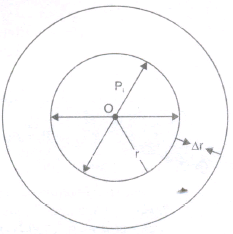
(a) Inside a liquid drop
Let r = radius of a spherieal liquid drop of centre O. T = surface tension of the liquid. Let Pi and Po be the values of pressure inside and outside the drop.
\(\therefore\) Excess pressure inside the liquid drop = Pi - Po
Let \(\Delta\)r be the increase in its radius due to excess pressure. It has one free surface outside.
\(\therefore\) increase in surface area of the liquid drop
= \(4\pi(r+\Delta r)^2-4\pi r^2\)
= \(4\pi[r^2+(\Delta r)^2+2r\Delta r-r^2]\)
= \(8\pi r\quad \Delta r\) .................(i)
\(\therefore\) increase in surface energy of the drop is
W = Surface tension x increase in area
= \(T\times 8\pi r\quad \Delta r\) .............. (ii)
Also W = Force due to excess of pressure x displacement
= Excess pressure x Area of drop x increase in radius
= \((p_i-p_0)4\pi r^2\Delta r\) ............(iii)
\(\therefore\) From eqns (ii) and (iii), we get
\((p_i-p_0)\times 4\pi r^2\quad \Delta r=T\times 8\pi r\quad \Delta r\)
\(\Rightarrow p_i-p_0=\frac{2T}{r}\)
(b) Inside a liquid bubbles:
A liquid bubble has air both inside and outside it and therefore it has two free surfaces.
Thus increase in its surfaces area
= \(2[4\pi (r+\Delta r)^2-4\pi r^2]\)
= \(2\times 8\pi r\Delta r=16\pi r\quad\Delta r\)
\(\therefore\) W = \(T\times 16\pi r\Delta r\) ...............(i)
Also W = \((p_i-p_0)4\pi r^2\times \Delta r\) ........(ii)
From eqnd (i) and (ii), we get
\((p_i-p_0)\times 4\pi r^2\times \Delta r=T.16\pi r\quad \Delta r\)
or \((p_i-p_0)=\frac{4T}{r}\)
(c) Inside an air bubble:
Air bubble is formed inside liquid, thus air bubble has one free surface inside it and liquid is outside.
If r = radius of air bubble
\(\Delta\)r = increase in its radius due to excess of pressure
(Pi - P0) inside it.
T = surface tension of the liquid in which bubble is formed.
\(\therefore\) increase in surface area = \(8\pi r \Delta r\).
\(\therefore\) W = T x \(8\pi r \Delta r\)
Also W = \((p_i-p_0)\times 4\pi r^2\Delta r\)
\(\therefore (p_i-p_0)\times 4\pi r^2\Delta r=T\times 8\pi r^2\Delta r\)
or \(p_i-p_0=\frac{2T}{r}\)
5.
Given, diameter , D = 1.30 cm = 1.3\(\times \)10-2 m.
Coefficient of viscosity of water, \(\eta \) = 10-3 Pa-s
The volume of the water flowing out per second is
V = vA =v \(\times \)\(\pi { r }^{ 2 }=v\pi \frac { { D }^{ 2 } }{ 4 } \)
\(\therefore \) Speed of flow, v = \(\frac { 4v }{ \pi { D }^{ 2 } } \)
Reynold's number, Re = \(\frac { \rho vD }{ \eta } =\frac { 4\rho v }{ \eta \pi D } \)
Case I when V = 0.58 L /min = \(\frac { 0.58\times 10^{ -3 }{ m }^{ 3 } }{ 1\times 60\quad s } \)
\(\\ =\quad 9.67\times { 10 }^{ -6 }{ m }^{ 3 }{ s }^{ -1 }\)
\(\\ { R }_{ e }=\frac { 4\times { 10 }^{ 3 }\times 9.67\times 10^{ -6 } }{ { 10 }^{ -3 }\times 3.14\times 1.3\times { 10 }^{ -2 } } =948\)
\(\\ \because \ { R }_{ e }<1000,\ so\ the\ flow\ is\ steady\ or\ streamlime\)
Case II when V = 4 L/min
\(=\frac { 4\times { 10 }^{ 3 } }{ 60 } { m }^{ 3 }{ s }^{ -1 }=6.67\times { 10 }^{ -5 }{ m }^{ 3 }{ s }^{ -1 }\)
\(\\ { R }_{ e }=\frac { 4\times { 10 }^{ 3 }\times 6.67\times { 10 }^{ -5 } }{ { 10 }^{ -3 }\times 3.14\times 1.3\times { 10 }^{ -2 } } =6536\)
\(\\ \because \ { R }_{ e }>3000,\ so\ the\ flow\ will\ be\ turbulent\)
6.
Let the radius of the small drop is r and that of big drop is R. The volume of the big drop = 27\(\times \) volume of each small drop
\(\frac { 4 }{ 3 } \pi { R }^{ 3 }=27\times \frac { 4 }{ 3 } \pi { r }^{ 3 }\Rightarrow R\quad =3r\)
Let the terminal velocities of small and big drop are v1 and v2, respectively. Then,
\(v=\frac { 2{ r }^{ 2 }(\rho -\sigma )g }{ 9\eta } \Rightarrow v\infty { r }^{ 2 }\)
\(\\ Hence,\frac { { v }_{ 2 } }{ { v }_{ 1 } } =\frac { { R }^{ 2 } }{ { r }^{ 2 } } \Rightarrow { v }_{ 2 }={ v }_{ 1 }\times \frac { { R }^{ 2 } }{ { r }^{ 2 } } =0.2\left( \frac { 3r }{ r } \right) ^{ 2 }=0.2\times 9\)
\( { v }_{ 2 }=1.8m/s\)
7.
Given, v = 160km/h = \(160\times \frac { 5 }{ 18 } m/s=44.44m/s\)
l = 6 m and \(\eta \) = 10-2 poise = 10-3 Pa-s
Shearing stress = \(\frac { F }{ A } =\eta \frac { v }{ 1 } ={ 10 }^{ 3 }\times \frac { 44.44 }{ 6 } \)
Shearing stress = 7.407 \(\times \)10-3 Nm-2
8.
(b) Consider v1 and v2 are the speeds of air on lower and upper surfaces of the wings and \(\rho _{ 1 }and{ \rho }_{ 2 }\) are the corresponding pressures.
From Bernoulli's principle
\({ \rho }_{ 1 }+\frac { 1 }{ 2 } \rho v^{ 2 }_{ 1 }=\rho _{ 2 }+\frac { 1 }{ 2 } { \rho v }^{ 2 }_{ 2 }\)
\(\\ \therefore { \rho }_{ 1 }-{ \rho }_{ 2 }=\Delta \rho =\frac { \rho }{ 2 } \left( { v }^{ 2 }_{ 2 }-{ v }^{ 2 }_{ 1 } \right) \)
\(\\ \left( { v }_{ 2 }-{ v }_{ 1 } \right) =\frac { 2\Delta \rho }{ \rho ({ v }_{ 2 }+{ v }_{ 1 }) } \)
Average speed, \({ v }_{ av }=\frac { { v }_{ 2 }+{ v }_{ 1 } }{ 2 } \) = 960 km/h = 267 m/s
So, \(\frac { { v }_{ 2 }+{ v }_{ 1 } }{ 2 } =\frac { \Delta \rho }{ \rho v^{ 2 }_{ av } } =\frac { 6.5\times { 10 }^{ 3 } }{ 1.2\times (267{ ) }^{ 2 } } \approx 0.08=8%x = {-b \pm \sqrt{b^2-4ac} \over 2a}\)
Then, the speed above the wing needs to be only 8% higher than that below.
9.
The Bernoulli's equation for the horizontal flow is
\(\rho _{ 1 }+\frac { 1 }{ 2 } { \rho v }^{ 2 }_{ 1 }=\rho _{ 2 }+\frac { 1 }{ 2 } { \rho v }^{ 2 }_{ 2 }\)
By equation of continunity,
\({ a }_{ 1 }{ v }_{ 1 }={ a }_{ 2 }{ v }_{ 2 }\quad or\quad { v }_{ 2 }=\frac { { a }_{ 1 }{ v }_{ 1 } }{ { a }_{ 2 } } \)
\(\\ \therefore \quad { \rho }_{ 1 }-{ \rho }_{ 2 }=\frac { 1 }{ 2 } \frac { \rho { a }^{ 2 }_{ 1 }{ v }^{ 2 }_{ 1 } }{ { a }^{ 2 }_{ 2 } } -\frac { 1 }{ 2 } \rho v^{ 2 }_{ 1 }\left[ \left( \frac { { a }^{ 2 }_{ 1 } }{ { a }^{ 2 }_{ 2 } } \right) -1 \right] \)
\(\\ Here,{ \rho }_{ 1 }-{ \rho }_{ 2 }=24Pa\)
\(\\ \rho (blood)=1.06\times 10^{ 3 }kgm^{ -3 },{ a }_{ 1 }/{ a }_{ 2 }=8/4=2\)
\(\\ \therefore { v }_{ 1 }=\sqrt { \frac { 2({ p }_{ 1 }-{ p }_{ 2 }) }{ \rho \left( \frac { { a }^{ 2 }_{ 1 } }{ { a }^{ 2 }_{ 2 } } -1 \right) } } =\sqrt { \frac { 2\times 24 }{ 1.06\times { 10 }^{ 3 }\times ({ 2 }^{ 2 }-1) } } =0.1228\quad m/s\)
10.
неге \(D_1=2.0 \mathrm{~cm}=0.02 \mathrm{~m}\)
\(v_1=1.0 \mathrm{~ms}^{-1}, D_2=?, v_2=4.0 \mathrm{~ms}^{-1}\)
Fromequation of continuity \(a_1 v_1=a_2 v_2\)
\( \text { or } \frac{\pi D_1^2}{4} \times v_1=\frac{\pi D_2^2}{4} \times v_2 \)
\( \text { or } D_2^2=\frac{v_1}{v_2}=D_1^2=\frac{1}{4} \times(0.2)^2=(0.01)^2 \)
\( \text { or } D_2=0.01 \mathrm{~m}=1.0 \mathrm{~cm}
\)
11.
0.02m

11th Standard CBSE Syllabus & Materials
11th Standard CBSE
CBSE 11th Business Studies Forms of Business Organisation Sample Question Papers Study Material - QB365 Set A
NEW11th Standard CBSE
CBSE 11th Business Studies Business, Trade and Commerce Sample Question Papers Study Material - QB365 Set A
NEW11th Standard CBSE
CBSE 11th Physics Waves Sample Question Papers Study Material - QB365 Set A
NEW11th Standard CBSE
CBSE 11th Physics Kinetic Theory Sample Question Papers Study Material - QB365 Set A



CBSE 11th Standard CBSE Subjects
CBSE Standards









