
 100% FREE ACCESS
11th Standard CBSE Syllabus & Materials
11th Standard CBSE
CBSE 11th Economics PART-A - Presentation of Data - New Sample Question Papers Study Material - QB365 Set A
NEW11th Standard CBSE
CBSE 11th Economics PART-A - Organisation of Data - New Sample Question Papers Study Material - QB365 Set A
NEW11th Standard CBSE
CBSE 11th Economics PART-A - Collection of Data - New Sample Question Papers Study Material - QB365 Set A
NEW11th Standard CBSE
CBSE 11th Economics PART-A - Introduction to Economics and Statistics - New Sample Question Papers Study Material - QB365 Set A
NEW11th Standard CBSE
CBSE 11th Business Studies International Trade Sample Question Papers Study Material - QB365 Set A
NEW11th Standard CBSE
CBSE 11th Business Studies Evolution and Fundamentals of Business Sample Question Papers Study Material - QB365 Set A

Published on: 04/12/2019
Mechanical Properties of Fluids
Download CBSE Class 11th Standard CBSE Physics question papers, sample papers, important questions, and previous year solved papers in PDF format. Get free study materials, NCERT solutions, and exam preparation resources for Class 11th Standard CBSE Physics
Questions + Answers key
Take MCQ Physics Test
1.
Water stands at a depth H in a tank, whose side walls are vertical. A hole is made on one of the walls at a depth h below the water surface. Find at what distance from the foot of the wall does the emerging stream of water strike the floor and for what value of h this range is maximum.
2.
Consider the two horizontal pipes of different diameters which are connected together and the water is flowing through these two pipes. In the first pipes, the pressure is 3.0\(\times\)104N/m2 and the speed of the water flowing is 5m/s. If the diameters of the pipes are 4 cm and 6 cm, respectively, then what will be the speed and the pressure of the water in the second pipe? Density of the water is 103kg/m3 .
3.
At a depth 1000m in an ocean
Find the force acting on the window of area \(20\ cm\ \times \ 20cm\) of a submarine at this depth, the interior of which is maintained at sea-level atmospheric pressure.(The density of sea water is \(1.03\times { 10 }^{ 3 }kg{ m }^{ -3 },\ g=10\ m{ s }^{ -2 }\))
4.
Water flows through a horizontal pipe whose internal diameter is 2.0 cm , at speed of 1.0 ms-1 . What should be the diameter of the nozzle, if the water is to emerge at a speed of 4.0 ms-1 ?
5.
What should be the maximum average velocity of water in a tube of diameter 2 cm so that flow is laminar? The viscosity of water is 0.001 Nm-2 s.
6.
On what factors does the critical velocity of the liquid depend?
7.
What is the corresponding flow rate? (Take viscosity of blood to be 2.084\(\times\) 10- 3Pa-s)
8.
Two soap bubbles have radii in the ratio2:3.Compare the excess of pressure inside these bubbles.
9.
27 identical drops of water are falling down vertically in air each with a terminal velocity 0.15\(ms^{ -1 }\)>if they combine to form a single bigger drop, what will be its terminal velocity?
10.
Why is it that a liquid set in rotation comes to rest after some time?
11.
How does the rate of flow of a liquid through a tube depend on the radius of its bore?
12.
Why the aeroplanes and cars are given a streamline shape?
13.
Why machines are sometimes jammed in winter?
14.
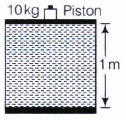
A container of area 0.02 m 2 is filled with water. Find the pressure at the bottom of the container if a weight is placed on the piston. (as shown in the figure).
15.
At which of the following temperature, the value of surface tension of water is minimum?
4°C
25°C
50°C
75°C
16.
What is the shape when a non-wetting liquid in displaced in a capillary tube?
Concave upwards
Convex upwards
Concave downwards
Convex downwards
17.
A cylindrical vessel is filled with water upto height H. A hole is bored in the wall at a depth h from the free surface of water. For maximum range, h is equal to
H/4
H/2
3H/4
H
18.
For a ball falling in a liquid with constant velocity, ratio of resistance force due to the liquid to that due to gravity is
1
\(\frac{2a^2\rho g}{9\eta^2}\)
\(\frac{2a^2(\rho-\sigma)g}{9\eta}\)
none
19.
Two small drops of mercury, each of radius R, coalesce to form a single large drop. The ratio of the total surface energies before and after the change is:
1: 21/3
22/3 : 1
2: 1
1: 2
20.
The mass of water rises in capillary tube of radius R is M. The mass of water that rises in tube of radius 2R is
M
M/2
2M
4M
21.
The Bernauli's Theorem is based on the conservation of:
mass
energy
momentum
all
1.
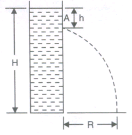
The situation is shown in fig. Here, we have
\(v_A=\sqrt{2gh}\) .............(1)
and (H - h) = \(\frac{1}{2}gt^2\) ..............(2)
The distance R is given by
R = vA x t ........................(3)
From equation (2) t = \(\sqrt{\frac{2(H-h)}{g}}\) ...............(4)
Substituting the value of vA from equation (1) and the value of t from equation (4) in equation (3), we get
R = \(\sqrt{(2gh)}\times \sqrt{\left\{2(H-h)/g \right\} }\)
= \(2\sqrt{\left\{ h(H-h)\right\} }\)
The range R will be maximum when
dR/dh = 0.
\(\therefore 22.\frac{1}{2}h^{-1/2}-2h^{1/2}.{1\over 2}(H-h)^{1/2}=0\)
Saving, we get h = H/2.
2.
\(According\ to\ the\ equation\ of\ continutity,\ we\ get\)
\(\\ { a }_{ 1 }{ v }_{ 1 }={ a }_{ 2 }{ v }_{ 2 }\)
\(\\ \Rightarrow \ \pi { r }_{ 1 }{ v }_{ 1 }=\pi { r }_{ 2 }{ v }_{ 2 }\)
\(\\ \therefore { v }_{ 2 }={ \left( \frac { { r }_{ 1 } }{ { r }_{ 2 } } \right) }^{ 2 }\ { v }_{ 1 }\)
\(\\ Given,\ { r }_{ 1 }=\frac { 4 }{ 2 } =2cm=2\times { 10 }^{ -2 }m\)
\({ r }_{ 2 }=\frac { 6 }{ 3 } =3cm\ =3\times { 10 }^{ -2 }m\)
\( { v }_{ 1 }=5m/s\)
\({ v }_{ 2 }={ \left( \frac { 2 }{ 3 } \right) }^{ 2 }\times 5=2.22m/s\)
\(\\ Now,\ applying\ the\ Bernoulli's\ theorem\)
\(\\ { p }_{ 1 }+\frac { 1 }{ 2 } { \rho { v } }_{ 1 }^{ 2 }={ p }_{ 2 }\frac { 1 }{ 2 } { \rho v }_{ 2 }^{ 2 }\)
\({ p }_{ 2 }={ p }_{ 1 }+\frac { 1 }{ 2 } \rho ({ { v } }_{ 1 }^{ 2 }+{ v }_{ 2 }^{ 2 })\)
\(=3.0\times { 10 }^{ 4 }+\frac { 1 }{ 2 } \times { 10 }^{ 3 }({ 5 }^{ 2 }-{ 2.22 }^{ 2 })\)
\(=3\times { 10 }^{ 4 }+\frac { 1 }{ 2 } \times { 10 }^{ 4 }+500\times 20.08\)
\( { p }_{ 2 }=4\times { 10 }^{ 4 }N/{ m }^{ 2 }\)
3.
Here h = 1000 m and ρ = 1.03 x 10 3 kg m-3
The pressure outside the submarine is P = Pa + ρgh and the pressure inside it is Pa . Hence, the net pressure acting on the window is gauge pressure, P g = ρgh. Since the area of the window is A = 0.04 m2 , the force acting on it is
F = P g A = 103 x 105 Pa x 0.04 m2 = 4.12 x 10⁵ N
4.
неге \(D_1=2.0 \mathrm{~cm}=0.02 \mathrm{~m}\)
\(v_1=1.0 \mathrm{~ms}^{-1}, D_2=?, v_2=4.0 \mathrm{~ms}^{-1}\)
Fromequation of continuity \(a_1 v_1=a_2 v_2\)
\( \text { or } \frac{\pi D_1^2}{4} \times v_1=\frac{\pi D_2^2}{4} \times v_2 \)
\( \text { or } D_2^2=\frac{v_1}{v_2}=D_1^2=\frac{1}{4} \times(0.2)^2=(0.01)^2 \)
\( \text { or } D_2=0.01 \mathrm{~m}=1.0 \mathrm{~cm}
\)
5.
D = 2 cm = 0.02 m
\(\rho\) = 103 kg m-3
\(\eta\) = 0.001 Nm-2 s = 10-3 Nm-2s
Flow of water will be laminar if
NR = 1000 where NR is Reynold number
Let v = maximum average velocity
\(\therefore\) Using the relation
\(N_R=\frac{\rho vD}{\eta}\)
or \(v=\frac{N_R\eta}{\rho D}=\frac{1000\times 0.001}{1000\times 0.02}\) = 0.5 ms-1.
6.
Critical velocity (vc) of a liquid is:
(i) directly proportional to the coefficient of viscosity of the liquid.
(ii) inversely proportional to the density of the liquid i.e., \(v_c\propto\frac{1}{\rho}\)
(iii) inversely proportional to the diameter of the tube through which it flows i.e., \(v_c\propto\frac{1}{D}\)
7.
Flow rate of blood = Volume of blood flowing per second
= Avc
= \(\pi\)r2\(\times\)vc
= 3.14\(\times\)(2\(\times\)10-3)2\(\times\)9.83\(\times\)105
= 12.35 m3/s
8.
Let R1 and R2 be the radii of the two bubbles.
Then, R1/R2 =2/3
If S is the surface tension of soap solution, then excess of pressure inside the soap bubble of radius R1 is \(p_1=\frac{4 S}{R_1}\)
Excess of pressure inside the soap bubble of
\( \text { radius } R_2 \text { is } p_2=\frac{4 S}{R_2} \)
\(\therefore \frac{p_1}{p_2}=\frac{R_2}{R_1}=\frac{3}{2}\)
Work done in blowing up the soap bubble is
W=S xsurface area of bubble
\( \therefore W_1=S \times\left(2 \times 4 \pi R_1^2\right) \)
\( \text { and } W_2=S \times\left(2 \times 4 \pi R_2^2\right) \)
\( \frac{W_1}{W_2}=\frac{R_1^2}{R_2^2}=\left(\frac{2}{3}\right)^2=\frac{4}{9} .\)
9.
Let R, and r be the radii of the big and small drops respectively.
The volume of the big drop =27 x volume of one small drops
\(\therefore \frac{4}{2} \pi R^3=27 \times \frac{4}{3} \pi r^3 \)
\( \therefore R^3=27 r^3 \ \therefore R=3 r\)
The terminal velocity of a drop \(v \propto{\text { (radius })^2}^2\)
\( \therefore \frac{v_2}{v_1}=\frac{R^2}{r^2}=\frac{(3 r)^2}{r^2}=9 \)
\( \therefore \frac{v_2}{0.15}=9 \ \therefore \ v_2=9 \times 0.15=1.35 \mathrm{~m} / \mathrm{s}\)
10.
The liquid comes to rest due to the viscous force i.e., due to internal fluid friction between its different layers.
11.
Rate of flow of a liquid through a tube is directly proportional to the fourth power of the radius of its bore i.e., V \(\propto\) r4.
12.
This is done to reduce the backward drag of the atmosphere.
13.
Due to change in viscosity with temperature.
14.
The net force acting on the base
\(=\left( \rho gh \right) A+mg\)
\(F=1000\times 9.8\times 1\times 0.02+10\times 9.8=294N\)
Pressure =\(\quad \frac { thrust }{ area } =\frac { 294N }{ 0.02 } =14700N\)
15.
(d)
75°C
16.
(c)
Concave downwards
17.
(b)
H/2
18.
(a)
1
19.
(b)
22/3 : 1
20.
(b)
M/2
21.
(b)
energy

11th Standard CBSE Syllabus & Materials
11th Standard CBSE
CBSE 11th Business Studies Forms of Business Organisation Sample Question Papers Study Material - QB365 Set A
NEW11th Standard CBSE
CBSE 11th Business Studies Business, Trade and Commerce Sample Question Papers Study Material - QB365 Set A
NEW11th Standard CBSE
CBSE 11th Physics Waves Sample Question Papers Study Material - QB365 Set A
NEW11th Standard CBSE
CBSE 11th Physics Kinetic Theory Sample Question Papers Study Material - QB365 Set A



CBSE 11th Standard CBSE Subjects
CBSE Standards









