
 100% FREE ACCESS
11th Standard CBSE Syllabus & Materials
11th Standard CBSE
CBSE 11th Economics PART-A - Presentation of Data - New Sample Question Papers Study Material - QB365 Set A
NEW11th Standard CBSE
CBSE 11th Economics PART-A - Organisation of Data - New Sample Question Papers Study Material - QB365 Set A
NEW11th Standard CBSE
CBSE 11th Economics PART-A - Collection of Data - New Sample Question Papers Study Material - QB365 Set A
NEW11th Standard CBSE
CBSE 11th Economics PART-A - Introduction to Economics and Statistics - New Sample Question Papers Study Material - QB365 Set A
NEW11th Standard CBSE
CBSE 11th Business Studies International Trade Sample Question Papers Study Material - QB365 Set A
NEW11th Standard CBSE
CBSE 11th Business Studies Evolution and Fundamentals of Business Sample Question Papers Study Material - QB365 Set A

Published on: 06/09/2019
Mechanical Properties of Solids
Download CBSE Class 11th Standard CBSE Physics question papers, sample papers, important questions, and previous year solved papers in PDF format. Get free study materials, NCERT solutions, and exam preparation resources for Class 11th Standard CBSE Physics
Questions + Answers key
Take MCQ Physics Test
1.
A load of 31.4 kg is suspended from a wire of radius 10-3 m and density 9 x 10³ kg/m3. Calculate the change in temperature of the wire if 75% of the work done is converted into heat. The Young's modulus and the specific heat capacity of the material of the wire are 9.8 x 10¹⁰ N/m2 and 490 J/kg/k respectively.
2.
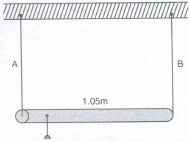
A rod of length 1.05 m having negligible mass is supported at its ends by two wires of steel (wire A) and aluminium (wire B) of equal lengths as shown in figure. The cross-sectional areas of wires A and Bare 1.0 mm? and 2.0 mm2, respectively. At what point along the rod should a mass m be suspended in order to produce (a) equal stresses and (b) equal strains in both steel and aluminium wires.
3.
What is the density of water at a depth where pressure is 80.0 atm, given that its density at the surface is 1.03 × 10³ kg m–3?
4.
Construction for metro line was carried out day and night. One night, when work was in full swing suddenly chain of the crane, lifting a heavy concrete block, snapped and it fell done. Immediately, people from nearby area came for help. They lifted the concrete block and saved many lives. Injured were transferred to hospital without waiting for police to arrive.
What of locals helped in saving lives?alues p
5.
Foucault Pendulum
In a physics department, Forcault pendulum consists of a 130 kg steel ball which swings at the end of a 8.0 m long steel cable having the diameter of 3.0 mm. If the ball was first hung from the cable, then setermine how much did the cable stretch?
6.
Volumetric Strain in a Cube
Consider a solid cube which is subjected to a pressure of 6 x 10⁵ N/m2. Due to this pressure, each side of the cube is shortened by 2 %. Find out the volumetric strain of the cube.
7.
How much should be pressure the a litre of water be changed to compress it by 0.10 %? Bulk modulus of elasticity of water = 2.2 x 10⁹ Nm-2.
8.
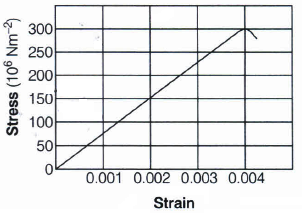
Figure shows the strain-stress curve for a given material. What are (a) Young’s modulus and (b) approximate yield strength for this material?
9.
A life is tied with thick wires and its mass is 1000 kg. If the maximum acceleration of its 1.2ms-2 and the maximum safe stress is 1.4 x 10⁸Nm-2, then find the minimum diameter of the wire. Take g = 9.8 ms-2
10.
A wire 50cm long and 1 sq mm is cross-section has the Young's modulus, Y = 2 x 10¹⁰Nm-2 . How much work is done in stretching the wire through 1 mm?
11.
What is Bulk modulud for a perfectly rigid body?
12.
What does the slope of stress versus strain graph indicate ?
13.
Which type of strain is there, when a spiral spring is stretched by a force ?
14.
Stress and pressure are both forces per unit area. Then, in what respect does stress differ from pressure ?
15.
A steel wire of length 4 m is stretched through 2 mm. The cross-section area of the wire is 2.0 mm2. If Young's modulus of steel is 2.0 x 10¹¹ N/m2, find
(i) the energy density of the wire and
(ii) the elastic potential energy stored in the wire.
16.
Read the following two statements below carefully and state, with reasons, if it is true or false.
(a) The Young’s modulus of rubber is greater than that of steel;
(b) The stretching of a coil is determined by its shear modulus.
17.
A uniform heavy rod of weight W, cross-sectional area A and length I is hanging from a fixed , support. Young's modulus of the material of the rod is Y. Neglecting the lateral contraction, find the elongation produced in the rod.
18.
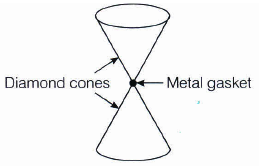
Anvils made of single crystals of diamond, with the shape as shown in figure are used to investigate the behaviour of materials under very high pressure. Flat faces at the narrow end of the anvil have a diameter of 0.50 mm and the wide en are subjected to a compressional force of 50000 N. What is the pressure at the tip of the anvil?
1.
Volume of wire
V = \(\pi\)r2L
∴ Density = \(\frac { mass }{ V } \)
9 x 103 = \(\frac { 31.4 }{ \pi r^{ 2 }\times L } \)
L = \(\frac { 3.14 }{ { \pi r }^{ 2 }\times 9\times 10^{ 3 } } \)
L = \(\frac { 31.4 }{ 3.14\times 10^{ -6 }\times 9\times 10^{ 3 } } \)
∴ L = \(\frac { 10 }{ 9 } \) x 103m
=\(\frac { { 10 }^{ 4 } }{ 9 } \)m
Now \(\Upsilon =\frac { mg\quad L }{ { \pi r }^{ 2 }l } \)
l = \(\frac { mg\quad L }{ { \pi r }^{ 2 }.\Upsilon } \)
=\(\frac { 3.14\times 9.8\times { 10 }^{ 4 } }{ 3.14\times 10^{ -6 }\times 9\times 9.8\times 10^{ 10 } } \)
= \(\frac { 10 }{ 9 } \)m
Now the work done =\(\frac { 1 }{ 2 } \)F.l
=\(\frac { 1 }{ 2 } \) x 3.14 x 9.8 x \(\frac { 10 }{ 9 } \)
75%of the work done is converted into heat energy
∴ Heat energy =\(\frac { 1 }{ 2 } \) x 31.4 x 9.8 x \(\frac { 10 }{ 9 } \times \frac { 75 }{ 100 } \)
But heat energy =mass x S.P. heat x temp difference
= 1.4 x 490 x t
∴ 31.4 x 490 x t = \(\frac { 1 }{ 2 } \) x31.4 x 9.8 x \(\frac { 10 }{ 9 } \times \frac { 75 }{ 100 } \)
∴ t = \(\frac { \frac { 1 }{ 2 } \times 3.14\times 9.8\times \frac { 10 }{ 9 } \times \frac { 75 }{ 100 } }{ 3.14\times 490 } \)
t = \(\frac { 1 }{ 120 } \)K or 0.00830C
2.
For steel wire A, l1 =I; Az = 1 mm2: \(\Upsilon \)1 = 2 x 10¹¹ Nm-2
For aluminium wire B, l2= I; A2 = 2mm2; \(\Upsilon \)2 = 7 x 10¹⁰ Nm-2
(a) Let mass m be suspended from the rod at distance x from the end where wire A is connected. Let F1 and F2 be the tensions in two wires and there is equal stress in two wires, then
\(\frac { { F }_{ 1 } }{ { A }_{ 1 } } =\frac { { F }_{ 2 } }{ { A }_{ 2 } } \Rightarrow \frac { { F }_{ 1 } }{ { F }_{ 2 } } =\frac { { A }_{ 1 } }{ { A }_{ 2 } } =\frac { 1 }{ 2 } \) ...(i)
Taking moment of forces about the point of suspension of mass from the rod, we have
F1x = F2(1.05 - x) or \(\frac { 1.05-x }{ x } =\frac { { F }_{ 1 } }{ F_{ 2 } } =\frac { 1 }{ 2 } \)
or 2.10-2x = x ⇒ x = 0.70 m = 70 cm
(b) Let mass m be suspended from the rod at distance x from the end where wire A is connected. Let F1 and F2 be the tension in the wires and there is equal strain in the two wires i.e.,
\(\frac { { F }_{ 1 } }{ { A }_{ 1 }{ \Upsilon }_{ 1 } } =\frac { F_{ 2 } }{ { A }_{ 2 }{ \Upsilon }_{ 2 } } \Rightarrow \frac { { F }_{ 1 } }{ { F }_{ 2 } } =\frac { { A }_{ 1 }{ \Upsilon }_{ 1 } }{ { A }_{ 2 }{ \Upsilon }_{ 2 } } =\frac { 1 }{ 2 } \times \frac { 2\times 10^{ 11 } }{ 7\times 10^{ 10 } } =\frac { 10 }{ 7 } \)
As the rod is stationary, so F1x = F2 (1.05 - x) or \(\frac { 1.05-x }{ x } =\frac { { F }_{ 1 } }{ { F }_{ 2 } } =\frac { 10 }{ 7 } \)
⇒ 10x = 7.35 - 7x or x = 0.4324 m
= 43.2 cm.
3.
Compressibility of water,
k =\(\frac{1}{B}\) = 45.8 x 10⁻¹¹ Pa-1
Change in pressure,
Δp = 80 atm - 1 atm
= 79 atm = 79 x 1.013 x 105 Pa.
\(\rho \)=1.03 x 10³ kg m-3
As B = \(\frac { \triangle p.V }{ \triangle V } \) or \(\frac { \triangle V }{ V } =\frac { \triangle p }{ B } =\triangle p\times \frac { 1 }{ B } \)=Δp x k
or \(\\ \frac { \triangle V }{ V } \)=\(\frac { \triangle V }{ V } =\frac { (M/\rho )-(M/\rho ') }{ (M/\rho ) } =1-\frac { \rho }{ { \rho }^{ ' } } \)
or \(\frac { \rho }{ { \rho }^{ ' } } =1-\frac { \triangle V }{ V } \)
or \({ \rho }^{ ' }=\frac { \rho }{ 1-(\triangle V/V) } \)
or \({ \rho }^{ ' }=\frac { 1.03\times 10^{ 3 } }{ 1-3.665\times 10^{ -3 } } =\frac { 1.03\times 10^{ 3 } }{ 0.996 } \)
= 1.034 x 10³ kg/m3.
4.
Quick reaction of locals and their help without waiting for police to arrive helped in saving lives.
5.
The amount by which the cable streches depends on the elascity of the steel cable. Young's Modulus for steel is given as Y = 20 x 108 N/m2
Given Diameter D = 3.0mm = 3.0 x 10⁻³m
Length, L = 8.0 m; Mass m = 130 kg
Radius \(r=\frac { D }{ 2 } =\frac { 3.0\times { 10 }^{ -3 } }{ 2 } =1.5\times { 10 }^{ -3 }m\)
The area of cross-section of the cable
\(A=\pi { r }^{ 2 }=\pi \times (1.5\times { 10 }^{ -3 })^{ 2 }=7.065\times { 10 }^{ -6 }{ m }^{ 2 }\)
Thus, F = w = mg =130 x 98
F = 1274 N
The change in length
\(Y=\frac { Stress }{ Strain } =\frac { F/A }{ \Delta L/L } \Rightarrow \Delta L=\frac { LF }{ AY }\)
\( \\ \Delta L=\frac { 8.0\times 1274 }{ 7.065\times { 10 }^{ -6 }\times 20\times { 10 }^{ 8 } } =0.72m=720mm\)
6.
Let L be the initial length of the each side of the cube.
Volume, V = L x L x L = L3
= initial volume (Vi say)
If the each side of the cube is shortened by 2 %, then final length of the cube
= L - 2 % of L
= \(\left( L-\frac { 2L }{ 100 } \right) \)
= L \(\left( 1-\frac { 2 }{ 100 } \right) \)
\(\therefore\) Final volume, Vf = L3 \(\left( 1-\frac { 2 }{ 100 } \right) ^{ 3 }\)
= V \(\left( 1-\frac { 2 }{ 100 } \right) ^{ 3 }\)
Change in volume, \(\Delta V\) = Vf - Vi = V\(\left( 1-\frac { 2 }{ 100 } \right) ^{ 3 }\) - V
= V \(\left[ \left( 1-\frac { 2 }{ 100 } \right) ^{ 3 }-1 \right] \)
\(\frac { \Delta V }{ V } \) = \(\left( 1-\frac { 2 }{ 100 } \right) ^{ 3 }\) - 1 = \(\left[ 1-\frac { 2\times 3 }{ 100 } \right] \) -1
( \(\because\) ( 1 - x )n \(\simeq \) 1 - nx for x <<1]
\(\therefore\) Volumetric strain = \(\frac { \Delta V }{ V } \) = 1 - 0.06 - 1 = 0.06 (take positive sign)
7.
V =1 litre = 10-3 m3; ΔV/V = 0.10/100 = 10-3
K = \(\frac { pV }{ \triangle V } \)
p = K\(\frac { pV }{ \triangle V } \) = (2.2 x 109) x 10-3 = 2.2 x 10⁶ Pa.
8.
(i) Young's modulus of the given material (Y) = Slope of strain-stress curve
Y = \(\frac { 150\times { 10 }^{ 6 } }{ 0.002 } =75\times { 10 }\) N/m2
= 7.5\(\times \)1010 N/m2
(ii) Yield strength of the given material = Maximum stress, the material can sustain
= 300 \(\times \) 106 N/m2 = 3 \(\times \) 108 N/m2
9.
0.01m
10.
2 x 10⁻²J
11.
Bulk modulus \((B)=\frac { p }{ \Delta V/V } =\frac { pV }{ \Delta V } \)
For perfectly rigid body, change in volume Δ V=0
\(B=\frac { pV }{ 0 } =\infty \)
Therefore, Bulk modulus for a perfectly rigd body is \(\infty \)
12.
The slope of stress (on y-axis) and strain (on x-acis) gives modulus of elasticity.
The Slope of stress (on x-axis) and strain (on y-axis) gives the reciprocal of modulus of elasticity.
13.
Longitudinal strain and shear strain.
14.
Pressure is an external force per unit area, while stress is the internal restoring force which comes into play in a deformed body acting transversely per unit area of body.
15.
(i) Energy density = \(\frac { 1 }{ 2 } \left( \frac { \Upsilon l }{ L } \right) .\frac { 1 }{ L } \)
=\(\frac { 1 }{ 2 } \left[ \frac { 2\times 10^{ 11 }\times 2\times { 10 }^{ -3 } }{ 4 } \right] \times \left[ \frac { 2\times 10^{ -3 } }{ 4 } \right] \)
=\(\frac { 1 }{ 2 } \) x 108 x \(\frac { 1 }{ 2 } \) x 10-3
= 0.25 x 105
= 2.5 x 10⁴ J/m3.
(ii) Potential energy stored in the wire
U = \(\frac { 1 }{ 2 } \left( \frac { \Upsilon Al }{ L } \right) .l\)
= \(\frac { 1 }{ 2 } \left[ \frac { 2\times { 10 }^{ 11 }\times 2\times 10^{ -6 }\times 2\times 10^{ -3 } }{ 4 } \right] \) x 2 x 10-3
= 102 x 2 x 10-3
= 0.2 J.
16.
(a) False. The Young's modulus is defined as the ratio of stress to the strain within elastic limit. For a given stretching force elongation is more in rubber and quite less in steel. Hence, rubber is less elastic than steel.
(b) True. Stretching of a coil is determined by its shear modulus. When equal and opposite forces are applied at opposite ends of a coil, the distance as well as shape of helicals of the coil change and it involves shear modulus.
17.
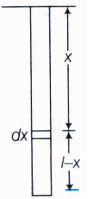
As shown in figure, consider a small element of thickness dx at distance x from the fixed support. Force acting on the element dx is
F = Weight of length (l- x) of the rod
= \(\frac { W }{ l } \)(l-x)
Elongation of the element = Original length \(\times \)\(\frac { Stress }{ Y } \)
= \(dx\times \frac { F/A }{ Y } =\frac { W }{ l\quad Ay } (l-x)dx\)
Total elongation produced in the rod = \(\frac { W }{ l\quad Ay } \int _{ 0 }^{ l }{ (l-x)dx } =\frac { W }{ l\quad Ay } { \left[ lx-\frac { { x }^{ 2 } }{ 2 } \right] }_{ 0 }^{ l }\)
= \(\frac { W }{ l\quad Ay } \left[ { l }^{ 2 }-\frac { { l }^{ 2 } }{ 2 } \right] =\frac { W }{ 2Ay } \)
18.
Given, compressional force, F = 50000 N
Diameter, D = 0.5 mm = 5\(\times \)10-4 m
Radius, r = \(\frac { D }{ 2 } \) = 2.5 \(\times \)10-4m
Pressure at the tip of the anvil (p) = \(\frac { Force }{ Area } \)
\( p=\frac { F }{ \pi { r }^{ 2 } } =\frac { 50000 }{ { \left( 2.5\times { 10 }^{ -4 } \right) }^{ 2 } } \)
= 2.5 \(\times \)1011 Pa.

11th Standard CBSE Syllabus & Materials
11th Standard CBSE
CBSE 11th Business Studies Forms of Business Organisation Sample Question Papers Study Material - QB365 Set A
NEW11th Standard CBSE
CBSE 11th Business Studies Business, Trade and Commerce Sample Question Papers Study Material - QB365 Set A
NEW11th Standard CBSE
CBSE 11th Physics Waves Sample Question Papers Study Material - QB365 Set A
NEW11th Standard CBSE
CBSE 11th Physics Kinetic Theory Sample Question Papers Study Material - QB365 Set A



CBSE 11th Standard CBSE Subjects
CBSE Standards









