
 100% FREE ACCESS
11th Standard CBSE Syllabus & Materials
11th Standard CBSE
CBSE 11th Economics PART-A - Presentation of Data - New Sample Question Papers Study Material - QB365 Set A
NEW11th Standard CBSE
CBSE 11th Economics PART-A - Organisation of Data - New Sample Question Papers Study Material - QB365 Set A
NEW11th Standard CBSE
CBSE 11th Economics PART-A - Collection of Data - New Sample Question Papers Study Material - QB365 Set A
NEW11th Standard CBSE
CBSE 11th Economics PART-A - Introduction to Economics and Statistics - New Sample Question Papers Study Material - QB365 Set A
NEW11th Standard CBSE
CBSE 11th Business Studies International Trade Sample Question Papers Study Material - QB365 Set A
NEW11th Standard CBSE
CBSE 11th Business Studies Evolution and Fundamentals of Business Sample Question Papers Study Material - QB365 Set A

Published on: 05/10/2019
Mechanical Properties of Solids
Download CBSE Class 11th Standard CBSE Physics question papers, sample papers, important questions, and previous year solved papers in PDF format. Get free study materials, NCERT solutions, and exam preparation resources for Class 11th Standard CBSE Physics
Questions + Answers key
Take MCQ Physics Test
1.
A boy's catapult is made of a rubber cord 42 cm long and 6 mm in diameter. The boy stretches the cord by 20 cm. Find the Young's modulus of the rubber if a stone weighing 0.02 kg when catapulated flies with a velocity of 20 ms-1. Disregard the change in the cross-section of the cord in stretching.
2.
Define the following terms:
(i) elastic limit
(ii) elastic fatigue
(iii) breaking stress
A steel wire of cross-sectional area 0.5 mm2 is held between two fixed supports. If the tension in the wire is negligible and it is just taut at a temperature of 20°C, determine the tension when the temperature falls to O°C. Young's modulus of steel is 21 x 1011 dyne cm-2 and the coefficient of linear expansion of steel is 12 x 10-6 per 0C. Assume that the distance between the supports remains unchanged.
3.
State Hooke's law. Define Young's modulus of elasticity. A wire loaded by a weight of density 7.6 g cm-3 is found to measure 90 cm. On immersing the weight in water, the length decreased by 0.18 cm. Find the original length of wire.
4.
What do you understand by Poisson's ratio? Find the value of Poisson's ratio at which the volume of a wire does not change when the wire is subjected to a tension.
5.
Show that work done by a stretching force to produce certain extension in the wire is W=\(\frac{1}{2}\) stretching force x extension. A wire that obeys Hooke's law is of length l1 when it is in equilibrium under a tension F1. Its length becomes l2 when the tension is increased to F2. Calculate the energy stored in the wire during this process.
6.
The edge of an aluminium cube is 10 cm long. One face of the cube is firmly fixed to a vertical wall. A mass of 100 kg is then attached to the opposite face of the cube. The shear modulus of aluminium is 25 GPa. What is the vertical deflection of this face?
7.
Volumetric Analysis
What will be the decrease in vloume of 100 cm3 of water under pressure of 100 atm if the compressibility of water is 4 x 10⁻⁵ per unit atmospheric pressure?
8.
Elongation of Copper Wire
A copper wire is streched by 10 N force. If radius of wire decreases by 2%. How will Young's modulus of wire be affected?
9.
An Elongated Wire
If a wire of length 4 m and crosssectional area of 2m2 is stretched by a force of 3 KN, then determine the change in length due to this force. Given Young's modulus of material of wire 110 x 109 N/m2.
10.
A Cubical Body Gets Deformed
If the angle of shear is 30\(^0\) for a cubical body and the change in length is 250 cm, then what must be the volume of this cubical body ?
11.
Shear Modulus is Less than Young's Modulus
The shear modulus of a material is always considerably smaller than the Young's modulus for it. What does it signify?
1.
Due to extension produced in the cord, energy is stored in it which is converted into kinetic energy when the stone flies away. Assuming that there is no loss of energy in this process, the kinetic energy of the stone is given by
W = \(\frac{1}{2}\)mv2 = 4J
This must be equal to the work done in stretching the cord.
Using the equation.
W = \(\frac{1}{2}\)FΔl = 4J
Where F is the stretching force. Since
Δl = 20 cm = 0.2 m
F= \(\frac { 4\times 2 }{ 0.2 } \)= 40 N
Stress = \(\frac { F }{ A } =\frac { 40 }{ { \pi r }^{ 2 } } \)
Now, r = 3 mm = 3 x 10⁻³ m
Hence, Stress = \(\frac { 40 }{ \pi (3\times 10^{ - })^{ 2 } } \)=1.415 x 10⁶ Nm-2
But Strain = \(\frac { 20 }{ 42 } \)=0.476
Young's modulus = \(\Upsilon =\frac { 1.415\times { 10 }^{ 6 } }{ 0.476 } \)
= 2.97 x 10⁶ Nm-2.
2.
Numerical: Let I be the length of the wire at 20°C and ley the length at O°C. Then
l-l0 = ∝l0 ΔT = 20 ∝.l0
Compressive strain =\(\frac { l-{ l }_{ 0 } }{ { l }_{ 0 } } \) =20∝ = 20 x 12 x 10-6 = 2.4 x 10⁻⁴
\(\Upsilon \)= \(\frac { Stress }{ Strain } \)
Stress = \(\Upsilon \) x strain = \(\frac{F}{A}\)
Hence, tension T=\(\Upsilon \)A x Strain
= 21 x 1011 x 0.5 x 10-2 x 2.4 x10-4
= 2.52 x 10⁶ dyne
= 25.2 N
This is the tension in the wire when the temperature falls to O°C.
3.
For Hooke's law and Young's modulus of elasticity, see fact that matter on pages 386-387 of this text book.
Let L be the original length of the wire, A be its .area of cross-section and W be the load attached to the wire. Then, Young's modulus of the wire is given by
Y = \(\frac { W\times L }{ A\times \triangle L } \)
Since ΔL = 90-L
∴ \(\Upsilon =\frac { W\times L }{ A(90-L) } \) ......(1)
Volume of weight attached = \(\frac { W }{ density\quad of\quad weight } \)
= \(\frac { W }{ 7.6 } \)cm3
Weight of water displaced = \(\frac { W }{ 7.6 } \) x density of water
\(\frac { W }{ 7.6 } \times 1=\frac { W }{ 7.6 } \)
∴ Net weight after immersing in water is
W'=W-\(\frac { W }{ 7.6 } =\frac { 6.6W }{ 7.6 } \)
Length of wire after immersing in water
= (90 - 0.18) = 89.82 cm
∴ Change in length on immersing in water,
ΔL'=(89.82-L)cm
∴ \(\Upsilon \)=\(\frac { W'L }{ A\triangle L' } \)
= \(\frac { 6.6W\times L }{ 7.6\times A(89.82-L) } \) ....(2)
Comparing eqns. (1) and (2), we get
\(\frac { W\times L }{ A(90-L) } =\frac { 6.6W\times L }{ 7.6\times A\times (89.82-L) } \)
7.6 x (89.82-L) = 6.6 (90-L)
682.632-7.6L = 594-6.6L
∴ L = 88.632 cm
4.
For Poisson's ratio, see text.
Poisson's ratio
where r is the radius of the wire and l its length.
Volume of the wire before expansion V1
Volume of the wire after expansion
V2 = \(\pi\)(r-Δr)2(l+Δl)
If the volume is to remain unchanged during expansion, we require that
V1 = V2, i.e.,
\(\pi\)r2l = \(\pi\)[r2-2r Δr + (Δr)2](l+Δl)
= \(\pi\)r2(l+Δl)-2\(\pi\)r Δrl-2r Δr Δl \(\pi\) + (Δr)2(l+Δl)\(\pi\)
or 2\(\pi\)r Δrl =\(\pi\)r2 Δl + terms containing the product of Δr and Δl, which can be neglected.
Hence \(\frac { \triangle r/r }{ \triangle l/l } =\frac { 1 }{ 2 } \)
or σ = 0.5
Thus the volume of the wire does not change if the Poisson's ratio of the material of the wire is 0.5.
5.
Consider a wire of length L and area of crosssection A. Let a force F be applied to stretch the wire (Fig. a). If Ibe the length through which the wire is stretched, then
Longitudinal strain = \(\frac{l}{L}\)
and tensile stress = \(\frac{F}{A}\)
∴ Young's modulus of elasticity,
\(\Upsilon =\frac { stress }{ strain } =\frac { F/A }{ l/L } =\frac { FL }{ Al } \)
⇒ F= \(\frac { \Upsilon Al }{ L } \) ......(i)
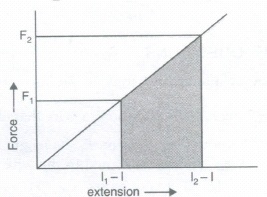
If the wire is stretched through a length dl, then work done is given by
dW = Fdl = \(\frac { \Upsilon Al }{ L } \)dl .....(ii)
∴ Total work done to stretch the wire through length l can be calculated by integrating
eqn. (ii) between the limits l=0 to ml=l
i.e., \(\int { dW } =\int _{ 0 }^{ 1 }{ \frac { \Upsilon A }{ L } } \)
⇒ W= \(\frac { \Upsilon A }{ L } \frac { { l }^{ 2 } }{ 2 } =\frac { 1 }{ 2 } \left( \frac { \Upsilon Al }{ L } \right) \times l\)
or W = \(\frac{1}{2}\)F x l
[F = \(\frac { \Upsilon Al }{ L } \) , from eqn. (i)]
Numerical:
Hence, work done =\(\frac{1}{2}\) stretching force x extension
W1 = \(\frac{1}{2}\)F1(l1-l) and W2=\(\frac{1}{2}\)F2(l2-l)
U = W2-W1=\(\frac{1}{2}\)F2(l2-l)-\(\frac{1}{2}\)F1(l1-l)
= \(\frac{1}{2}\)[F2l2-F1l1+(F1-F2)l] .....(i)
Now, \(\frac { { F }_{ 1 } }{ { F }_{ 2 } } =\frac { { l }_{ 1 }-l }{ { l }_{ 2 }-l } \) or F1l1-F1l=F2l1-F2l
or (F2-F1)=F2l1-F1l2
⇒ l = \(\frac { { F }_{ 2 }{ l }_{ 1 }-{ F }_{ 1 }{ l }_{ 2 } }{ { F }_{ 2 }-{ F }_{ 1 } } \)
From eqn. (i)
U=\(\frac{1}{2}\)[F2l2-F1l1+(F1-F2)\(\frac { { F }_{ 2 }{ l }_{ 1 }-{ F }_{ 1 }{ l }_{ 2 } }{ { F }_{ 2 }-{ F }_{ 1 } } \)]
= \(\frac{1}{2}\)[F2l2-F1l1-F2l1+F1l2]
= \(\frac{1}{2}\)[(F2+F1)l2-(F2+F1)l1]
U = \(\frac{1}{2}\)(F2+F1)(l2-l1).
6.
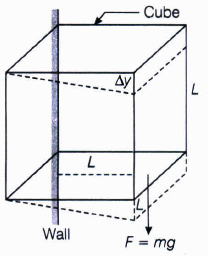
Given, side of a cube (l) = 10 cm = 0.1 m
Area of its each face (A) = l2 = (0.1)2 = 0.01 m2
Load(m) = 100 kg
Tangential force acting on one face of the cube, F = mg = 100\(\times \) 9.8 =980 N
Shear stress acting on this face = \(\frac { F }{ A } \) = \(\frac { 980 }{ 0.01 } \) N/m2
= 9.8 \(\times \)104 N/m2
Shear modulus of aluminium (\(\eta \)) = 25 GPa
= 25\(\times \) 109 N/m2
Shear modulus (\(\eta \))=\(\frac { Shearing\ stress }{ Shearing\ strain } \)
or shearing strain \(\left( \frac { \Delta L }{ L } \right) \) = \(\frac { Shearing\ stress }{ Shear\ modulus } \)
or \(\Delta L\) = \(\frac { Shearing\ stress }{ Shear\ modulus } \) \(\times \) L = \(\frac { 9.8\times { 10 }^{ 4 } }{ 25\times { 10 }^{ 9 } } \)\(\times \) 0.1
= 0.0392 \(\times \)10-5m
= 3.92 \(\times \) 10-7m
7.
Bulk modulus(B)\(=\frac { 1 }{ Compressibility } =\frac { 1 }{ k } \)
\(=0.25\times { 10 }^{ 5 }\times 1.013\times { 10 }^{ 5 }\ N/m^{ 2 }\)
\(\\=2.533\times { 10 }^{ -4 }{ m }^{ 3 }\)
\(\\ Volume,V\ =100cm^{ 3 }=10^{ -4 }m^{ 3 }\)
\(\\ Pressure,P=100\ atm=100\times 1.013\times { 10 }^{ 5 }\ N/m^{ 2 }\)
\(\\ =1.013\times { 10 }^{ 5 }N/m^{ 2 }\)
\(\\ Now\quad apply\frac { 1 }{ B } =k=\frac { \Delta V }{ pV } \)
\(\\ \therefore \Delta V=\frac { pV }{ B } =\frac { 1.013\times { 10 }^{ 7 }\times { 10 }^{ -4 } }{ 2.533\times { 10 }^{ 9 } } \)
\( \Delta V=0.4\times { 10 }^{ -6 }{ m }^{ 3 }=0.4{ cm }^{ 3 }\)
8.
Since, Young's modulus depends only on the nature of material and not on ita dimensions. So, the value of Young's modulud of the copper wire is not changed when its radius decreases. Thus , Young's modulus of the wire remains the same.
9.
Given area of cross section A = 2m2
Force F = 3kN = 3 x 10³ N
Length L = 4m
Young's modulus Y = 110 x 109 N/m2
Change in length, \(\Delta L=?\)
Apply, \(Y=\frac { FL }{ A\Delta L } \)
\(\Rightarrow \Delta L=\frac { Fl }{ AY } =\frac { 3\times { 10 }^{ 3 }\times 4 }{ 2\times 110\times { 10 }^{ 9 } } =0.0545\times { 10 }^{ -6 }m\)
\( \Delta L=54.5\times 10^{ -3 }mm\)
10.
Given, angle of shear = 30\(^0\) and change in length \(\Delta L\) = 250 cm = 2.5 m
\(\therefore\) Shear strain, tan \(\theta \) = \(\frac { \Delta L }{ L } \) \(\Longrightarrow \) tan 30\(^0\) = \(\frac { 2.5 }{ L } \)
L = \(\frac { 2.5 }{ tan30^{ 0 } } \) = \(\frac { 2.5 }{ 0.577 } \) = 4.332 m
Volume, V = L3 = 81.309 m3
11.
\(\eta \) of material is smaller than its Y. As,we know that it is easier to slide layers of atome of solids over one another than to pull them apart or to squeeze them to close together.

11th Standard CBSE Syllabus & Materials
11th Standard CBSE
CBSE 11th Business Studies Forms of Business Organisation Sample Question Papers Study Material - QB365 Set A
NEW11th Standard CBSE
CBSE 11th Business Studies Business, Trade and Commerce Sample Question Papers Study Material - QB365 Set A
NEW11th Standard CBSE
CBSE 11th Physics Waves Sample Question Papers Study Material - QB365 Set A
NEW11th Standard CBSE
CBSE 11th Physics Kinetic Theory Sample Question Papers Study Material - QB365 Set A



CBSE 11th Standard CBSE Subjects
CBSE Standards









