
 100% FREE ACCESS
11th Standard CBSE Syllabus & Materials
11th Standard CBSE
CBSE 11th Economics PART-A - Presentation of Data - New Sample Question Papers Study Material - QB365 Set A
NEW11th Standard CBSE
CBSE 11th Economics PART-A - Organisation of Data - New Sample Question Papers Study Material - QB365 Set A
NEW11th Standard CBSE
CBSE 11th Economics PART-A - Collection of Data - New Sample Question Papers Study Material - QB365 Set A
NEW11th Standard CBSE
CBSE 11th Economics PART-A - Introduction to Economics and Statistics - New Sample Question Papers Study Material - QB365 Set A
NEW11th Standard CBSE
CBSE 11th Business Studies International Trade Sample Question Papers Study Material - QB365 Set A
NEW11th Standard CBSE
CBSE 11th Business Studies Evolution and Fundamentals of Business Sample Question Papers Study Material - QB365 Set A

Published on: 04/12/2019
Mechanical Properties of Solids
Download CBSE Class 11th Standard CBSE Physics question papers, sample papers, important questions, and previous year solved papers in PDF format. Get free study materials, NCERT solutions, and exam preparation resources for Class 11th Standard CBSE Physics
Questions + Answers key
Take MCQ Physics Test
1.
A load of 31.4 kg is suspended from a wire of radius 10-3 m and density 9 x 10³ kg/m3. Calculate the change in temperature of the wire if 75% of the work done is converted into heat. The Young's modulus and the specific heat capacity of the material of the wire are 9.8 x 10¹⁰ N/m2 and 490 J/kg/k respectively.
2.
The edge of an aluminium cube is 10 cm long. One face of the cube is firmly fixed to a vertical wall. A mass of 100 kg is then attached to the opposite face of the cube. The shear modulus of aluminium is 25 GPa. What is the vertical deflection of this face?
3.
Volumetric Analysis
What will be the decrease in vloume of 100 cm3 of water under pressure of 100 atm if the compressibility of water is 4 x 10⁻⁵ per unit atmospheric pressure?
4.
Percentage Strain in Rod
Consider a steel rod having radius of 8 mm and the length of 2m. If a force of 150 kN stretches it along its length, then calculate the stress, percentage strain in the rod if the elongation in length is 7.46 mm.
5.
The bulk modulus of water is 2.3 x 10⁹ Nm-2. Find its compressibility. How much pressure in atmosphere is needed to compress a sample of water by 0.1 %. Take 1 atmosphere pressure = 1.01 x 10 Nm-2.
6.
A steel ring of radius r and cross-section area A is fitted onto a wooden disc of radius R (R> r). If Young's modulus be E, find the force with which the steel ring is expanded.
7.
What are ductile materials?
8.
Two wires made of same material are subjected to forces in the ratio 1 : 4. Their lengths are in the ratio 2 : 1 and diameters in the ratio 1 : 3. What is the ratio of their extensions ?
9.
A square lead slab of side 50 cm and thickness 10 cm is subjected to a shearing force (on its narrow edge) of 9.0 x 10⁴ N. The lower edge is reveted to the floor. How much will the upper edge be displaced? Modulus of rigidity of lead = 5.6 x 10⁹ N/m2
10.
A uniform pressure P is exerted on all sides of a solid cube. It is heated through t0C in order to bring its volume back to the value it had before the application of pressure. Find the value of t.
11.
Elasticity is said to be internal property of matter. Explain.
12.
A uniform heavy rod of weight W, cross-sectional area A and length I is hanging from a fixed , support. Young's modulus of the material of the rod is Y. Neglecting the lateral contraction, find the elongation produced in the rod.
13.
Anvils made of single crystals of diamond, with the shape as shown in figure are used to investigate the behaviour of materials under very high pressure. Flat faces at the narrow end of the anvil have a diameter of 0.50 mm and the wide en are subjected to a compressional force of 50000 N. What is the pressure at the tip of the anvil?
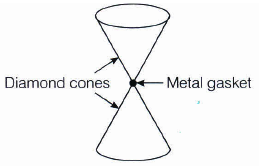
14.
Determine the volume contraction of a solid copper cube, 10cm on an edge, when subjected to a hydraulic pressure of 7 x 10⁶ Pa. Bulk modulus for copper = 140 x 109 Pa.
15.
Young's modulus of a wire depends on
its material
its length
its area of cross-section
both (b) and (c)
16.
A spring of force constant k is cut into two equal parts. The force constant of each part is
k/2
k
2k
4k
17.
A wire suspended vertically from one end, is stretched by attaching a weight 200 N to the lower end. The weight stretches the wire by 1 mm. The energy gained by the wire is
0.1 J
0.2 J
0.4 J
4 k
18.
Which of the following is not a unit of Young's modulus?
Nm-2
Mega Pascal (MPa)
dyne cm-2
Nm-1
19.
Elastic limit is equal to
Young's modulus
Modulus of rigidity
stress
strain
20.
Young's modulus of a material has the same unit as
stress
energy
compressibility
pressure
21.
Dimensional formula of stress is same as that of
impulse
strain
force
pressure
1.
Volume of wire
V = \(\pi\)r2L
∴ Density = \(\frac { mass }{ V } \)
9 x 103 = \(\frac { 31.4 }{ \pi r^{ 2 }\times L } \)
L = \(\frac { 3.14 }{ { \pi r }^{ 2 }\times 9\times 10^{ 3 } } \)
L = \(\frac { 31.4 }{ 3.14\times 10^{ -6 }\times 9\times 10^{ 3 } } \)
∴ L = \(\frac { 10 }{ 9 } \) x 103m
=\(\frac { { 10 }^{ 4 } }{ 9 } \)m
Now \(\Upsilon =\frac { mg\quad L }{ { \pi r }^{ 2 }l } \)
l = \(\frac { mg\quad L }{ { \pi r }^{ 2 }.\Upsilon } \)
=\(\frac { 3.14\times 9.8\times { 10 }^{ 4 } }{ 3.14\times 10^{ -6 }\times 9\times 9.8\times 10^{ 10 } } \)
= \(\frac { 10 }{ 9 } \)m
Now the work done =\(\frac { 1 }{ 2 } \)F.l
=\(\frac { 1 }{ 2 } \) x 3.14 x 9.8 x \(\frac { 10 }{ 9 } \)
75%of the work done is converted into heat energy
∴ Heat energy =\(\frac { 1 }{ 2 } \) x 31.4 x 9.8 x \(\frac { 10 }{ 9 } \times \frac { 75 }{ 100 } \)
But heat energy =mass x S.P. heat x temp difference
= 1.4 x 490 x t
∴ 31.4 x 490 x t = \(\frac { 1 }{ 2 } \) x31.4 x 9.8 x \(\frac { 10 }{ 9 } \times \frac { 75 }{ 100 } \)
∴ t = \(\frac { \frac { 1 }{ 2 } \times 3.14\times 9.8\times \frac { 10 }{ 9 } \times \frac { 75 }{ 100 } }{ 3.14\times 490 } \)
t = \(\frac { 1 }{ 120 } \)K or 0.00830C
2.
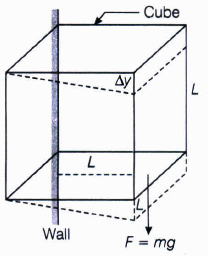
Given, side of a cube (l) = 10 cm = 0.1 m
Area of its each face (A) = l2 = (0.1)2 = 0.01 m2
Load(m) = 100 kg
Tangential force acting on one face of the cube, F = mg = 100\(\times \) 9.8 =980 N
Shear stress acting on this face = \(\frac { F }{ A } \) = \(\frac { 980 }{ 0.01 } \) N/m2
= 9.8 \(\times \)104 N/m2
Shear modulus of aluminium (\(\eta \)) = 25 GPa
= 25\(\times \) 109 N/m2
Shear modulus (\(\eta \))=\(\frac { Shearing\ stress }{ Shearing\ strain } \)
or shearing strain \(\left( \frac { \Delta L }{ L } \right) \) = \(\frac { Shearing\ stress }{ Shear\ modulus } \)
or \(\Delta L\) = \(\frac { Shearing\ stress }{ Shear\ modulus } \) \(\times \) L = \(\frac { 9.8\times { 10 }^{ 4 } }{ 25\times { 10 }^{ 9 } } \)\(\times \) 0.1
= 0.0392 \(\times \)10-5m
= 3.92 \(\times \) 10-7m
3.
Bulk modulus(B)\(=\frac { 1 }{ Compressibility } =\frac { 1 }{ k } \)
\(=0.25\times { 10 }^{ 5 }\times 1.013\times { 10 }^{ 5 }\ N/m^{ 2 }\)
\(\\=2.533\times { 10 }^{ -4 }{ m }^{ 3 }\)
\(\\ Volume,V\ =100cm^{ 3 }=10^{ -4 }m^{ 3 }\)
\(\\ Pressure,P=100\ atm=100\times 1.013\times { 10 }^{ 5 }\ N/m^{ 2 }\)
\(\\ =1.013\times { 10 }^{ 5 }N/m^{ 2 }\)
\(\\ Now\quad apply\frac { 1 }{ B } =k=\frac { \Delta V }{ pV } \)
\(\\ \therefore \Delta V=\frac { pV }{ B } =\frac { 1.013\times { 10 }^{ 7 }\times { 10 }^{ -4 } }{ 2.533\times { 10 }^{ 9 } } \)
\( \Delta V=0.4\times { 10 }^{ -6 }{ m }^{ 3 }=0.4{ cm }^{ 3 }\)
4.
If the rod stretches along its length, then the stress produced is the tensile stress whereas the strain produced is longitudinal strain.
Radius, r = 8 mm = 8 x 10⁻³ m,
Length, L = 2 m
Force, F = 150 kN = 15 x 104 N
Area, A = \(\pi \) r2 = \(\pi \) x ( 8 x 10⁻³)2 = 201 x 10-6 m2
\(\Delta \) L = 7.46 mm = 7.46 x 10⁻³ m, Percentage strain = ?
Stress = \(\frac { F }{ A } \) = \(\frac { 15\times { 10 }^{ 4 } }{ 201\times { 10 }^{ -6 } } \) = 0.0746 x 10¹⁰ N/m2
= 7.46 x 10⁸ N/m2
Longitudinal strain = \(\frac { \Delta L }{ L } \) = \(\frac { 7.46\times { 10 }^{ -3 } }{ 2 } \) = 3.73 x 10⁻³
Percentage strain = 3.73 x 10-3 x 100 = 0.37 %
5.
Here B = 2.3 x 10⁹ Nm-2 = \(\frac { 2.3\times { 10 }^{ 9 } }{ 1.01\times { 10 }^{ 5 } } \) atmosphere = 2.27 x 10⁴ atmosphere
(a) ∴ Compressibility k =\(\frac { 1 }{ B } =\frac { 1 }{ 2.27\times 10^{ 4 } } \) = 4.4 x 10⁻⁴ atm-1
(b) As \(\frac { \triangle V }{ V } \) = -0.1% = -\(\frac { 0.1 }{ 100 } \) = -0.001
∴ Increase in pressure p=B\(\left( -\frac { \triangle V }{ V } \right) \) = 2.27 x 104 x 0.001 = 22.7 atm.
6.
Original length, 1 = 2 \(\pi\) r; Extension, Δl = 2 \(\pi\)r = 2\(\pi\)(R - r)
Strain = \(\frac { \triangle l }{ l } =\frac { \pi (R-r) }{ 2\pi r } =\frac { R-r }{ r } \)
Young's modulus, E= \(\frac { F/A }{ (R-r)/r } \) or F = EA\(\left( \frac { R-r }{ r } \right) \).
7.
The material whose plastic range is comparatively large.
8.
According to Hooke's law,
Modulus of elasticity, E = \(\frac { F }{ \pi { r }^{ 2 } } \times \frac { l }{ \Delta l } \)
or \(\Delta l=\frac { Fl }{ \pi { r }^{ 2 }E } \)
or \(\Delta l\propto \frac { Fl }{ { r }^{ 2 } } \) [ \(\because\) E is same for two wires]
\(\therefore\) \(\frac { \Delta { l }_{ 1 } }{ \Delta { l }_{ 2 } } =\frac { { F }_{ 1 } }{ { F }_{ 2 } } \times \frac { { l }_{ 1 } }{ { l }_{ 2 } } \times \frac { { r }_{ 2 }^{ 2 } }{ { r }_{ 1 }^{ 2 } } \)
= \(\frac { 1 }{ 4 } \times \frac { 2 }{ 1 } \times \left( \frac { 3 }{ 1 } \right) ^{ 2 }=\frac { 9 }{ 2 } \)
So, \(\Delta { l }_{ 1 }\quad :\Delta { l }_{ 2 }\)
= 9 : 2
9.
Given,
L=50 cm=50×10−2 m
t=10 cm=10×10−2 m
G=5.6×10⁹ Pa
F=9.0×10⁴ N
Area of the face on which force is applied,
A=50×10=500 cm2=0.05 m2
Let ΔL be the displacement of the upper edge of the slab, due to tangential force F applied.
\( \text { Then, } G=\frac{\left(\frac{F}{A}\right)}{\left(\frac{\Delta L}{L}\right)} \)
\( \Rightarrow \Delta L=\frac{F L}{G A}=\frac{9 \times 10^4 \times 50 \times 10^{-2}}{5.6 \times 10^9 \times 0.05} \)
\( \therefore \Delta L=1.6 \times 10^{-4} \mathrm{~m}
\)
10.
Let \(\gamma \) = coefficient of cubical expansion of the cube.
Let K be bulk modulus of elasticity of its material.
V = initial volume,
P = pressure applied
ΔV = Decrease in its volume
∴ By definiton, K = \(\frac { P }{ \frac { \triangle V }{ V } } \)
or ΔV = \(\frac { PV }{ K } \)
Also ΔV ∝ V
∝ t
or ΔV = \(\gamma \) V x t = \(\gamma \)Vt
where t = rise in its temperature so as to increase the volume by ΔV s.t. it is brought back to its initial volume.
∴ From (i) and (ii), we get
\(\frac { PV }{ K } \)= \(\gamma \)Vt
or t = \(\frac { PV }{ K\gamma V } =\frac { P }{ \gamma K } \) .
11.
When a deforming force acts on a body, the atoms of the substance get displaced from their original positions. Due to this, the configuration of the body (substance) changes. The moment, the deforming force is removed, the atoms return to their original positions and hence the substance or body regains its original configuration. That is why, elasticity is said to be internal property of matter.
12.
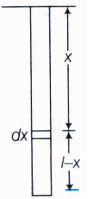
As shown in figure, consider a small element of thickness dx at distance x from the fixed support. Force acting on the element dx is
F = Weight of length (l- x) of the rod
= \(\frac { W }{ l } \)(l-x)
Elongation of the element = Original length \(\times \)\(\frac { Stress }{ Y } \)
= \(dx\times \frac { F/A }{ Y } =\frac { W }{ l\quad Ay } (l-x)dx\)
Total elongation produced in the rod = \(\frac { W }{ l\quad Ay } \int _{ 0 }^{ l }{ (l-x)dx } =\frac { W }{ l\quad Ay } { \left[ lx-\frac { { x }^{ 2 } }{ 2 } \right] }_{ 0 }^{ l }\)
= \(\frac { W }{ l\quad Ay } \left[ { l }^{ 2 }-\frac { { l }^{ 2 } }{ 2 } \right] =\frac { W }{ 2Ay } \)
13.
Given, compressional force, F = 50000 N
Diameter, D = 0.5 mm = 5\(\times \)10-4 m
Radius, r = \(\frac { D }{ 2 } \) = 2.5 \(\times \)10-4m
Pressure at the tip of the anvil (p) = \(\frac { Force }{ Area } \)
\( p=\frac { F }{ \pi { r }^{ 2 } } =\frac { 50000 }{ { \left( 2.5\times { 10 }^{ -4 } \right) }^{ 2 } } \)
= 2.5 \(\times \)1011 Pa.
14.
Given, each side of cube()=10cm=0.1m
Hydralic pressure (p)=7×10⁶ Pa
Bulk modulus for copper(B)=140×109 Pa
Volume contraction(△V)=?|
Volume of the cube(V)=I3=(0.1)3=1×10⁻³m3
Bulk modulus for copper(B) \(=\frac { p }{ \triangle V/V } \)
\(\\ \triangle V=\frac { pV }{ B }\)
\( \\ \triangle V=\frac { 7\times 10^{ 6 }\times 1\times 10^{ -3 } }{ 140\times 10^{ 9 } } =\frac { 1 }{ 20 } \times 10^{ -6 }m^{ 3 }\)
\(\\ =0.05\times 10^{ -6 }m^{ 3 }=5\times 10^{ -8 }m^{ 3 }\)
15.
(a)
its material
16.
(c)
2k
17.
(a)
0.1 J
18.
(d)
Nm-1
19.
(c)
stress
20.
(a)
stress
21.
(d)
pressure

11th Standard CBSE Syllabus & Materials
11th Standard CBSE
CBSE 11th Business Studies Forms of Business Organisation Sample Question Papers Study Material - QB365 Set A
NEW11th Standard CBSE
CBSE 11th Business Studies Business, Trade and Commerce Sample Question Papers Study Material - QB365 Set A
NEW11th Standard CBSE
CBSE 11th Physics Waves Sample Question Papers Study Material - QB365 Set A
NEW11th Standard CBSE
CBSE 11th Physics Kinetic Theory Sample Question Papers Study Material - QB365 Set A



CBSE 11th Standard CBSE Subjects
CBSE Standards









