
 100% FREE ACCESS
11th Standard CBSE Syllabus & Materials
11th Standard CBSE
CBSE 11th Economics PART-A - Presentation of Data - New Sample Question Papers Study Material - QB365 Set A
NEW11th Standard CBSE
CBSE 11th Economics PART-A - Organisation of Data - New Sample Question Papers Study Material - QB365 Set A
NEW11th Standard CBSE
CBSE 11th Economics PART-A - Collection of Data - New Sample Question Papers Study Material - QB365 Set A
NEW11th Standard CBSE
CBSE 11th Economics PART-A - Introduction to Economics and Statistics - New Sample Question Papers Study Material - QB365 Set A
NEW11th Standard CBSE
CBSE 11th Business Studies International Trade Sample Question Papers Study Material - QB365 Set A
NEW11th Standard CBSE
CBSE 11th Business Studies Evolution and Fundamentals of Business Sample Question Papers Study Material - QB365 Set A

Published on: 30/09/2019
Motion in a Plane
Download CBSE Class 11th Standard CBSE Physics question papers, sample papers, important questions, and previous year solved papers in PDF format. Get free study materials, NCERT solutions, and exam preparation resources for Class 11th Standard CBSE Physics
Questions + Answers key
Take MCQ Physics Test
1.
A projectile, launched with a speed v at an angle \(\theta\) to the horizontal, hits a plane inclined at an angle a to the horizontal (\(\alpha < \theta\)) and passing through the point of launching. Obtain an expression for the range r of the projectile on this inclined plane. When does the projectile hit this plane?
2.
A ball is thrown from a point in level with and at a horizontal distance r from the top of a tower of height H. How must the speed and angle of projection of the ball be related to r in order that the ball may just go grazing past the top edge of the tower? At what horizontal distance x from the foot of the tower does the ball hit the ground? For a given speed of projection, obtain an equation for finding the angle of projection so that x is at a minimum.
3.
Write the expression for the magnitude and direction of the resultant of two vectors inclined at an angle \(\theta\) . Discuss special cases when value of \(\theta\) is (i) 0°, (ii) 180° and (iii) 90°.
4.
On an open ground, a motorist follows a track that turns to his left by an angle of 600 after every 500 m. Starting from a given turn, specify the displacement of the motorist at the third, sixth and eighth turn. Compare the magnitude of the displacement with the total path length covered by the motorist in each case.
5.
A body of mass 10 kg revolves in a circle of diameter 0.4m making 1000 revolutions per minute. Calculate its linear velocity and centripetal acceleration.
6.
A particle is projected in air at an angle \(\beta \) to a surface which itself is inclined at an angle \(\alpha \) to the horizontal as shown in figure
Find
(i) time of flight
(ii) expression for the range on the plane surface i.e. L and
(iii) the value of \(\beta \) at which range will be maximum.
7.
A motorboat is racing towards north at 25 km/h and the water current in that region is 10 km/h in the direction of 60° east of south. Find the resultant velocity of the boat.
8.
From a school, a group of boys went for a picnic in a village. They went through fields and enjoyed the beauty of nature. While walking, they saw a well which they had never seen in the city. They were very excited and started drawing water from well. They planned to have a competition in which they decide that the who would draw more water would become winner . A villager who was listening to them, went to them and told them about the importance of water. He also explained that they use the water of this for irrigating their fields and also for drinking.
If the two boys raising the bucket, pull it an angle \(\theta \) to each other and each exerts a force of 20N, their effective pull is 30N. What is the angle between their arms?
9.
A cricket ball us thrown at a speed of 28\({ ms }^{ -1 }\)in a direction \({ 30 }^{ \circ }\)above the horizontal.
(i) the maximum height
(ii) the time taken by the ball to return to the same level and
(iii) the distance from the thrower to the point where the baU returns to the same level.
10.
A soccer player kicks a ball at an angle of \({ 30 }^{ \circ }\)with an initial speed of 20m/s. Assuming that the ball travels in a vertical plane. Calculate the maximum height reached\(g=10m/s^{ 2 }\)
11.
State the reason , whether the following algebraic operations with scalar and vector physical quantities are meaningful
Multiplying any two scalars
1.
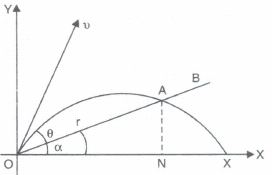
Let OAB be the inclined plane making an angle \(\alpha\) to the horizontal and let the projectile hit it at a point A where OA = r (Fig.).
At the instant the projectile hits the inclined plane, its horizontal and vertical displacements are ON (= r cos \(\alpha\)) and NA (= r sin \(\alpha\)) respectively.
Now the time taken to cover a horizontal distance r cos \(\alpha\) is clearly r cos \(\alpha\)/ v cos \(\theta\). The vertical distance moved in this time being r sin \(\alpha\), we have
\(r \ sin \alpha=(v \ sin \theta)({r \ cos \alpha \over v \ cos \theta})-{1\over2}g({r \ cos \alpha\over v cos \theta})^2\)
or \(r(sin \alpha - tan \theta cos \alpha)=-{1\over2}g{\cos^2\alpha\over v^2 \cos^2 \theta }r^2\)
\(\therefore r={2v^2cos^2\theta\over g \ cos^2 \alpha}[tan \theta cos \alpha-sin \alpha]\)
\(={2v^2cos^2\theta\over g \ cos^2 \alpha}[{sin \theta cos \alpha-cos \theta sin \alpha\over cos \theta}]\)
\(={2v^2cos^2\theta\over g \ cos^2 \alpha} sin (\theta - \alpha)\)
Thus the range of the projectile on the inclined plane is
\(={2v^2cos^2\theta\over g \ cos^2 \alpha} sin (\theta - \alpha)\)
The time at which the projectile hits the inclined plane being (r cos \(\alpha\) / v cos \(\theta\)), we have
\(t={r \ cos \alpha \over v \ cos \theta}={2v^2cos\theta\over g \ cos^2\alpha} sin (\theta - \alpha){cos \alpha\over v cos \theta}\)
or \(t={2 \ v \ sin (\theta - \alpha)\over g \ cos \alpha}\)
A confirmation of these results is obtained by putting \(\alpha\) = 0 for which case we get
\(r={2 \ v^2 cos \theta \ sin \theta \over g}={v^2sin 2\theta\over g}and \ t={2 \ v \ sin \theta \over g}\)
the usual expressions for the range and time of flight of a projectile.
2.
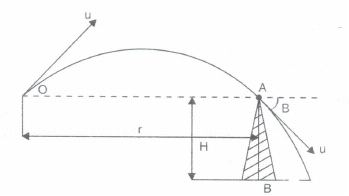
Let AB be the tower of height H and 0 the point of projection at a horizontal distance r from A as shown in Fig. Let u and \(\theta\) be the speed and the angle of projection of the ball.
The ball will go just grazing past the top edge of the tower if r equals the horizontal range of the projectile, i.e., if
\(r=u \ cos \theta .{2u \ sin \theta \over g}={u^2 \ sin 2\theta \over g}\)
Thus r, U and \(\theta\) must be related according to the relation
g r = u2 sin 2\(\theta\)
At point A, the velocity of the ball is again u at an angle \(\theta\) to the horizontal. The horizontal distance x at which the ball strikes the ground from the foot of the tower is the horizontal distance covered with a horizontal velcoity u cos\(\theta\) in the time the ball falls vertically through a distance H starting with an initial vertically downward velocity u sin \(\theta\)and having a vertically downward acceleration g. If t is this time, we have
H=(u sin \(\theta\)) t + \({1\over2}g \ t^2\)
or g t2 + 2 u sin \(\theta\) t - 2H = 0
or t= \({-2 u sin \theta \pm \sqrt{4 \ u^2 sin ^2 \theta +8g H}\over 2g}\)
or t= \({-2 u sin \theta \pm 2\sqrt{ \ u^2 sin ^2 \theta +2g H}\over 2g}\)
t= \({1\over g}[{-u \ sin \theta \pm \sqrt{ \ u^2 sin ^2 \theta +2g H}}]\)
Thus \(x=u \ cos \theta \ t={u \ cos \theta \over g}[\sqrt{ \ u^2 sin ^2 \theta +2g H}-u\ sin \theta]\)
The angle of projection \(\theta\) for which x is minimum for a given value of u is given by
\({dx\over d \theta}=0\)
Thus, \({u \ cos \theta \over g}[{u^22sin \theta cos \theta \over \sqrt{u^2sin ^2\theta+2 \ g \ H}}-u \ cos \theta]+[\sqrt{u^2sin^2\theta+2 \ g H}-u \ sin \ \theta] ({-u \ sin \theta\over g})=0\)
or \({u^2sin2 \theta cos \theta \over \sqrt{gu^2sin ^2\theta+2 \ g \ H}}-{u \ cos^2 \theta \over g}-{ \ sin \theta\over g}\sqrt {u^2sin^2\theta+2 \ g H}+{u \ sin^2 \theta\over g}=0\)
or\({u^2sin 2\theta cos \theta \over \sqrt{u^2sin ^2\theta+2 \ g \ H}}- sin \theta \sqrt {u^2sin^2\theta+2 \ g H}-u \ cos 2 \theta=0\)
or \({u^2sin \theta cos \theta}- sin \theta \sqrt {u^2sin^2\theta+2 \ g H}-u \ cos 2 \theta\sqrt{u^2sin ^2\theta+2 \ g \ H}=0\)
The angle of projection for which x is minimum is a solution of this equation.
3.
Let two vectors \(\vec{A}\) and \(\vec{B}\) be acting simultaneously at a particle, inclined at an angle \(\theta\) from one another. The magnitude of resultant vector \(\vec{R}\) is given by
\(R=\sqrt{A^2+B^2+2AB \ cos \theta}\)
If the resultant vector subtends an angle B from the direction of \(\vec{A}\), then
\(tan \beta ={B \ sin \theta\over A+B \ cos \theta}\)
There are three special cases which are as follows
(i) If \(\theta\) = 0° i.e., vectors \(\vec{A}\)and \(\vec{B}\) are acting in same direction, then cos \(\theta\) = cos 0° = 1 and sin \(\theta\) = sin 0° = 0. Hence,
\(R=\sqrt{A^2+B^2+2AB (1)}=A+B\)
and \(tan \beta ={B \times (0)\over A+B (1)}=0 or \beta=tan ^{-1}(0)=0^0\)
Thus the magnitude of resultant vector is equal to the sum of the magnitudes of \(\vec{A}\) and \(\vec{B}\) and the resultant vector acts in the direction of \(\vec{A}\) or \(\vec{B}\).
(ii) If \(\theta\) = 180°, i.e., vectors \(\vec{A}\) and \(\vec{B}\) are acting in mutually opposite direction, then
cos \(\theta\) = cos 180° = - 1 and sin \(\theta\) = sin 180° = 0.
\(\therefore R=\sqrt{A^2+B^2+2AB (-1)}= \sqrt{A^2+B^2+2AB}=(A-B)\)
and \(tan \beta ={B \times (0)\over A+B \times(1)}=0 or \beta=tan ^{-1}(0)=0^0 \ or \ 180^o.\)
Hence the magnitude of resultant vector is equal to the difference of the magnitudes of \(\vec{A}\) and \(\vec{B}\) and the resultant vector acts in the direction of bigger of two vectors \(\vec{A}\) or \(\vec{B}\).
(iii) If\(\theta\) = 90° i.e., vectors \(\vec{A}\) and \(\vec{B}\) are in mutually perpendicular directions, then cos \(\theta\) = cos 90° = 0 and sin \(\theta\)= sin 90° = 1
\(\therefore R=\sqrt{A^2+B^2+2AB (0)}= \sqrt{A^2+B^2}\)
and \(tan \beta ={B \times (1)\over A+B .(0)}={B\over A}\)
Thus, the magnitude of resultant vector is R =\(\sqrt{A^2+B^2}\) and it subtends an angle \(\beta\) from \(\vec{A}\) such that tan\(\beta={B\over A}\) .
4.
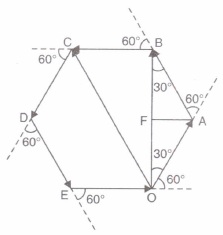
(i) The path followed by the motorist will be a closed hexagonal path.
Suppose the motorist starts his journey from the point O. He takes the turn at the point C.
Displacement = \(\overset\rightarrow{OC}\)
Here OC = \(\sqrt { \left( OB \right) ^{ 2 }+\left( BC \right) ^{ 2 } } =\sqrt { \left( OF+FB \right) ^{ 2 }+\left( BC \right) ^{ 2 } } \)
= \(\sqrt { \left( 500cos\quad 30^{ 0 }+500cos30^{ 0 } \right) ^{ 2 }+(500)^{ 2 } } \)
=\(\sqrt { \left( 2\times 500\times \frac { \sqrt { 3 } }{ 2 } \right) ^{ 2 }+(500)^{ 2 } } \)
= 500\(\sqrt{4}\) = 1000 m = 1 km
Total path length= 500 m + 500 m + 500 m = 1500 m = 1.5 km
\(\frac{Magnitude \ of\ displacement}{Total\ path \ length}\)=\(\frac{1}{1.5}\)=\(\frac{2}{3}\)=0.
(ii) The motorist will take the sixth turn at O.
Displacement is zero. So, displacement vector is a null vector.
Path length is 3000 m, i.e., 3 km.
Ratio of magnitude of displacement and path length is zero.
(iii) The motorist will take the 8th turn at B.
Magnitude of displacement = 2 x 500 cos 30°= 500\(\sqrt{3m}\)=\(\frac { \sqrt { 3 } }{ 2 } \) km = 0.866 km
Path length = 8 x 500 m = 4 km
Ratio of magnitude of displacement and path length is \(\frac { \sqrt { 3 } /2 }{ 4 } \)i.e.,\(\frac { \sqrt { 3 } }{ 2 } \) = 0.22
5.
m =10 kg, d = 0.4m, r = 0.2m
Revolutions per min, \(\nu =1000/min=\frac { 1000 }{ 60 } s,Linear\)
velocity, v=?,centripetal acceleration, a=?
\(\\ \omega =2\pi \nu =2\pi \times \frac { 1000 }{ 60 } =\frac { 100\pi }{ 3 } rad/s\)
\(\\ v=r\omega =0.2\times \frac { 100\pi }{ 3 } =\frac { 20\pi }{ 3 } m/s\)
\(\\ a=r\omega ^{ 2 }=0.2\times \left( \frac { 100\pi }{ 3 } \right) ^{ 2 }=\frac { 2000\pi ^{ 2 } }{ 9 } m/s^{ 2 }\)
6.
(i) \(T=\frac { { 2u }_{ 0 }\sin { \beta } }{ g\cos { \alpha } } \)
(ii) \(R=\frac { { 2u }_{ 0 }\sin { \beta } \cos { \left( \alpha +\beta \right) } }{ g\cos { ^{ 2 }\alpha } } \)
(iii) \(\beta =\frac { \pi }{ 4 } -\frac { \alpha }{ 2 } \)
7.
The vector vb representing the velocity of the motorboat and the vector vc representing the water current are shown in directions specified by the problem. Using the parallelogram method of addition, the resultant R is obtained in the direction shown in the figure.
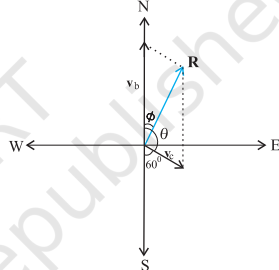
We can obtain the magnitude of R using the Law of cosine
\(R=\sqrt{v_{\mathrm{b}}^{2}+v_{\mathrm{c}}^{2}+2 v_{\mathrm{b}} v_{\mathrm{c}} \cos 120^{\circ}}\)
\(=\sqrt{25^{2}+10^{2}+2 \times 25 \times 10(-1 / 2)} \cong 22 \mathrm{~km} / \mathrm{h}\)
To obtain the direction, we apply the Law of sines
\(\frac{R}{\sin \theta}=\frac{v_{c}}{\sin \phi} \text { or, } \sin \phi=\frac{v_{c}}{R} \sin \theta\)
\(=\frac{10 \times \sin 120^{\circ}}{21.8}=\frac{10 \sqrt{3}}{2 \times 21.8} \cong 0.397\)
\(\phi \cong 23.4^{\circ}\)
8.
Given, A = 20 N, B = 20 N, R = 30 N, \(\theta \) = ?
\(R=\sqrt { { A }^{ 2 }+{ B }^{ 2 }+2AB\cos { \theta } }\)
\( \\ 30=\sqrt { { 2 }0^{ 2 }+{ 2 }0^{ 2 }+2\times 20\times 20\cos { \theta } } \)
\(\\ \cos { \theta } =\frac { { 30 }^{ 2 }-{ 2 }0^{ 2 }-{ 2 }0^{ 2 } }{ 2\times { 2 }0^{ 2 } } =0.125\)
\( \Rightarrow \quad \theta ={ 82 }^{ 0 }{ 49 }^{ ' }\)
9.
(i) The maximum height attained by the ball is
\({ H }_{ m }=\frac { ({ \nu }_{ 0 }sin{ \theta }_{ 0 })^{ 2 } }{ 2g } \)
\(\\ =\frac { (28sin30^{ \circ })^{ 2 } }{ 2(9.8) } =\frac { 14\times 14 }{ 2\times 9.8 } =10.0\quad m\)
(ii) The time taken by the ball to return the same level is
\(T=\left( { 2\nu }_{ 0 }sin\theta _{ 0 } \right) /g=(2\times 28\times sin30^{ \circ })/9.8\)
\(=28/9.8=2.9s\)
(iii) The distance from the thrower to the point where the ball returns to the same level is
\(R=\frac { \left( { \nu }_{ 0 }^{ 2 }sin2\theta _{ 0 } \right) }{ g } =\frac { 28\times 28\times sin60^{ \circ } }{ 9.8 } =69m\)
10.
\(\theta ={ 30 }^{ \circ },u=20m/s,g=10m/s^{ 2 }\)
\(\\ H=\frac { u^{ 2 }\sin { ^{ 2 }\theta } }{ 2g } =\frac { (20)^{ 2 }\times \sin { ^{ 2 }30^{ \circ } } }{ 2\times 10 } =5m\)
11.
Yes, Multiplying any two scalars is meaningful. Density p and volume V both the scalar quantities.When density is multiplied by volume,then we get \(p\times VB=m\) , mass of the body,which is scalar quantity

11th Standard CBSE Syllabus & Materials
11th Standard CBSE
CBSE 11th Business Studies Forms of Business Organisation Sample Question Papers Study Material - QB365 Set A
NEW11th Standard CBSE
CBSE 11th Business Studies Business, Trade and Commerce Sample Question Papers Study Material - QB365 Set A
NEW11th Standard CBSE
CBSE 11th Physics Waves Sample Question Papers Study Material - QB365 Set A
NEW11th Standard CBSE
CBSE 11th Physics Kinetic Theory Sample Question Papers Study Material - QB365 Set A



CBSE 11th Standard CBSE Subjects
CBSE Standards









