
 100% FREE ACCESS
11th Standard CBSE Syllabus & Materials
11th Standard CBSE
CBSE 11th Economics PART-A - Presentation of Data - New Sample Question Papers Study Material - QB365 Set A
NEW11th Standard CBSE
CBSE 11th Economics PART-A - Organisation of Data - New Sample Question Papers Study Material - QB365 Set A
NEW11th Standard CBSE
CBSE 11th Economics PART-A - Collection of Data - New Sample Question Papers Study Material - QB365 Set A
NEW11th Standard CBSE
CBSE 11th Economics PART-A - Introduction to Economics and Statistics - New Sample Question Papers Study Material - QB365 Set A
NEW11th Standard CBSE
CBSE 11th Business Studies International Trade Sample Question Papers Study Material - QB365 Set A
NEW11th Standard CBSE
CBSE 11th Business Studies Evolution and Fundamentals of Business Sample Question Papers Study Material - QB365 Set A

Published on: 04/12/2019
Motion in a Plane
Download CBSE Class 11th Standard CBSE Physics question papers, sample papers, important questions, and previous year solved papers in PDF format. Get free study materials, NCERT solutions, and exam preparation resources for Class 11th Standard CBSE Physics
Questions + Answers key
Take MCQ Physics Test
1.
What is the angle between velocity vector and acceleration vector in uniform circular motion?
2.
What conclusion do you draw about \(\overset\rightarrow{B}\), if \(\overset\rightarrow{A}\)-\(\overset\rightarrow{B}\)=\(\overset\rightarrow{A}\)+\(\overset\rightarrow{B}\) ?
3.
State the reason , whether the following algebraic operations with scalar and vector physical quantities are meaningful
Adding any two vectors
4.
State the reason , whether the following algebraic operations with scalar and vector physical quantities are meaningful
Multiplying any two scalars
5.
The angle between vector A and B is 600 .What is the ratio of A.B and \(\left| A\times B \right| \) ?
6.
The dot product of two vectors vanished when vectors are orthogonal and has maximum value when vectors are parallel to each other.Explain
7.
A man moves towards East with velocity 6\({ ms }^{ -1 }\)and another man B moves in N \(-30^{ \circ }E\)with 6\({ ms }^{ -1 }\)> Find the velocity of B w.r.t A.
8.
A particle starts from origin at t = 0 with a velocity 15\(\overset { \wedge }{ i } \)m/s and moves in xy-plane under the action of a force which produces a constant acceleration of 15\(\overset { \wedge }{ i } \)+10\(\overset { \wedge }{ j } \)\({ m }/{ s^{ 2 } }\).Find the y-coordinate of the particle at the instant.Its x-coordinate is 125m.
9.
A plane is indined at an angle of 30° with horizontal. The magnitude of component of a vector \(\overset\rightarrow{A}\)=-10\(\hat{k} \) perpendicular to this plane is (here z-direction is vertically upwards
5\(\sqrt{2}\)
5\(\sqrt{3}\)
5
2.5
10.
At the top of the trajectory of a projectile, the directions of its velocity and accelerations are
parallel to each other
anti-parallel to each other
perpendicular to each other
inclined to each other at an angle of 45°
11.
From the top of a tower of height 40 m, a ball is projected upwards with a speed of 20 m/ s at an angle of elevation of 30°. The ratio of the total time taken by the ball to hit the ground to its time of flight (time taken to come back to the same elevation) is (Take g = 10 m/s2)
2:1
3:1
3:2
1.5:1
12.
A particle moves on a given line with a constant speed \(\upsilon \). At a certain time it is at a point P on its straight line path. O is fixed point. The value of \(\overrightarrow { OP } \times \overrightarrow { \upsilon } \) is (where y is perpendicular distance from O to given line)
- y\(\upsilon \)\(\hat{k}\)
-2y\(\upsilon \)\(\hat{k}\)
-3y \(\upsilon \)\(\hat{k}\)
none
13.
If the resultant of three forces \(\overrightarrow { F } _{ 1 }=p\hat { i } +3\hat { j } -\hat { k } ,\overrightarrow { F } _{ 2 }\)and \(\overrightarrow { F } _{ 3 }=6\hat { i } -\hat { k } \) acting on a particle has a magnitude equal to 5 units, then the value of p is
-6
-4
3
4
14.
The sum of magnitudes of two forces acting at a point is 18 units and the magnitude of their resultant is 12 units. The resultant is at 90° with the force of the smaller magnitude. The magnitude of the individual forces is
5, 12
5, 13
6,14
none of these
15.
If \(\overrightarrow { { a }_{ 1 } } \) and \(\overrightarrow { { a }_{ 2 } } \) are two non collinear unit vectors and if \(\left| \overrightarrow { { a }_{ 1 } } +\overrightarrow { { a }_{ 2 } } \right| \) =\(\sqrt{3}\), then the value of \(\left( \overrightarrow { { a }_{ 1 } } -\overrightarrow { { a }_{ 2 } } \right) .\left( 2\overrightarrow { { a }_{ 1 } } +\overrightarrow { { a }_{ 2 } } \right) \) is
2
\(\frac{3}{2}\)
\(\frac{1}{2}\)
1
16.
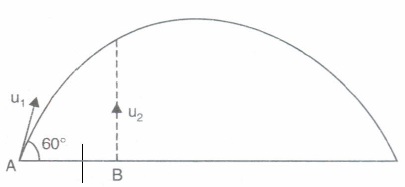
A body is projected with the velocity u1 from the point A as shown in figure. At the same time another body is projected vertically upwards with the velocity U2 from the point B. What should be the value of u1/u2 for both the bodies to collide?
17.
Define centripetal acceleration. Give two examples.
18.
A body is projected in horizontal direction with a uniform velocity from top of tower. Show that the path is parabola.
1.
Angle between velocity vector and acceleration vector in uniform circular motion is 90°.
2.
The identity is possible only if \(\overset\rightarrow{B}\)= \(\overset\rightarrow{0}\)i.e.,\(\overset\rightarrow{B}\) is a null vector.
3.
No,adding any two vectors is not meaningful because only vectors of the same dimensions i.e. having same unit can be added.
4.
Yes, Multiplying any two scalars is meaningful. Density p and volume V both the scalar quantities.When density is multiplied by volume,then we get \(p\times VB=m\) , mass of the body,which is scalar quantity
5.
\(\therefore \) Ratio is
\(\frac { A.B }{ \left| A.B \right| } =\frac { AB\quad cos\quad \theta }{ AB\quad sin\quad \theta } =cot\quad \theta \)
\(\\ =cot\quad { 60 }^{ o }=\frac { 1 }{ \sqrt { 3 } } \)
\(\\ As,\quad\theta ={ 60 }^{ o },cot{ 60 }^{ o }=\frac { 1 }{ \sqrt { 3 } } \)
6.
We know that \(A.B=ABcos\theta \) when vectors are orthogonal \(\theta ={ 90 }^{ o }\)
So, \(A.B=ABcos90^{ o }=0\) when vectors are parallel \(\theta ={ 0 }^{ o }\) so, \(A.B=ABcos{ 0 }^{ o }=AB\ (maximum)\)
7.
Given \({ \nu }_{ A }=6\overset { \wedge }{ i } ;{ \nu }_{ B }=6\cos { 30^{ \circ } } \overset { \wedge }{ i } +6sin30^{ \circ }\overset { \wedge }{ j } \)
\(=\frac { 6\sqrt { 3 } }{ 2 } \overset { \wedge }{ i } +\frac { 6 }{ 2 } \overset { \wedge }{ j } =3\sqrt { 3 } \overset { \wedge }{ i } +3\overset { \wedge }{ j } \)
\(\\ \therefore \quad { \nu }_{ BA }={ \nu }_{ B }-{ \nu }_{ A }=(3\sqrt { 3 } \overset { \wedge }{ i } +3\overset { \wedge }{ j } )-6\overset { \wedge }{ i } \)
\( { \nu }_{ BA }=(3\sqrt { 3 } -6)\overset { \wedge }{ i } +3\overset { \wedge }{ j }\)
\( { \nu }_{ BA }=\sqrt { (3\sqrt { 3 } -6)^{ 2 }+({ 3) }^{ 2 } } =3.11m/s\)
\(\\ \tan { \alpha =\frac { 3 }{ 3\sqrt { 3 } -6 } =\frac { 1 }{ \sqrt { 3 } -2 } \Rightarrow \alpha =105.13^{ \circ } } \)
8.
The position of the particle is given by
\(r(t)={ \nu }_{ 0 }t+\frac { 1 }{ 2 } at^{ 2 }=15\overset { \wedge }{ i } t+\frac { 1 }{ 2 } (15\overset { \wedge }{ i } +10\overset { \wedge }{ j } ){ t }^{ 2 }\)
\(=(15t+7.5{ t }^{ 2 })\overset { \wedge }{ i } +5\overset { \wedge }{ j } { t }^{ 2 }\)
\(\\ \therefore \quad x(t)=15t+7.5{ t }^{ 2 }\Rightarrow y(t)=5t^{ 2 }\)
\(\\ If\quad x(t)=125m,t=?\)
\(\\ 125=15t+7.5{ t }^{ 2 }\Rightarrow 1.5{ t }^{ 2 }+3{ t }-25=0\)
\(\\ t=3.2s\)
\(\\ \therefore \quad y(t)=5\times (3.2)^{ 2 }=51.2m\)
9.
(b)
5\(\sqrt{3}\)
10.
(d)
inclined to each other at an angle of 45°
11.
(a)
2:1
12.
(a)
- y\(\upsilon \)\(\hat{k}\)
13.
(c)
3
14.
(b)
5, 13
15.
(c)
\(\frac{1}{2}\)
16.
The two bodies will collide, if they reach at
a point acquiring the same vertical distance in the same time. Therefore
y = u1 sin 600\(\times\) t-\(\frac{1}{2}\)gt2 = u2 t - \(\frac{1}{2}\)gt2
\(\Rightarrow\)u1 sin 600\(\times\)t = u2t
or \(\frac { { u }_{ 1 } }{ { u }_{ 2 } } =\frac { 1 }{ sin\quad { 60 }^{ 0 } } =\frac { 2 }{ \sqrt { 3 } } \)
17.
Acceleration needed for a particle to undergo uniform circular motion is called 'centripetal acceleration'. It is directed along the radius of circular path towards its centre. Two common examples are:
(i) An electron revolving around the nucleus of an atom in a uniform circular motion experiences a centripetal acceleration on account of Coulombian electrostatic force on electron due to nucleus.
(ii) A satellite revolving around the earth in a circular orbit experiences a centripetal acceleration on account of gravitational force due to the earth.
18.
Let the body be projected horizontally with a velocity u, from the top of a tower of height h.
Time taken to reach the ground, t = \(\sqrt{2h/g}\)
Since the initial vertical velocity is zero and there is no acceleration in the horizontal.
Thus, x = ut
x = u\(\sqrt{2h/g}\)
i.e., h = x2 h=x2\(\frac{g}{2u^2}\)
As h \(\alpha\)x2, the path is a parabola.

11th Standard CBSE Syllabus & Materials
11th Standard CBSE
CBSE 11th Business Studies Forms of Business Organisation Sample Question Papers Study Material - QB365 Set A
NEW11th Standard CBSE
CBSE 11th Business Studies Business, Trade and Commerce Sample Question Papers Study Material - QB365 Set A
NEW11th Standard CBSE
CBSE 11th Physics Waves Sample Question Papers Study Material - QB365 Set A
NEW11th Standard CBSE
CBSE 11th Physics Kinetic Theory Sample Question Papers Study Material - QB365 Set A



CBSE 11th Standard CBSE Subjects
CBSE Standards









