
 100% FREE ACCESS
11th Standard CBSE Syllabus & Materials
11th Standard CBSE
CBSE 11th Economics PART-A - Presentation of Data - New Sample Question Papers Study Material - QB365 Set A
NEW11th Standard CBSE
CBSE 11th Economics PART-A - Organisation of Data - New Sample Question Papers Study Material - QB365 Set A
NEW11th Standard CBSE
CBSE 11th Economics PART-A - Collection of Data - New Sample Question Papers Study Material - QB365 Set A
NEW11th Standard CBSE
CBSE 11th Economics PART-A - Introduction to Economics and Statistics - New Sample Question Papers Study Material - QB365 Set A
NEW11th Standard CBSE
CBSE 11th Business Studies International Trade Sample Question Papers Study Material - QB365 Set A
NEW11th Standard CBSE
CBSE 11th Business Studies Evolution and Fundamentals of Business Sample Question Papers Study Material - QB365 Set A

Published on: 14/09/2019
Motion in a Straight Line
Download CBSE Class 11th Standard CBSE Physics question papers, sample papers, important questions, and previous year solved papers in PDF format. Get free study materials, NCERT solutions, and exam preparation resources for Class 11th Standard CBSE Physics
Questions + Answers key
Take MCQ Physics Test
1.
Explain the difference between uniform velocity and variable velocity.
2.
Define one dimensional motion.
3.
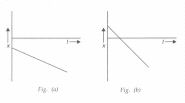
What is common between the two graphs shown in Figs. (a) and (b)?
4.
Why the speed of an object can never be negative?
5.
What is the significance of the slope of x-t graph?
6.
What is meant by 'point object' in physics?
7.
A body covers half of its journey with a speed of 40 m/s and half with a speed of 60 m/s. What is the average speed during the whole journey?
8.
The odometer of Raja's car reads 1700 km at the start of a trip and 2500 km at the end of the trip. The trip took 16h.What is the average speed of Raja's car in ms-1?
9.
The distance travelled by a body is proportional to the square of time. What type of motion this body has?
10.
The position of an object is given by x = 2t2 + st. Find out that its motion is uniform and nonuniform.
11.
What are uses of a velocity - time graph ?
12.
Thye position x of a body is given by x = A sin(wt). Find the time at which the displacements is maximum.
13.
The displacement o a particle is given by at2. What is the dependency of accleration on time?
14.
For what condiion, an object could be considered as a point object? Describe in brief
1.
If a body travels equal displacements in equal intervals of time, then the velocity of body is uniform velocity. On the other hand, if the body covers unequal displacements in equal intervals of time, then its velocity is variable velocity.
2.
A particle moving along a straight line or a path is said to undergo one dimensional motion.
3.
Both represent negative velocity.
4.
Speed is distance covered per unit time. Since distance cannot be negative therefore speed cannot be negative.
5.
Slope of x-t graph provides velocity of motion. The nature of motion is identified by the shape of the graph.
6.
An object is said to be point object if its dimensions are negligible as compared to the distance travelled by it. For example, an aeroplane which flies from Delhi to London.
7.
Average speed=\(\frac { Total\ distance }{ Time\ taken } \)
Let x be the distance to be covered
∴ average speed = \(\frac { x }{ \frac { x }{ 2v_{ 1 } } +\frac { x }{ 2v_{ 2 } } } \)
where, \(\frac { x }{ 2v_{ 1 } } \) = time taken to cover first half of the distance
\(\frac { x }{ 2v_{ 2 } } \) = time taken to cover second half of the distance
Now, average speed =\(\frac { x }{ \frac { X(V_{ I }+V_{ 2 }) }{ 2V_{ I }V_{ 2 } } } \)
=\(\frac { x\times 2v_{ 1 }v_{ 2 } }{ x(v_{ 1 }+v_{ 2 }) } =\frac { 2v_{ 1 }v_{ 2 } }{ v_{ 1 }v_{ 2 } } \)
\(\Rightarrow \) Vav=\(\frac { 2\times 20m/s\times 60m/s }{ 100m/s } \)
= 48ms-1
8.
Here, distance covered by the car = (2500-1700)km
= 800 km
Time elapsed = 16 h
Average speed \(=\frac { Total \ distance }{ Toatal \ time } \)
\(u=\frac { 800 }{ 16 } =50\quad km/h\)
As 1 km = 1000 m and 1 h = 3600 s
\(u=\frac { 50\times 1000 }{ 1\times 3600 } =13.9\quad ms^{ -1 }\)
9.
Let x bet the distance travelled in time t. Then ,
x \(\propto\) t2
x = kt2 [ here, k = constant of proportionality ]
We know that velocity is gigven
v = \( \frac{dx}{dt}\)
= 2kt
and acceleration is given by
a = \(\frac{dv}{dt}\) = 2 k [ constant ]
thus, the body has uniform accelerated motion.
10.
As given, x = 2t2 + 3t
by differentiating x w.r.t, we get
Velocity, \(v=\frac { dx }{ dt } =\frac { d }{ dt } ({ 2 }t^{ 2 }+3t)\)
v = (4t +3)
As velocity is time dependent, it means that motion is non-uniform
11.
(i) The velocity of a body at any instant.
(ii) The acceleration of the body and
(iii) the net displacement of the body in a given time - interval.
12.
The value of position x will be maximum, when the value of sin (wt) is maximum for this
\(sin(\omega t)=1=sin\quad \pi /2\)
or \(\omega t=\frac { \pi }{ 2 } \Rightarrow t=\left( \frac { \pi }{ 2\omega } \right) \)
13.
Let x be the displacement . Then, x = at2
\(\therefore\) Velocity of the object , v = \(\frac{dx}{dt}\)
Accleration of the object , a = \(\frac{dv}{dt}\)
It means that a is constant.
14.
An object could be considered as a point object if it covers a distance much larger than its own size.
e.g., If a bus of 5 m in size move 100 km, then the bus can be considered as a point object.

11th Standard CBSE Syllabus & Materials
11th Standard CBSE
CBSE 11th Business Studies Forms of Business Organisation Sample Question Papers Study Material - QB365 Set A
NEW11th Standard CBSE
CBSE 11th Business Studies Business, Trade and Commerce Sample Question Papers Study Material - QB365 Set A
NEW11th Standard CBSE
CBSE 11th Physics Waves Sample Question Papers Study Material - QB365 Set A
NEW11th Standard CBSE
CBSE 11th Physics Kinetic Theory Sample Question Papers Study Material - QB365 Set A



CBSE 11th Standard CBSE Subjects
CBSE Standards









