
 100% FREE ACCESS
11th Standard CBSE Syllabus & Materials
11th Standard CBSE
CBSE 11th Economics PART-A - Presentation of Data - New Sample Question Papers Study Material - QB365 Set A
NEW11th Standard CBSE
CBSE 11th Economics PART-A - Organisation of Data - New Sample Question Papers Study Material - QB365 Set A
NEW11th Standard CBSE
CBSE 11th Economics PART-A - Collection of Data - New Sample Question Papers Study Material - QB365 Set A
NEW11th Standard CBSE
CBSE 11th Economics PART-A - Introduction to Economics and Statistics - New Sample Question Papers Study Material - QB365 Set A
NEW11th Standard CBSE
CBSE 11th Business Studies International Trade Sample Question Papers Study Material - QB365 Set A
NEW11th Standard CBSE
CBSE 11th Business Studies Evolution and Fundamentals of Business Sample Question Papers Study Material - QB365 Set A

Published on: 30/09/2019
Motion in a Straight Line
Download CBSE Class 11th Standard CBSE Physics question papers, sample papers, important questions, and previous year solved papers in PDF format. Get free study materials, NCERT solutions, and exam preparation resources for Class 11th Standard CBSE Physics
Questions + Answers key
Take MCQ Physics Test
1.
During a hard sneeze, your eyes might shut for 0.5 s. If you are driving a car at 90 km/h during such a sneeze, how far does the car move during that time?
2.
A train 100 m long is moving with a speed of 60 km/h. In what time shall it cross a bridge of 1 km long?
3.
A bus starts with a constant acceleration 1ms-2. At the same time a car moving with a constant velocity of 5 ms-1 overtakes the bus.
(i) How far from the starting point, the bus overtakes the car and
(ii) How fast the bus was moving at the time of overtake?
4.
A parachutist bails out from an airplane and after dropping through a distance of 40 m, he opens the parachute and decelerates at 2 m/ 2, If he reaches the ground with a speed of 2 m/s, how long does he float in tha air? At what height did he bail out from the plane?
5.
A motor boat covers the distance between two spots on the river in t1= 8 h and t2 = 12 h, downstream and upstream, respectively.What is the time required for the boat to cover this distance in still water?
6.
(i) Draw position-time graph for
(a) Accelerated motion
(b) Retarded motion
(ii) A juggler throws balls into air. He throws one whenever the previous one is at its highest point.How high do the balls rise if he throws n balls in each second? Take acceleration due to gravity as g.
7.
A car starts from rest and accelerate uniformly for 10s to a velocity of 8 m/s, then it runs at a constant velocity and is finally brought to rest in 64m with a constant retardation. The total distance covered by the car is 584 m.Find the values of acceleration, retardation and total time taken.
8.
Prove Galileo's Law of Odd Numbers
9.
Two parallel rail tracks run North-South.Train A moves North with a speed of 54 kmh-1. and train B moves South with a speed of 90 kmh-1 . What is the velocity of monkey on the roof of the train A against its motion (with a velocity of 18 kmh-1 with respect to train A) as observed by a man standing on the ground?
10.
If the average speed of the particle is [ \({ 2t }^{ 2 }\hat { i } +3t\hat { j } \) ], then find out the instantaneous speed of the particle.
1.
Given, t = 0.5
Velocity (v) = 90 km/h
\(=\frac { 90\times1000 }{ 60\times60 } =25m/s\)
We know that, v = \(\frac { \triangle x }{ \triangle t } \)
\(\triangle x=v\triangle t=(25m/s)(0.5)=12.5m\approx 13m\)
2.
Given length of the train, s1= 100 m
Length of the bridge, s2 = 1 km = 1000 m, t = ?
Total length, s = 100 + 1000 = 1100 m
Speed of trains, s = 60 km/h = 60 x \(\frac { 5 }{ 18 } =\frac { 50 }{ 3 } m/s\)
\(t=\frac { Distance }{ Speed } =\frac { 1100 }{ \frac { 50 }{ 3 } } =66s\)
3.
Initial velocity of bus, u = O. Let the bus overtakes the car after time t.
∴ Distance travelled by bus in time t,
Sb = \(ut+\frac { 1 }{ 2 } at^{ 2 }=0+\frac { 1 }{ 2 } t^{ 2 }=\frac { { t }^{ 2 } }{ 2 } \)
Distance travelled by car moving with constant velocity (a = 0), (∵a=1 ms-1)
Sc= \(ut+\frac { 1 }{ 2 } at^{ 2 }=5t\) (∵ u = 5 ms-1 and a = 0)
Since Sb=Sc
∴ \(\frac { { t }^{ 2 } }{ 2 } \)5t
or t = 10s
∴ Distance travelled by bus when it overtakes car,
Sb= ut + \(\frac { 1 }{ 2 } \)at2
\(=0\times 10+\frac { 1 }{ 2 } \times 1(10)^{ 2 }\)
= 50m.
speed of bus, v = u + at
= 0 +1x 10 = 10ms-1.
4.
Applyiag 3rd equation to calculate the final velocity,
\( v^2=0+2 \times 9.8 \times 40 \)
\( v=\sqrt{784}\)
\( =28 \mathrm{mb} .\)
\( \text { Time taken. } t_4=\frac{2.5}{9.8} \quad[\mathrm{v}+\mathrm{at}] =2.85 \mathrm{~s} .\)
Thera, the seoved pott says thas he reached the ground with velocity \(2 \mathrm{~m} / \mathrm{s}\) ( frul velocity) with dovelctation of 2 m/s
\((2)^9=(28)^7+2(-2)=h \)
4 x v=784-4 = 790
Time taken, \(t_2=\frac{x-7}{7} \quad[\mathrm{v}=1 \mathrm{n}+\mathrm{at}]\)
-13 s
Tinae taken while he is in air.
\(t=t_1+t_2 \)
-2.85+13 -15.85 s
5.
Given: t1=8 hr, t2=12 hr
Let, s be the distance between that two spots. Also assume that the velocity of the motor boat in still water is v and the velocity of flow of water is u.
Then, for downward journey,
\(\frac{\mathrm{s}}{\mathrm{t}_1}=\mathrm{v}+\mathrm{u}\)
For upward journey,
\(\frac{\mathrm{s}}{\mathrm{t}_2}=\mathrm{v}-\mathrm{u}\)
Adding equation (i) to (ii),
\( \frac{\mathrm{s}}{\mathrm{t}_1}+\frac{\mathrm{s}}{\mathrm{t}_2}=2 \mathrm{v} \)
\( 2 \mathrm{v}=\mathrm{s}\left[\frac{1}{8}+\frac{1}{12}\right]=s\left[\frac{5}{24}\right] \)
\(\mathrm{v}=\mathrm{s}\left[\frac{5}{48}\right] \Rightarrow \frac{\mathrm{s}}{\mathrm{v}}=\frac{48}{5}\)
Time required for boat to cover distance s in still water
\(\mathrm{t}=\frac{\mathrm{s}}{\mathrm{v}}\)
\(\therefore \mathrm{t}=\frac{48}{5}=9.6 \mathrm{hr}\)
Hence that proved
6.
(i) Draw position-time graph for
(a) Accelerated motion
(b) Retarded motion
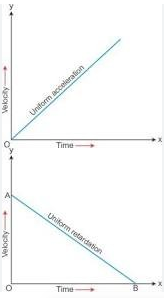
(ii) Juggler throws the ball into the air with ball having initial velocity = u
At the highest point of its path velocity will be zero as at maximum height velocity =0
So final velocity=0
According to question juggler throws a ball each second so for "n" balls time taken to reach highest position (t)= 1/n
v=u+gt
0=u-g/n
-u=-g/n
u=g/n
S= ut-gt²/2
S=u/n-g/2n²
But u=g/n
S= g/n²-g/2n²
S=g/2n²
7.
Step 1: Given that
Initial velocity (u) of the car =0
time for uniform acceleration (a)=10 m
final velocity of the car during acceleration (v)=8\(\mathrm{~ms}^{-1}\)
Total distance covered, d=584 m
Distance travelled during retardation =64 m
Step 2 : Formula used
\(\mathrm{s}=\mathrm{ut}+\frac{1}{2} \mathrm{at} \mathrm{t}^2 \)
\(\mathrm{v}=\mathrm{u}+\mathrm{at}\)
Step 3: Calculation of acceleration
Using first equation of motion, v=u+at, we get
\( a=\frac{v-u}{t} \)
\(a=\frac{8-0}{10} \)
\(a=0.8 \mathrm{~ms}^{-2}\)
Step 4: Calculation of distance travelled by the car during this time
Using second equation of motion,
\(\mathrm{s}=\mathrm{ut}+\frac{1}{2} \mathrm{at}^2\), we get
\( \mathrm{s}=0 \times 10 \mathrm{~s}+\frac{1}{2} \times 0.8 \mathrm{~ms}^{-2} \times(10 \mathrm{~s})^2\)
\( \mathrm{~s}=0.4 \times 100 \)
\( \mathrm{~s}=40 \mathrm{~m}\)
Suppose it travels ' x ' distance with constant velocity,
8\(\mathrm{~ms}^{-1}\), for time ' t '.
It then travels 64 m with uniform retardation and comes to rest.
Total distance travelled
40 m + x + 64 m = 584 m
x = 584-104
x = 480 m
So,
\(8 \mathrm{~ms}^{-1} \times \mathrm{t} =480 \mathrm{~m} \)
\(\mathrm{t} =\frac{480}{8} \)
\(\mathrm{t} =60 \mathrm{sec}\)
Let the car travel 64 m with uniform retardation for time t' Using,
\( \mathrm{v}^2=\mathrm{u}^2+2 a \mathrm{~s} \)
\( \mathrm{O}=8^2+2 \mathrm{a} \times 64 \)
\( \mathrm{a}=-\frac{64}{2 \times 64} \)
\( \mathrm{a}=-0.5 \mathrm{~m} \mathrm{~s}^{-2} \)
\(\text { retardation }=-0.5 \mathrm{~m} \mathrm{~s}^{-2} \)
\(\mathrm{t}^{\prime}=\frac{0-8}{-0.5} \)
\( \mathrm{t}^{\prime}=16 \mathrm{~s}\)
Therefore,
Total time taken is \(=10 s+60 s+16 s=86 s\)
8.
Let us divide the time interval of motion of an object under free fall into many equal intervals \(\tau \) and find out the distances travelled during successive intervals of
time.Since u = 0.then
\(y=\frac { 1 }{ 2 } gt^{ 2 }\)
To calculate the position of the object after different time intervals 0, \(0.\tau ,2\tau ,3\tau \) ..which are given in the second column of the table shown below
| t | y | Y in Terms of y0=(-1/2)g t2 |
Distance Traversed in Successive Intervals |
Ratio Distances Traversed |
| 0 | 0 | 0 | ||
| \(\tau \) | \((-1/2)g\quad \tau ^{ 2 }\) | \({ y }_{ 0 }\) | \({ y }_{ 0 }\) | 1 |
| \(2\tau \) | \(-4(1/2)g\quad \tau ^{ 2 }\) | \(4{ y }_{ 0 }\) | \(3{ y }_{ 0 }\) | 3 |
| \(3\tau \) | \(-9(1/2)g\quad \tau ^{ 2 }\) | \(9{ y }_{ 0 }\) | \(5{ y }_{ 0 }\) | 5 |
| \(4\tau \) | \(-16(1/2)g\quad \tau ^{ 2 }\) | \(16{ y }_{ 0 }\) | \(7{ y }_{ 0 }\) | 7 |
| \(5\tau \) | \(-25(1/2)g\quad \tau ^{ 2 }\) | \(25{ y }_{ 0 }\) | \(9{ y }_{ 0 }\) | 9 |
| \(6\tau \) | \(-36(1/2)g\quad \tau ^{ 2 }\) | \(36{ y }_{ 0 }\) | \(11{ y }_{ 0 }\) | 11 |
The third column gives the position in the unit of y0 .The fourth coloumn the distances traversed in successive \(\tau s\).At last,the fifth coloumn find the distances are simpe ratio 1:3:5:7
Hence Proved
9.
Taking South to North direction as the positive direction
i.e., x-axis, we have
Let velocity of monkey with respect to ground = v m
\(\therefore \) Relative velocity of monkey with respect to train A= vm-vA=-18kmh- = -5ms-1
vm= v-5 = 15 - 5 = 10ms-1
10.
Given, position of the particle
s = [ \({ 2t }^{ 2 }\hat { i } +3t\hat { j } \) ]
si = \(=\frac { ds }{ dt } =\frac { d }{ dt } [{ 2t }^{ 2 }\hat { i } +3t\hat { j } ]\)
Instantaneous speed of the particle is
si = 4t\(\hat { i } +3\hat { j } \)

11th Standard CBSE Syllabus & Materials
11th Standard CBSE
CBSE 11th Business Studies Forms of Business Organisation Sample Question Papers Study Material - QB365 Set A
NEW11th Standard CBSE
CBSE 11th Business Studies Business, Trade and Commerce Sample Question Papers Study Material - QB365 Set A
NEW11th Standard CBSE
CBSE 11th Physics Waves Sample Question Papers Study Material - QB365 Set A
NEW11th Standard CBSE
CBSE 11th Physics Kinetic Theory Sample Question Papers Study Material - QB365 Set A



CBSE 11th Standard CBSE Subjects
CBSE Standards









