
 100% FREE ACCESS
11th Standard CBSE Syllabus & Materials
11th Standard CBSE
CBSE 11th Economics PART-A - Presentation of Data - New Sample Question Papers Study Material - QB365 Set A
NEW11th Standard CBSE
CBSE 11th Economics PART-A - Organisation of Data - New Sample Question Papers Study Material - QB365 Set A
NEW11th Standard CBSE
CBSE 11th Economics PART-A - Collection of Data - New Sample Question Papers Study Material - QB365 Set A
NEW11th Standard CBSE
CBSE 11th Economics PART-A - Introduction to Economics and Statistics - New Sample Question Papers Study Material - QB365 Set A
NEW11th Standard CBSE
CBSE 11th Business Studies International Trade Sample Question Papers Study Material - QB365 Set A
NEW11th Standard CBSE
CBSE 11th Business Studies Evolution and Fundamentals of Business Sample Question Papers Study Material - QB365 Set A

Published on: 04/12/2019
Motion in a Straight Line
Download CBSE Class 11th Standard CBSE Physics question papers, sample papers, important questions, and previous year solved papers in PDF format. Get free study materials, NCERT solutions, and exam preparation resources for Class 11th Standard CBSE Physics
Questions + Answers key
Take MCQ Physics Test
1.
Explain the difference between uniform velocity and variable velocity.
2.
What is the relative velocity of have bodies having equal velocities?
3.
Can a particle have acceleration at an instant if its velocity is zero at that instant? Give example.
4.
What is meant by 'point object' in physics?
5.
A bus starting from rest moves with a uniform acceleration of 0.1 m / s2 for 2 min. Find the
(i) the speed acquired
(ii) the distance travelled.
6.
Establish the kinematic equation v2 - u2 = 2as from velocity-time graph for a uniformly accelerated motion.
7.
The velocity of a particle is given by equation v = 4 + 2 (c1 + c2 t), where c1and c2 are constant. Find the initial velocity and acceleration of the particle.
8.
A certain automobile manufacturer claims that its super-delux sports car will accelerate from rest to a speed of 42.0 ms:' in 8.0 s. Under the important assumption that the acceleration is constant,
(a) Determine the acceleration of car in ms-2.
(b) Find the distance the car travels in 8.0 s.
(c) Find the distance the car travels in 8th second.
9.
Read each statement below carefully and state with reasons and examples, if it is true or false ; A particle in one-dimensional motion
(a) with zero speed at an instant may have non-zero acceleration at that instant
(b) with zero speed may have non-zero velocity,
(c) with constant speed must have zero acceleration,
(d) with positive value of acceleration must be speeding up.
10.
To what height does the ball rise and after how long does the ball return to the player's hands?(Take g = 9.8ms-2 and neglect air resistance)
11.
Paul went to Shimla with his friends on a college trip. In Shimla, they went for ride in a hot air balloon. They were in picnic mood, so they took different variety of food packets with them. As the balloon rose up and started wandering in the air they started enjoying. Suddenly, Paul saw that at a place some people were struck on an island and shouting for help. He wanted to help those people but all be could do at that time was dropping the food packets so that they could survive till the help arrived after coming down on the ground, he immediately called the police to help those people.
(iii) What will be the position-time curve for dropped packet?
12.
A juggler throws balls into air. He throws one whenever the previous one is at its highest point.How high do the balls rise if he throws n balls in each second? Take acceleration due to gravity as g.
13.
(i) Draw position-time graph for
(a) Accelerated motion
(b) Retarded motion
(ii) A juggler throws balls into air. He throws one whenever the previous one is at its highest point.How high do the balls rise if he throws n balls in each second? Take acceleration due to gravity as g.
14.
Identify one dimensional motion out of the following:
A honey bee dancing in air
A teacher writing on a blackboard
A scooterist speeding on a level road
A kite flying in sky.
15.
When the distance travelled by a body is directly proportional to the time, the body is said to have a
zero speed
uniform acceleration
zero velocity
uniform speed
16.
Which of the following is not a vector quantity?
acceleration
velocity
speed
displacement
17.
The area under the velocity time graph between any two instants t = t1 and t = t2 gives the distance covered in a time \(\delta \) t = t2 - t1.
only if the particle moves with a uniform acceleration
only if the particle moves with a uniform velocity.
only if the particle moves with an acceleration increasing at a uniform rate.
in all cases irrespective of whether the motion is one of uniform velocity, or of uniform acceleration or of variable acceleration
18.
The displacement of an object at any instant is given by x = 30 + 20 t2, where x is in metres and t in seconds. The acceleration of the object will be
40 ms-2
50 ms-2
30 ms-2
zero
19.
The displacement x of a particle varies with time according to the relation x=\(\frac { a }{ b } \)(1-e-bt). Then
At t =\(\frac { 1 }{ b } \) , the displacement of the particle is nearly (2/3) (a/b).
The particle cannot reach a point at a distance x from its starting position if x> a/ b.
The velocity and acceleration of the particle at t = 0 are a and - ab respectively.
The particle will come back to its starting point as t ⇾∞.
1.
If a body travels equal displacements in equal intervals of time, then the velocity of body is uniform velocity. On the other hand, if the body covers unequal displacements in equal intervals of time, then its velocity is variable velocity.
2.
When two bodies have equal veloci.ties (i.e., \(\overrightarrow { v_{ a } } =\overrightarrow { v_{ b } } =\overrightarrow { v } \)), then their relative velocity is zero i.e., \(\overrightarrow { v_{ ab } } =\overrightarrow { v_{ a } } -\overrightarrow { v_{ b } } =\overrightarrow { v } -\overrightarrow { v } =0.\)
3.
Yes, it is possible. In motion under gravity at the highest point of its motion velocity is zero but acceleration a = g in downward direction.
4.
An object is said to be point object if its dimensions are negligible as compared to the distance travelled by it. For example, an aeroplane which flies from Delhi to London.
5.
(i) u = 0, a = 0.1 m / s2 and t = 2 min 120 m / s
v = u + at
= 0 + 0.1 \(\times\)120
= 12 m / s
(ii) u = 0, a = 0.1 m / s2 and t = 2 min 120 m / s
v = ut +\( \frac{1}{2}\) at2
= 0 +\( \frac{1}{2}\) \(\times\) 0.1\(\times\)( 120 )2
= \( \frac{1}{2}\) \(\times\) 0.1\(\times\)120\(\times\)120
= 720 m
6.
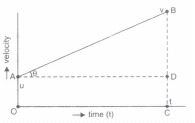
The velocity-time graph for uniformly accelerated motion has been shown in Fig. with initial velocity at t = 0 as u and final velocity at = 5 time t as v. Then area under the v-t graph gives the value of total displacement in the given time. Hence, displacement of moving particle in time t
=area of trapezium ∆ ABC
s = \(\frac { 1 }{ 2 } \)(OA + CB) x OC,
= \(\frac { 1 }{ 2 } \)(U + V) x t
However, from definition of acceleration, we know that \(a=\frac { v-u }{ t } \)or \(t=\frac { v-u }{ a } \)
Substituting this value of time t in equation (i), we get
Displacement s =\(\frac { 1 }{ 2 } (u+v)\times \frac { v-u }{ a } \) or \(\frac { v^{ 2 }-u^{ 2 } }{ 2a } \)
\(\Rightarrow \)2as = v2-u2 of v2 = u2+ 2as
7.
Given equation of velocity,
v = 4 + 2 (c1 + c2t)
=> v = (4 + 2c1) + 2c2t
Compare the above equation with equation of motion
v = u + at
Initial velocity, u = 4 + 2c1
Acceleration of the particle = 2c2.
8.
(a) We are given that u = 0 and velocity after 8 s is 42 m/s, so we can use v = u + at to find acceleration
a = \(\frac { v-u }{ t } =\frac { 42.0-u }{ 8.0 } \)= 5.25ms-2
(b) distance travelled in 8.0 s, we can use , s = ut +\(\frac { 1 }{ 2 } \)at2
= 0 + \(\frac { 1 }{ 2 } \)\(\times \)5.25\(\times \)82 = 168m
(c) distance travelled in 8th second, we have, Sn =u+(2n-1)\(\frac { a }{ 2 } \)
= (2 x 8 - 1) \(\times \frac { 5.25 }{ 2 } \) = 39.375 m.
9.
(i) True, when a body is thrown vertically upwards in the space, then at the highest point, the body has zero speed but has downward acceleration equal to the acceleration due to gravity.
(ii) False, because velocity is the speed of body in a given direction. When speed is zero, the magnitude of velocity of body is zero, hence velocity is zero.
(iii) True, when a particle is moving along a straight line with a constant speed, its velocity remains constant with time. Therefore, acceleration (i,e. change in velocity/time) is zero.
(iv) False, if the initial velocity of a body is negative, then even in the case of positive acceleration, the body speeds down. A body speeds up when the acceleration acts in the direction of motion.
10.
Let t be the time taken by the ball to reach the highest point where height from ground be s.
Taking vertical upward motion of the ball, we have u =- 29.4ms-, a = 9.8ms-, v = 0, s = S,t = ?
As, v2-u2 = 2 as
0 -(-29.4)2 = 2 x 9.8 x S
or \(S=\frac { -{ (29.4) }^{ 2 } }{ 2\times 9.8 } =-44.1m\)
Here, negative sign shows that the distance is covered in upward direction.
As, v = u + at
\(\therefore \quad 0=-29.4+9.8\times t\quad or\quad t=\frac { 29.4 }{ 9.8 } =3s\)
It means time of ascent = 3s
When an object moves under the effect of gravity alone, the time of ascent is always equal to the time of descent.
Therefore, total time after which the ball returns to the player's hand = 3 + 3 = 6s.
11.
(iii) What will be the position-time curve for dropped packet?
In position-time curve, when a packet is dropped. Let us consider origin at the point where packet was dropped.
-S.png)
12.
Juggler throws the ball into the air with ball having initial velocity = u
At the highest point of its path velocity will be zero as at maximum height velocity =0
So final velocity=0
According to question juggler throws a ball each second so for "n" balls time taken to reach highest position (t)= 1/n
v=u+gt
0=u-g/n
-u=-g/n
u=g/n
S= ut-gt²/2
S=u/n-g/2n²
But u=g/n
S= g/n²-g/2n²
S=g/2n²
13.
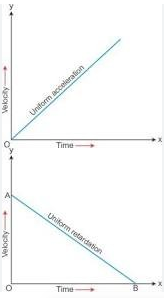
(i) Draw position-time graph for
(a) Accelerated motion
(b) Retarded motion
(ii) Juggler throws the ball into the air with ball having initial velocity = u
At the highest point of its path velocity will be zero as at maximum height velocity =0
So final velocity=0
According to question juggler throws a ball each second so for "n" balls time taken to reach highest position (t)= 1/n
v=u+gt
0=u-g/n
-u=-g/n
u=g/n
S= ut-gt²/2
S=u/n-g/2n²
But u=g/n
S= g/n²-g/2n²
S=g/2n²
14.
(c)
A scooterist speeding on a level road
15.
(d)
uniform speed
16.
(c)
speed
17.
(d)
in all cases irrespective of whether the motion is one of uniform velocity, or of uniform acceleration or of variable acceleration
18.
(c)
30 ms-2
19.
(a)
At t =\(\frac { 1 }{ b } \) , the displacement of the particle is nearly (2/3) (a/b).

11th Standard CBSE Syllabus & Materials
11th Standard CBSE
CBSE 11th Business Studies Forms of Business Organisation Sample Question Papers Study Material - QB365 Set A
NEW11th Standard CBSE
CBSE 11th Business Studies Business, Trade and Commerce Sample Question Papers Study Material - QB365 Set A
NEW11th Standard CBSE
CBSE 11th Physics Waves Sample Question Papers Study Material - QB365 Set A
NEW11th Standard CBSE
CBSE 11th Physics Kinetic Theory Sample Question Papers Study Material - QB365 Set A



CBSE 11th Standard CBSE Subjects
CBSE Standards









