
 100% FREE ACCESS
11th Standard CBSE Syllabus & Materials
11th Standard CBSE
CBSE 11th Economics PART-A - Presentation of Data - New Sample Question Papers Study Material - QB365 Set A
NEW11th Standard CBSE
CBSE 11th Economics PART-A - Organisation of Data - New Sample Question Papers Study Material - QB365 Set A
NEW11th Standard CBSE
CBSE 11th Economics PART-A - Collection of Data - New Sample Question Papers Study Material - QB365 Set A
NEW11th Standard CBSE
CBSE 11th Economics PART-A - Introduction to Economics and Statistics - New Sample Question Papers Study Material - QB365 Set A
NEW11th Standard CBSE
CBSE 11th Business Studies International Trade Sample Question Papers Study Material - QB365 Set A
NEW11th Standard CBSE
CBSE 11th Business Studies Evolution and Fundamentals of Business Sample Question Papers Study Material - QB365 Set A

Published on: 05/10/2019
Oscillation
Download CBSE Class 11th Standard CBSE Physics question papers, sample papers, important questions, and previous year solved papers in PDF format. Get free study materials, NCERT solutions, and exam preparation resources for Class 11th Standard CBSE Physics
Questions + Answers key
Take MCQ Physics Test
1.
Suppose a tunnel is dug through the earth from one side to the other side along a diameter. Show that the motion of a particle dropped into the tunnel is simple harmonic motion. Find the time period. Neglect all the frictional forces and assume that the earth has a uniform density. G = 6.67 x 10⁻¹¹ Nm2 kg-2; density of earth = 5.51 x 10³ kg m-3
2.
A particle is vibrating in SHM when the displacements of the particle from its equilibrium position are x1 and x2 it has velocities v1 and v2 respectively. Show that its time period is given by \(T=2\pi\sqrt{x_1^2-x_2^2\over v_2^2-v_1^2}\)
3.
Two linear simple harmonic motions of equal amplitudes and frequencies ω and 2ω are impressed on a particle along the axes of X and Y respective/yo If the initial phase difference between them is π/2 find the resultant path followed by the particle.
4.
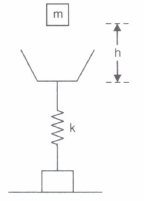
A body of mass m falls from a height h on to the pan of a spring balance. The masses of the pan and spring are negligible. The spring constant of the spring is k. Having stuck to the pan the body starts performing harmonic oscillations in the vertical direction. Find the amplitude and energy of oscillation.
5.
The potential energy of a particle of mass 1 kg in motion along the x-axis is given by U = 4 (1 - cos 2x) J Here x is in metres . Find the period of small oscillations.
6.
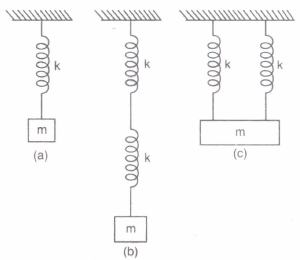
What do you understand by undamped and damped simple harmonic oscillations? Show that the time periods for vertical harmonic oscillations of the three systems shown in Figs. (a), (b) and (c) are in the ratio of \(1:\sqrt2:{1\over \sqrt2}.\) identical, each having a force constant k
7.
Find the expression for time period of motion of a body suspended by two springs connected in parallel and series.
8.
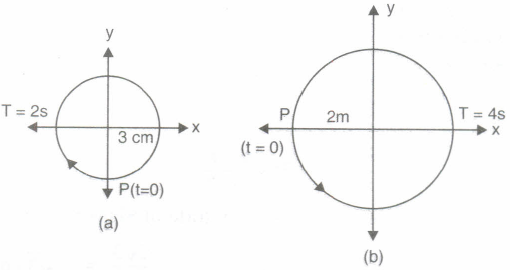
Figures correspond to two circular motions. The radius of the circle, the period of revolution, the initial position, and the sense of revolution (i.e. clockwise or anti-clockwise) are indicated on each figure.
Obtain the corresponding simple harmonic motions of the x-projection of the radius vector of the revolving particle P in each case.
9.
The motion of a particle executing simple harmonic motion is described by the displacement function, x(t) = A cos (ωt + φ ).
If the initial (t = 0) position of the particle is 1 cm and its initial velocity is ω cm/s, what are its amplitude and initial phase angle ? The angular frequency of the particle is π s–1. If instead of the cosine function, we choose the sine function to describe the SHM : x = B sin (ωt + α), what are the amplitude and initial phase of the particle with the above initial conditions.
10.
Which of the following functions of time represent (a) simple harmonic, (b) periodic but not simple harmonic, and (c) non-periodic motion? Give period for each case of periodic motion (ω is any positive constant):
(a) sin ωt – cos ωt
(b) sin3 ωt
(c) 3 cos(\(\frac{\pi}{4}\)-2ωt)
(d) cosωt + cos3ωt + cos5ωt
(e) exp(-ω2t2)
(f) 1 + ωt + ω2t2
1.
Figure shows a tunnel dug along the diameter of the earth. Consider the case of a particle of mass m at a distance y from the centre of the earth. There will be a gravitational attraction of the earth on this particle due to the portion of matter contained in a sphere of radius y. The mass of the sphere of radius y is given by
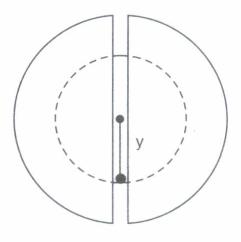
M=Volume x density
or M=\(\frac { 4 }{ 3 } \pi { y }^{ 3 }\times d\)
(where d = density of earth).
This mass can be regarded as concentrated at the centre of the earth. The force F between this mass and the particle of mass m is given by
\(F=-\frac { GMm }{ { y }^{ 2 } } \)
Negative sign shows that the force is of attraction.
\(\therefore F=-G\left( \frac { 4 }{ 3 } \pi { y }^{ 3 }d \right) \frac { m }{ { y }^{ 2 } } =-G\times \left( \frac { 4 }{ 3 } \pi md \right) y\)
or F∝y.
The force is directly proportional to the displacement, hence the motion is simple harmonic motion.
Here ,the constant k=\(\frac { 4 }{ 3 } \pi mdG\)
The time period, T=\(2\pi \sqrt { (m/k) } \)
\(=2\pi \sqrt { \left( \frac { 3m }{ 4\pi mdG } \right) } =2\pi \sqrt { \left( \frac { 3 }{ 4\pi dG } \right) } \)
\(=\sqrt { \left( \frac { 3\pi }{ dG } \right) } =\sqrt { \left( \frac { 3\times 3.14 }{ 5.51\times { 10 }^{ 3 }\times 6.67\times { 10 }^{ -11 } } \right) } \)
= 42.2 minutes.
2.
The particle velocity in SHM is given by : v = ω\(\sqrt{A^2-x^2}\)where A is the amplitude of oscillation.
For displacement x = x1, v1 =\(ω\sqrt{A^2-x_1^2}\)or \(v_1^2=ω^2(A^2-x_1^2)\)
and for displacement x = x2' \(v_2=ω\sqrt{A^2-x_2^2}\) or \(v_2^2=ω^2(A^2-x_2^2)\)
Subtracting (i) from (ii), we have
\(v_2^2=v_2^2=ω^2\left(x_1^2-x_2^2\right)\)
∴ Period of oscillation \(T={2\pi\over ω}={2\pi}\sqrt{(x_1^2-x_2^2)\over (v_2^2-v_1^2)}\)
3.
Two simple harmonic motions of equal amplitudes (A) and frequencies ω and 2ω and initial phase difference of π/2 are represented by
x = A sin ωt ...(i)
\(y=A\ sin\left({2ω+{\pi\over 2}}\right)=A\ cos\ 2 \omega t\) ...(ii)
Since cos 2 ωt (1 - 2 sin2 ωt)
∴ y = A[1 - 2 sin2 ωt] ...(iii)
From eqn. (i)
\(sin^2\ ωt={x^2\over A^2}\)
\(∴\ \ y=A\left[1-{2x^2\over A^2}\right]=A-{2x^2\over A}\)
\(⇒\ \ {2x^2\over A}+y-A=0\)
or \(x^2+{Ay\over 2P}-{A^2\over 2}=0\)
which is the equation of a parabola. Hence the resultant path followed by the particle is parabolic.
4.
Suppose by falling down through a height h, the mass m compresses the spring balance by a length x.
This P.E. lost by the mass = mg (h + x)
This is stored up as energy of the spring by compression
\(={1\over 2}kx^2\)
∴ mg (h + x) = \({1\over 2}kx^2\) or \({1\over 2}kx^2-mgx - mgh = a\)
or \(x^2-{2mgx\over k}-{2mgh\over k}=0\)
Solving this quadratic equation, we get
\(x={{2mg\over k}\pm\sqrt{\left(2mgh\over k\right)^2+\left(8mgh\over k\right)}\over 2}\)
In the equilibrium position, the spring will be compressed through the distance mg / k and hence the amplitude oscillation is
\(A={mg\over k}\sqrt{1+{2kh\over mg}}\)
Energy of oscillation \(={1\over 2}kA^2={1\over 2}k\left(mg\over k\right)^2\left(1+{2kh\over mg}\right)\)
\(=mgh+{(mg)^2\over 2k}\)
5.
\(F=-{dU\over dx}=-{d\over dx}[4(1-cos2x)]\)
= - 8 sin 2x
or F = - 8 x 2x
or F = -16 x
As F ∝ x and - ve sign shows that x is directed towards equilibrium position, hence the particle will execute SHM.
Here, spring factor, k = 16 N/m
inertia factor, m 1 kg
∴ time period, \(T={2\pi}\sqrt{m\over k}=2\pi\sqrt{1\over 16}={\pi\over 2}s\)
6.
Let us suppose that an extension x is produced in the spring when a force mg is applied to it. The equilibrium position in case (a) is given by
F = mg = kx
The time period in this case is given by
\(T_a=2\pi\sqrt{mass\over spring\ constant}=2\pi\sqrt{m\over k}\)
(b) In this case, the length of the spring is doubled. Hence a given force II1g will double the extension. Let x' be the extension produced and keff be the force constant of the combination. Thus
F = mg = keff x'
= 2 keff x (∵ x' = 2x)
Comparing (1) and (3) we get
F = k x = 2 keffx
or \(k_{eff}={k\over 2}\)
Thus the time period in this case is given by
\(T_b=2\pi\sqrt{m\over k_{eff}}=2\pi\sqrt{2m\over k}=\sqrt{2}T_a\)
(c) In this case, the extension x" produced in each spring by a force mg is half that produced in case (a), i.e.,
\(x''={x\over 2}\)
If keff is the force cosntant of the combination in this case, we have
F = mg = keff x"\(={k_{eff}\over 2}x\)
Comparing (5) with (1) we have
keff = 2k
Hence, \(T_e=2\pi\sqrt{m\over k_{eff}}=2\pi\sqrt{m\over k}={T_a\over \sqrt2}\)
From (2), (4) and (6) we have
\(T_a:T_b:T_c=\sqrt2:{1\over \sqrt2}\)
7.
Consider a body of mass M suspended by two springs connected in parallel as shown in Fig. (n) Let k1 and k2 be the spring constants of two springs respectively. Let the body be pulled down so that each spring is stretched through a distance y. Restoring forces F1 and F2 will be developed in the springs S1 and S2 respectively.
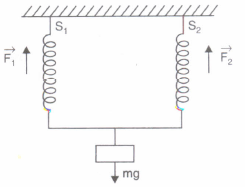
According to Hooke's law, F1 = - k1y
and F2 = -k2y
Since both the forces acting in the same direction, therefore, total restoring force acting on the body is given by
F = F1 + F2 = - k1 y - k2 Y = - (k1 + k2) y
∴ Acceleration produced in the body is given by
\(a={F\over M}=-{(k_1+k_2)y\over M}\) ..(i)
since \({(k_1+k_2)\over M}\) is constant ∴ a ∝ - y
Hence motion of the body is SHM.
Time period of body is given by
\(T=2\pi\sqrt{y\over |a|}=2\pi\sqrt{M\over k_1+k_2}\ \ ...(ii)\)
If k1=k2=k
Then \(T=2\pi\sqrt{M\over 2K}\)
For series: Consider a body of mass M suspended by two springs S1 and S2 which are connected in series as shown in Fig. (b). Let k1 and k2 be the spring constants of springs S1 and S2 respectively. Suppose at any instant, the displacement of the body from equilibrium position is y in the downward direction. If y1 and y2 be the extension produced in the springs S1 and S2 respectively, then
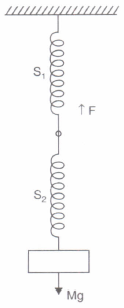
y = y1 + y2 ...(i)
Restoring forces developed in S1 and S2 are given by
F1 = - k1 + y1 ....(ii)
F2 = - k2 + Y2 ....(iii)
Multiplying eqns. (ii) by k2 and eqn. (iii) by k1 and adding, we get
∴ k2 F1 + k1 F2 = - k1 k2 (yl + y2) = - k1 k2 y
[From eqn. (i)]
Since both the springs are connected in series, so
F1 = F2 = F
∴ F(k1 + k2) = -k1k2y or \(F=-{k_1k_2\over (k_1+k_2)y}\)
If a be the acceleration produced in the body of mass M, then
\(a={F\over M}=-{k_1k_2y\over (k_1+k_2)M}\) ...(ii)
Time period of the body is given by
\(T=2\pi\sqrt{y\over |a|}=2\pi\sqrt{(k_1+k_2)M\over k_1k_2}\)
\(T=2\pi\sqrt{\left({1\over k_1}+{1\over k_2}\right)M}\)
8.
(1) Let A be any point on the circle of reference of the fig. (a) From A, draw BN perpendicular on x-axis.
If ∠POA = θ then
∠OAM = θ = ωt
∴ In triangle OAM
\(\frac{OM}{OA}\) = sinθ
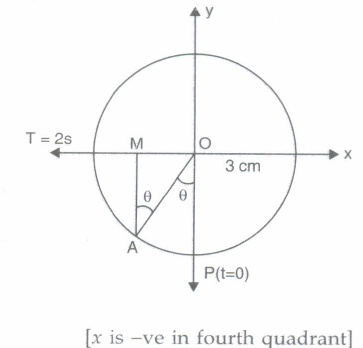
∴ \(\frac { -x }{ 3 } =sin\omega t=sin\frac { 2\pi }{ T } t\)
∴ \(x=-3sin\frac { 2\pi }{ T } t\quad or\quad x=-3sin\pi t\)
which is the equation of SHM
(2) Let B be any point on the circle of reference of fig. (b). From B, draw BN perpendicular on x-axis.
Then ∠BON = θ = ωt
∴ In ΔONB, cosθ = \(\frac{ON}{OB}\)
or ON = OB cos θ
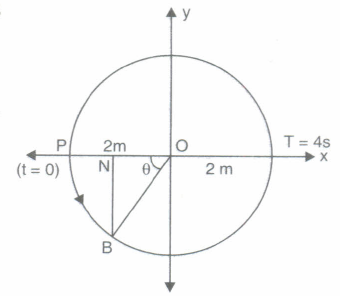
∴ -x = 2 cos ωt
⇒ x=-2cos\(\frac{2\pi}{T}t\) =- 2 cos\(\frac{2\pi}{4}t\)
∴ x=- 2 cos \(\frac{\pi}{4}t\) which is equation of SHM
9.
The given displacement function is
x(t) = A cos (ωt + \(\phi \)) ...(i)
At t 0, x(0) = 1 cm. Also, ω = \(\pi\)s-1
∴ 1 = A cos(\(\pi\)\(\times\)0+\(\phi \))
⇒ A cos\(\phi \) = 1 ....(ii)
Also, differentiating eqn. (i) w.r.t. 't'.
v = \(\frac{d}{dt}x(t)\)=-Aωsin(ωt + \(\phi \)) ....(iii)
Now at t = 0, v = ω
∴ from eqn. (iii), ω = -Aωsin(\(\pi\)\(\times\)0 + \(\phi \))
or A sin \(\phi \)=-1 ....(iv)
Squaring and adding eqns. (ii) and (iv).
A2 cos2\(\phi \)+ A2 sin2\(\phi \) = 12 + 12 or A =\(\sqrt2\)cm
Dividing eqns. (ii) and (iv),
\(\frac { Asin\phi }{ Acos\phi } =\frac { -1 }{ 1 } \therefore tan\phi =-1\Rightarrow \phi =\frac { 3\pi }{ 4 } \)
If instead we use the sine function, i.e.,
x = B sin (ωt+ α),then v =\(\frac{d}{dt}\)Bωcos(ωt + α)
∴ At t = 0, using x = 1and v = ω, we get 1 = B sin(ω\(\times\)0+α)
or B sin α = 1 ...(v)
and ω = Bωcos(ω\(\times\)0+α) or Bcosα = 1 ...(vi)
Dividing (v) by (vi),
tanα = 1 or α = \(\frac{\pi}{4}\) or \(\frac{5\pi}{4}\)
Squaring (v) and (vi), we get
B2 sin2α + B2 cos2 α= 12 + 12
⇒ B = \(\sqrt2\) cm
10.
(a) (i) Given, function is
\(\sin { \omega t } -\cos { \omega t } \) = \(\sin { \omega t } -\sin { \left( \frac { \pi }{ 2 } -\omega t \right) } \)
\(=2\sin { \left( \frac { \omega t+\frac { \pi }{ 2 } -\omega t }{ 2 } \right) } .\sin { \left( \frac { \omega t-\frac { \pi }{ 2 } +\omega t }{ 2 } \right) } \)
Given function \(=2\sin { \left( \frac { \pi }{ 4 } \right) } .\sin { \left( \omega t-\frac { \pi }{ 4 } \right) } \)
\(=\sqrt { 2 } \sin { \left( \omega t-\frac { \pi }{ 4 } \right) } \)
This function represents a simple harmonic motion having period of \(T=\frac { 2\pi }{ \omega } \) and a phase angle \(\left( -\frac { \pi }{ 4 } \right) \) or \(\left( -\frac { 7\pi }{ 4 } \right) \).
(b) Periodic, but not SHM
The given function is:
sin3ωt = 143sin ωt - sin3 ωt
The terms sin ωt and sin ωt individually represent simple harmonic motion (SHM). However, the superposition of two SHM is periodic and not simple harmonic.(c) 3cos(\(\frac{\pi}{4}\)-2ωt) = 3 cos(2ωt -\(\frac{\pi}{4}\)) [∵ cos (- θ) = cos θ]
Clearly it represents SHM and its time period is 2π/2ω
(d) cos ωt + cos 3 ωt + cos 5 ωt. It represents the periodic but not S.H.M. Its time period is 2π/2ω
(e) \({ e }^{ -{ \omega }^{ 2 }{ t }^{ 2 } }\) It is an exponential function which never repeats itself. Therefore it represents non-periodic motion.
(f) 1 + ωt + ω2t2 also represents non periodic motion.

11th Standard CBSE Syllabus & Materials
11th Standard CBSE
CBSE 11th Business Studies Forms of Business Organisation Sample Question Papers Study Material - QB365 Set A
NEW11th Standard CBSE
CBSE 11th Business Studies Business, Trade and Commerce Sample Question Papers Study Material - QB365 Set A
NEW11th Standard CBSE
CBSE 11th Physics Waves Sample Question Papers Study Material - QB365 Set A
NEW11th Standard CBSE
CBSE 11th Physics Kinetic Theory Sample Question Papers Study Material - QB365 Set A



CBSE 11th Standard CBSE Subjects
CBSE Standards









