
 100% FREE ACCESS
11th Standard CBSE Syllabus & Materials
11th Standard CBSE
CBSE 11th Economics PART-A - Presentation of Data - New Sample Question Papers Study Material - QB365 Set A
NEW11th Standard CBSE
CBSE 11th Economics PART-A - Organisation of Data - New Sample Question Papers Study Material - QB365 Set A
NEW11th Standard CBSE
CBSE 11th Economics PART-A - Collection of Data - New Sample Question Papers Study Material - QB365 Set A
NEW11th Standard CBSE
CBSE 11th Economics PART-A - Introduction to Economics and Statistics - New Sample Question Papers Study Material - QB365 Set A
NEW11th Standard CBSE
CBSE 11th Business Studies International Trade Sample Question Papers Study Material - QB365 Set A
NEW11th Standard CBSE
CBSE 11th Business Studies Evolution and Fundamentals of Business Sample Question Papers Study Material - QB365 Set A

Published on: 18/01/2020
Download CBSE Class 11th Standard CBSE Physics question papers, sample papers, important questions, and previous year solved papers in PDF format. Get free study materials, NCERT solutions, and exam preparation resources for Class 11th Standard CBSE Physics
Questions + Answers key
Take MCQ Physics Test
1.
Can gravitational force exist without any physical contact between acting bodies?
2.
What determines the natural frequency of a body?
3.
State the condition for rotational equilibrium of a body
4.
A steel ball is floating in a trough of mercury. If we fill the empty part of the trough with water, what will happen to the steel ball?
5.
At room temperature, diatomic gas molecule has five degrees of freedom, at high temperature. It has seven degrees of freedom, explain?
6.
If there are f degrees of freedom with n moles of a gas, then find the internal energy possessed at a temperature T.
7.
If all the objects radiate electromagnetic energy, why do not the objects around us in everyday life become colder and colder?
8.
Stress and pressure are both forces per unit area. Then, in what respect does stress differ from pressure ?
9.
A force of 1 N acts on a body of mass 1 g. Calculate the acceleration produced in the body.
10.
Is the rocket in flight is an illustration of projectile?
11.
State the reason , whether the following algebraic operations with scalar and vector physical quantities are meaningful
Multiplying any two scalars
12.
A body travels with a velocity v1 for time t1 and with a velocity v2 for time t2 find the average velocity of the body for the total time.
13.
Can the relative velocity of two bodies be greater than the absolute velocity of either?
14.
Using a screw gauge, the diameter of a metal rod was measured. The observation are given as follows: 0.39 mm, 0.37 mm, 0.41 mm, 0.38 mm, 0.38 mm, 0.37 mm, 0.40 mm, 0.39 mm. Calculate the relative error.
15.
What are the dimensions of a and b in the relation : F = a + bx, where F is force and (x) is distance?
16.
No physicist has ever 'seen' an 'electron'. Yet all Physicists believe in the existence of electron. An intelligent but superstitious man advances this analogy to argue that 'ghosts' exist even though no one has seen one. How will you refute his argument?
17.
State the law of conservation of momentum. Establish the same for a 'n' body system.
18.
Two loudspeakers have been installed in an open space to listen to a speech. When both the
loudspeakers are in operation, a listener sitting at a particular place receives a very feeble sound. Why? What will happen if one loudspeaker is kept off?
19.
why does a gas not have a unique value of specific heat ?
20.
A refrigerator transfers 250 J heat per second from -23o C. Find the power consumed, assuming no loss of energy.
21.
Determine the velocity with which a body must be thrown vertically upward from the surface of earth so that it may reach a height of 10R, where R is the radius of the earth.
22.
To simulate car accidents, auto manufacturers study the collisions of moving cars with mounted springs of different spring constants. Consider a typical simulation with a car of mass 1000 kg moving with a speed 18.0 km/h on a smooth road and colliding with a horizontally mounted spring of spring constant 5.25 × 10 3 N m–1 . What is the maximum compression of the spring ?
23.
A vector has magnitude and direction .Does it have a location in the space?
24.
Find the dimensions of constant 'd' and 'b' occuring in van der Waals' equation.
\(\left[ p+\frac { a }{ { v }^{ 2 } } \right] \left[ V-b \right] =RT\)
25.
Derive the expression for excess pressure inside:
(a) a liquid drop
(b) a liquid bubble
(c) an air bubble.
26.
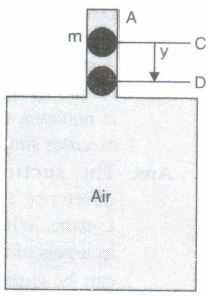
An air chamber of volume V has a neck area of cross section a into which a ball of mass m just fits and can move up and down without any friction (Fig.). Show that when the ball is pressed down a little and released, it executes SHM. Obtain an expression for the time period of oscillations assuming pressure-volume variations of air to be isothermal.
27.
A meter long narrow bore held horizontally (and closed at one end) contains a 76 Cm long mercury thread which traps a 15 Cm column of air. What happens if the tube is held vertically with the open end at the bottom?
28.
Find the components along the x, y, z axes of the angular momentum l of a particle, whose position vector is r with components x, y, z and momentum is p with components Px,Py and Pz. Show that if the particle moves only in the x-y plane the angular momentum has only a z-component.
29.
A particle of mass 150g is attached to one end of a massless, inextensible string. It is made to describe a vertical circle of radius 1 m. When the string is making an angle of 48.20 with the vertical, its instantaneous speed is 2 ms-1, What is the tension in the string in this position? Would this particle be able to complete its circular path? (Take g = 10 ms-2)
30.
It was the occasion of Diwali. Everyone was in festive mood. Houses were decorated with diyas and candles and children were bursting crakers. Suddenly, a cracker misfired and instead of going up in the air, it went inside a house and house caught fire. Everyone ran here and there. They brought buckets of water to douse the fire. But the fire was increasing. people called up fire bridge but since roads were narrow, it couldn't reach the house. Some of the boys got an idea. They went to the garden nearby and brought the water pipe used to water the plants. Pipe was of varying cross- section but water was coming at very fast rate. Four to five boys holded the pipe and sprinkled water on house and the fire was gradually doused. Everyone thanked the boys and praised them.
(i) What values of boys do you appreciate?
(ii) If the water flows through the pipe of varying cross-section at the rate of 20L/min. Determine the velocity of water at a point where diameter is 4 cm.
(iii) Why should we say no to crackers?
31.
Ajay was a very naughty boy. One day , he bought a rubber cord catapult from market and started hitting passerby. When his father came to know about this, he immediately called Ajay and scolled him. He made him realise what damage his act could do. Ajay realised his mistake and apologised for his mistake.
What values do you associate with Ajay?
32.
A foreigner arrived at Mumbai airport at around 1AM in the moring . She found a text waiting outside. She asked the driver to drop her at the nearby hotel. The taxi driver obliged and drove the foreigner round and round in the city and dropped her at a hotel at around 1:30AM in the morning.
The hotel was only few kilometer away but he charged her one thousand rupees. While driver was arguing with foreigner , a man from the hotel came out to help her. When he heard that drive was charging one thousand rupees, he scolded him and asked him to charge genuinely and not to spoil their country's name. Driver apologised to foreigner and refunded her eight hundred rupees.
The hotel of the foreigner was at a distance of 10 km away from airport on a straight road and dishonest cabman took her along a circuitous path 23 km long and reached the hotel in 28 min. What was the average speed and magnitude of average velocity?
33.
Paul went to Shimla with his friends on a college trip. In Shimla, they went for ride in a hot air balloon. They were in picnic mood, so they took different variety of food packets with them. As the balloon rose up and started wandering in the air they started enjoying. Suddenly, Paul saw that at a place some people were struck on an island and shouting for help. He wanted to help those people but all be could do at that time was dropping the food packets so that they could survive till the help arrived after coming down on the ground, he immediately called the police to help those people.
(iii) What will be the position-time curve for dropped packet?
34.
(i) Draw position-time graph for
(a) Accelerated motion
(b) Retarded motion
(ii) A juggler throws balls into air. He throws one whenever the previous one is at its highest point.How high do the balls rise if he throws n balls in each second? Take acceleration due to gravity as g.
35.
Class XI students were given as experiment to find diameter of a wire using screw gauge. The teacher asked the students to take number of reading. Ravi took only three readings and finished his practical. Seeing this, his friend Rahul asked him to take more readings as it would give more accuracy to his result and also, they should follow the instruction of his teacher.
If the diameter of the wire as measured by screw gauge was found to be 1.328, 1.330, 1.325, 1.326, 1.334 and 1.336 cm. Calculate
(a) mean value of diameter
(b) absolute error in each measurement
36.
A cylindrical solid of mass M has raidus R and length L. Its moment of inertia about a generator is:
\(N\left( \frac { L }{ R } +\frac { { R }^{ 2 } }{ 4 } \right) \)
\(\frac { 1 }{ 2 } { MR }^{ 2 }\)
\(\frac { 3 }{ 2 } { MR }^{ 2 }\)
\(M\left( \frac { { L }^{ 2 } }{ 3 } +\frac { { R }^{ 2 } }{ 4 } \right) \)
37.
Which of the following statements is true?
Both light and sound waves can travel in vacuum
Both light and sound waves in air are transverse
The sound waves in air are longitudinal, while the light waves are transverse
Both light and sound waves in air are longitudinal.
38.
If g is the acceleration due to gravity on the earth's surface, the gain in the potential energy of an object of mass m raised from the earth's surface to a height equal to the radius R of the earth,is
\(\frac{1}{2}mgR\)
2mgR
mgR
\(\frac{1}{4}mgR\)
39.
A block of mass M is pulled along a horizontal frictionless surface by a rope of mass m. Force P is applied at one end of the rope. The force which the rope exerts on the block is: _______.
\({P\over M-m}\)
\({PM\over m+M}\)
\({P\over M(m+M)}\)
\({Pm\over M-m}\)
40.
A black body is at 727°C. It emits energy at a rate which is proportional to _______.
(1000)4
(1000)2
(727)4
(727)2
41.
Who proposed the wave theory of light?
G. P. Thomson
Huygens
M. Planck
Maxwell
1.
()
Yes, gravitational force exist without any physical contact between acting bodies.
2.
Natural frequency of a body depends upon
(i) elastic properties of the material of the body and
(ii) dimensions of the body.
3.
For rotational equilibrium of a body the vector sum of torques of all the forces acting on the body about the reference point must be zero.
4.
It will move up.
5.
At low temperature, diatomic gas has three translational and two rotational degrees of freedom, so a total number of degrees of freedom is 5.
But at high temp, gas molecule starts to vibrate which give two additional degrees of freedom i.e. 7.
6.
For 1 mole with f degrees of freedom,
Internal energy, U = 1 x Cv x T = f2/RT
For n moles, U = nCvT = nf2/RT
7.
According to the principal of heat exchanges, all the objects (above 0 K) not only radiate electromagnetic energy but also absorb at the same rate from their surroundings. Thus they do not become colder.
8.
Pressure is an external force per unit area, while stress is the internal restoring force which comes into play in a deformed body acting transversely per unit area of body.
9.
Fiven F = 1N, m = 1 g = 10-3 kg
Now, F = ma ⟹ a = \(\frac{F}{m} = \frac{1}{10^{-3}}\)
= 103 m/s2
10.
No, because it is propelled by combustion of fuel and does not move under the effect of gravity alone.
11.
Yes, Multiplying any two scalars is meaningful. Density p and volume V both the scalar quantities.When density is multiplied by volume,then we get \(p\times VB=m\) , mass of the body,which is scalar quantity
12.
Displacement travelled in time
(t1 + t2) = s1+s2
= v1t1 + v2t2
Average velocity \(=\frac { Net \ displacement }{ Total \ time \ taken } =\frac { { v }_{ 1 }{ t }_{ 1 }+{ v }_{ 2 }{ t }_{ 2 } }{ ({ t }_{ 1 }+{ t }_{ 2 }) } \)
13.
Yes, when two bodies move in opposite direction then relative velocity of each is greater than the individual velocities.
14.
Relative error = \(\frac { \triangle \bar { d } }{ d } =\frac { 0.01 }{ 0.39 } =0.0256\)
15.
\([a]=[F]=\left[M L T^{-2}\right]\)
\([b]=\left[\frac{F}{x}\right]=\left[\frac{M L T^{-2}}{L}\right]=\left[M T^{-2}\right]\)
16.
It is true that no physicist has ever seen an electron but several phenomena taking place in our daily life give us evidence of the existence of the electron such as frictional electricity.
On the other hand, no one has ever seen ghosts but there is no phenomena which can be explained on the basis of the existence of ghosts. Therefore, there is no comparison between two cases.
17.
When no external force acts on a system the momentum will remain conserved. Consider a system of a n bodies of masses m1, m2, m3 ....., mn· If P1' P2' P3' ....., Pn are the momentum associated then, the rate of change of momentum with the system,
\({dp\over dt}={dp_1\over dt}+{dp_2\over dt}+{dp_3\over dt}+....+{dp_n\over dt}\)
\({d\over dt}(p_1+p_2+p_3+.....+p_n)\)
If no external force acts,\({dp\over dt}=0\)
\(\therefore p=\) constant, i.e., \((p_1+p_2+p_3+.....+p_n)\) = constant.
18.
When the distance between two loudspeakers from the position of listener is an odd multiple of \(\frac{\lambda}{2}\), then due to destructive interference between sound waves from two loudspeakers, a feeble sound is heard by the listener.
When one loudspeaker is kept off, no interference is will take place and the listener will hear the full sound of the operating loudspeaker.
19.
This is because a gas can be heated under different conditions of pressure and volume. The amount of heat required to raise the temperature of unit mass through unit degree is different under different conditions of heating
20.
Here, Q2 = 250 Js-1
T2 = -23o C = -23 + 273 = 250 K
T1 = 25o C = 25 + 273 = 298 K
We know, \(\beta =\frac { { Q }_{ 2 } }{ W } =\frac { { T }_{ 2 } }{ { T }_{ 1 }-{ T }_{ 2 } } \)
\(W=\frac { { Q }_{ 2 }({ T }_{ 1 }-{ T }_{ 2 }) }{ { T }_{ 2 } } \)
\(\\ W=\frac { 250(298-250) }{ 250 } =\frac { 250\times48 }{ 250 } \)
\(\\ W=48{ Js }^{ -1 }\)
21.
Conservation of energy gives
\( \frac{1}{2} m v^2-\frac{G M m}{R}=0-\frac{G M m}{(R+10 R)} \)
\(v=\sqrt{\left(\frac{20}{11} \frac{G m}{R}\right)=1.07 \times 10^4 m s^{-1}}\)
22.
At maximum compression the kinetic energy of the car is converted entirely into the potential energy of the spring.
The kinetic energy of the moving car is
\(K=\frac{1}{2} m v^{2}\)
\(=\frac{1}{2} \times 10^{3} \times 5 \times 5\)
K = 1.25 x 10⁴ J
where we have converted 18 km h–1 to 5 m s–1 [It is useful to remember that 36 km h–1 = 10 m s–1]. At maximum compression xm , the potential energy V of the spring is equal to the kinetic energy K of the moving car from the principle of conservation of mechanical energy.
\(V=\frac{1}{2} k x_{m}^{2}\)
= 1.25 x 10⁴ J
We obtain
xm = 2.00 m
We note that we have idealised the situation. The spring is considered to be massless. The surface has been considered to possess negligible friction.
23.
A vector, in general, has no definite location in space because a vector remains unaffected whenever it is displaced anywhere in space provided its magnitude and direction do not change. However, a position vector has a definite location in space.
24.
We can add and structure only like quantities.
\(\Rightarrow\) Dimensions of P = Dimensions of \(\frac{\mathrm{a}}{\mathrm{V}^2}\)
and dimension of V = Dimensions of b
From (i),
Dimensions of a = Dimensions of P x Dimensions of \(\mathrm{V}^2[\mathrm{a}]\)
\( =\left[\mathrm{M}^1 \mathrm{~L}^{-1} \mathrm{~T}^{-2}\right] \times\left[\mathrm{L}^3\right]^2 \)
\( =\left[\mathrm{M}^1 \mathrm{~L}^5 \mathrm{~T}^{-2}\right]\)
Unit of a = Unit of p x Unit of v2
\(=\frac{\mathrm{N}}{\mathrm{m}^2} \times \mathrm{m}^6=\mathrm{Nm}^4\)
From (ii), \([\mathrm{b}]=[\mathrm{V}]=\left[\mathrm{M}^0 \mathrm{~L}^3 \mathrm{~T}^0\right]\)
So unit of b = Unit of \(\mathrm{V}=\mathrm{m}^3\)
a = [M1L5T-2], b = [L3]
25.
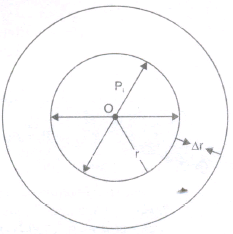
(a) Inside a liquid drop
Let r = radius of a spherieal liquid drop of centre O. T = surface tension of the liquid. Let Pi and Po be the values of pressure inside and outside the drop.
\(\therefore\) Excess pressure inside the liquid drop = Pi - Po
Let \(\Delta\)r be the increase in its radius due to excess pressure. It has one free surface outside.
\(\therefore\) increase in surface area of the liquid drop
= \(4\pi(r+\Delta r)^2-4\pi r^2\)
= \(4\pi[r^2+(\Delta r)^2+2r\Delta r-r^2]\)
= \(8\pi r\quad \Delta r\) .................(i)
\(\therefore\) increase in surface energy of the drop is
W = Surface tension x increase in area
= \(T\times 8\pi r\quad \Delta r\) .............. (ii)
Also W = Force due to excess of pressure x displacement
= Excess pressure x Area of drop x increase in radius
= \((p_i-p_0)4\pi r^2\Delta r\) ............(iii)
\(\therefore\) From eqns (ii) and (iii), we get
\((p_i-p_0)\times 4\pi r^2\quad \Delta r=T\times 8\pi r\quad \Delta r\)
\(\Rightarrow p_i-p_0=\frac{2T}{r}\)
(b) Inside a liquid bubbles:
A liquid bubble has air both inside and outside it and therefore it has two free surfaces.
Thus increase in its surfaces area
= \(2[4\pi (r+\Delta r)^2-4\pi r^2]\)
= \(2\times 8\pi r\Delta r=16\pi r\quad\Delta r\)
\(\therefore\) W = \(T\times 16\pi r\Delta r\) ...............(i)
Also W = \((p_i-p_0)4\pi r^2\times \Delta r\) ........(ii)
From eqnd (i) and (ii), we get
\((p_i-p_0)\times 4\pi r^2\times \Delta r=T.16\pi r\quad \Delta r\)
or \((p_i-p_0)=\frac{4T}{r}\)
(c) Inside an air bubble:
Air bubble is formed inside liquid, thus air bubble has one free surface inside it and liquid is outside.
If r = radius of air bubble
\(\Delta\)r = increase in its radius due to excess of pressure
(Pi - P0) inside it.
T = surface tension of the liquid in which bubble is formed.
\(\therefore\) increase in surface area = \(8\pi r \Delta r\).
\(\therefore\) W = T x \(8\pi r \Delta r\)
Also W = \((p_i-p_0)\times 4\pi r^2\Delta r\)
\(\therefore (p_i-p_0)\times 4\pi r^2\Delta r=T\times 8\pi r^2\Delta r\)
or \(p_i-p_0=\frac{2T}{r}\)
26.
Consider an air chamber of volume V with a long neck of uniform area of cross-section A, and a frictionless ball of mass m fitted smoothly in the neck at position C, Fig. The pressure of air below the ball inside the chamber is equal to the atmospheric pressure. Increase the pressure on the ball by a little amount p. so that the ball is depressed to position D, where CD = y.
There will be decrease in volume and hence increase in pressure of air inside the chamber. The decrease in volume of the air inside the chamber, ΔV = Ay
Volumetric strain =\(\frac { change\ in\ volume }{ original\ volume } \)
\(=\frac { \Delta V }{ V } =\frac { Ay }{ V } \)
∴Bulk Modulus of elasticity E. will be
\(E=\frac { stress(or\ increase\ in\ pressure) }{ volumetric\ strain } \)
\(=\frac { -p }{ Ay/V } =\frac { -pV }{ Ay } \)
Here, negative sign shows that the increase in pressure will decrease the volume of air in the chamber.
Now, \(p=\frac { -EAy }{ V } \)
Due to this excess pressure, the restoring force acting on the ball is
\(F=p\times A=\frac { \_ EAy }{ V } .A=\frac { -E{ A }^{ 2 } }{ V } y\quad ...(i)\)
Since F ∝ y and negative sign shows that the force is directed towards equilibrium position. If the applied increased pressure is removed from the ball, the ball will start executing linear SHM in the neck of chamber with C as mean position.
In S.H.M., the restoring force,
F = -ky ...(ii)
Comparing (i) and (ii), we have
Spring factor, k = EA2/V
Here inertia factor mass of ball = m.
Period, T = \(2\pi \sqrt { \frac { inertia\ factor }{ spring\ factor } } \)
\(=2\pi \sqrt { \frac { m }{ { EA }^{ 2 }/V } } =\frac { 2\pi }{ A } \sqrt { \frac { mV }{ E } } \)
∴ Frequency, v = \(\frac { 1 }{ T } =\frac { A }{ 2\pi } \sqrt { \frac { E }{ mV } } \)
27.
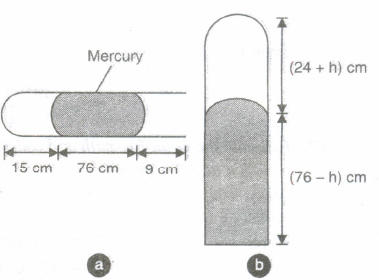
When the tube is held horizontally, the mercury thread of length 76 cm traps a length of air = 15 cm. A length of 9 Cm of the tube will be left at the open end. The pressure of air enclosed in
tube will be atmospheric pressure. Let area of cross-section of the tube be 1sq. cm.
\(\therefore \) P1 = 76 Cm and V1 = 15 Cm3
When the tube is held vertical1y, 15 em air gets another 9 cm of air (filled in the right handside in the horizontal position) and let h cm of mercury flows out to balance the atmospheric pressure. Then the heights of air column and mercury column are (24 + h) cm and (76 - h) cm respectively.
The pressure of air = 76 - (76 - h) -h cm of mercury.
\(\therefore \) V2 = (24 + h) CM3 and P2 = h cm
If we assume that temperature remains constant, then
P1V1 =P2 V2 or 76 x 15 = h x (24 + h) or h2 + 24h - 1140 = 0
\(or \ h=\frac { -24\pm \sqrt { \left( { 24 } \right) ^{ 2 }+4\times 1140 } }{ 2 } =23.8\ cm\ or\ -47.8cm\)
Since h cannot be negative(because more mercury cannot flow into the tube), therefore h = 23.8 cm thus in the vertical position of the tube, 23.8 cm of mercury flows out.
28.
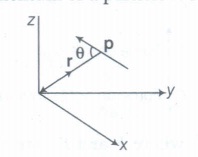
We know that angular momentum \(\vec { l } \) of a particle having position vector \(\vec { r } \) and momentum \(\vec { p } \) is given by
\(\vec { l } \) = \(\vec { r } \)\(\times\)\(\vec { p } \)
But, \(\vec { r } \)= [x\(\vec { i} \)+ y\(\vec { j} \)+ z\(\vec { k} \)] where x,y,z are the components of
\(\vec { r } \)and\(\vec { p } \) = [px\(\vec { i} \)+ py\(\vec { j} \)+ pz\(\vec { k} \)]
∴ \(\vec { l } \) = \(\vec { r } \)\(\times\)\(\vec { p } \) [x\(\vec { i} \)+ y\(\vec { j} \)+ z\(\vec { k} \)]\(\times\)[px\(\vec { i} \)+ py\(\vec { j} \)+ pz\(\vec { k} \)]
or (lx\(\vec { i} \)+ ly\(\vec { j} \)+ lz\(\vec { k} \)) = \(\left| \begin{matrix} \hat { i } & \hat { j } & \hat { k } \\ x & y & z \\ { p }_{ x } & { p }_{ y } & { p }_{ z } \end{matrix} \right| \)
=(ypz - zpy)\(\vec { i} \) +(zpx - xpz)\(\vec { j} \)+(xpy - ypx)\(\vec { k} \)
From this relation, we conclude that
lx= ypz - zpy, ly= zpx - xpz and lz = xpy - ypx
If the given particle moves only in the x - y plane, then z = 0 and pz = 0 and hence,
\(\vec { l } \)=(xpy-ypx)\(\hat { k } \) ,which is only the .z-comonent of \(\vec { l } \)
It means that for a particle moving only in the x - y plane, the angular momentum has only the z-component
29.
The tension in the string when it makes angle \(\theta\) with the vertical line is given by
\(T={mV^2\over r}+mgcos\theta\) (V is the instantaneous velocity)
\(T={0.15\times(2)^2\over 1}+0.15\times 10\times cos 48.2^o\)
=(0.6 + 1.5 x 0.67) N
= 1.6 N
Now let \(\overrightarrow{v_1}\) be the speed of the particle at the lowest point
\(\therefore V_1^2=V^2+2gr(1-cos \theta)\)
= (2)2 + 2 x 10 x 1 (1 - cos 48.20)
= 4 + 20(1 - 0.67)
= 4 + 20 x 0.33
= 4 + 6.6
= 10.6
\(\therefore V_1=\sqrt{10.6}=3.25ms^{-1}\)
The minimum value of VI so that the particle is able to complete its vertical circle is \(\sqrt{5gr}\)
\(\therefore \overrightarrow{v_{1}}_{min}=\sqrt{5\times10\times1}=7.07m/s\)
The value of \(\overrightarrow{v_1}\) obtained above is less than this minimum speed. The particle in the given case would not be able to complete its vertical circular path.
30.
(i) Boys were courageous and have presence of mind.
(ii) Volume of water flowing per second,
\(V=20\quad L/min\)
\(\\ =\ \frac { 20\times 1000 }{ 60\times (100)^{ 3 } } =\frac { 1 }{ 3 } \times { 10 }^{ -3 }{ m }^{ 3 }/s\)
Radius of pipe, \(r=\frac { 4 }{ 2 } =2\quad cm=0.02m\)
Area of cross-section, \(a={ \pi r }^{ 2 }=\frac { 22 }{ 7 } \times (0.02)^{ 2 }m^{ 2 }\)
Let v be the velocity of the flow of water, at given point. so volume , V = av
or \(\frac { 1 }{ 3 } \times { 10 }^{ -3 }=\frac { 22 }{ 7 } =(0.02)^{ 2 }\times v\)
\(\\ v=\frac { 7\times { 10 }^{ -3 } }{ 3\times 22\times (0.02)^{ 2 } } =0.2651m/s\)
\(\\ v=0.2651m/s\)
(iii) We should say no to crakers, because
(a) bursting of crackers pollutes the environment.
(b) crackers industry employs a lot of children fro the job and if we don't but cracker, they will be rescued.
31.
Ajay is naughty but when he is made to realise his mistake, he is ready to apologise
32.
Actual length of path travelled =23 km
Displacement = 10 km
Time taken =20 min =28/60 h
Average speed of taxi =\(\frac { actual \ path \ length }{ time \ taken } \)
= \(\frac { 23 }{ 28/60 } =49.3\quad km/h\)
Magnitude of average velocity = \(\frac { displacement }{ time } =\frac { 10 }{ 28/60 } =21.4\quad km/h\)
33.
(iii) What will be the position-time curve for dropped packet?
In position-time curve, when a packet is dropped. Let us consider origin at the point where packet was dropped.
-S.png)
34.
(i) Draw position-time graph for
(a) Accelerated motion
(b) Retarded motion
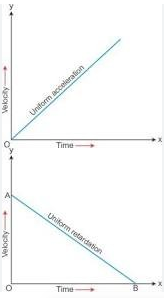
(ii) Juggler throws the ball into the air with ball having initial velocity = u
At the highest point of its path velocity will be zero as at maximum height velocity =0
So final velocity=0
According to question juggler throws a ball each second so for "n" balls time taken to reach highest position (t)= 1/n
v=u+gt
0=u-g/n
-u=-g/n
u=g/n
S= ut-gt²/2
S=u/n-g/2n²
But u=g/n
S= g/n²-g/2n²
S=g/2n²
35.
(a) Mean value of diameter,
\({ D }_{ m }=\frac { 1.328+1.330+1.325+1.326+1.334+1.336 }{ 6 } \)
\(=\frac { 7.979 }{ 6 } =1.3298=1.330\)
(b) Taking Dm as the true value absolute errors in different observations are
\({ \triangle }_{ 1 }=\left| 1.330-1.328 \right| =0.002\quad cm\)
\(\\ { \triangle }_{ 2 }=\left| 1.330-1.330 \right| =0.00\quad cm\)
\(\\ { \triangle }_{ 3 }=\left| 1.330-1.325 \right| =0.005\quad cm\)
\(\\ { \triangle }_{ 4 }=\left| 1.330-1.326 \right| =0.004\quad cm\)
\(\\ { \triangle }_{ 5 }=\left| 1.330-1.334 \right| =0.004\quad cm\)
\(\\ { \triangle }_{ 6 }=\left| 1.330-1.336 \right| =0.006\quad cm\)
36.
(c)
\(\frac { 3 }{ 2 } { MR }^{ 2 }\)
37.
(d)
Both light and sound waves in air are longitudinal.
38.
(a)
\(\frac{1}{2}mgR\)
39.
(b)
\({PM\over m+M}\)
40.
(a)
(1000)4
41.
(b)
Huygens

11th Standard CBSE Syllabus & Materials
11th Standard CBSE
CBSE 11th Business Studies Forms of Business Organisation Sample Question Papers Study Material - QB365 Set A
NEW11th Standard CBSE
CBSE 11th Business Studies Business, Trade and Commerce Sample Question Papers Study Material - QB365 Set A
NEW11th Standard CBSE
CBSE 11th Physics Waves Sample Question Papers Study Material - QB365 Set A
NEW11th Standard CBSE
CBSE 11th Physics Kinetic Theory Sample Question Papers Study Material - QB365 Set A



CBSE 11th Standard CBSE Subjects
CBSE Standards









