
 100% FREE ACCESS
11th Standard CBSE Syllabus & Materials
11th Standard CBSE
CBSE 11th Economics PART-A - Presentation of Data - New Sample Question Papers Study Material - QB365 Set A
NEW11th Standard CBSE
CBSE 11th Economics PART-A - Organisation of Data - New Sample Question Papers Study Material - QB365 Set A
NEW11th Standard CBSE
CBSE 11th Economics PART-A - Collection of Data - New Sample Question Papers Study Material - QB365 Set A
NEW11th Standard CBSE
CBSE 11th Economics PART-A - Introduction to Economics and Statistics - New Sample Question Papers Study Material - QB365 Set A
NEW11th Standard CBSE
CBSE 11th Business Studies International Trade Sample Question Papers Study Material - QB365 Set A
NEW11th Standard CBSE
CBSE 11th Business Studies Evolution and Fundamentals of Business Sample Question Papers Study Material - QB365 Set A

Published on: 05/10/2019
System of Particles and Rotational Motion
Download CBSE Class 11th Standard CBSE Physics question papers, sample papers, important questions, and previous year solved papers in PDF format. Get free study materials, NCERT solutions, and exam preparation resources for Class 11th Standard CBSE Physics
Questions + Answers key
Take MCQ Physics Test
1.
Two bodies of masses 1 kg and 2 kg are located at (1, 2) and (-1, 3), respectively. Calculate the coordinates of the centre of mass.
2.
Since his childhood Sanjay had always seen his mother grinding flour in the grindstone. He had observed that his mother had to do a lot of hand work in order to get flour from wheat. He felt very helpless at that time. As he grew older he thought of an idea to connect an electric motor to the wheel of grindstone . Now, it become very easy to get flour with help of grindstone and now his mother is very happy and felt proud of his intelligence.
A grinding stone of diameter 4 m revolving at 120 rpm accelerates to 660 rpm in 9s. Calculate the angular acceleration and linear acceleration.
3.
Centre of gravity of a body on the earth coincides with its centre of mass for a small object and for a large object, it may not. What is the qualiative meaning of small and large in this regards? For which following two of them coincides, a building, a pond, a lake, a mountain.
4.
Point masses m1 and m1 are placed at the opposite ends of a rigid rod of length L, and negligible mass. The rod is to be set in rotation about an axis perpendicular to it. Find the position on this rod through which the axis should pass in order that the work required to set the rod i1rotation with angular velocity ωo should be minimum.
5.
Locate the centre of mass of a system of particles of mass m1 = 1 kg, m2 = 2 kg and m3 = 3 kg, situated at the corners of an equilateral triangle of side 1.0 metre.
6.
Establish the relationship between Torque and Moment of Inertia.
7.
Define radius of gyration and give the physical significance of moment of inertia
8.
A man stands on a rotating platform with his arms stretched horizontally holding a 5 kg weight in each hand. The angular speed of the platform in 30 rpm. The man then brings his arms close to his body with the distance of each weight from the axis changing from 90 cm to 20 cm. The moment of inertia of the man together with the platform may be taken to be constant and equal to 7.6 kg-m2.
Is kinetic energy conserved in the process? If not, from where does the change come about?
9.
To maintain a rotor at a uniform angular speed of 200 rad s-1, an engine needs to transmit a torque of 180 N m. What is the power required by the engine ? (Note: uniform angular velocity in the absence of friction implies zero torque. In practice, applied torque is needed to counter frictional torque). Assume that the engine is 100% efficient.
10.
The angular speed of a motor wheel is increased from 1200 rpm to 3120 rpm in 16 seconds.
(i) What is its angular acceleration, assuming the acceleration to be uniform?
(ii) How many revolutions does the engine make during this time?
1.
\(Given,\ { m }_{ 1 }=1kg,{ m }_{ 2 }=2kg\)
\( { x }_{ 1 }=1m,{ x }_{ 2 }=-1m\)
\( { y }_{ 1 }=2m,{ y }_{ 2 }=3m\)
\(\\ \therefore \quad { x }_{ CM }=\frac { { m }_{ 1 }{ x }_{ 1 }+{ m }_{ 2 }{ x }_{ 2 } }{ { m }_{ 1 }+{ m }_{ 2 } } =\frac { 1\times 1+2\times -1 }{ 1+2 } \)
\(=\frac { 1-2 }{ 3 } =\frac { -1 }{ 3 } =-0.33\)
\(\\ and\ { y }_{ CM }=\frac { { m }_{ 1 }{ y }_{ 1 }+{ m }_{ 2 }{ y }_{ 2 } }{ { m }_{ 1 }+{ m }_{ 2 } } =\frac { 1\times 2+2\times 3 }{ 1+2 } \)
\(\\=\frac { 2+6 }{ 3 } =\frac { 8 }{ 3 } =2.66\)
Thus, the coordinates of the centre of mass are (-0.33, 2.66).
2.
Given, \(radius,r=\frac { diameter }{ 2 } =\frac { 4 }{ 2 } =2m\)
\({ n }_{ 1 }=120rpm=\frac { 120 }{ 60 } rps=2rps\)
\(\\ { n }_{ 1 }=660rpm=\frac { 660 }{ 60 } rps=11rps\)
\(\therefore \ Angular\ acceleration,\alpha =\frac { { \omega }_{ 2 }-{ \omega }_{ 1 } }{ t } =\frac { 2\pi \left( { n }_{ 2 }-{ n }_{ 1 } \right) }{ t } \)
\(=\frac { 2\pi \left( 11-2 \right) }{ 9 } =2\pi rad/{ s }^{ 2 }\)
Linear acceleration, \(\alpha =r\alpha =2\times 2\pi =4\pi m/s^{ 2 }\).
3.
Centre of mass and centre of gravity are two different concepts. But if g goes not vary from one part of body to other than CG and CM coincides.
So, when vertical height of the object is very small compared to a radius of earth, we call object small, otherwise, we call it extended. In above context, building and pond are small objects and a deep lake and a mountain are large extend objects.
4.
Let the axis of rotation be at a distance x from mass m1. Therefore, the distance of the axis of rotation from mass m2 is (L-x)
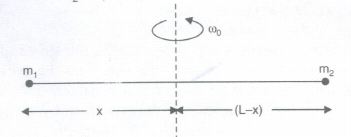
When the rod is set into rotation, the increase in the rotational KE. is given by
K.E = \(\frac { 1 }{ 2 } I{ _{ 1 }\omega }_{ 0 }^{ 2 }=\frac { 1 }{ 2 } I{ _{ 1 }\omega }_{ 0 }^{ 2 }=\frac { 1 }{ 2 } I{ _{ 2 }\omega }_{ 0 }^{ 2 }\)
= \(\frac { 1 }{ 2 } { m }_{ 1 }{ x }^{ 2 }{ \omega }_{ 0 }^{ 2 }+\frac { 1 }{ 2 } { m }_{ 2 }=(L-x)^{ 2 }{ \omega }_{ 0 }^{ 2 }\)
According to work-energy theorem
Work done W =increase in rotational K.E
i.e W = \(\frac { 1 }{ 2 } { m }_{ 1 }{ x }^{ 2 }{ \omega }_{ 0 }^{ 2 }+\frac { 1 }{ 2 } { m }_{ 2 }=(L-x)^{ 2 }{ \omega }_{ 0 }^{ 2 }\)
Work will be minimum if \(\frac { dW }{ dx } \)= 0
or \(\frac { d }{ dx } \left[ \frac { 1 }{ 2 } { m }_{ 1 }{ x }^{ 2 }{ \omega }_{ 0 }^{ 2 }+\frac { 1 }{ 2 } { m }_{ 2 }(L-{ x })^{ 2 }{ \omega }_{ 0 }^{ 2 } \right] \)=0
\({ m }_{ 1 }{ x }{ \omega }_{ 0 }^{ 2 }-{ m }_{ 2 }(L-x){ \omega }_{ 0 }^{ 2 }=0\)
\({ \omega }_{ 0 }^{ 2 }[{ m }_{ 1 }x-{ m }_{ 2 }(L-x)]=0\)
Since \({ \omega }_{ 0 }^{ 2 }\neq 0\quad \) ∴ m1x -m2(L-x) = 0
or (m1 + m2)x = m2L
∴ x = m2L/(m1+m2)
5.
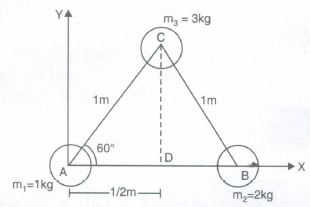
Consider an equilateral triangle of side 1 m as shown in fig. Take X and Y axes as shown in fig.
By the definition of centre of mass, we have
\(\vec { x } \) =\(\frac { { m }_{ 1 }{ x }_{ 1 }{ +m }_{ 2 }{ x }_{ 2 }+{ m }_{ 3 }{ x }_{ 3 } }{ { m }_{ 1 }{ +m }_{ 2 }+{ m }_{ 3 } } \)
and \(\vec { y } =\frac { { m }_{ 1 }y_{ 1 }{ +m }_{ 2 }y_{ 2 }+{ m }_{ 3 }y_{ 3 } }{ { m }_{ 1 }{ +m }_{ 2 }+{ m }_{ 3 } } \)
Here, m1 = 1 kg, m2= 2kg and m3 = 3 kg
[x1= 0,y1= 0] [x2 =1,y2= 0] and [x3= 0.5 y3 = \(\frac { \sqrt { 3 } }{ 2 } \)]
Here y3 = CD = AC sin 60o = \(\frac { \sqrt { 3 } }{ 2 } \)
\(\bar { x } \) = \(\frac { 1\times 0+2\times 1+3\times 0.5 }{ 1+2+3 } =\frac { 3.5 }{ 6 } m\)
and \(\vec { y } =\frac { 1\times 0+2\times 0+3\times \left( \frac { \sqrt { 3 } }{ 2 } \right) }{ 1+2+3 } =\frac { \sqrt { 3 } }{ 4 } m\)
The co-ordinates of centre of mass are \(\left( \frac { 3.5 }{ 6 } ,\frac { \sqrt { 3 } }{ 4 } \right) \)
6.
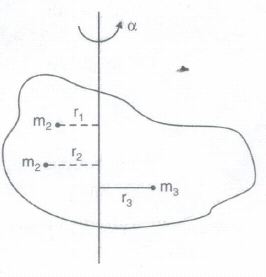
Consider a rigid body rotating about a given axis with a uniform angular acceleration a, under the action of a torque.
Let the body consist of particles of masses m1, m2, m3 ... mn at perpendicular distances r1, r2, r3 ... rn respectively from the axis of rotation,
As the body is rigid, angular acceleration a of all the particles of the body is the same. However, their linear accelerations are different because of different distances of the particles from the axis.
If a1,a2,a3...an are the respective linear accelerations of the particles, then a1=r1∝,a2=r2∝ ,a3∝=r3∝
Force on particle of mass m1 is
f1 =m1a1 = m1r1∝
Moment of this force about the axis of rotation
= f1r1=(m1r1∝)r1 =m1r12∝
Similarly, moments of forces on other particles about the axis of rotation are m1r12∝,
\({ m }_{ 3 }{ r }_{ 3 }^{ 2 }\alpha ,{ m }_{ n }{ r }_{ n }^{ 2 }\alpha \)
∴ Torque acting on the body, ፒ
=\({ m }_{ 1 }{ r }_{ 1 }^{ 2 }\alpha +{ m }_{ 2 }{ r }_{ 2 }^{ 2 }\alpha +{ m }_{ 3 }{ r }_{ 3 }^{ 2 }\alpha +...{ m }_{ n }{ r }_{ n }^{ 2 }\alpha \)
= (\({ m }_{ 1 }{ r }_{ 1 }^{ 2 }+{ m }_{ 2 }{ r }_{ 2 }^{ 2 }+{ m }_{ 3 }{ r }_{ 3 }^{ 2 }+...{ m }_{ n }{ r }_{ n }^{ 2 }\))\(\alpha \)
ፒ = \(\left( \sum _{ i=1 }^{ i=n }{ { m }_{ i }{ r }_{ i }^{ 2 } } \right) \alpha \)
or ፒ= I or ∝ \(\vec { \tau } =I\vec { \alpha } \)
7.
The radius of gyration of a body about the axis of rotation of a body is the point at which the weighed mass of the body acts. It is also equal to the square root of moment of inertia of all particles of the body about the axis of rotation divided by the total mass of the body i.e.,
\(k=\sqrt {\frac{m_1r_1^2+m_2r_2^2+m_3r_3^2....+m_nr_n^2}{m_1+m_2+m_3...+m_n}}\)
\(\sqrt {\frac{\sum mR}{M}}=\sqrt {\frac{I}{M}}\)
Its dimensions are those of length and its is measured in metre in SI units. The moment of a body is a quantity which comes in rotational motion and plays same role in rotational motion as does mas in translational motion. Thus a body continues of rotate or be at rest in the absence of any external torque. This is similar to the law of inertia in translational motion. This aspect is used in over creasing the dead points in the engines and crankshafts. Similarly, the kinetic energy of rotation is dependent on the moment of inertia of the body in the same manner the kinetic energy of translation of motion depends, on the mass of the body. For a given angular velocity (\(\omega\)) kinetic energy of rotation \(\propto\) I. If equal torques are applied I1 and I2 the their angular acceleration are inversely proportional to the moments of inertia of the bodies.
\(\frac{I_1\alpha_1}{I_2\alpha_2}=1\)
\(\frac{\alpha_1}{\alpha_2}=\frac{I_2}{I_1}\)
\(\alpha\propto\frac{1}{I}\)
Similarly if two bodies have same angular acceleration, then the moments of inertia are directly proportional to the torque applied on then.
\(\frac{\tau_1}{\tau_2}=\frac{I_1}{I_2}\ or \alpha_1=\alpha_2\)
The linear momentum of a body depends on its mass and velocity. If two bodies have same velocity, then their moments are proportional to their masses i.e.,
\(\frac{\rho_1}{\rho_2}=\frac{m_1}{m_2}\)
Similarly for angular momentum
\(\frac{L_1}{L_2}=\frac{I_1}{I_2}\)
Thus, moment of inertia of a body plays same role in the rotational motion as does mass in translational motion.
The moment of inertia determines the amount of torque to be applied to produce desired angular acceleration.
8.
KE is not conserved in process.
Kfinal > Kinitial
Muscular work done by the man in folding his arms is converted into KE.
9.
Work done by torque in turing rotor by angle d \(\theta \) is
= \(\tau \) d \(\theta \)
So, power delivered by engine
P = \(\frac { Work\ done }{ Time\ taken } =\tau \frac { d\theta }{ dt } \)
[dt= time for turing by angle dθ]
or P = \(\tau \omega \)
So, power required = 180 x 200 = 36000 W
= 36 k W [ 1 k W = 1000 W]
10.
(i) We shall use ω = ω0 + αt
ω0 = initial angular speed in rad/s
= 2π × angular speed in rev/s
\(=\frac{2 \pi \times \text { angular speed in rev } / \mathrm{min}}{60 \mathrm{~s} / \mathrm{min}} \)
\(=\frac{2 \pi \times 1200}{60} \mathrm{rad} / \mathrm{s} \)
\(=40 \pi \mathrm{rad} / \mathrm{s}\)
Similarly \(\omega=\) final angular speed in rad / s
\( =\frac{2 \pi \times 3120}{60} \mathrm{rad} / \mathrm{s} \)
\(=2 \pi \times 52 \mathrm{rad} / \mathrm{s} \)
\(=104 \pi \mathrm{rad} / \mathrm{s}\)
Therefore Angular acceleration
\(\alpha=\frac{\omega-\omega_0}{t} =4 \pi \mathrm{rad} / \mathrm{s}^2\)
The angular acceleration of the engine \(=4 \pi \mathrm{rad} / \mathrm{s}^2\)
(ii) The angular displacement in time t is given by
\( \theta=\omega_0 t+\frac{1}{2} \alpha t^2\)
\(= \left(40 \pi \times 16+\frac{1}{2} \times 4 \pi \times 16^2\right) \mathrm{rad}\)
\(= (640 \pi+512 \pi) \mathrm{rad} \)
\(= 1152 \pi \mathrm{rad}\)
Number of revolutions \(=\frac{1152 \pi}{2 \pi}=576\)

11th Standard CBSE Syllabus & Materials
11th Standard CBSE
CBSE 11th Business Studies Forms of Business Organisation Sample Question Papers Study Material - QB365 Set A
NEW11th Standard CBSE
CBSE 11th Business Studies Business, Trade and Commerce Sample Question Papers Study Material - QB365 Set A
NEW11th Standard CBSE
CBSE 11th Physics Waves Sample Question Papers Study Material - QB365 Set A
NEW11th Standard CBSE
CBSE 11th Physics Kinetic Theory Sample Question Papers Study Material - QB365 Set A



CBSE 11th Standard CBSE Subjects
CBSE Standards









