
 100% FREE ACCESS
11th Standard CBSE Syllabus & Materials
11th Standard CBSE
CBSE 11th Economics PART-A - Presentation of Data - New Sample Question Papers Study Material - QB365 Set A
NEW11th Standard CBSE
CBSE 11th Economics PART-A - Organisation of Data - New Sample Question Papers Study Material - QB365 Set A
NEW11th Standard CBSE
CBSE 11th Economics PART-A - Collection of Data - New Sample Question Papers Study Material - QB365 Set A
NEW11th Standard CBSE
CBSE 11th Economics PART-A - Introduction to Economics and Statistics - New Sample Question Papers Study Material - QB365 Set A
NEW11th Standard CBSE
CBSE 11th Business Studies International Trade Sample Question Papers Study Material - QB365 Set A
NEW11th Standard CBSE
CBSE 11th Business Studies Evolution and Fundamentals of Business Sample Question Papers Study Material - QB365 Set A

Published on: 04/12/2019
System of Particles and Rotational Motion
Download CBSE Class 11th Standard CBSE Physics question papers, sample papers, important questions, and previous year solved papers in PDF format. Get free study materials, NCERT solutions, and exam preparation resources for Class 11th Standard CBSE Physics
Questions + Answers key
Take MCQ Physics Test
1.
When the earth shrinks, without reducing its mass, what change will be there in the duration of a day?
2.
Why do we place handles at maximum possible distance from the hinges in a door
3.
Since his childhood Sanjay had always seen his mother grinding flour in the grindstone. He had observed that his mother had to do a lot of hand work in order to get flour from wheat. He felt very helpless at that time. As he grew older he thought of an idea to connect an electric motor to the wheel of grindstone . Now, it become very easy to get flour with help of grindstone and now his mother is very happy and felt proud of his intelligence.
When his mother uses grindstone to get flour, what energy transformation takes place?
4.
If earth contract to half its radius. What would be the length of the day?
5.
A solid cylinder of mass 20 kg rotates about its axis with angular speed of 100 rad/s. The radius of cylinder is 0.25m. What is KE of rotation of cylinder?
6.
If ice on poles melts, then what is the change in duration of day?
7.
Show that a.(b × c) is equal in magnitude to the volume of the parallelepiped formed on the three vectors , a, b and c.
8.
A solid disc and a ring, both of radius 10 cm are placed on a horizontal table simultaneously, with initial angular speed equal to \(10\ \pi\ rad{ s }^{ -1 }\). Which of the two will start to roll earlier? The coefficient of kinetic friction is \({ \mu }_{ k }\)= 0.2 ?
9.
The angular speed of a motor wheel is increased from 1200 rpm to 3120 rpm in 16 seconds.
(i) What is its angular acceleration, assuming the acceleration to be uniform?
(ii) How many revolutions does the engine make during this time?
10.
How much fraction of the kinetic energy of rolling is purely rotational.
11.
How much fraction of the kinetic energy of rolling is purely translational
12.
A cylinder of mass 10 kg and radius 15 cm is rolling perfectly on a plane of inclination \({ 30 }^{ \circ }\). The coefficient of static friction,\({ \mu }_{ s }=0.25\).
If the inclination of the plane is increased, at what value of \(\theta \) does the cylinder begin to skid and not roll perfectly?
13.
A particle on a rotating disc have initial and final angular position are 6rad, -2rad. In which case, particle undergoes a negative displacement.
14.
A solid cylinder of mass 20 kg rotates about its axis with angular speed 100 rad s-1. The radius of the cylinder is 0.25 m. What is the kinetic energy associated with the rotation of the cylinder? What is the magnitude of angular momentum of the cylinder about its axis?
15.
The radius of gyration of a uniform rod of length L about an axis passing through its centre of mass is:
\(\frac { L }{ \sqrt { 12 } } \)
\(\frac { l }{ \sqrt { 2 } } \)
\(\frac { { L }^{ 2 } }{ 12 } \)
\(\frac { { L }^{ 2 } }{ \sqrt { 3 } } \)
16.
One end of a thin uniform rod of length L and mass M1 is riveted to the centre of a uniform circular disc of radius r and mass M2 so that both are coplanar. The centre of mass of the combinsiion from the centre of the disc is (assume that the point of attachment is at the origin).
\(\frac { L({ M }_{ 1 }+M_{ 2 }) }{ 2{ M }_{ 1 } } \)
\(\frac { { LM }_{ 1 } }{ 2({ M }_{ 1 }+{ M }_{ 2 }) } \)
\(\frac { 2({ M }_{ 1 }+{ M }_{ 2 }) }{ { LM }_{ 1 } } \)
\(\frac { 2L{ M }_{ 1 } }{ ({ M }_{ 1 }+{ M }_{ 2 }) } \)
17.
A loaded spring gun of mass M fires a 'shot' of mass m with a velocity \(\vartheta \) at an angle of elevation \(\theta\). The gun is initially at rest on a horizontal frictionless surface. After firing, the centre of mass of the gun-shot system
moves with a velocity \(\vartheta \) m / M
moves with velocity \(\frac { \vartheta m }{ M } \)cos \(\theta\) in the horizontal direction
remains at rest
moves with a velocity \(\frac { \vartheta (M-m) }{ (M+m) } \) in the horizontaI direction.
18.
A particle performing uniform circular motion has angular momentum L. If its angular frequency is doubled and its kinetic energy halved, then the new angular momentum is
4L
\(\frac { L }{ 2 } \)
\(\frac { L }{ 4 } \)
2L
19.
A man of mass M is standing at the centre of a rotating turn table rotating with an angular velocity w. The man holds two 'dumb bells' of mass M/4 each in each of his two hands. If he stretches his arms to a horizontal position, the turn table acquires a new angular velocity w' where
\(\omega\)' = 2 \(\omega\)
\(\omega\)' =\(\omega\)/2
\(\omega\)' > \(\omega\)
\(\omega\)' < \(\omega\)
20.
A cylindrical solid of mass M has raidus R and length L. Its moment of inertia about a generator is:
\(N\left( \frac { L }{ R } +\frac { { R }^{ 2 } }{ 4 } \right) \)
\(\frac { 1 }{ 2 } { MR }^{ 2 }\)
\(\frac { 3 }{ 2 } { MR }^{ 2 }\)
\(M\left( \frac { { L }^{ 2 } }{ 3 } +\frac { { R }^{ 2 } }{ 4 } \right) \)
21.
A couple produces a:
pure linear motion
pure rotational motion
none of the above.
both linear and rotational motion
1.
L is conserved. If the earth shrinks, duration of the day decreases.
2.
To develop torque with less force being applied.
3.
Muscular energy to mechanical energy.
4.
The moment of inertia \(\left( I=\frac { 1 }{ 2 } MR^{ 2 } \right) \) of the earth about its own axis will become one-fourth and so its angular velocity will become four times\(\left( L=I\omega =constant \right) \). Hence, the time period will reduce to one-fourth \(\left( T=2\pi /\omega \right) \), i.e. 6 hours.
5.
M = 20 Kg, \(\omega =100rad/s,R=0.25m\).
Moment of inertia of cylinder about its own axis
\(=\frac { 1 }{ 2 } MR^{ 2 }=\frac { 1 }{ 2 } \times 20\times { \left( 0.25 \right) }^{ 2 }\)
Rotational KE \(=\frac { 1 }{ 2 } { I\omega }^{ 2 }\)
\(=\frac { 1 }{ 2 } { I\omega }^{ 2 }=\frac { 1 }{ 2 } \times 0.625\times { \left( 100 \right) }^{ 2 }=3125J\).
6.
Molten ice from poles into ocean and so mass is going away from axis of rotation. So, moment of inertia of earth increases and to conserve angular momentum, angular velocity (\(\omega \)) decreases. So, time period of rotation increases (\(T=2\pi /\omega \) ). So, net effect of global warming is increasing in the duration of day.
7.
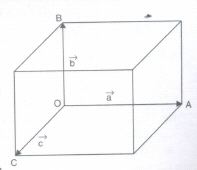
Let a parallelopiped be formed on the three vectors
\(\vec { OA } \)= \((\vec { a } ),\) \(\vec { OB} \) = \(\vec { b } \) and \(\vec { OC } \)=\(\vec { c } \)
Now, \(\vec { b } \) \(\times\)\(\vec { c } \)= bc sin 90o \(\hat { n } \)=bc \(\hat { n } \)
where \(\hat { n } \) is unit vector along \(\vec { OA } \) perpendicular to the plane containing \(\vec { b } \) and \(\vec { c } \)
Now \(\vec { a } \)(\(\vec { b } \) \(\times\)\(\vec { c } \)) = (a) (bc) cos 0o
= a b c
which is equal in magnitude to the volume of the parallelopiped.
8.
Thus, the force of friction \({ \mu }_{ k }\)mg produces an acceleration a in the centre of mass. So, the equation of motion for centre of mass is
\({ \mu }_{ k }\) mg = ma
The torque due to force of friction is \({ \mu }_{ k }mg\times R\). It produces angular retardation given by
\({ \mu }_{ k }mgR=-I\alpha \)
Rolling begins when
\(v=R\omega \)
But v = 0 + at = \({ \mu }_{ k }gt\)
and \(\omega ={ \omega }_{ 0 }+\alpha t={ \omega }_{ 0 }-\frac { { \mu }_{ k }mgR }{ I } t\) [using Eq. (ii)]
or \(\frac { v }{ R } ={ \omega }_{ 0 }-\frac { { \mu }_{ k }mgR }{ I } t\Rightarrow \frac { { \mu }_{ k }gt }{ R } ={ \omega }_{ 0 }-\frac { { \mu }_{ k }mgRt }{ I } x = {-b \pm \sqrt{b^2-4ac} \over 2a}\)
or \(\frac { { \mu }_{ k }gt }{ R } \left[ 1+\frac { { mR }^{ 2 } }{ I } \right] ={ \omega }_{ 0 }\quad or\quad t=\frac { R{ \omega }_{ 0 } }{ { \mu }_{ k }g\left[ 1+\frac { { mR }^{ 2 } }{ I } \right] } \)
For a disc, \(I={ mR }^{ 2 }/2\quad \)
\(\therefore t=\frac { R{ \omega }_{ 0 } }{ { 3\mu }_{ k }g } =\frac { 0.01\times 10\pi }{ 3\times 0.2\times 9.8 } =0.53s\)
For a ring, \(I={ mR }^{ 2 }\)
\(\therefore \ t=\frac { R{ \omega }_{ 0 } }{ { 2\mu }_{ k }g } =\frac { 0.01\times 10\pi }{ 3\times 0.2\times 9.8 } =0.80s\).
9.
(i) We shall use ω = ω0 + αt
ω0 = initial angular speed in rad/s
= 2π × angular speed in rev/s
\(=\frac{2 \pi \times \text { angular speed in rev } / \mathrm{min}}{60 \mathrm{~s} / \mathrm{min}} \)
\(=\frac{2 \pi \times 1200}{60} \mathrm{rad} / \mathrm{s} \)
\(=40 \pi \mathrm{rad} / \mathrm{s}\)
Similarly \(\omega=\) final angular speed in rad / s
\( =\frac{2 \pi \times 3120}{60} \mathrm{rad} / \mathrm{s} \)
\(=2 \pi \times 52 \mathrm{rad} / \mathrm{s} \)
\(=104 \pi \mathrm{rad} / \mathrm{s}\)
Therefore Angular acceleration
\(\alpha=\frac{\omega-\omega_0}{t} =4 \pi \mathrm{rad} / \mathrm{s}^2\)
The angular acceleration of the engine \(=4 \pi \mathrm{rad} / \mathrm{s}^2\)
(ii) The angular displacement in time t is given by
\( \theta=\omega_0 t+\frac{1}{2} \alpha t^2\)
\(= \left(40 \pi \times 16+\frac{1}{2} \times 4 \pi \times 16^2\right) \mathrm{rad}\)
\(= (640 \pi+512 \pi) \mathrm{rad} \)
\(= 1152 \pi \mathrm{rad}\)
Number of revolutions \(=\frac{1152 \pi}{2 \pi}=576\)
10.
Fraction of rotational kinetic energy = \(\frac { \frac { 1 }{ 2 } { mv }^{ 2 } }{ \frac { 1 }{ 2 } { mv }^{ 2 }+\frac { 1 }{ 2 } I{ \omega }^{ 2 } } \)
= \(\frac { \frac { { k }^{ 2 } }{ { r }^{ 2 } } }{ 1+\frac { { k }^{ 2 } }{ { r }^{ 2 } } } \)
= \(\frac { { k }^{ 2 } }{ { r }^{ 2 }+{ k }^{ 2 } } \)
11.
Fraction of translational kinetic energy = \(\frac { \frac { 1 }{ 2 } { mv }^{ 2 } }{ \frac { 1 }{ 2 } { mv }^{ 2 }+\frac { 1 }{ 2 } I{ \omega }^{ 2 } } \)
\(=\frac { 1 }{ 1+\frac { { k }^{ 2 } }{ { r }^{ 2 } } } =\frac { { r }^{ 2 } }{ ({ k }^{ 2 }+r^{ 2 }) } \)
12.
Given, mass of the cylinder m =10 kg
Radius, r = 15 cm = 0.15 m
Inclination of plane, \(\theta ={ 30 }^{ \circ }\)
Coefficient of static friction, \({ \mu }_{ s }=0.25\).
For rolling without slipping,
\(\mu =\frac { 1 }{ 3 } \tan { \theta } \)
or \(\tan { \theta } =3\mu =3\times 0.25=0.75\)
\(=tan{ 36 }^{ \circ }{ 54 }^{ ' }\)
or \(\theta ={ 36 }^{ \circ }{ 54 }^{ ' }={ 37 }^{ \circ }\).
13.
Angular displacement is
\(\Delta \theta =-2rad-(+6rad)=-8rad\)
14.
Moment of inertia of cylinder about its own axis = \(=\frac { 1 }{ 2 } MR^{ 2 }\)
\(=\frac { 1 }{ 2 } \times 20\times { \left( 0.25 \right) }^{ 2 }kg-m^{2}\)
= 0.625 kg-m2
Kinetic energy of rotating cylinder
\(=\frac { 1 }{ 2 } { I\omega }^{ 2 }=\frac { 1 }{ 2 } (0.625) { \left( 100 \right) }^{ 2 }J=3125J\).
Angular momentum of cylinder about its own axis
\(=I\omega =0.625\times 100\)
\(\\ =62.5\ kg-{ m }^{ 2 }/s\)
15.
(a)
\(\frac { L }{ \sqrt { 12 } } \)
16.
(b)
\(\frac { { LM }_{ 1 } }{ 2({ M }_{ 1 }+{ M }_{ 2 }) } \)
17.
(c)
remains at rest
18.
(c)
\(\frac { L }{ 4 } \)
19.
(d)
\(\omega\)' < \(\omega\)
20.
(c)
\(\frac { 3 }{ 2 } { MR }^{ 2 }\)
21.
(b)
pure rotational motion

11th Standard CBSE Syllabus & Materials
11th Standard CBSE
CBSE 11th Business Studies Forms of Business Organisation Sample Question Papers Study Material - QB365 Set A
NEW11th Standard CBSE
CBSE 11th Business Studies Business, Trade and Commerce Sample Question Papers Study Material - QB365 Set A
NEW11th Standard CBSE
CBSE 11th Physics Waves Sample Question Papers Study Material - QB365 Set A
NEW11th Standard CBSE
CBSE 11th Physics Kinetic Theory Sample Question Papers Study Material - QB365 Set A



CBSE 11th Standard CBSE Subjects
CBSE Standards









