
 100% FREE ACCESS
11th Standard CBSE Syllabus & Materials
11th Standard CBSE
CBSE 11th Economics PART-A - Presentation of Data - New Sample Question Papers Study Material - QB365 Set A
NEW11th Standard CBSE
CBSE 11th Economics PART-A - Organisation of Data - New Sample Question Papers Study Material - QB365 Set A
NEW11th Standard CBSE
CBSE 11th Economics PART-A - Collection of Data - New Sample Question Papers Study Material - QB365 Set A
NEW11th Standard CBSE
CBSE 11th Economics PART-A - Introduction to Economics and Statistics - New Sample Question Papers Study Material - QB365 Set A
NEW11th Standard CBSE
CBSE 11th Business Studies International Trade Sample Question Papers Study Material - QB365 Set A
NEW11th Standard CBSE
CBSE 11th Business Studies Evolution and Fundamentals of Business Sample Question Papers Study Material - QB365 Set A

Published on: 05/10/2019
Thermal Properties of Matter
Download CBSE Class 11th Standard CBSE Physics question papers, sample papers, important questions, and previous year solved papers in PDF format. Get free study materials, NCERT solutions, and exam preparation resources for Class 11th Standard CBSE Physics
Questions + Answers key
Take MCQ Physics Test
1.
A block of wood is floating on water at ooe with a certain volume x above the level of water. The temperature of water is gradually increased from ooe to 8 0C, How does the volume x change with change in temperature ?
2.
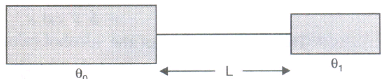
The figure shows a large tank of water at a constant temperature f}o and a small vessel containing
a mass 'm' ofwater at an initial temperature f}l « f}c). A metal rod of length L, area of cross section and thermal conductivity K connects the two vessels, Find the time taken for the temperature of the water in the smaller vessel to become \(\theta\)2 (\(\theta\)1< \(\theta\)2 <\(\theta\)0 ) Specific heat capacity of water is's' and all other heat capacities are negligible.
3.
What is thermal expansion ? Discuss the types of thermal expansions.
Equal volumes ofwater and alcohol, when put in similar calorimeters take 100 sand 74 s respectively to cool from 50°C to 40°C. Calculate the specific heat capacity of alcohol given that the thermal capacity of each calorimeter is numerically equal to the volume of either liquid. Take the relative density of alcohol as 0.8 and the specific heat capacity of water as 1 cal per gram per "C,
4.
What do you understand by thermal resistance?
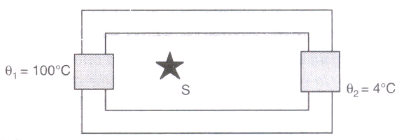
closed cubical box is made of perfectly insulating material and the only way for heat to enter or leave the box is through two solid cylindrical metal plugs, each of cross-sectional area 12 cm2 and length 8 em fixed in the opposite walls of the box. The outer surface of one plug is kept at a temperature of 100°C while the outer surface of other plug is maintained at a temperature of 4°C. The thermal conductivity of the material of the plug is 2.0 W/m-°C. A source of energy generating 13 W is enclosed inside the box. Find the equilibrium temperature of the inner surface of the box assuming that it is the same at all points on the inner surface
5.
A Hot Body Radiating Energy
A hot body having the surface temperature 13270C. Determine the wavelength at which it radiates maximum energy. Given wien's constant = 2.9 x 10⁻³ mK.
6.
Perfect Black Body
Calculate the temperature (in K) at which perfect black body radiates energy at the rate of 5.67 W/cm2 .Given, \(\sigma\) = 5.67 x 10- 8 Wm-2 K-4
7.
A specific book describes a new temperature scale called Z, in which boiling and freezing points of water are referred as 65oZ and -15oZ , respectively.
(i) To what temperature on Fahrenheit scale would a temperature -95o Z correspond?
(ii) What temperature change on the Z scale would correspond to change of 40o on Celsius scale?
8.
On a winter day the temperature of the tap water is 20o C whereas the atmospheric temperature is 5o C. Water is stored in a tank of capacity 0.5 m3 for household use. Is it were possible to use the heat liberated by the water to left a 10 kg mass vertically. How high can it be lifted as the water comes to the room temperature. Take g = 10 ms-1
9.
A copper cube of mass 200 g slides down on a rough inclined plane having inclination 37o at a constant speed. If any loss in mechanical energy goes into the copper block as thermal energy. Find the increase in the temperature of the block as it slides down through 60 cm. Given, specific heat of copper is 420 J Kg-1K-1 .
1.
As the density of water increases and volume of water decreases from a °C to 4°C, so the volume x of the wooden block will increase till the temperature of water becomes 4°C. Now, as the temperature increases from 4°C to 8°C, the density of water decreases and its volume increases above 4°C, therefore the volume x of the block will also decrease.
2.
Suppose the temperature of the water in the smaller vessel is 8 at time t. In the next time interval dt, a heat, \(\triangle\)\(\theta\) is transferred to it where
\(\triangle \theta =\frac { KA }{ L } \left( { \theta }_{ 0 }-{ \theta } \right) dt\)
This heat increases the temperature of the water of mass 'm' to \(\theta\) + d\(\theta\)
Where \(\triangle\)\(\theta\) = ms d\(\theta\)
From eqn. (i) and (ii),
\(\frac { KA }{ L } \left( { \theta }_{ 0 }-{ \theta } \right) dt=msd\theta \)
or dt = \(\frac { Lms }{ KA } \frac { d\theta }{ { \theta }_{ 0 }-\theta } \)
\(\Rightarrow\) \(\int _{ 0 }^{ T }{ dt } =\frac { Lms }{ KA } \int _{ { \theta }_{ 1 } }^{ { \theta }_{ 2 } }{ \frac { d\theta }{ { \theta }_{ o }-\theta } } \)
where T is the time required for the temperature of the water to become \(\theta\)2
Thus, \(\left[ \frac { Lms }{ KA } In\frac { { \theta }_{ 0 }-{ \theta }_{ 1 } }{ { \theta }_{ 0 }-{ \theta }_{ 2 } } \right] \)
3.
For thermal expansion and its classification, see text.
Let V cm3' be the volume of either liquid. Then the thermal capacity of each calorimeter
is also V cal per 0c.
Mass of water = V x 1 = V g
Mass of alcohol = V x 0.8 = 0.8 V g
The rate of cooling of the 'water calorimeter'
= \(\frac { 1 }{ 100 } \) IV x (50 - 40) + V x 1 x (50- 40)}
= 5 V CalS-1
= The rate of cooling of the' alcohol calorimeter'
= \(\frac { 1 }{ 74 } \) (V x (50-40) +0.8 V x s x(50 - 40)}
= \(\frac { 1 }{ 74 } \) (10V + 8Vs)
Because identical volumes of the liquids are getting cooled under identical conditions, the rate of cooling is the same in both the cases. Hence
5V = \(\frac { 1 }{ 74 } \) (10 V + 8 Vs) which gives
s = 0.6 cal g-1 (0C-1)
4.
\(\frac { \triangle \theta _{ 1 } }{ \triangle t } =\frac { KA\left( { \theta }_{ 1 }-{ \theta }_{ 2 } \right) }{ x } \)
The rate of heat generation in the box = 13 W. The rate at which heat flows out of the box through the right plug is
\(\frac { \triangle \theta _{ 1 } }{ \triangle t } +13W=\frac { \triangle \theta _{ 2 } }{ \triangle t } \)
or \(\frac { KA }{ x } \left( { \theta }_{ 1 }-\theta \right) +13W=\frac { KA }{ x } \left( { \theta }-\theta _{ 2 } \right) \)
or \(2\frac { KA }{ x } \theta =\frac { KA }{ x } \left( { \theta }_{ 1 }+{ \theta }_{ 2 } \right) +13W\quad \Rightarrow \frac { { \theta }_{ 1 }+{ \theta }_{ 2 } }{ 2 } +\frac { (13w)x }{ 2KA } \)
or \(\theta =\frac { { 100 }^{ 0 }C+4C }{ 2 } +\frac { (13w)x0.08 }{ 2x(2.0W/m-°C)\left( 12\times { 10 }^{ -4 }{ m }^{ 2 } \right) } \)
= 52°C + 216.67°C \(\equiv \) 269°C.
5.
Given, T =1327 + 273 = 1600K
Wien's constant , b = 2.9 x 10⁻³ m K
\(\lambda _{ m }=\frac { b }{ t } =\frac { 2.9\times 10^{ -3 } }{ 1600 } =1.81X10^{ -6 }m\)
6.
Given, \(\sigma \) = 5.67W / cm-2 =5.67 x 10⁴ W/m2
\(\sigma \) = 5.67 x 10⁻⁸ Wm-2 K-4
Apply Stefan's law, E = \(\sigma T^{ 4 }\)
\(\\ T^{ 4 }=\frac { E }{ \sigma } \Rightarrow T=\left( \frac { E }{ \sigma } \right) ^{ { 1 }/{ 4 } }=\left( \frac { 5.67\times 10^{ 4 } }{ 5.67\times 10^{ -8 } } \right) ^{ { 1 }/{ 4 } }\)
\(\\ T=(10^{ 12 })^{ { 1 }/{ 4 } }=10^{ 3 }\)
\(\\ T=1000K\)
7.
(i) -148o F
(ii) 32oZ
8.
Here m=0.5 m2=500L=500 kg
So the heat liberated during the water changes 20∘C to 5∘C
=500×4200×15
[Δθ=20−5=15]
=500×4200×15
=75×420×1000
=31500×1000
Let the height = h
the required work
=mgh=10×10×h=100 h
But, 100 h = 3150000
⇒h=315000 m=315 km
9.
8.6 × 10∘C

As block slides along x only mgsinθ and friction F do work, let them be mglsin θ and wF.
Now, speed is constant
∴ All the loss in potential energy is dissipated as heat, no. kinetic energy being gained.
(s is the specific heat) ⇒ mglsinθ = wF = Heat lost = ms Δ T
\( \Rightarrow \Delta T=\frac{g l \sin \theta}{5}=\frac{10 \times \frac{60}{100} \times \frac{3}{5}}{420}\)
\( =8.6 \times 10^{-3}{ }^{\circ} \mathrm{C}
\)

11th Standard CBSE Syllabus & Materials
11th Standard CBSE
CBSE 11th Business Studies Forms of Business Organisation Sample Question Papers Study Material - QB365 Set A
NEW11th Standard CBSE
CBSE 11th Business Studies Business, Trade and Commerce Sample Question Papers Study Material - QB365 Set A
NEW11th Standard CBSE
CBSE 11th Physics Waves Sample Question Papers Study Material - QB365 Set A
NEW11th Standard CBSE
CBSE 11th Physics Kinetic Theory Sample Question Papers Study Material - QB365 Set A



CBSE 11th Standard CBSE Subjects
CBSE Standards









